 NexIP官方博客
To determine how to verify authentic dual-ISP residential IPs, the core lies in checking the ASN registration entity, Usage Type, and reverse DNS (PTR) records layer by layer. If any layer shows a hosting mark or data center characteristic, it can be deemed a fake residential IP. Traditional bandwidth metrics are no longer sufficient for decision-making; the authenticity of underlying fields is key. When creating an acceptance checklist, refer to parameters such as city/ASN targeting and session stickiness provided by service providers like NexIP to ensure the delivery standards meet expectations.
The Real Costs Incurred in Dual-ISP Acceptance
Many sellers mistakenly believe that "dual-ISP" refers to two physical fiber connections for redundancy, but this is technically incorrect. Dual-ISP means that the IP's data-plane ASN record and Company Usage Type both point to an ISP (Internet Service Provider), not Hosting. This distinction directly affects the cost structure of acceptance:
- Time Cost: Manual verification of a single IP takes a dozen minutes; batch screening can take hours.
- Rework Cost: Discovering disguise leads to re-application, environment unbinding, and fingerprint reset, which consumes effort.
- Associated Suspension Risk: If you use an IP marked as Hosting or if it's in the same adjacent C-segment as a provider with violating accounts, it can trigger cluster-style reviews.
- Appeal Cost: After store suspension, the appeal process involves long waiting periods.
- Reconstruction Cost: Time investment to restore account environment and reputation.
- Opportunity Cost: Daily sales drop to zero during the suspension period.
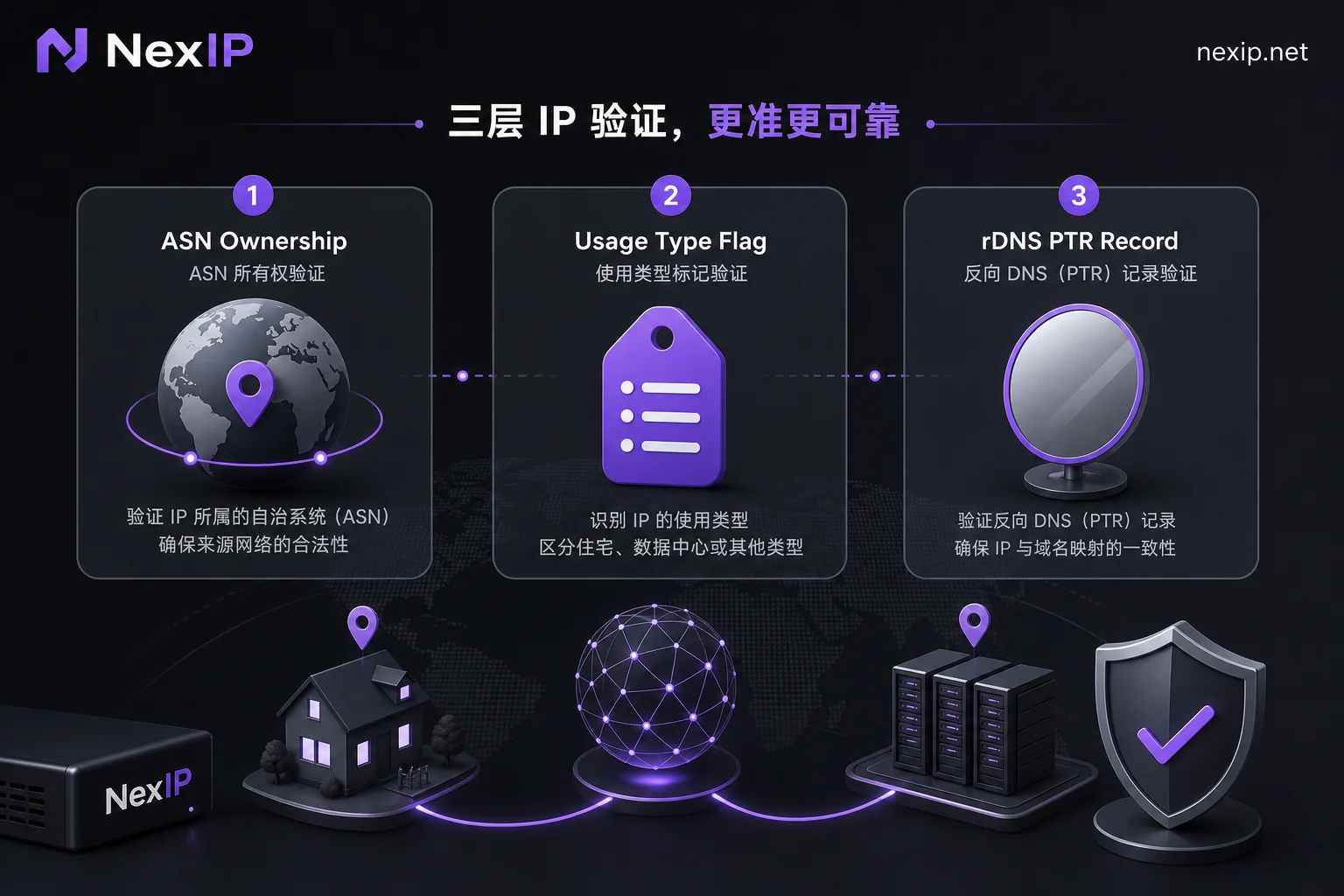
What ASN, Usage Type, and Reverse DNS Reveal
To confirm the true attributes of an IP, you need to dissect key fields layer by layer. First, look at the ASN registration entity. A genuine dual-ISP residential IP should have its ASN owned by a local broadband operator, not a cross-border hosting or cloud service provider. Second, examine the Usage Type or is_hosting field. Some sellers may modify the front-end display using technical means, but the underlying registry often leaves traces. If the ASN shows ISP but the Usage Type still marks hosting or business, it indicates a single-layer packaging suspicion. At this point, refer to the broadcast address difference interpretation logic in What is the fundamental difference between native and non-native IPs.
Third, check the Whois registration organization and geographic location, verifying that the registered country, state/province match the promised city. The fourth layer is a crucial corroborative evidence—reverse DNS (PTR). Real home broadband PTR records typically follow the operator's dial-up naming conventions, while data center or relay segments often have empty PTRs or contain data center characteristic strings like compute, vps, server, or datacenter. Such anomalies are exactly the underlying exposure points mentioned in Why data center IPs are easily identified as high-risk IPs. When multiple databases conflict, records with clear hosting marks and abnormal PTRs are more trustworthy.
C-Segment Neighbors and Shared Pool Contamination Risks
In multi-account operations, the cleanliness of a single IP is just the foundation; the continuity of the C-segment (/24 subnet) is the hidden killer. Mainstream platforms' risk control algorithms have strengthened the joint assessment of IP ownership service providers and subnet topology. If multiple stores' IPs belong to adjacent /24 subnets of the same data center provider, even if each IP individually appears "residential," they may be judged as operated by the same entity. Historical violations by other accounts can contaminate neighbors in the same segment, triggering cluster reviews. Additionally, low-cost shared residential pools are a major problem; IPs in such pools are often reused by many users, leading to very low reputation scores and frequent session drift. For sellers on platforms like Etsy, it is recommended to consult Etsy Seller Account Network Environment Windproof Plan to optimize isolation strategies.
Therefore, during acceptance, you must not only look at the individual IP but also inspect the composition of neighbors in the same segment. If you find many known high-risk IPs or empty PTR records within the same C-segment, immediately remove that batch. Adhere to the principle of "one store, one environment, one independent exit," and ensure procurement specifications reflect this. Ensure that IPs for different stores not only have different ASNs but ideally non-overlapping C-segments to cut off potential association chains.
Self-Check, Cross-Database Verification, and Proof Time Comparison
For different scales of procurement, the choice of acceptance path directly affects efficiency and security. Here is a comparison of costs and effects for three common paths:
| Acceptance Path | Evidence Layers Covered | Estimated Time per IP | Total Time for 50 IPs | Main Risk Intercepted | Applicable Scenarios |
|---|---|---|---|---|---|
| Quick Self-Check Using Single Database | ASN, Usage Type | 1-2 minutes | 50-100 minutes | Obvious data center IP disguise | Small-scale tests, non-core accounts |
| Multi-Database Cross-Verification + PTR | ASN, Usage Type, Whois, PTR | 10-15 minutes | 8-12.5 hours | Single-layer packaging, fake PTR, geographic mismatch | Core business, high-value accounts |
| Provider Issued Certificate | Full-chain ownership, targeted parameters, session stickiness | High communication cost (counted in days) | Depends on response speed | Entire batch quality, long-term stability commitment | Enterprise-level procurement, long-term cooperation |
Note: Times above are empirical ranges; actual times depend on query tool responsiveness and network conditions. For small batches, multi-database cross-verification is time-consuming but offers the best cost-effectiveness; for enterprise procurement, requiring providers to supply batch-level ownership reports and targeted parameter commitments, though initially cumbersome, can significantly reduce future operational uncertainty.
Disposal Sequence After Detecting Fake Dual-ISP
If you discover that the purchased US dual-ISP is fake, do not immediately force an IP switch, as this may lead to account bans due to sudden behavioral changes. The correct loss mitigation sequence is as follows:
- Freeze New Operations: Stop binding new stores or logging into new devices on that exit, keeping existing sessions until a replacement is ready.
- Verify Replacement IP: Conduct strict multi-database cross-verification on the new IP, ensuring its ASN, Usage Type, and city targeting do not fall within the same provider's adjacent subnet as the original exit.
- Gradual Migration: Follow the principle of "environment first, then accounts." Configure the new IP in your browser environment, test connectivity and fingerprint consistency, then gradually migrate low-weight accounts. Avoid same-store jumps across countries or ASNs in a short time.
- Observation Period Sampling: Run several sessions on the new exit to monitor IP ownership drift and PTR stability. If fraud score issues are excessive, refer to the troubleshooting approach in How to Solve High Proxy IP Fraud Score.
- Basis for Claims: When demanding refunds or replacements from the seller, take screenshots of ASN query results, Usage Type marks, PTR records, and Whois information that contradict commitments, as direct evidence of field discrepancies.
Converting Acceptance Time into Money
Assume a team operates 10 stores and uses the multi-database cross-verification path, with each IP taking 10-15 minutes. A one-time acceptance would require 1.7-2.5 hours of labor (using the conservative upper limit of 2.5 hours). In contrast, if failure to verify leads to a cluster review, the costs include: daily sales drop to zero during suspension, weeks of waiting for appeal, and time spent rebuilding account environments and reputation. This also explains why dual-ISP residential IPs are more expensive than ordinary residential IPs. The price premium comes from the authenticity of ownership registration and exclusivity, not bandwidth. Ordinary dynamic residential IPs are often shared pools, cheap but risk-controlled; true dual-ISP static residential IPs are directly assigned by operators to specific users, with independent ASNs and stable PTRs, suitable for businesses requiring long-term login sessions.
When purchasing, classify according to business nature:
- Store Backend Management: Requires static long-lasting residential IPs with precise city/ASN targeting and strong session stickiness to ensure exit ownership doesn't drift.
- Phased Registration/Operations: Requires static short-term IPs, balancing cost and cleanliness.
- Public Data Retrieval: Requires dynamic residential bandwidth, tolerating certain IP rotation.
It is recommended to list the fields and targeting parameters you need in a requirements checklist before placing an order, then confirm with the service provider. If you need long-term login sessions and non-drifting exit ownership, cross-check against NexIP's static long-lasting residential IP regional and city/ASN targeting and session stickiness parameters before deciding.
Frequently Asked Questions
How to check if a newly purchased IP is dual-ISP?
You can query databases like IPinfo or MaxMind to see if the ASN owner is an ISP, and simultaneously check if the Usage Type field is "ISP" or "Residential." If both match, and the PTR record shows no data center characteristics, it is likely a true dual-ISP. It is advised to use multi-database cross-verification to avoid single-source errors.
What is the difference between dual-ISP residential IP and ordinary residential IP?
The main difference lies in ownership registration and stability. Ordinary residential IPs are often dynamic and rotating, with mixed ASNs; dual-ISP static residential IPs have ASN and Usage Type clearly registered as local broadband operators, and the IP address is fixed, making them more suitable for e-commerce backend operations that require long-term login sessions.
IPinfo shows ISP but the ASN is a data center—what's that about?
This usually indicates single-layer packaging by the seller, who modified only the front-end ISP label but did not change the underlying ASN registration. In such cases, focus on checking the Whois organization name and PTR record. If the PTR contains strings like vps or cloud, even if the ASN displays ISP, it should be considered a high-risk data center IP.
What to do if Amazon multi-store bought fake dual-ISP?
Immediately stop using that IP for sensitive operations. Collect screenshots of ASN, Usage Type, PTR, and Whois as evidence, and contact the provider to request replacement with clean IPs from different C-segments or a refund. Do not force a switch; first verify the security of the new IP, then migrate slowly following the "environment first, then accounts" order.
Why are such IPs priced significantly higher than ordinary residential IPs?
The high cost is due to resource scarcity and maintenance difficulty. The premium for authentic dual-ISP static IPs can be explained by three aspects: authenticity of ownership registration, exclusivity, and limited availability. Compared to large-scale collected dynamic residential pools, their supply is tighter, and technical requirements for session stickiness and ownership stability are higher.




Comments(0)