 NexIP官方博客
Whether to choose static or dynamic residential IPs for TikTok depends on whether the account's exit IP needs to remain unchanged long-term. There are three tiers: use static long-term residential IPs for long-term login and live streaming, static short-term for registration and phased operations, and dynamic residential bandwidth for public content browsing and product research. For example, if a live stream disconnects after 20 minutes and encounters temporary risk control, it's often due to dynamic IP segment changes. This article does not cover account unbanning methods or speculate on unpublicized platform thresholds.
In May 2026, proxy provider kookeey released a guide noting that high-risk social media platforms like TikTok and Instagram are extremely sensitive to geographic location and network environment. Low-purity datacenter proxies can lead to zero views or account bans, recommending static ISP residential IPs paired with fingerprint browsers for 1-to-1 binding. This article addresses a single fork: how the differences between static and dynamic residential IPs in session persistence, exit drift, and billing correspond to your three types of usage actions.
First, Distinguish Two Things: Residential Attribute Solves Exit Identity, Static vs. Dynamic Solves Session Persistence
To decide how to choose TikTok residential IPs, first distinguish two things. Many teams still experience instability after buying residential IPs, and their first reaction is "insufficient purity," but more often it's a persistence issue. The residential attribute solves "where you come from"—the IP's registration information is home broadband rather than a data center, which is also why residential IPs are needed; static vs. dynamic solves "how long you stay"—whether the exit for the same account drifts within a period.
Based on third-party security vendor telemetry and industry practice, platform risk control is closer to joint scoring, with IP attributes only part of the initial trust score. The official weights and thresholds are not public. Even if the exit is genuine residential, frequent segment changes within a session, ASN jumps, and mismatched device environments still create abnormal signals. So the main axis for selection is not price or IP freshness, but "whether this account's exit needs to remain unchanged long-term."
Scenario 1: Long-term Login and Account Warming: Rotating Exits Under Logged-in Status Actually Create Abnormal Signals
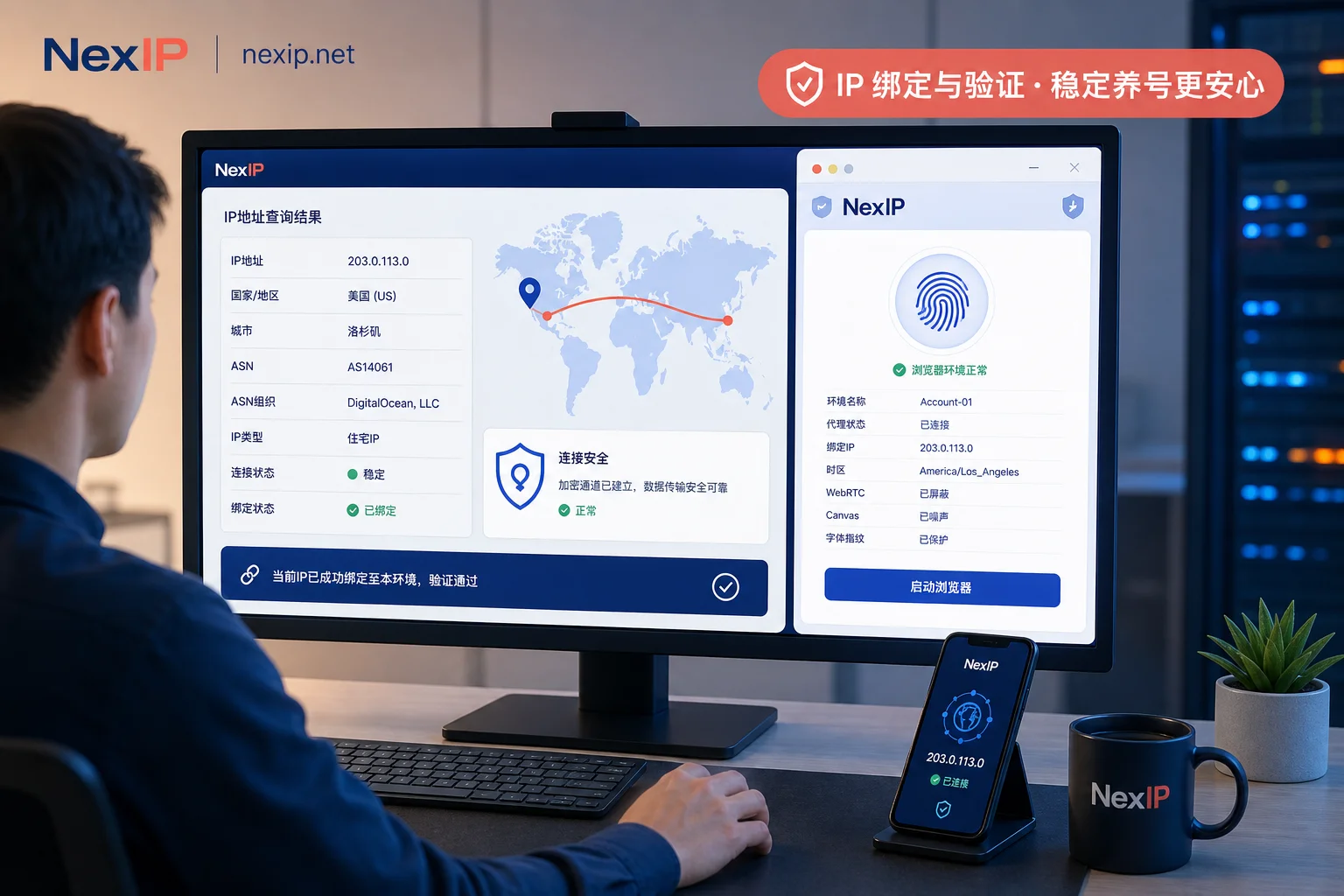
For a logged-in account with historical behavior, if each request switches to a different exit, geographic spans and ASN jumps make normal operations look like account theft. During the warming period, avoid large-pool rotation at all costs.
- Recommended tier: static long-term residential IP, one account one exit long-term binding.
- Supporting actions: bind the IP 1-to-1 in a fingerprint browser, keeping system timezone, language, DNS consistent with the IP's geolocation.
This directly answers "is it necessary for a TikTok account to have one IP?"—if the account is for long-term operation, the answer is yes, an independent exit is part of the account's identity.
Scenario 2: Live Streaming: Can TikTok Residential IPs Avoid Segment Changes During the Broadcast Window?
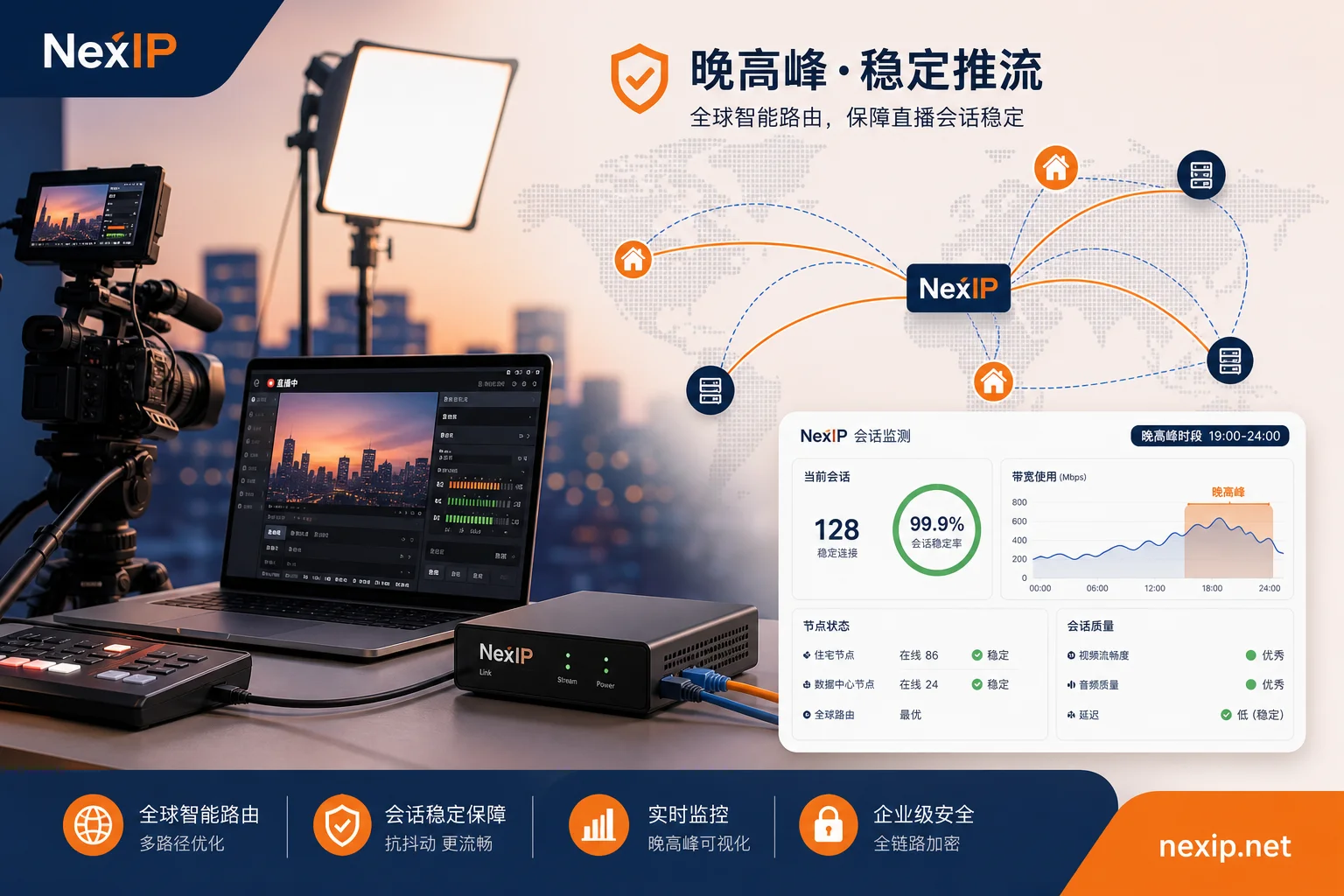
Live streaming is a long-connection scenario. Mid-session segment or ASN changes mean connection re-establishment and visual anomaly risks. Therefore, the streaming exit must remain unchanged throughout the entire broadcast window, especially during prime time from 8 PM to midnight local time. Note: convert to your local schedule based on the target country's timezone to ensure session persistence covers the entire stream.
Verification method: not a single check before going live, but sampling the exit IP and ASN every 5 minutes for 30 minutes before going live, recording whether changes occur. If drift is found, switch to a static long-term plan immediately, rather than gambling. To be clear, network-side control only ensures exit stability during the session; content and account behavior risk limitations are not handled at the proxy layer.
Scenario 3: Public Content Browsing and Product Research: When Dynamic Residential Bandwidth is More Cost-Effective
Another type of action is "logged-out public information access," such as browsing competitor profiles, checking trending hashtags, and product research. These have high request volumes, short sessions, and no need for identity continuity. Using dynamic residential proxies billed by traffic or bandwidth is more cost-effective.
The key is to physically separate these tasks from account operation exits to avoid dragging account exits down—otherwise, high concurrency requests may trigger risk control and affect the static IPs being warmed.
Look Beyond Pool Size: The Combined Impact of /24 Subnet Dispersion and Peak-Time Availability
In August 2026, Kuaidaili's static proxy test guide noted that simply comparing total IP pool size is no longer meaningful. Enterprises focus on /24 subnet dispersion and actual connectivity during peak hours to avoid associated risks from neighbors in the same subnet.
This standard applies equally to TikTok multi-account scenarios: if multiple accounts' IPs fall in the same /24 subnet, an issue with one account may lead to associated risk control on others. There's often a gap between the "tens of millions of IPs" claimed by providers and actual usable dispersion. Don't just look at numbers when selecting.
TikTok Residential IP Acceptance: Four Fields to Verify Before and After Purchase
Before and after ordering, verify each of the following four fields. This is also the practical method for how to detect if a residential IP is true dual-ISP:
| Field | Verification Standard | Tool |
|---|---|---|
| ASN Registration Entity | Should be a local residential ISP in the target country, not a cloud vendor or datacenter hosting provider | ipinfo.io or whois lookup |
| Hosting Flag | Must not have "Hosting" or "Datacenter" flag | ipinfo.io to check if privacy.hosting is true and company.type is hosting/isp |
| Geolocation | Should match the target market, e.g., US accounts use LA IPs | IP geolocation lookup |
| Session Drift | During the set session persistence duration, exit IP and ASN must not change | Scheduled script to capture |
Third-party detection scores should only be used as cross-reference, not as platform pass or ban criteria. Only if all four fields meet requirements can it be considered a qualified TikTok residential IP.
Environmental Alignment: Timezone, Language, DNS, and WebRTC Must Corroborate with IP Geolocation
Kookeey's guide emphasizes that static residential IPs need to be bound 1-to-1 with a fingerprint browser, keeping system timezone, language, DNS resolution exit, and IP geolocation consistent, and WebRTC must not leak the real exit. If these are inconsistent, even a clean IP will be penalized for environmental contradictions.
For questions like "is 0 views on TikTok an IP problem?", the correct troubleshooting order is: first check environmental consistency and account behavior, then IP type. For example, check if the system timezone matches IP geolocation, browser language matches, DNS goes through local resolution, and WebRTC has no leaks. If there are no hard issues at the environment level, then consider if the IP type is wrong. Don't attribute all problems to IP. For selection, you can refer to the TikTok Overseas Multi-Region Operation Network Setup Plan for overall planning; IP is just one part.
Mapping to NexIP: Dynamic Residential Traffic/Bandwidth, Static Short-term, Static Long-term Roles
Mapping the three scenarios to NexIP's TikTok residential IP plan types can be done as follows:
| Plan Type | Applicable Scenarios | Configuration Suggestions |
|---|---|---|
| Dynamic Residential Traffic/Bandwidth | Public content browsing, product research, short-duration tasks | Billed by traffic or bandwidth, not bound to accounts |
| Static Short-term Residential IP | Registration verification, short-term activities, phased operations | Set session persistence duration, e.g., 24-72 hours |
| Static Long-term Residential IP | Long-term login, live streaming exits | Bound to account, session persistence set as needed |
When ordering, you can choose global regions, cities, or ASN targeting and set session persistence parameters. HTTP/SOCKS5 protocols suit different workflows: HTTP for easy API integration, SOCKS5 for browsers or clients. NexIP's public capabilities include the above configuration options but do not make performance promises. It's recommended to test in small batches before scaling.
Pre-Launch Self-Checklist
Before formal operation, check the following items one by one:
- [ ] Is the exit type aligned with the scenario (static for login, dynamic for browsing)?
- [ ] Does the session persistence duration cover the single work window (based on the actual planned duration of this live stream, session persistence must be longer than that duration)?
- [ ] Have the four fields been verified (ASN, Hosting, City, no segment changes during session)?
- [ ] Has environmental consistency been passed (timezone, language, DNS, WebRTC)?
- [ ] Are browsing tasks and account exits separated (not mixed on the same IP)?
FAQ
Should TikTok use static or dynamic residential IPs?
If the account requires long-term login or live streaming, choose static residential IPs; if it's just for browsing public pages or product research, dynamic residential IPs are more cost-effective. The criterion is whether the exit needs to remain unchanged long-term.
Is 0 views on TikTok an IP problem?
Not necessarily. First check environmental consistency (timezone, language, DNS, WebRTC), then IP type. If the IP is datacenter or dynamic rotating, it could be the cause; if the IP attribute is clean and environment consistent, the issue is more likely content or account behavior.
What IP is less likely to lag for TikTok live streaming?
Live streaming is a long connection; the exit must not change segments during the entire stream. Choose static long-term residential IPs and ensure stable connectivity during peak hours with continuous sampling verification in advance.
Is it necessary to have one IP per TikTok account?
If you want long-term account stability, it is necessary. Independent IPs avoid geographic jumps and association risks, especially during warming. But for short-term tests, sharing is acceptable.
Can datacenter IPs log into the TikTok backend?
It's possible, but risky. Datacenter IPs are easily flagged by risk control, potentially leading to zero views or bans. It's recommended to use static residential IPs to avoid unnecessary risks, which is also why datacenter IPs are easily identified as high-risk.
Can switching to residential IPs save a restricted account?
No. Account historical reputation and content risk control are independent of the network layer; changing residential IPs cannot guarantee unbanning a restricted account.
Is it safe after using residential IPs?
No. Based on industry practice, risk control is a joint score of TLS fingerprint, WebRTC, DNS, timezone, language, and account behavior; IP attributes are only part of the initial trust score.


Comments(0)