 NexIP官方博客
In 2026, Japan's e-commerce and digital content ecosystem is undergoing a deep "localization reshuffle."
On one hand, the Japanese e-commerce market is projected to reach $203.25 billion by 2026, with user penetration rising to 81.6%; Rakuten has officially partnered with Google for the "YouTube Shopping Affiliate Program" and aims for 3-4 times growth in overseas sellers, while Yahoo! Shopping also adjusted its store opening plan in September of the same year. On the other hand, TikTok Shop Japan has been online for a full year, generating approximately 50 billion yen in GMV, with over 200,000 local creators and 50,000 merchants making "short video seeding + influencer selling" a new consumption habit for Japan's Gen Z and urban white-collar workers.
However, behind high returns lies Japan's consistently strict compliance and risk control system. Whether it's the full-chain data audit brought by the new JCT consumption tax policy or the cleanup of "fake local accounts" by major platforms, the authenticity and stability of network exits (IP addresses) have become an unavoidable infrastructure foundation for teams expanding into Japan. This article combines the risk control characteristics of mainstream Japanese platforms in 2026 to break down the selection logic and configuration plans for Japan residential IPs.
I. Why Are Japanese Platforms So Strict About Network Exit Review?
Compared to Western or Southeast Asian markets, Japan's internet ecosystem has strong "cohesion" and credit thresholds. Many cross-border teams operating Japanese sites often encounter issues such as new account registration triggering two-step verification, Mercari (Mercari) product listings being instantly removed, or TikTok Japan video views stuck at single digits for extended periods.
From the network perspective, this mainly stems from three characteristics of Japanese platforms' risk control:
- Highly Concentrated Domestic Telecom Operator (ISP) Landscape
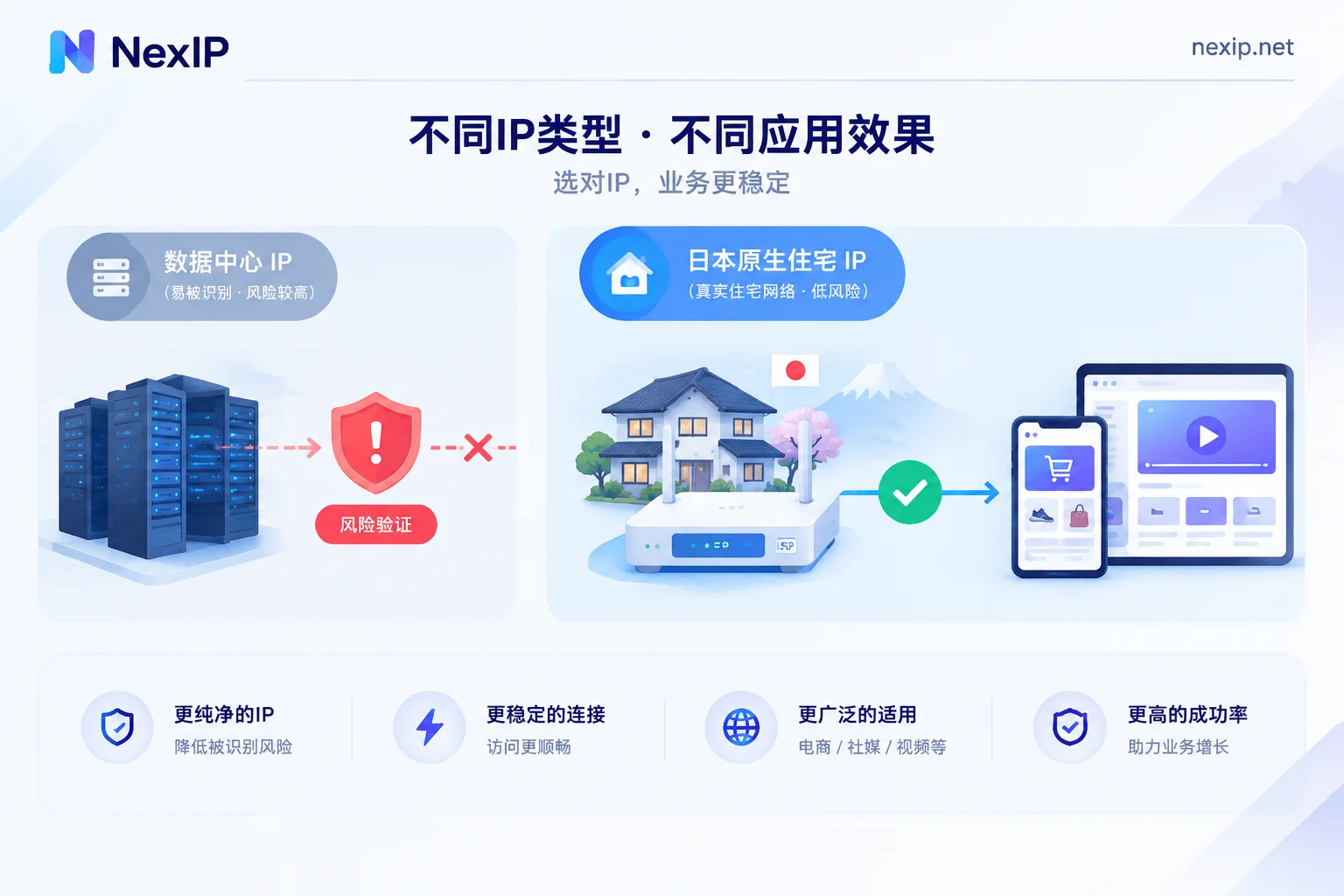
Japan's home broadband and mobile networks are dominated by four major operators: NTT, KDDI (AU), SoftBank, and Rakuten Mobile. Japanese platforms (such as Rakuten, Yahoo, Mercari) are extremely familiar with the Autonomous System Numbers (ASNs) and IP range distributions of these four operators. Once an access request comes from a non-domestic operator or belongs to a data center (Hosting) subnet in Tokyo or Osaka, the risk control system will immediately flag it as high-risk cross-border proxy traffic. - Weight Isolation Between "Local Stores" and "Cross-border Stores"
Whether it's Amazon Japan, Rakuten, or TikTok Shop, platforms strictly differentiate between local and cross-border entities in terms of traffic倾斜 and compliance review. If a store or influencer account claiming local Japanese fulfillment consistently uses non-residential IPs to log into the backend, it can easily trigger platform qualification re-review or even fund freezing. - Zero Tolerance for IP Historical Reputation and Location Drift
Japanese consumers place high importance on privacy and transaction security. To prevent fraud, platforms closely monitor the continuity of the login environment. Frequent changes in exit location (e.g., Tokyo in the morning, Fukuoka in the afternoon) or use of NAT proxy pools shared by multiple users with black market records will directly trigger security blocks. If you're interested in how platforms identify underlying network attributes, you can first read our previous deep dive: Why are you still throttled even when detected as residential? Starting from the risk control differences between native residential IPs and broadcast subnets.
II. Core Business Scenario Breakdown: Which Residential IP Should Different Japanese Businesses Use?
After clarifying the risk control logic of Japanese platforms, we can no longer use the extensive "one proxy for all business" model. For store backends, content matrices, account verification, and public data scraping, network exits need to be strictly separated by static/dynamic and tiered.
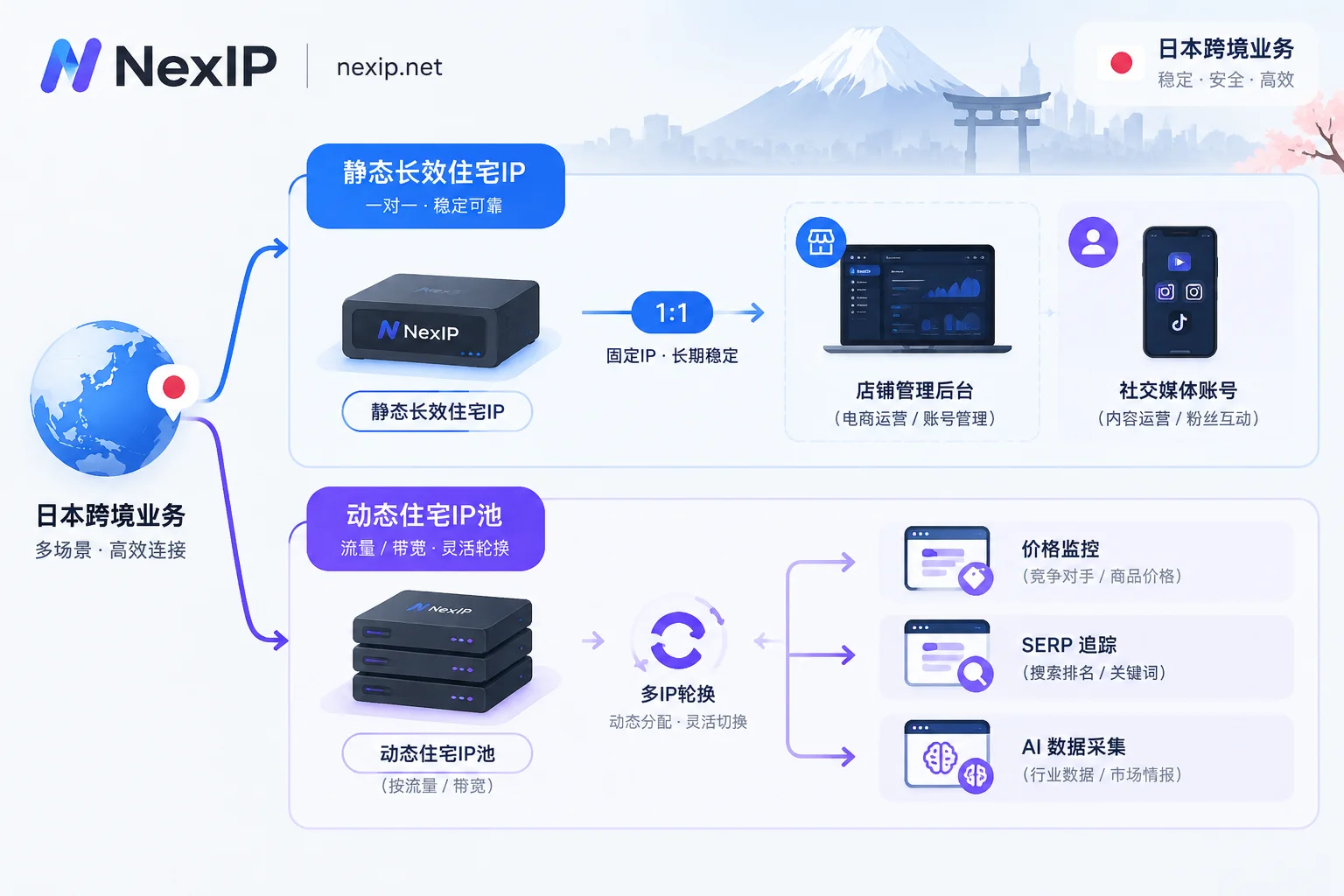
1. Rakuten, Amazon Japan, and Mercari Store Management: Strictly Follow "One Store, One Fixed Exit"
Japan's top comprehensive e-commerce platforms (Rakuten, Amazon.co.jp, Yahoo! Shopping) and second-hand trading giant Mercari have extremely high requirements for account anti-association and login location consistency. In particular, Mercari and Rakuten backends are at the top of the industry in sensitivity to data center IPs and cross-region jumps.
- Configuration Recommendation: Must use exclusive fixed static exits. We recommend NexIP's Static Residential Proxy · Long-term IP, rented monthly or annually with unlimited traffic. For high-value local entity stores, prioritize the residential native subtype that supports native dual ISP, ensuring WHOIS registration and announced ASN both belong to Japan's mainstream local broadband operators; for regular cross-border铺货 stores, you can evaluate the residential broadcast subtype based on cost budget (for technical differences, refer to the official website's How to choose between residential native and residential broadcast comparison).
- Operational Tips: In the article Should Amazon seller backends use dynamic or static IPs, we emphasized that backend management should never use rotating IPs. After extracting a fixed IP from the NexIP backend, it's recommended to bind it directly to the team's anti-association environment or fixed device via username/password authentication, achieving "one store, one fixed Japan IP." If underlying line fluctuations occur, use the long-term plan's free replacement mechanism for smooth transition.
2. TikTok Shop Japan and Local Social Media (X / Instagram / Line) Matrix
In 2026, about 70% of TikTok Shop's GMV in Japan comes from short videos and live streams, with affiliate videos particularly prominent in conversion; meanwhile, after Rakuten integrated with YouTube Shopping Affiliate, the path from video seeding to direct order placement has matured. Whether building a matrix of Japanese influencer accounts, contacting local KOLs, or conducting high-frequency local live streams like Yodobashi Camera, the "local native feel" of the network environment directly determines traffic precision.
- Configuration Recommendation: For TikTok operations, the official website explicitly recommends using residential native IPs from the static long-term category, strictly implementing the "one account, one fixed IP" strategy. Native home broadband attributes enable platform algorithms to accurately identify accounts as real local Japanese users (e.g., in core consumption cities like Tokyo and Osaka), avoiding "0 views" or traffic being diverted to other language regions. For the actual role of dual ISP attributes in social media anti-ban, you can further read: Why do you still encounter pitfalls with dual ISP residential IPs? Unpacking the two technical meanings of dual ISP and real home broadband configuration.
3. Japan Region Account Registration, Payment Integration Testing, and Short-term Evaluation: Low-cost Independent Static Exit
In daily operations, teams often need to batch register Japanese local platform buyer accounts, verify JCT tax filing pages, test local Japanese e-wallets and credit card payment channels, or conduct localized integration testing for Japanese apps. Such tasks also require maintaining an absolutely stable single Japanese residential identity for hours or days, but do not require monthly long-term subscriptions.
- Configuration Recommendation: Use Static Residential Proxy · Short-term IP. This solution provides exclusive fixed static residential (ISP) IPs, supports hourly or daily billing with unlimited traffic, and is ideal for short-cycle tasks like account verification, payment validation, and integration testing. Stop when done, significantly reducing marginal costs.
4. Price Monitoring, SERP Tracking, and AI Japanese Corpus Collection: High-concurrency Dynamic Residential Pool
Japanese consumers are extremely sensitive to prices, shipping fees, and point rewards (like Rakuten points). Cross-border sellers and data teams need to continuously scrape real-time price, inventory, and review data from Rakuten, Amazon Japan, Yahoo! Auction, and ZOZOTOWN, or monitor local search rankings (SERP) on Google.co.jp / Yahoo! Japan. Additionally, training vertical e-commerce AI agents for the Japanese market or building RAG retrieval libraries requires massive Japanese web page collection.
If such public data tasks use static IPs for high-frequency requests, they will quickly trigger platform anti-scraping blocks. The correct approach is to use high-anonymity dynamic residential IP pools, distributing request pressure by constantly switching real home exits.
- Traffic-based billing scenarios: For intermittent price comparison scraping, local Japanese ad verification, SEO monitoring, or training corpus scraping and real-time web access for AI agents in AI applications, we recommend Dynamic Residential Proxy · Traffic Plan. Billed by traffic (GB), supporting per-request rotation or sticky sessions, with targeted extraction by specific Japanese cities (e.g., Tokyo, Yokohama, Osaka) or local operators.
- Bandwidth-based billing scenarios: For 24/7 continuous Japanese internet sentiment monitoring, real-time inventory tracking of hot products, or high-frequency API polling with large throughput and stable task flow, switch to Dynamic Residential Proxy · Bandwidth Plan. Billed by port bandwidth with unlimited traffic (fair use), it significantly controls budgets for large-scale data pipelines (teams unsure how to estimate costs can refer to How to choose between traffic-based and bandwidth-based billing).
III. Practical Implementation: Japan Residential IP Selection and Access Comparison Table
To help development and operations teams quickly align on configuration standards, we have organized the core business scenarios in the Japanese market and corresponding NexIP product lines as follows:
| Japanese Business Scenario | Core Risk Control Pain Points | Recommended NexIP Product Solution | Session and Billing Mode | Key Configuration Advice |
|---|---|---|---|---|
| Rakuten / Amazon Japan / Mercari Store Backend | Cross-region login review, data center subnet association bans | Static Residential Proxy · Long-term IP | Exclusive fixed exit, monthly/annual, unlimited traffic | Choose residential native (supporting native dual ISP) or residential broadcast; one store one IP |
| TikTok Shop Japan Operations / Social Media Matrix | 0 views throttling, non-local traffic, abnormal verification | Static Residential Proxy · Long-term IP (residential native) | Exclusive fixed exit, monthly/annual, unlimited traffic | Strictly bind to a single account, target core cities like Tokyo/Osaka |
| Japan Buyer Account Verification / Payment Channel Testing | Temporary tasks require pure independent residential identity | Static Residential Proxy · Short-term IP | Exclusive fixed ISP IP, hourly/daily, unlimited traffic | Rent independent IPs on demand, release after verification and integration testing |
| E-commerce Price Comparison / Japan SERP Monitoring / AI Collection | Anti-scraping CAPTCHA blocks, regional personalized display differences | Dynamic Residential Proxy · Traffic Plan | Billed by GB, per-request rotation or sticky sessions | Use per-request rotation for list scraping, sticky sessions for pagination/add-to-cart flows |
| 24h Real-time Inventory Tracking / Japan Sentiment Monitoring | Continuous high-throughput scraping leads to uncontrolled traffic costs | Dynamic Residential Proxy · Bandwidth Plan | Billed by port bandwidth, unlimited traffic | Maintain stable concurrency, use automatic rotation to avoid single-IP rate limits |
IV. Team Integration and Daily Pitfall Avoidance Tips
After selecting the right Japan residential IP plan, pay attention to the following details during engineering integration and daily management to ensure the network exit performs optimally:
- Leverage Multi-dimensional Targeting Capabilities
Consumption preferences and search results vary significantly across regions in Japan. When configuring dynamic proxies for ad verification or SERP monitoring, use NexIP's global coverage nodes to precisely target by country, specific city, ASN, or local operator (subject to real-time inventory), reproducing the most authentic Japanese local user perspective. - Choose Protocols and Access Methods That Match Your Workflow
NexIP supportsHTTP,HTTPS, andSOCKS5protocols across the board, and offers username/password authentication or IP whitelist authentication. For scraper and data engineering teams, integrate quickly into your custom scheduling architecture via API extraction or port forwarding (see Crawler Proxy IP Integration Architecture Design: Task Tiering, Cookie Binding, and Dual Pool Scheduling Guide); for cross-border e-commerce and social media operations teams, manage IPs through the official website panel or client, and use the sub-account feature to securely assign static IP permissions for different Japanese stores to corresponding operations specialists. - Clarify Responsibility Boundaries and Ensure Full-chain Isolation
It's important to note that NexIP focuses on providing pure, stable residential proxy network exits. In actual anti-association operations, besides ensuring the independence and purity of Japan residential IPs, operations teams must also handle browser fingerprint environment isolation, cookie cleaning, and alignment of Japanese timezone/language parameters locally to avoid client-side environment leaks rendering network-side configurations futile.
Conclusion
In 2026, the Japanese cross-border market has long passed the stage where extensive product listing and cheap data center proxies could work. Facing compliance upgrades from Rakuten and Amazon Japan and the content dividends of TikTok Shop Japan, "fixing backend accounts on pure static native home broadband and delegating public data collection to high-anonymity dynamic residential pools" is a standard practice for every mature overseas expansion team.
If you are preparing for or expanding your Japan region business, feel free to browse NexIP's industry and platform solutions, or go directly to the NexIP User Backend to register an account, check real-time inventory of Japan nodes, and access integration documents, building solid network infrastructure for your Japanese business.


Comments(0)