 NexIP官方博客
In current overseas business and global data collection, the role of overseas proxy IPs has evolved from an early "single-machine IP switching tool" to enterprise-level underlying network infrastructure.
Two recent industry changes are particularly evident: on one hand, with the explosive demand for AI search and cross-platform consumer insights (VOC), public comment collection and real-time public opinion monitoring on communities such as Reddit, YouTube, and TikTok have increased significantly, and platforms have upgraded their interception mechanisms for automated traffic and abnormal network segments; on the other hand, after early extensive expansion, cross-border e-commerce and overseas social media teams have begun to shift from "blindly comparing the number of nominal IP pools" to focusing on the authenticity of resource sources, scenario matching, and team collaboration management efficiency.
When a team is simultaneously running public data crawlers, 24/7 public opinion monitoring pipelines, payment testing environments, and dozens of overseas social media and store accounts, trying to solve all problems with the same package often leads to uncontrolled collection costs or frequent verification triggers for core accounts. This article starts from real business workflows and breaks down how to plan an overseas proxy IP architecture according to task characteristics.
I. Three Fundamental Shifts in Overseas Proxy IP Selection in 2026
When evaluating overseas proxy IP service providers, simply looking at "how many countries are covered" or "the lowest price per GB" can easily lead to pitfalls. Based on recent practical feedback from mainstream overseas teams, selection criteria are converging toward the following three dimensions:
- From "focusing on nominal scale" to "verifying attributes and sources"
Whether for public web scraping or account login, the target platform's risk control system cross-checks the IP's WHOIS registration ownership and ASN type. If you are not familiar with the underlying verification methods, we recommend first referring to our previously compiled How to check whether an IP's ASN belongs to an ISP and How to tell from WHOIS whether it is a data center or home broadband, to confirm the egress attributes before putting them into production. - From "single billing model" to "layering by throughput characteristics"
Burst high-concurrency web retrieval (such as price comparison, SERP monitoring) and all-weather uninterrupted data streams (such as community public opinion polling, inventory tracking) have completely different consumption models for traffic and ports. Mixing the two types of tasks in the same billing pool either leads to idle computing resources or traffic overspending. - From "manual personal configuration" to "team-based permissions and API scheduling"
When collection teams and operations teams share a proxy budget, the lack of sub-account isolation and API automated management makes troubleshooting extremely difficult—once an egress anomaly or quota exhaustion occurs, the team often spends a lot of time figuring out which script or operator's action triggered a chain reaction.
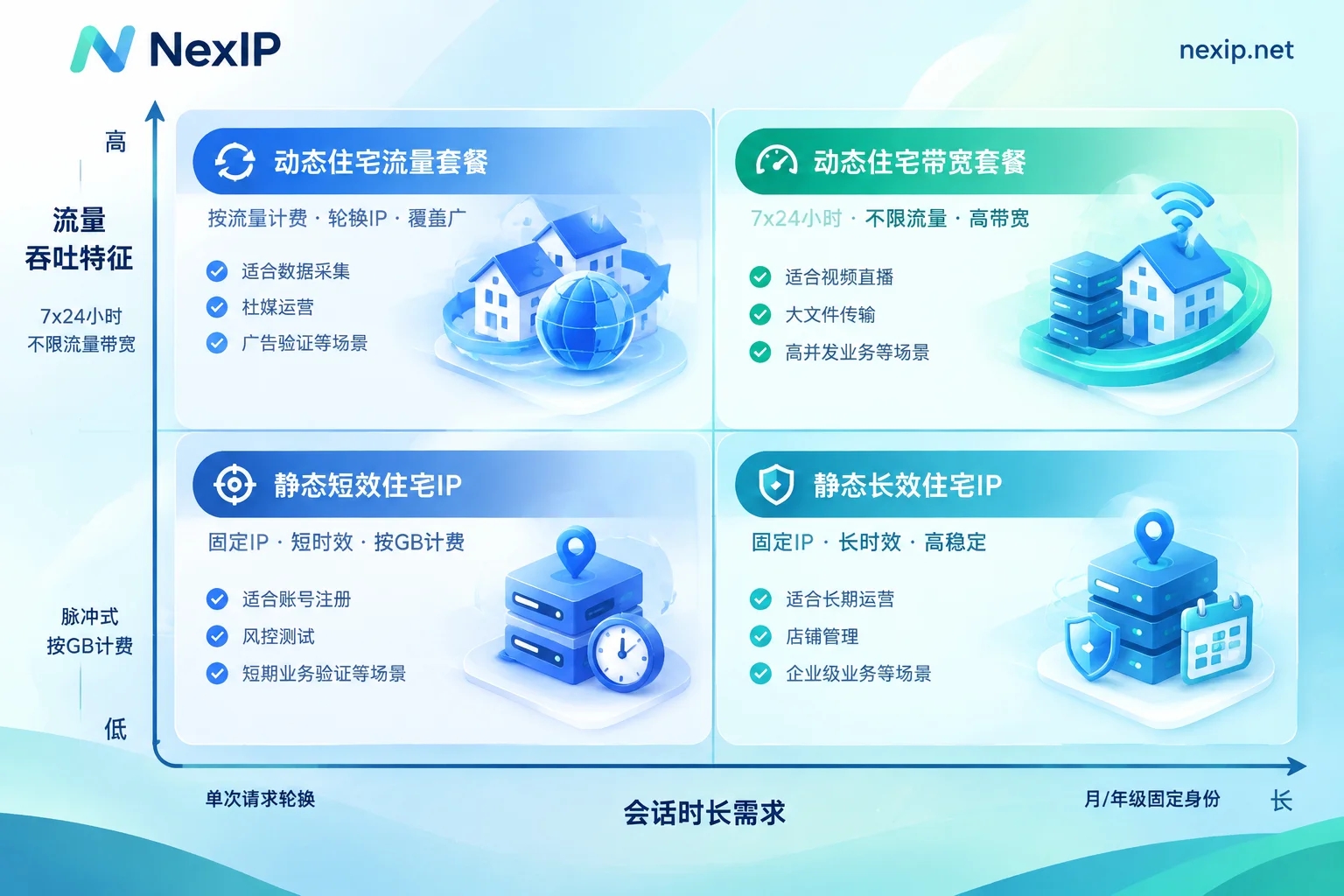
II. Overseas Proxy IP Matching Strategies for Four Core Overseas Scenarios
To avoid mismatches such as "using collection IPs to log into stores" or "using pay-as-you-go packages for high-frequency polling," NexIP divides its residential proxy network into four clear product lines. Teams can match them according to the task's session duration and throughput characteristics (for more detailed platform solutions, see NexIP Industry and Platform Solutions):
1. Continuous overseas public opinion monitoring and inventory tracking: Dynamic Residential Proxy (Bandwidth Package)
Recently, many brand overseas teams and data analysis agencies need to poll overseas forums (such as Reddit vertical sections), social media trends, or real-time inventory of key products 24/7. The characteristics of such tasks are continuous operation, stable throughput, and extremely large total traffic consumption.
- Configuration plan: Choose Dynamic Residential Proxy · Bandwidth Package.
- Core logic: Billed by port bandwidth with unlimited traffic (subject to fair use policy), supporting automatic rotation or sticky sessions. For continuously running API polling and public opinion monitoring pipelines, fixed port bandwidth can lock monthly network costs within a predictable range, eliminating concerns about traffic bills spiraling out of control due to a surge in comments triggered by hot events. For detailed critical point calculations of the two billing models, you can read How to choose between traffic-based billing and bandwidth-based billing.
2. Cross-regional price comparison, ad verification, and AI real-time retrieval: Dynamic Residential Proxy (Traffic Package)
When performing search engine results page (SERP) monitoring, multi-country ad landing page verification, travel and e-commerce price comparison collection, or crawling public web corpora for AI Agent / RAG retrieval pipelines, tasks often exhibit pulsed concurrency, controllable single-request volume, but requiring extremely wide geographic dispersion.
- Configuration plan: Access Dynamic Residential Proxy · Traffic Package (for AI-related scenarios, you can also directly refer to AI Application Exclusive Solution).
- Core logic: Billed by actual traffic consumed (GB), supporting per-request IP rotation or sticky sessions, and precise targeting by country, city, ASN, and carrier (subject to inventory). When scraping geo-sensitive public data, rotating through highly dispersed real residential egresses can effectively reduce CAPTCHA interception triggered by overly dense requests from a single network segment (for specific pipeline configuration, see Configuration Logic of Dynamic Residential IPs in AI Data Pipelines).
3. Account verification, payment integration testing, and short-term testing: Static Residential Proxy (Short-lived IP)
Before business processes go live, development and testing teams often need to perform cross-border payment gateway verification, localized purchase process walkthroughs, or short-term account verification. If the IP changes mid-way during such operations, it will directly interrupt the session and trigger security interception; but after testing, there is no need to retain the node long-term.
- Configuration plan: Use Static Residential Proxy · Short-lived IP.
- Core logic: Provides exclusive fixed static residential (ISP) IPs with hourly or daily leases, billed by number of IPs with unlimited traffic. During the lease period, the egress identity is completely fixed, satisfying the strict requirement of "the same stable residential IP" for payment verification and testing integration, while avoiding wasting funds on monthly packages for temporary tasks.
4. Cross-border store backend, TikTok operations, and long-term AI accounts: Static Residential Proxy (Long-lived IP)
For cross-border e-commerce store backends, long-term Facebook/Instagram/Reddit operation accounts, overseas AI membership accounts that need to maintain login status long-term, and TikTok matrix operations, the core logic of platform risk control is to verify "the consistency and authenticity of network identity."
- Configuration plan: Bind Static Residential Proxy · Long-lived IP.
Core logic: Provides monthly or yearly exclusive fixed egress, unlimited traffic, supports native dual ISP and free replacement upon failure. In specific subcategories, NexIP further divides into three types: native home broadband, broadcast home broadband, and data center:
- For businesses with extremely strict environmental risk control (such as TikTok operations), it is officially recommended to directly choose native home broadband IPs among static long-lived IPs, and strictly implement the isolation principle of "one account, one fixed IP."
- If the team has questions about choosing between "local ISP home broadband (native)" and "network segments registered as residential attributes but hosted in data centers via BGP (broadcast)" during procurement, it is recommended to directly consult the official website's Comparison of Native Home Broadband and Broadcast Home Broadband, or combine with our recent in-depth article "Why are you still rate-limited even when it shows residential attributes? Starting from the risk control differences between native residential IPs and broadcast network segments" for on-demand tiering.
| Business Scenario Classification | Typical Task Examples | Recommended NexIP Product Line | Billing and Session Mechanism |
|---|---|---|---|
| Pulsed public collection | Price comparison collection, ad verification, SEO monitoring, AI corpus and web access | Dynamic Residential · Traffic Package | Billed by traffic (GB); per-request rotation or sticky sessions |
| All-weather continuous stream tasks | Overseas public opinion monitoring, inventory tracking, high-frequency API polling | Dynamic Residential · Bandwidth Package | Billed by port bandwidth, unlimited traffic; automatic rotation or sticky sessions |
| Short-term fixed identity tasks | Account verification, cross-border payment verification, localized testing integration | Static Residential · Short-lived IP | Billed by IP (hourly/daily), unlimited traffic; exclusive fixed ISP egress |
| Long-term fixed asset operations | Cross-border store management, TikTok operations, social media matrix, AI account maintenance | Static Residential · Long-lived IP | Monthly/yearly exclusive fixed egress, unlimited traffic; divided into native/broadcast/data center |
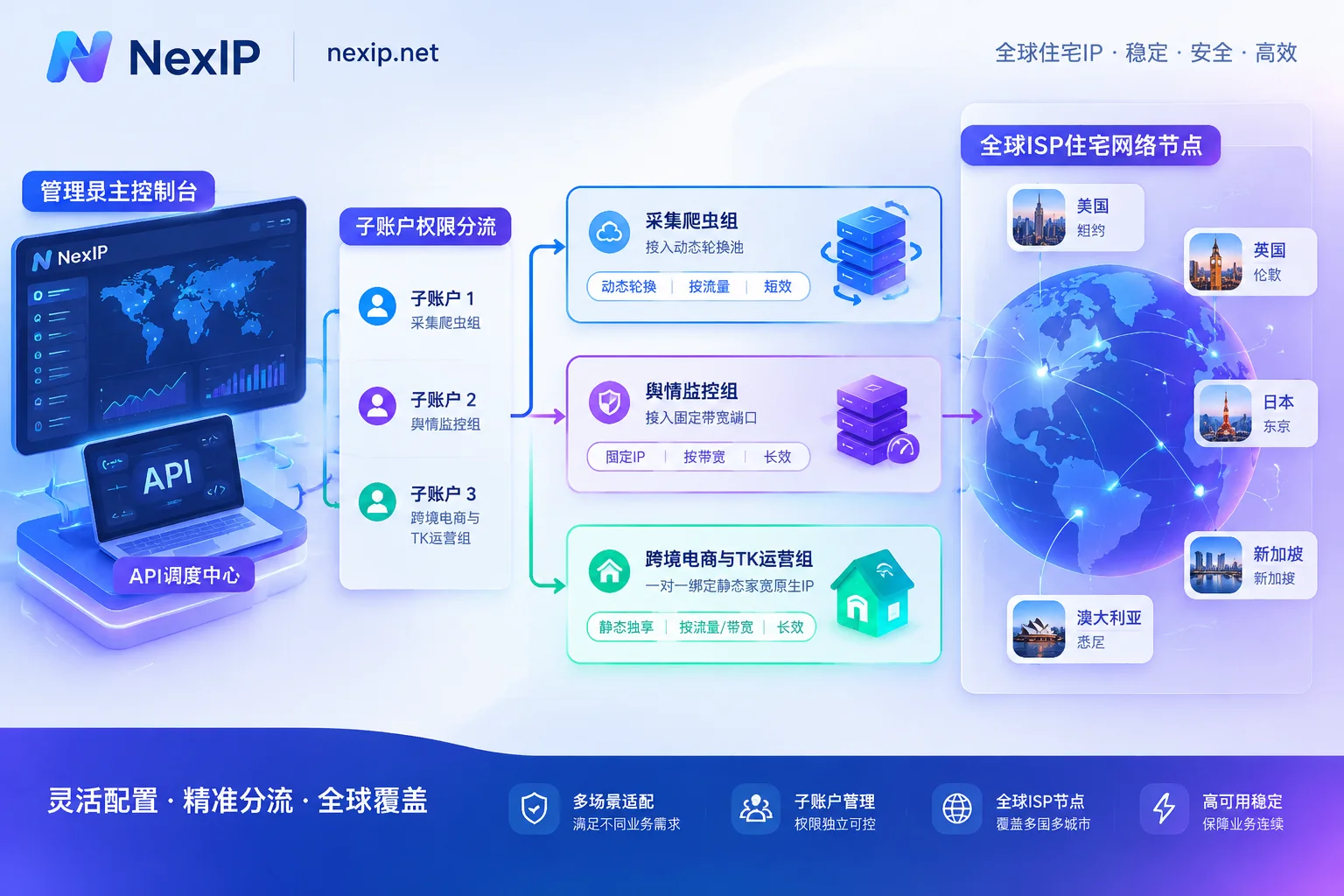
III. Engineering Implementation: How Can Teams Efficiently Access and Manage Overseas Proxy IPs?
After determining the product mix, the access efficiency of network egress and permission isolation directly determine the team's daily operation and maintenance costs. In actual deployment, the proxy architecture can be standardized through the following steps:
- Verify target region and carrier coverage in advance
Mainstream home broadband carriers (ASNs) differ significantly across overseas markets. Before bulk deployment, it is recommended to first check the NexIP Global Country and Region Coverage Page to view local carriers, available cities, and adaptation to popular platforms in the target country, ensuring that targeting parameters match the business target market. - Choose matching protocols and access methods based on the tech stack
NexIP supportsHTTP,HTTPS, andSOCKS5protocols across the board, and provides username/password authentication or IP whitelist authentication. For different development and operations terminals, teams can flexibly adopt four access modes: API extraction, username/password direct connection, port forwarding, or process proxy, and complete configuration through the official website control panel or client (for crawler-side architecture integration, see Crawler Proxy IP Access Architecture Design). - Use sub-accounts and APIs to achieve team permission isolation
In multi-department collaboration or studio matrix operations, it is crucial not to have all personnel share the same set of main account credentials. Through the NexIP panel and API management system, administrators can create independent sub-accounts by project group (such as "Reddit Public Opinion Group," "US TikTok Operations Group," "European Price Comparison Crawler Group"), and allocate traffic or assign static long-lived IPs separately. This not only clearly accounts for the proxy costs of each business but also fundamentally prevents multiple account associations caused by operations personnel mistakenly using the same static egress.
Conclusion
Facing evolving platform anti-crawling strategies and cross-regional compliance requirements, a stable and reliable overseas proxy IP architecture is no longer a contest of single nodes, but a coordinated combination of dynamic traffic, fixed bandwidth, short-term testing, and long-term native egress.
If your team is restructuring overseas data collection pipelines, or plans to upgrade to cleaner fixed network egress for cross-border stores and social media matrices, you are welcome to directly visit the NexIP User Backend to register an account, consult the complete access documentation, and purchase a matching residential proxy solution based on your actual business scale.


Comments(0)