 NexIP官方博客
Developers engaged in overseas public data collection, competitor price monitoring, or SERP tracking have recently encountered a common phenomenon: crawler scripts are logically sound and even use proxy pools, but requests either frequently get stuck on security verification pages (like Turnstile) or return 403 errors, or even get silently redirected to decoy pages with distorted data.
Today's mainstream WAFs and anti-scraping systems no longer rely on a single "single-IP request frequency threshold" but have shifted to multi-dimensional linkage verification of IP network attributes (ASN/ISP) + protocol fingerprint (TLS/HTTP2) + session state (Cookie/Token). Under this mechanism, the crude strategy many teams still use—"just swap to another crawler proxy IP whenever an error occurs"—not only fails to bypass blocks but also causes widespread Cookie invalidation due to frequent session interruptions, multiplying proxy procurement costs.
To keep the data collection pipeline running stably long-term, the core lies not in blindly piling up IPs but in implementing tiered scheduling and session alignment for crawler proxy IPs on the engineering side.
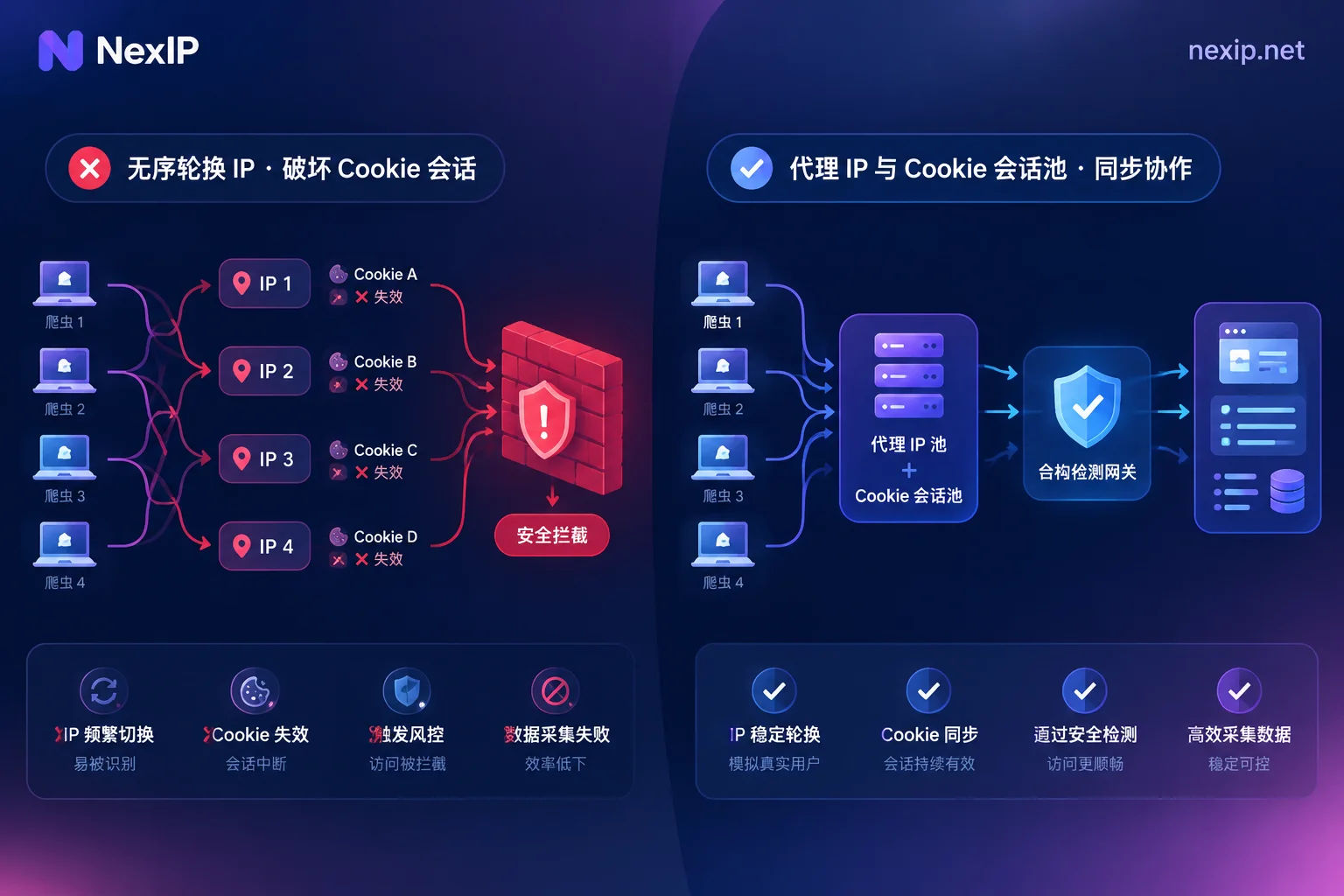
1. Why is the traditional "swap IP on error" proxy pool increasingly ineffective?
When troubleshooting collection rate drops, issues at the network egress level typically concentrate on the following three disconnects:
- IP changes disconnected from session lifecycle
Many target sites, when issuing initial Cookies or passing the first JS challenge, associate that credential with the current egress IP (or its subnet/ASN). If the crawler, while paginating or calling subsequent detail APIs, has its underlying proxy pool forcibly switch to an IP from a distant country or ISP on a per-second basis, the server immediately flags session hijacking, invalidates the Cookie, and bans both old and new IPs. - Egress network attributes mismatched with target business profile
When doing regional e-commerce price comparisons, local life data, or SERP monitoring for specific countries, mixing in large numbers of datacenter IPs or cross-continental broadcast subnets not only easily triggers edge node risk control but often yields incorrect pricing, inventory, and ranking results. As we previously dissected in "How to Tell if WHOIS Shows Datacenter or Residential Broadband", platform validation of underlying ASN ownership is becoming increasingly strict. - Burst tasks and persistent tasks sharing the same billing channel
Stuffing high-throughput streaming list polling and attachment downloads together with low-frequency high-concurrency API probing into the same proxy channel either leads to runaway traffic bills or bursts port bandwidth during peak business hours, causing global timeouts.
2. Proxy Pool + Session Pool: Aligning Crawler Proxy IPs with Request Context
A mature collection architecture separates "stateless scraping" from "stateful scraping" and applies two different binding logics when integrating crawler proxy IPs:
1. Stateless single-page collection: per-request rotation + geo/ASN convergence
For targets like search engine result pages (SERP), public product snapshots, and news lists that require no prior login or context state, the core requirement is to disperse request density.
- Configuration: Use residential proxy egress that supports per-request rotation, automatically assigning a new egress each time an HTTP/HTTPS or SOCKS5 connection is initiated.
- Noise reduction tip: Don't blindly draw randomly from the global pool. Use the proxy provider's targeting parameters to lock egress to the country, city, or even local mainstream ISP (ASN) corresponding to the target site. This ensures localized accurate content and avoids triggering WAF geo-fencing due to anomalous cross-region traffic.
2. Multi-step interaction and state preservation: sticky sessions or short-lived static IPs
For tasks that require first obtaining a Token, paginating after search, or fetching details with temporary Cookies, it is essential to ensure "egress remains unchanged within one work unit." For guidance on when to change IPs, refer to "How Often Should Dynamic IPs Be Changed: Change by Work Unit and Risk Signals, Not by Seconds".
- Lightweight session (minute-level): Enable the Sticky Session feature of dynamic residential proxies so that the same Task ID and Cookie always use the same residential broadband egress within a specified lifetime.
- Strict validation session (hour/day-level): If the target API is extremely sensitive to IP changes, or involves complex account login state verification and payment link testing, passive disconnection of sticky sessions may still interrupt tasks. In this case, a more reliable approach is to switch to Static Residential Proxy · Short-lived IP, exclusively occupying a fixed static residential (ISP) IP for hours or days with unlimited traffic, completely eliminating egress drift risk in a single long-duration collection.
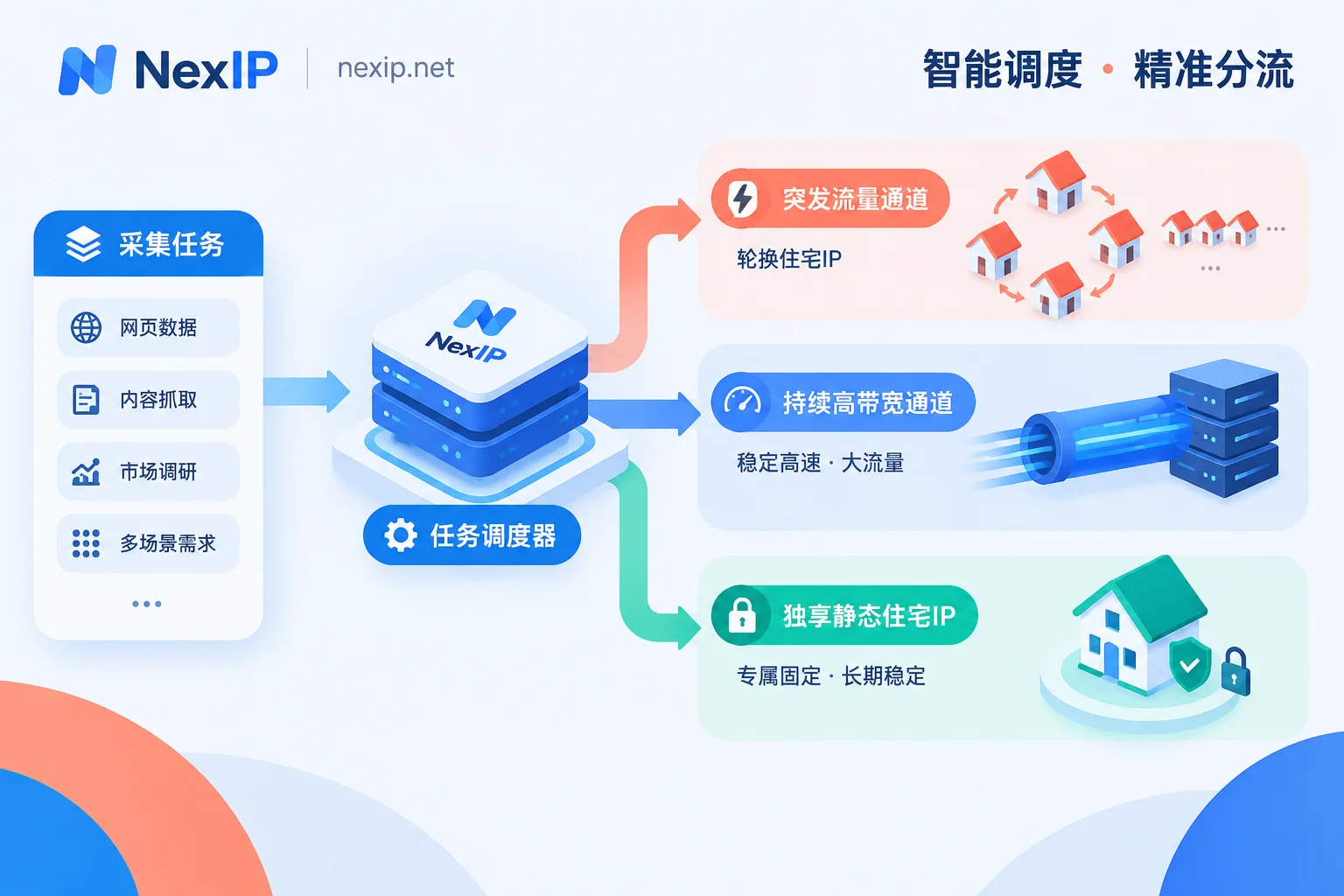
3. Routing by Task Form: Building a Cost-Effective Hybrid Proxy Architecture
In actual production environments, a single type of crawler proxy IP can hardly balance cost and throughput across all collection pipelines. It is recommended to split egress into three independent resource pools at the scheduling layer according to the task's traffic model (for more detailed financial calculation logic, see "How to Choose Between Traffic-Based and Bandwidth-Based Billing"):
| Collection Task Type | Typical Business Scenarios | Core Network Requirements | Recommended Proxy Pool Configuration |
|---|---|---|---|
| High-discreteness, high-anonymity pulse type | E-commerce price comparison, SEO/SERP monitoring, ad verification, AI corpus and RAG real-time web retrieval | Requires massive unique residential broadband IPs to disperse risk control; single request response size controllable | Dynamic Residential Proxy · Traffic Plan (billed by GB, supports per-request rotation or sticky sessions) |
| 7×24 continuous throughput type | Real-time public opinion monitoring, all-weather inventory tracking, high-frequency API polling | Tasks run persistently, data throughput large and stable; traffic-based billing too costly | Dynamic Residential Proxy · Bandwidth Plan (billed by port bandwidth, unlimited traffic under fair use) |
| Long-term identity binding type | AI accounts requiring long-term login state, cross-border store backend data sync, fixed social media operations | Strictly prohibit multi-user reuse and frequent IP changes; need long-term exclusive clean residential egress | Static Residential Proxy · Long-lasting IP (monthly/yearly exclusive, supports residential native/broadcast and native dual ISP) |
Through this layered design, architects can route high-risk, low-traffic requests through the dynamic traffic pool for high pass rates; let high-throughput persistent polling use the dynamic bandwidth pool to lock in a fixed budget; and assign nodes requiring long-term account nurturing or high-privilege Cookie maintenance to long-lasting static IPs (if configuring collection networks for AI Agents or large model pipelines, you can also directly refer to the architecture division in the AI Application Proxy Solution).
4. Engineering Integration and Operations Pitfall Prevention Checklist
Once the proxy pool selection is determined, integration details at the code and infrastructure layers directly determine the final effective request rate:
Choose the right authentication and access protocol
- In multi-node distributed crawler clusters (like Scrapy-Redis, K8s crawler Pods), prioritize IP whitelist authentication with port forwarding or API extraction configured in the backend, eliminating the overhead of hardcoding credentials in every request header.
- For local clients, automation scripts, or collectors requiring multi-language environment isolation, you can flexibly combine username/password authentication with process proxy, fully supporting HTTP, HTTPS, and SOCKS5 protocols.
Tiered retry by status code to avoid "guilt by association" losses
- Upon receiving
429 Too Many Requests: indicates current egress triggered rate limiting; immediately move that IP to a cooling queue and switch to a new IP for retry for the current request. - Upon receiving
401/403accompanied by verification page features: do not just swap the crawler proxy IP; first check TLS fingerprint (e.g., usecurl_cffior align JA3 fingerprint with a real browser kernel), and clean contaminated Cookies, then re-initiate the chain with a fresh "IP + clean session" combination.
- Upon receiving
Isolate quotas between teams and projects
- When multiple collection projects share one main account, a test script stuck in an infinite loop often drains global traffic. It is recommended to use the proxy platform's sub-account management and API management capabilities to assign independent credentials and quotas to different business lines, achieving fault isolation and precise cost accounting.
If you are rebuilding the underlying network for data collection, or need to test egress pass rates for specific industries and target sites, you can check the NexIP Industry and Platform Solutions to learn about customized configurations covering e-commerce, SERP monitoring, brand protection, and major social media; you can also first browse the Global Country and City Node Coverage to verify the required ISP ASNs, then go to the NexIP User Portal to obtain integration documents and testing resources.


Comments(0)