 NexIP官方博客
The Essential Difference Between the Two Billing Models
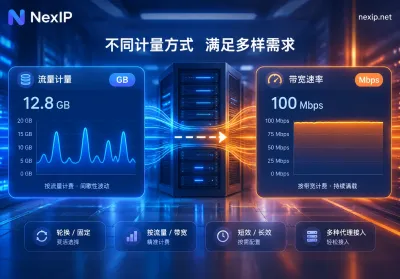
Traffic-based billing purchases a total data transfer quota (GB). You pay for what you use, and idle time incurs no cost. Bandwidth-based billing purchases a fixed peak rate (Mbps). Within the plan period, total transfer is unlimited, but instantaneous throughput is capped by the rate limit.
The former is like paying for a taxi by distance; the latter is like a monthly commuting pass—which to choose depends on whether your task runs occasionally or at full load every day.
What Tasks Suit Traffic-Based Billing
If your tasks match the following characteristics, traffic-based billing is usually more suitable:
Small data volume per request. SERP monitoring, price scraping, lightweight API calls—these tasks return tens to hundreds of KB per request. Even with tens of thousands of requests a day, total traffic remains manageable.
Intermittent runtime. Triggered only at specific times or on demand, such as collecting competitor data for a few hours daily, or launching scraping tasks temporarily based on client orders. Idle periods are not billed, so overall spending is lower than monthly bandwidth.
Frequent IP changes needed. Dynamic plans with traffic-based billing typically support rotation or sticky sessions. The marginal cost of switching IPs is extremely low, making it ideal for data collection that requires high-frequency egress changes.
Risks of Traffic-Based Billing
The biggest hidden danger of this model is budget overrun. If your crawler script doesn't filter static resources like images and videos, or if target pages are larger than expected, traffic can spike rapidly. With infinite redirect loops or large responses, you could exhaust a weekly traffic package in hours.
In practice, do three things:
- Filter useless media payloads and external resources at the code level
- Set usage alert thresholds in the platform dashboard
- During small-scale tests, verify that actual transferred bytes match the platform's statistics
What Scenarios Suit Bandwidth-Based Billing
If your business has the following needs, bandwidth-based billing (unlimited traffic plans) is more reasonable:
24/7 continuous operation. Long-cycle stable scraping and real-time monitoring tasks with near-constant full utilization—the average cost per GB under bandwidth billing is far lower than traffic-based billing.
Involves multimedia or large file transfers. Video downloads, bulk image collection, large-scale file synchronization—these tasks transfer large volumes per run, and traffic-based billing would quickly exhaust quotas.
Need to lock in a fixed budget. Bandwidth-based billing has fixed costs within the plan period, making financials easy to predict—suitable for enterprise procurement and long-term projects.
Constraints of Bandwidth-Based Billing
The core limitation is peak rate and concurrency capacity. If you buy a 10 Mbps bandwidth plan, when concurrent requests or instantaneous throughput exceed this limit, you'll see queuing delays, slower responses, or timeout retries.
When selecting, calculate in advance:
- Concurrent threads × average response size per request = peak bandwidth usage
- If the result approaches or exceeds the plan specs, either upgrade the bandwidth tier or reduce concurrency
"Unlimited traffic" does not mean "unlimited speed"—the rate cap always exists.
How to Evaluate Which to Choose
The core decision logic is the per-GB marginal cost crossover point:
- Estimate your business's monthly total throughput (GB)
- Calculate the estimated total cost using traffic-based unit price
- Compare with the fixed monthly bandwidth fee for equivalent throughput capacity
- Assess the proportion of idle time
If tasks run only briefly at specific times, traffic-based billing usually costs less overall. If utilization is near full year-round, the average cost per GB under bandwidth billing drops significantly.
Another consideration is tolerance for traffic runaway risk. If your business has zero tolerance for budget overruns, or you're unsure of actual consumption during script debugging, bandwidth-based billing with a locked ceiling is safer.
Access and Verification
Whichever billing model you choose, NexIP's dynamic traffic plans and dynamic bandwidth plans support API extraction, username/password authentication, whitelisting, and HTTP/HTTPS/SOCKS5 protocols.
Before running at scale, it's recommended to do three things in a test environment:
- Verify that actual transferred bytes match the platform's statistics
- Confirm whether target requests carry useless media payloads
- Validate with small traffic whether peak concurrency triggers rate limits
This helps avoid choosing the wrong billing model or resource overruns.
Corresponding Product Pages
Once you've decided, go directly to the corresponding product page to select specs:
- If you choose traffic-based billing → Dynamic Traffic Plans
- If you choose bandwidth-based billing → Dynamic Bandwidth Plans
For specific bandwidth tiers, recommended concurrent thread limits, and country coverage, refer to the current official specifications.



Comments(0)