 NexIP官方博客
When integrating large language models into production environments, many development teams encounter a problem more tricky than 403 Forbidden: all HTTP status codes are 200 OK, no pop-up captchas, no connection resets, but the text stuffed into the vector database or fed to the model is completely irrelevant.
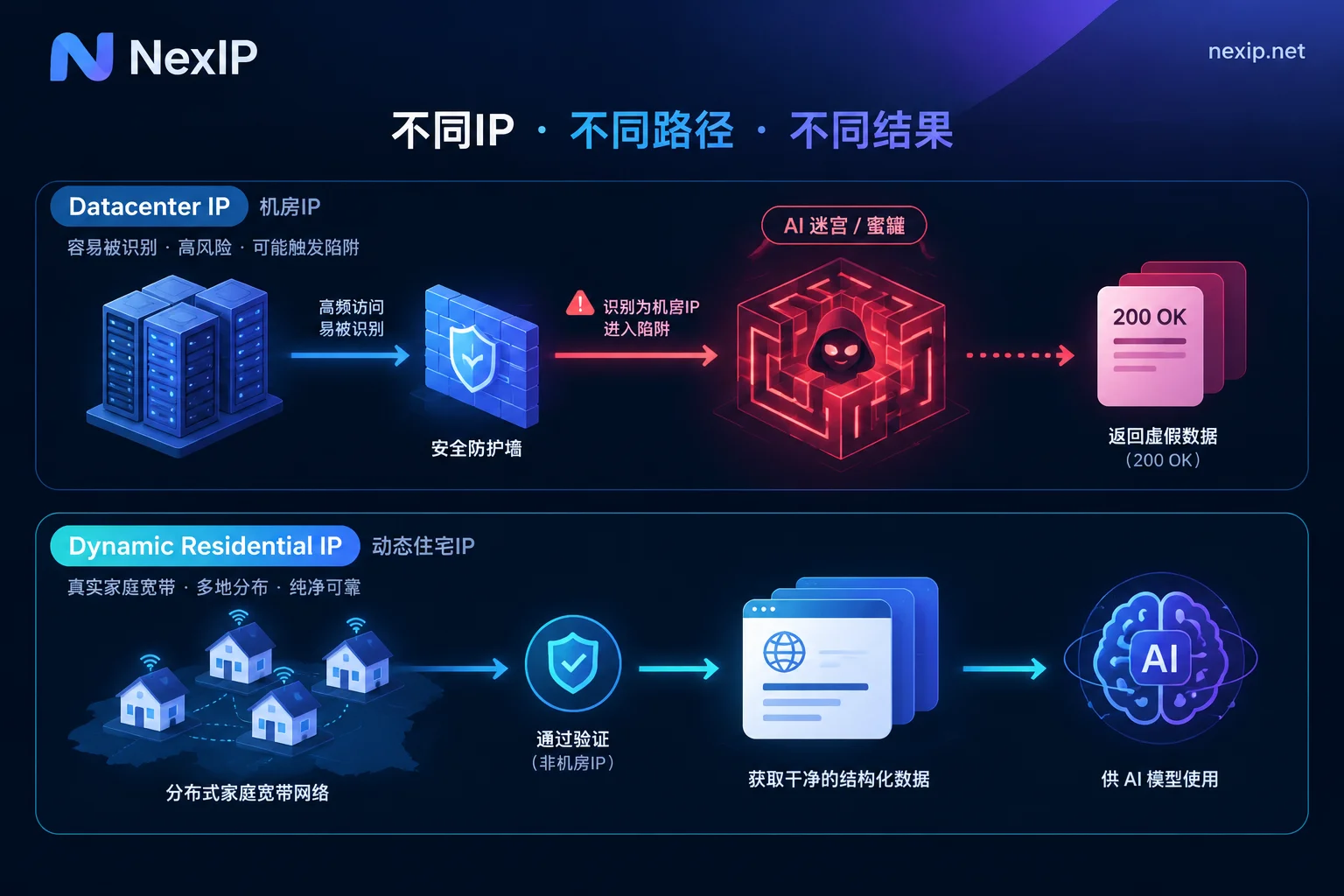
As automated traffic continues to climb (according to Imperva's "2026 Bad Bot Report," automated traffic accounts for over 53% of all web traffic; HUMAN Security's benchmark report also shows web scraping requests surged 47% in a year), the defense strategies of major security vendors have changed. Take Cloudflare's popular AI Labyrinth as an example: when risk control identifies uninvited automated scraping or low-reputation exits, it no longer directly blocks with errors but uses generative AI to dynamically inject hidden links and realistic fake pages, leading crawlers into endless dead ends.
For traditional crawlers, this only wastes bandwidth and compute; but for RAG (Retrieval-Augmented Generation) systems and AI Agents that rely on external real-time information and autonomous task execution, the fake data retrieved directly pollutes the knowledge base and induces severe model hallucinations.
To ensure AI data pipelines get clean, real web content, besides content validation at the parsing layer, a more critical step is to switch the network exit to high-reputation dynamic residential IPs before sending requests.
I. Why Can't Traditional Datacenter Exits Support AI Agent Clusters?
Three years ago, running a script to scrape a few hundred static pages with cheap datacenter IPs and random delays was sufficient. But in AI workflows, request characteristics have fundamentally changed:
- High-concurrency fan-out: When a user asks a complex question to a Deep Research application or RAG assistant on the frontend, the backend decomposes it into dozens of sub-queries within seconds and concurrently requests search engines, news sources, e-commerce sites, or vertical communities.
- Real browser interactions: Modern AI Agent frameworks (such as agents built on Playwright or Browser Use) typically drive headless browsers to perform multi-step actions like clicks, page navigation, and form filling.
Datacenter IPs have highly concentrated and publicly transparent ASN (Autonomous System Number) ownership. The target site's WAF doesn't even need to analyze your TLS fingerprint or mouse trajectory; simply based on the ASN attribute of the exit IP range (hosting instead of isp), it can directly tag the request as high-risk. The response may be a downgraded, stripped-down page, or the request may be thrown into the "AI Labyrinth" to consume your token budget. For how to verify the underlying ownership of an exit, refer to our previous guide on how to check if an IP's ASN belongs to an ISP.
In contrast, dynamic residential IPs come from real home broadband networks and belong to major local ISPs. Distributing high-concurrency Agent requests across a large pool of real residential nodes makes these accesses appear more like ordinary home users scattered across various locations to the target site, thereby greatly reducing the probability of triggering silent risk control at the entry layer.
II. Single-Step Retrieval vs. Multi-Step Interaction: How to Configure Rotation and Stickiness for Dynamic Residential IPs?
In AI application solutions, web access at different stages has completely different requirements for session continuity. After obtaining dynamic residential proxies, you cannot use the same rotation logic for all tasks; the key is to distinguish the applicable boundaries of "per-request rotation" and "sticky sessions":
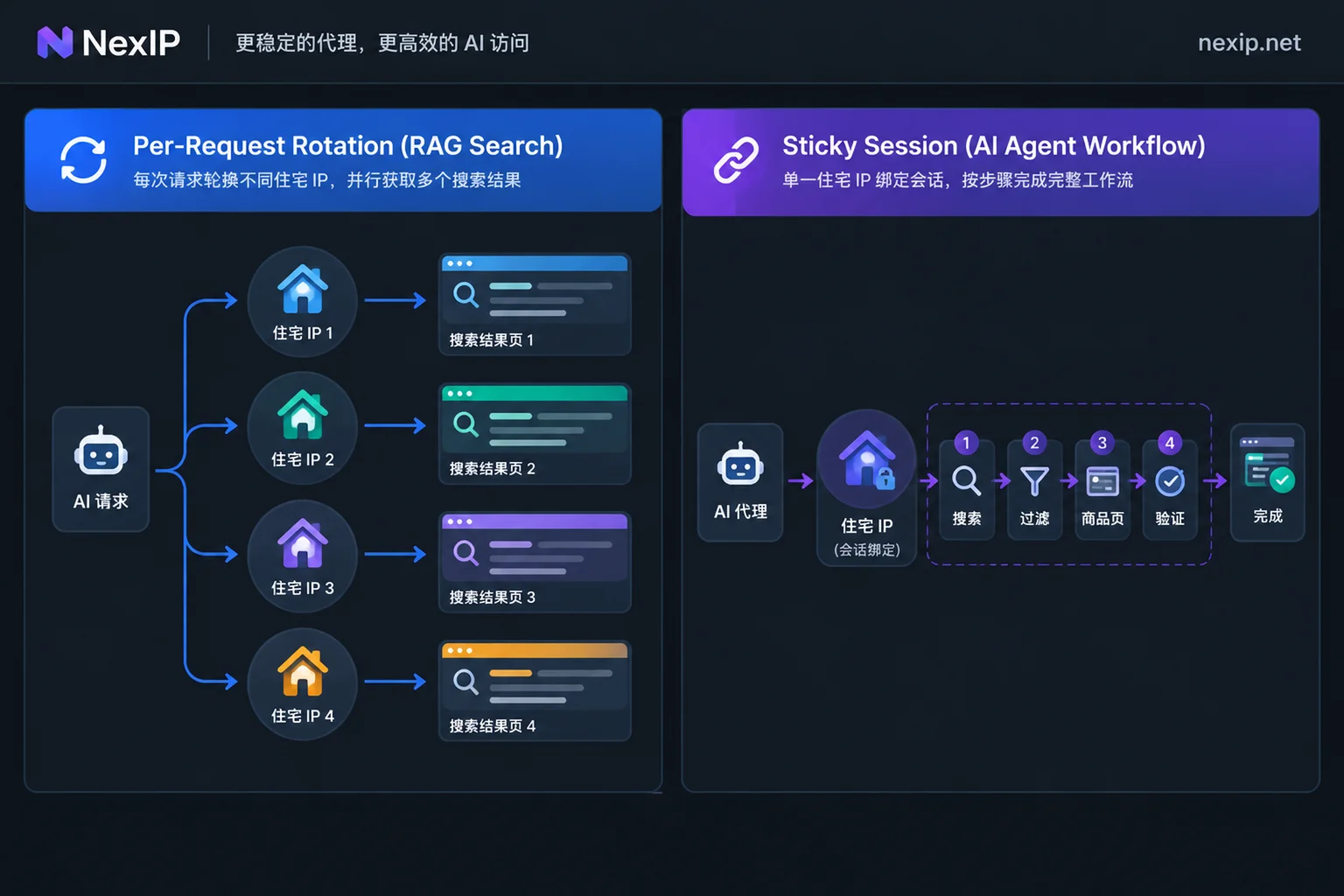
1. Public Corpus Scraping and RAG Real-Time Search: Use "Per-Request Rotation"
When the task is batch scraping public encyclopedias, news articles, product detail pages, or performing SERP monitoring to feed search results in real-time to the LLM, there is no contextual state dependency between pages.
- Configuration strategy: Enable per-request rotation. Each HTTP request extracts a new residential exit from the dynamic pool, maximizing the dispersion of request density and avoiding hitting the site's rate limit due to high request frequency from a single IP.
2. AI Agent Multi-Step Web Operations: Use "Sticky Sessions"
If the AI Agent's task is "open a price comparison site → enter ZIP code → filter in-stock items → click into detail page to verify shipping," this is a typical stateful multi-step workflow. If the exit IP suddenly jumps from New York to Dallas when clicking the next page, the site's server detects a sudden change in the IP or geolocation bound to the session, immediately clearing the filter state or even popping up a verification challenge.
- Configuration strategy: Enable sticky sessions. Keep the same residential IP exit for the same Agent instance during the entire set of actions, then release and switch after the task is complete. (Readers who want to delve into the underlying mechanism can read Is session stickiness the same as static IP and How often should dynamic IPs be changed.)
3. Regional Content Alignment: Target by Country/City/ISP
Much public information has strong regional attributes—the same search term or product link shows completely different inventory, pricing, and recommendation rankings in London, Tokyo, and Los Angeles. When configuring proxies, utilize the targeting capabilities of dynamic residential proxies to lock the exit by country, city, or even local ISP/ASN of the target business, ensuring the context retrieved by the AI matches the real physical perspective of the target user.
III. AI Data Pipeline Selection: By Traffic or Bandwidth? Dynamic or Static?
When actually building or scaling AI data infrastructure, engineering teams usually need to optimize the combination of billing models and IP attributes. According to NexIP's product matrix, you can match the following logic:
| AI Business Scenario | Load and Session Characteristics | Recommended Product Type | Key Configuration Points |
|---|---|---|---|
| AI Agent on-demand retrieval, training corpus expansion, RAG Q&A verification | Requests triggered in bursts by user queries or scheduled tasks, high concurrency fluctuations, controllable data volume per transmission | Dynamic Residential Proxy · Traffic Plan | Billed by traffic (GB); use per-request rotation for public pages, sticky sessions for multi-step browsing |
| 7×24 all-weather sentiment monitoring, real-time inventory tracking, high-frequency API polling | Continuous operation, stable throughput and online all day, traffic-based billing easily overspends | Dynamic Residential Proxy · Bandwidth Plan | Billed by port bandwidth, unlimited traffic (fair use); supports automatic rotation or sticky sessions |
| Temporary account verification, payment process testing, API integration | Need to exclusively use a fixed ISP exit for closed-loop testing within hours or days | Static Residential Proxy · Short-lived IP | Hourly or daily rental, billed by IP, exclusive static residential exit, unlimited traffic |
| Long-term maintenance of overseas AI platform account login state, fixed identity operations | Require a fixed home broadband exit for months or even a whole year, strictly no frequent IP changes | Static Residential Proxy · Long-lived IP | Monthly or yearly exclusive fixed exit, optional residential native/broadcast and native dual ISP, free replacement if invalid |
If your team is struggling with how to calculate collection budget more cost-effectively, you can first read this article on how to choose between traffic-based and bandwidth-based billing, and plug in concurrency peaks, average page size, and daily runtime to do the math.
Here's a common pitfall to note: Do not use dynamic residential IPs to log into AI platform developer backends or high-value subscription accounts that require long-term maintenance. The design purpose of dynamic pools is to disperse request identities for public data collection; account management requires long-term stable network reputation. For such scenarios, be sure to switch back to static residential long-lived IPs and ensure dedicated IPs for dedicated accounts (see Which is better for scraping: static residential IP or dynamic residential IP).
IV. Engineering Integration and Troubleshooting Recommendations
When integrating dynamic residential proxies into Playwright, LangGraph, or self-built crawler clusters in your code, paying attention to the following engineering details can significantly reduce invalid retries:
- Flexibly choose access and authentication methods: NexIP supports
HTTP/HTTPS/SOCKS5all protocols. When scheduling Agents in containerized or serverless environments, you can use username/password authentication with parameters (passing country, city, or sticky session identifiers in the username), or configure IP whitelist authentication on a fixed gateway server, and distribute directly to downstream worker nodes via API extraction or port forwarding. - Eliminate redundant static resources: AI training and RAG retrieval typically only need the core HTML text or JSON API data of the page. Even with the dynamic traffic plan, intercepting the loading of images, videos, font files, and ad scripts at the headless browser layer can compress per-page traffic consumption by over 70% and significantly shorten the Agent's page wait time.
- Establish response-layer exception triage: When scraping quality drops, don't blindly retry infinitely. First check the text entropy and DOM structure characteristics of the returned content at the response layer to distinguish whether it's a target site redesign, rate limiting, or a fake page like AI Labyrinth triggered, then switch exit nodes or adjust session duration accordingly (for specific troubleshooting processes, refer to When scraping success rate suddenly drops, check the exit first or the target site first).
- Use sub-accounts for team and business isolation: If your team is running multiple lines such as RAG real-time retrieval, competitor price comparison, and SEO monitoring simultaneously, it is recommended to create independent sub-accounts via the user dashboard panel or API, isolating traffic quotas and exit credentials for different projects, making it easier to calculate the true cost per effective request by business line.
Whether you are building a real-time external knowledge base for large models or configuring a highly available web access layer for multi-agent workflows, choosing clean residential exits is the first line of defense for data quality. You can directly visit the NexIP AI Industry Solution Page to view complete architecture recommendations, or log in to the NexIP User Dashboard to obtain test credentials and integration documentation, and quickly integrate the real global dynamic residential network into your data pipeline.


Comments(0)