 NexIP官方博客
In 2026, competition in Southeast Asia's e-commerce market has entered a white-hot phase. According to recent industry data, TikTok Shop's combined visits across six core markets—Indonesia, Vietnam, Malaysia, the Philippines, Thailand, and Singapore—are already approaching those of Shopee, and in Malaysia, Indonesia, and Vietnam, traffic between content commerce and traditional shelf-based commerce is nearly at parity. At the same time, the three major platforms—Shopee, Lazada, and TikTok Shop—have fully tightened operational compliance and risk-control review standards in 2026: from local store qualification verification and multi-store anti-association detection to geo-based traffic distribution for short-video accounts, "whether the network egress carries genuine characteristics of local Southeast Asian residential broadband" has become the first threshold determining store survival and data collection efficiency.
Yet many cross-border teams still remain at the crude stage of "as long as the IP's geolocation shows Southeast Asia, it's fine" when purchasing Southeast Asian residential IPs, even using Singapore data-center IPs to batch log in to local stores in Vietnam or Indonesia—only to run into frequent secondary verification, zero-play throttling, or even linked account bans.
Southeast Asia is far from monolithic: the basic telecom operator (ISP) landscape, routing infrastructure, and platform risk-control sensitivity differ enormously across the six countries. This article starts from the real-world cross-border needs of Southeast Asia in 2026 and breaks down how to configure compliant, stable Southeast Asian residential IPs for your team by site and by business scenario.
I. Why Can Southeast Asian Operations No Longer Use "Generic Data-Center IPs" or "Mixed Nodes"?
In the 2026 platform risk-control system, network-layer verification has long gone beyond simple GeoIP country database matching and evolved into compound detection of ASN ownership type, ISP registration attributes, and network request path consistency:
- Local vs. cross-border store locality isolation requirements: Whether it's a Shopee local store or a TikTok Shop country site, the platform checks whether the login IP's ASN (Autonomous System Number) belongs to a genuine local civilian broadband operator (for example, Malaysia's TM Unifi, Vietnam's Viettel or VNPT, Thailand's AIS or True Internet). If you persistently use IPs registered as Hosting (data center) to log in to the backend, you are highly likely to be flagged as non-natural-person operation or off-site agency operation. For how to self-check an IP's underlying attributes, see our previous article: How to Tell Whether a WHOIS Lookup Shows a Data Center or Home Broadband.
- The anti-association red line for multi-store matrices: Southeast Asian sellers commonly adopt a "multi-site + store cluster" or "main store + creator matrix accounts" strategy. Logging in to multiple stores on the same platform under the same IP, or using low-quality shared proxies used by many people, means that once one account violates rules, it can easily trigger linked bans. To understand the underlying risk difference between shared and dedicated IPs, we recommend reading: Can a Shared IP Get Your Account Banned Due to Someone Else's Account?.
- Geographic anchoring by content recommendation algorithms: On platforms that rely on recommendation algorithms such as TikTok, the IP used for account registration and daily posting/livestreaming directly affects how the system determines the account's audience pool. Only by using native home broadband egress with high purity and a location strictly consistent with the registration location can you ensure content is precisely pushed to local consumers in Indonesia, Thailand, or Vietnam.
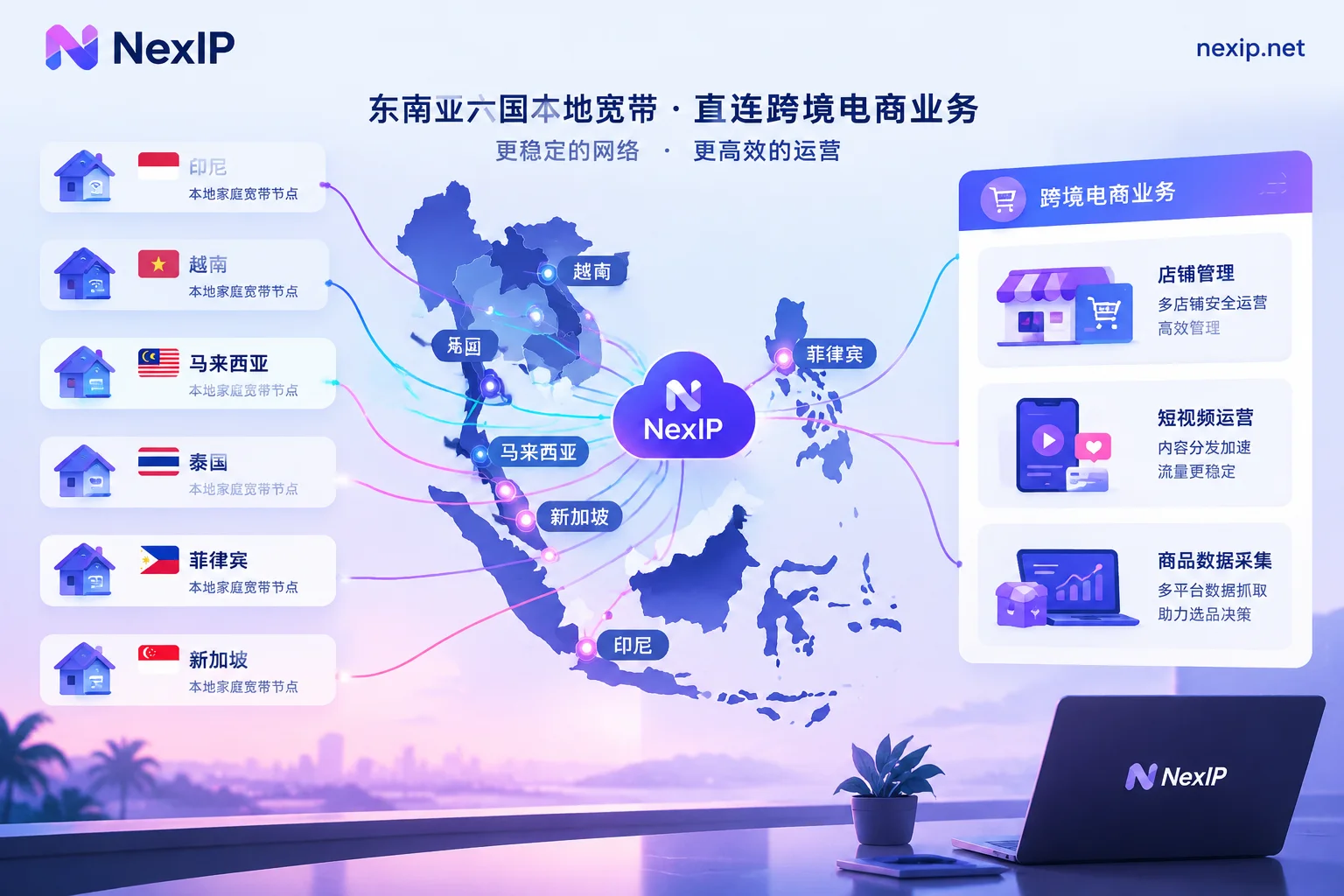
II. Residential IP Demand Characteristics and Selection Priorities for the Six Core Southeast Asian Countries
Internet infrastructure and IP resource scarcity differ across Southeast Asian countries, so proxy egress configuration must be tailored to local conditions:
- Indonesia & Vietnam (high-growth, strict risk-control zones): As the two fastest-growing markets by visits in Southeast Asia, platform scrutiny of local accounts in Indonesia and Vietnam is the strictest. For TikTok main accounts or high-revenue core stores operating these two sites, it is strongly recommended to prioritize native home broadband IPs from mainstream local operators and avoid cross-city jumps.
- Malaysia & Thailand (content commerce and branding strongholds): Livestream selling and short-video seeding conversion rates in Malaysia and Thailand are extremely high, and they are also the main battlegrounds for refined multi-brand operations. Such markets have high demands on network stability and uplink/downlink throughput, making dedicated static long-term egress suitable, with "one store, one fixed IP."
- Singapore (regional hub and high-ticket market): Singapore has advanced network infrastructure, but the market is flooded with cloud vendor data-center IPs labeled as Singapore. If you are doing local Singapore social media or store operations, be sure to verify whether the ASN is a genuine ISP attribute (see How to Check Whether an IP's ASN Belongs to an ISP), and never use ordinary cloud server IPs as residential IPs.
- Philippines (frequent big promotions and an emerging traffic pool): The Philippines site has dense promotion nodes (such as the Christmas season promotion warm-up that starts as early as September), with strong demand for product price comparison, bestseller ranking scraping, and creator data monitoring—making it very suitable for pairing with high-concurrency dynamic residential proxies for public data collection.
If you want to learn about specific network coverage, available local operators, city nodes, and supported popular platforms in each Southeast Asian country, you can directly view NexIP Global Country and Region Coverage Details.
III. Match by Business Scenario: How Should Southeast Asian Residential IPs Be Configured?
In actual business, "account nurturing and store management" and "data collection" have completely opposite IP requirements (see Static vs. Dynamic IPs for Account Nurturing). NexIP strictly divides its proxy product lines by scenario to help Southeast Asia-focused teams precisely control cost and risk:
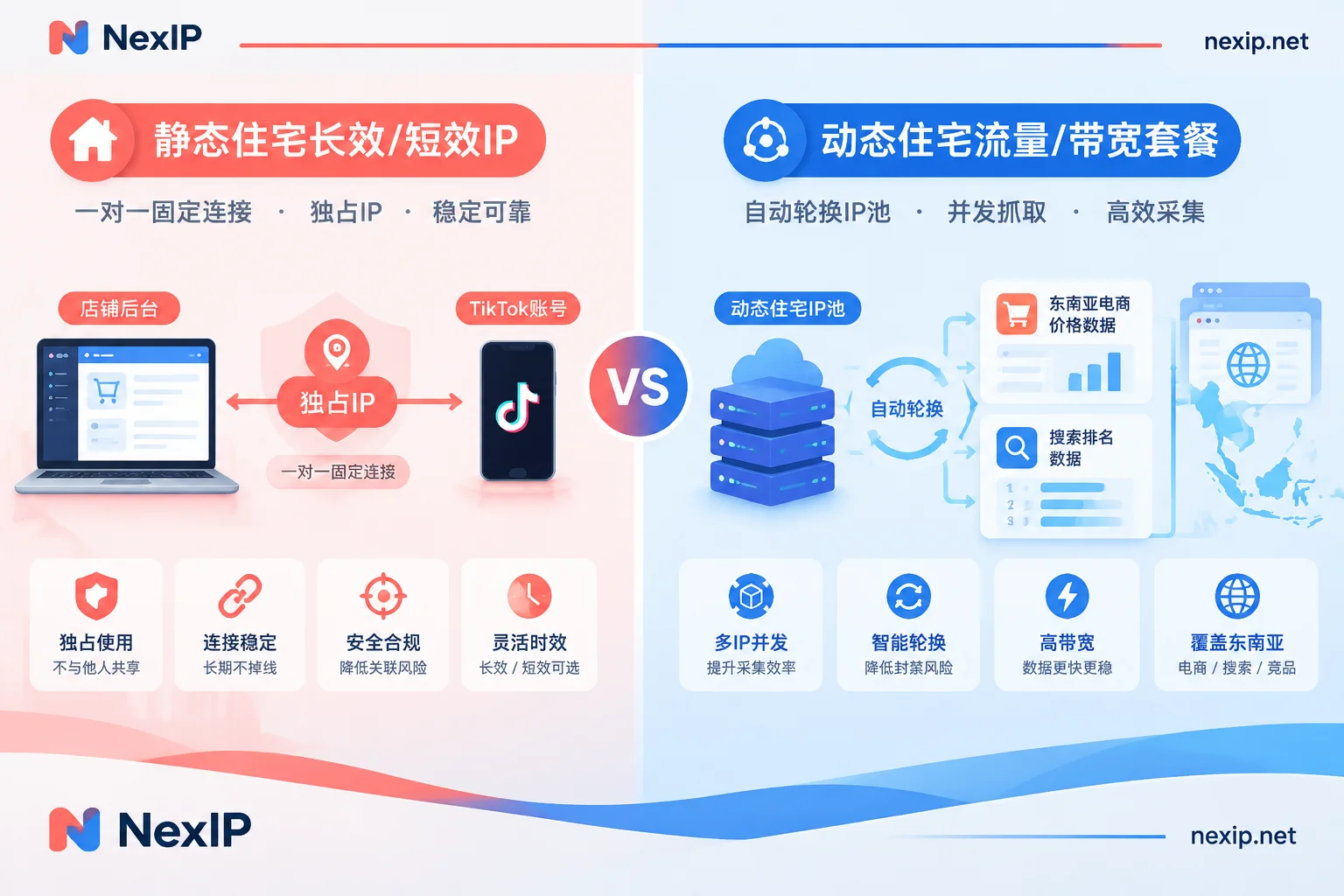
1. Store Backend Management, Cross-Border E-commerce, and TikTok Matrix Operations: Static Residential Proxy · Long-Term IP
For Shopee, Lazada, and TikTok Shop store backends, as well as long-term operation of overseas social media such as Facebook and Instagram, the core requirements are "fixed egress, one person/one store/one IP, long-term stability without disconnections."
For such scenarios, choose NexIP Static Residential Proxy · Long-Term IP. It provides exclusive fixed egress billed monthly or annually, with unlimited traffic, supports native dual-ISP attributes, and offers free replacement if the IP fails. For specific subtype selection, you can tier your configuration according to account weight:
- Core main stores and TikTok operations: For high-value boutique stores or TikTok account operations, the official site recommends native home broadband IPs within the static long-term category (real home broadband IPs allocated directly by local Southeast Asian ISPs), so that each account is permanently bound to one native egress, staying as close as possible to the local natural-person network environment.
- Ordinary matrix stores and routine backends: If budget is limited or for secondary store management, you can consider home broadband broadcast IPs (network segments registered as residential attributes and hosted in data centers via BGP). For the detailed underlying differences and trade-off logic between the two, see How to Choose Between Native Home Broadband and Home Broadband Broadcast.
2. Short-Term Account Verification, Payment Integration Testing, and Temporary Testing: Static Residential Proxy · Short-Term IP
If you don't need monthly account maintenance and only temporarily need a fixed local Southeast Asian ISP residential egress to complete local payment gateway testing, initial account verification, or short-term business integration, you can use NexIP Static Residential Proxy · Short-Term IP. It is likewise an exclusive fixed static residential (ISP) IP with unlimited traffic, but supports flexible hourly or daily rental—stop when done, avoiding long-term idle waste.
3. Southeast Asian E-commerce Price Comparison, SERP Monitoring, and Ad Verification: Dynamic Residential Proxy
When your data team needs to scrape competitor prices and reviews from Shopee/Lazada's six country sites, monitor Google local search rankings (SERP) in Southeast Asia, verify landing pages for Meta or TikTok overseas ad campaigns, or collect multilingual Southeast Asian corpora for AI applications and LLM RAG pipelines, a fixed IP can instead easily trigger rate limits on target websites.
In this case, you should use a dynamic residential IP pool composed of real home broadband, with precise targeting by country, city, ASN, or local ISP:
- Traffic-based billing (suitable for fluctuating, high-concurrency discrete collection): Choose Dynamic Residential Proxy · Traffic Plan, billed by GB, supporting automatic IP rotation per request or sticky sessions—ideal for e-commerce price comparison collection, ad verification, and SEO monitoring.
- Bandwidth-based billing (suitable for stable-throughput tasks running 24/7): If your system needs uninterrupted round-the-clock Southeast Asian sentiment monitoring, bestseller inventory tracking, or high-frequency API polling, choosing Dynamic Residential Proxy · Bandwidth Plan is more cost-effective (for detailed billing calculation methods, see: Proxy IP Billing: By Traffic or By Bandwidth).
More configuration ideas segmented by e-commerce, brand protection, and social media platforms can also be found in NexIP Industry and Platform Solutions.
IV. Practical Advice for Team Onboarding and Daily Risk Control
After choosing the right type of Southeast Asian residential IP, there are three things to pay attention to at the team execution level to prevent operational mistakes from planting hidden risks:
- Choose matching access and authentication methods: NexIP supports HTTP, HTTPS, and SOCKS5 protocols across the board, offers username/password authentication and IP whitelist authentication, and supports four access methods: API extraction, username/password configuration, port forwarding, and process proxy. Cross-border operations teams can typically configure static long-term IPs via username/password mode directly into the independent browser environments they use daily; scraper and developer teams can seamlessly integrate dynamic proxies into collection architectures via API or port forwarding (for architecture design, see Crawler Proxy IP Access Architecture Design).
- Implement sub-account permission isolation: When multiple stores or multiple small teams work together, never let everyone share the same proxy list. Use the sub-account management features in the official dashboard or client to assign static IPs for different countries and stores to designated owners, achieving "dedicated fixed egress for dedicated personnel" (further reading: How to Configure Proxy IP Permissions for Team Collaboration).
- Never let fixed egress jump frequently: For Southeast Asian local stores bound to static long-term IPs, keep the network egress stable during daily operations—avoid using a Kuala Lumpur node in the morning and switching to a Hanoi node in the afternoon. Once the platform detects abnormal location drift, it can easily trigger identity re-verification.
Conclusion
To strike gold in Southeast Asia in 2026, what matters is not only supply chain and content creativity but also the compliance and stability of underlying infrastructure. Assign public data collection to on-demand rotating dynamic residential IPs, and assign core stores and TikTok accounts to exclusive fixed static long-term native home broadband IPs—only then can you safeguard your assets during a cycle of tightened platform risk control.
You can visit the NexIP User Dashboard at any time to register an account, check real-time residential IP inventory across Southeast Asian countries, test network connectivity, and consult the complete integration documentation.


Comments(0)