 NexIP官方博客
In cross-border e-commerce, social media matrix operations, or overseas business operations, many teams encounter a strange phenomenon: after purchasing a proxy, they immediately check it with third-party detection tools, and the page clearly labels it as ISP or Residential (residential attribute), with a low fraud score. But once they attach their accounts, TikTok videos still get stuck at zero views, store backends pop up with secondary verification within a few days, and even normal logins to AI tools frequently trigger human-machine interception.
Since it's already a "residential attribute," why can platform risk control systems still see through it at a glance?
The problem often lies in the physical source and announcement method behind the "residential attribute." With the upgrade of risk control models on major platforms, it's hard to pass with just surface-level registration labels. To solve this issue, we first need to understand the fundamental network logic differences between native home broadband and broadcast home broadband.
1. Both Show "ISP" – What Other Metrics Does Platform Risk Control Examine?
Many basic detection tools only read the Usage Type (usage type) field from a single IP database. As long as the subnet is registered as a residential broadband operator in the registry, the tool determines it as a "residential IP." However, risk control engines of large e-commerce platforms, short video apps, and financial payment systems perform multi-dimensional cross-verification:
- Consistency between registered location and physical routing: Platforms not only check which country the WHOIS registration is in, but also use network latency characteristics, BGP routing paths, and connection attributes of peer nodes to determine whether the IP is actually running in the local operator's physical network (for basic information verification, refer to our article How to Tell if WHOIS Shows a Data Center or Home Broadband).
- Announcing entity (ASN) and hosting environment: Is a residential subnet directly distributed to end-home users by a local broadband operator, or is it announced in a rack of a multinational data center? (For specific autonomous system verification logic, see How to Check if an IP's ASN Belongs to an ISP).
- Multi-database comparison: Mainstream platforms often simultaneously trust three to five commercial geolocation and threat intelligence databases. If an IP range shows as US home broadband in database A, but in database B shows a location offset due to recent cross-region routing adjustments, the risk control system will directly tag the session as "suspected proxy or relay."
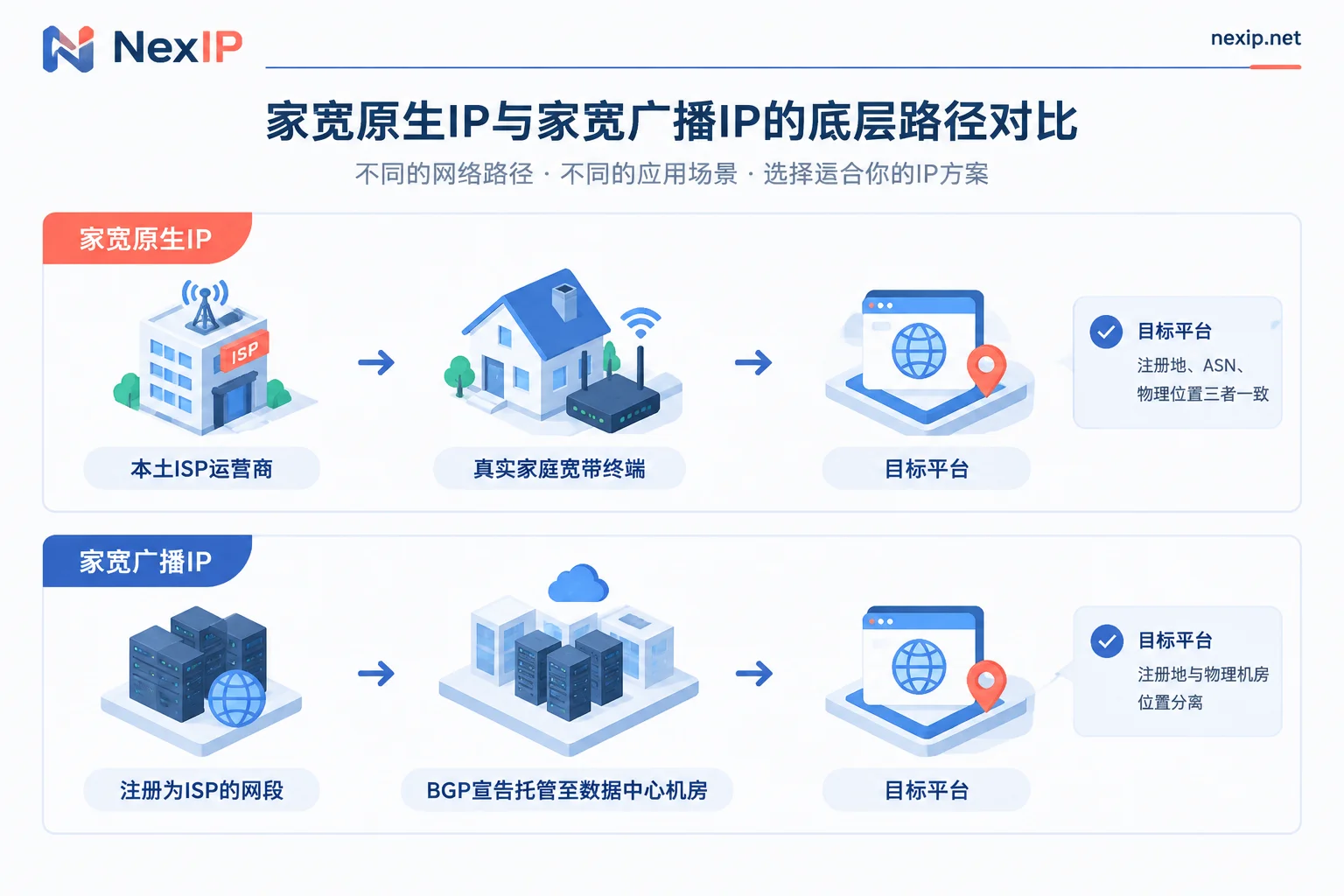
This leads to the two types of subdivided resources commonly discussed in the industry: native residential IPs and broadcast residential IPs.
1. Native Residential IP (Native Home Broadband IP)
A native residential IP is an address directly assigned by the local Internet Service Provider (ISP) of the target country or region to home broadband terminals. Its IP registration country, ASN owning operator, and actual physical exit location are completely consistent. From the platform's perspective, requests initiated through such exits have no difference in network characteristics from local ordinary residents connecting to Wi-Fi at home to browse phones or log into backends, and naturally enjoy high trust weight.
2. Broadcast Residential IP
A broadcast residential IP's subnet also belongs to residential (ISP) in registration attributes, but it does not directly run on local residents' home routers. Instead, it uses BGP (Border Gateway Protocol) to announce and host a residential subnet originally registered in one location within a data center.
The advantage of this approach is more stable power and international bandwidth in the data center, flexible management, and relatively controllable costs; however, in the face of strict risk control that highly values "local real geographic location and local access networks," its routing path differs from pure home broadband.
2. Which Businesses Must Stick to "Native Residential IPs"?
Having understood the fundamentals of both, it's clear that not all businesses need to buy the most expensive resources across the board. But for the following high-sensitivity scenarios, using the wrong exit often means directly damaging account assets (for a comprehensive parameter breakdown of fixed exits, you can read How to Choose Static Residential IPs together).
1. TikTok Operations and Localized Content Distribution
TikTok's recommendation algorithm and risk control mechanisms have extremely high requirements for the local nativeness of network exits. If using data center ranges or cross-region subnets with questionable attribution, the system easily categorizes accounts into non-natural-person traffic pools, manifesting as new accounts' videos getting zero views for a long time, or live stream pushes being interrupted.
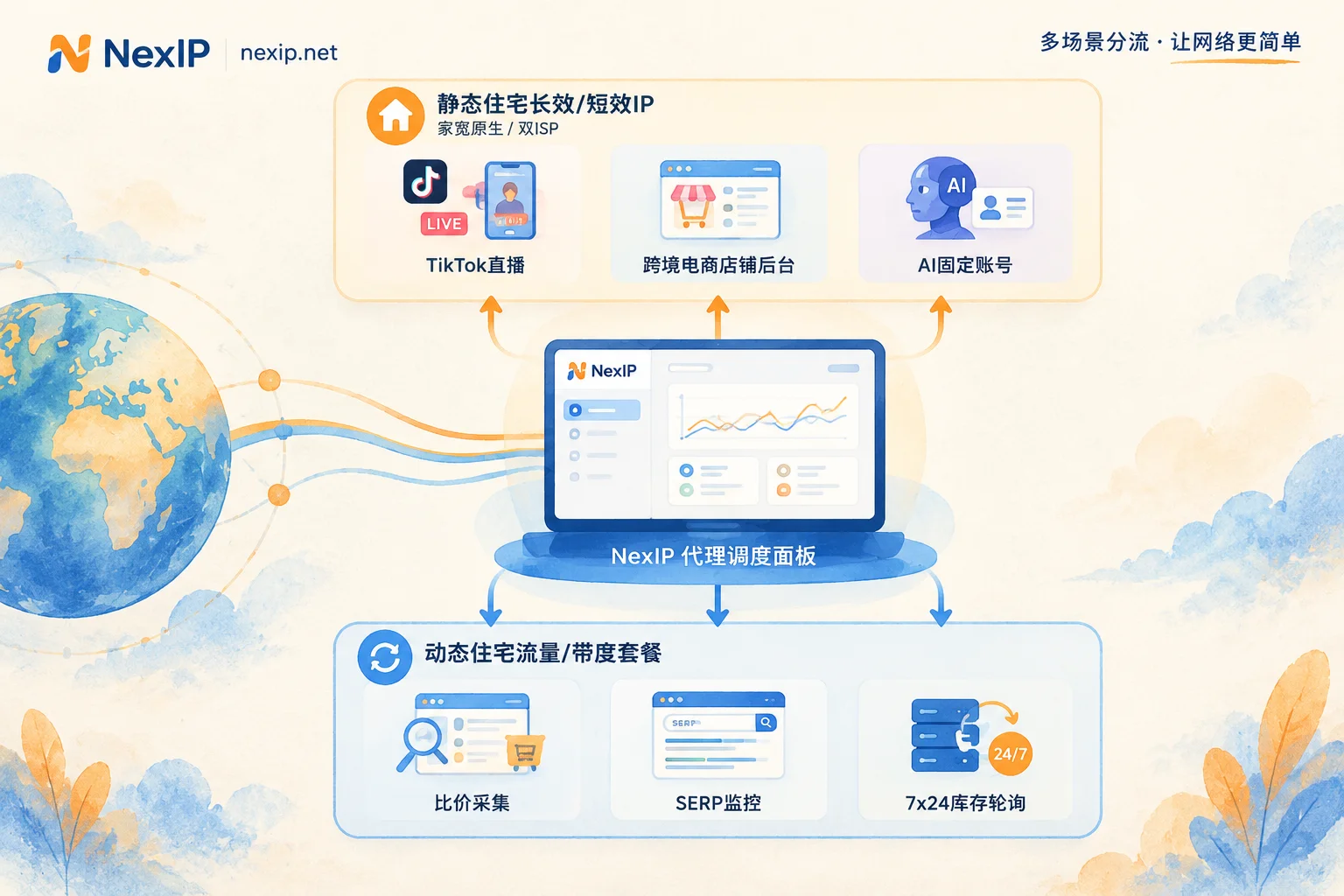
For such scenarios, when configuring TikTok operation solutions, it is recommended to directly use native home broadband IPs from Static Residential Proxy · Long-term IP, and strictly implement the isolation principle of "one account, one fixed IP." For main sales accounts or core matrix accounts, you can further select long-term exits supporting native dual ISP, leveraging dual operator attributes to ensure stability for long-term account nurturing and daily operations.
2. Cross-border E-commerce Main Stores and Payment Backends
When reviewing store environments, Amazon, TikTok Shop, and various overseas payment tools are most wary of exit drift and data center hosting characteristics. For core stores that need long-term maintenance on a monthly or yearly basis, exclusive fixed static long-term native home broadband IPs can help accounts accumulate stable local login reputation; even if rare unavoidable node fluctuations occur, NexIP's static long-term packages support free replacement upon failure, avoiding operational interruptions.
For registering new stores, short-term card binding verification, or payment interface integration by development teams, where monthly environment nurturing is not needed, you can choose Static Residential Proxy · Short-term IP billed by hour or day as needed. It also provides exclusive fixed static residential (ISP) exits with unlimited traffic, and stops when no longer needed.
3. Long-term AI Account Survival and Advanced Tool Invocation
Besides e-commerce and social media, many teams need to maintain login states of overseas AI accounts for a long time. Frequent region changes or using cheap data center exits easily triggers account bans. In AI application solutions, binding AI accounts that require fixed identities to static long-term native exits can greatly reduce the interference of secondary verification.
3. Put the Right Exit into the Corresponding Business Basket
Since native residential IPs have obvious advantages in risk control, are broadcast residential IPs and dynamic residential proxies useless? On the contrary, a reasonable network architecture emphasizes cost allocation according to risk control levels:
| Business Requirement Type | Platform Risk Control Focus | Recommended NexIP Product Line | Core Configuration Logic |
|---|---|---|---|
| TK account nurturing / core e-commerce stores / long-term AI accounts | Local real home broadband attribution, ASN consistency, long-term fixed without jumps | Static Residential Proxy · Long-term IP (choose native home broadband / native dual ISP) | Monthly/yearly exclusive fixed exit, unlimited traffic, one account one fixed IP |
| Routine store daily management / non-extreme local verification backends | Requires fixed residential (ISP) identity, higher tolerance for data center hosted routing | Static Residential Proxy · Long-term IP (choose broadcast home broadband) | Has residential registration attributes, balancing fixed identity and long-term connection cost-effectiveness |
| Short-term account verification / payment testing / interface integration | Requires clean exclusive static ISP identity in the short term | Static Residential Proxy · Short-term IP | Hourly or daily lease, billed per IP, unlimited traffic |
| Price comparison scraping / ad verification / SEO monitoring / AI corpus crawling | Single IP request frequency, real home exit rotation, city-level targeting | Dynamic Residential Proxy · Traffic Package | Billed per GB, supports per-request rotation or sticky sessions |
| 7×24 public opinion monitoring / real-time inventory tracking / high-frequency API polling | Continuous stable high throughput, automatic rotation to prevent blocking | Dynamic Residential Proxy · Bandwidth Package | Billed per port bandwidth, unlimited traffic (fair use) |
As can be seen, tasks like public web scraping, ad display verification, and AI Agent real-time web retrieval do not need to pay for "long-term fixed" single IPs at all. Instead, they should tap into dynamic residential pools and rely on massive real home exits for rotation or stickiness.
4. Practical Implementation: How to Quickly Select and Access Exits in Target Regions?
In actual deployment, it is recommended that teams organize network exits according to the following three steps:
- Check target market and operator inventory: Different sites have different local mainstream broadband providers (e.g., the US, UK, Japan, South Korea, and Southeast Asia each have their own top local ISPs). Before ordering, you can check the Global Country and Region Coverage page to see local operators, available cities, and adaptation for popular platforms in the target country, and combine with specific Industry and Platform Solutions to clarify exit specifications.
- Choose access method according to business form: NexIP fully supports
HTTP,HTTPS, andSOCKS5protocols. When operations teams use multiple environments, they can directly fill in proxy parameters via username/password authentication or port forwarding; development and data teams can use IP whitelist authentication combined with API extraction and process proxy for automated scheduling. - Use sub-accounts for team permission isolation: If the team simultaneously runs a store operations group and a data scraping group, you can create sub-accounts in the NexIP user backend or client panel, and uniformly manage IP allocation and usage for different business lines through the panel and API, avoiding mixing scraping tasks into the static native exits of core accounts.
When your business again encounters "clearly showing as a residential IP but still being rate-limited," it's worth pausing the blind account switching and checking whether the exit in hand is a cross-region broadcast subnet or a true native residential IP that actually falls within the local operator's network. Assign high-risk-control accounts to static long-term native home broadband, and high-frequency scraping to dynamic residential pools, so that every bit of network budget is spent where it matters most.



Comments(0)