 NexIP官方博客
In daily work such as multi-store management for cross-border e-commerce, TikTok account matrix operations, and maintaining long-term login sessions for overseas AI productivity tools, "fixed network egress" has become standard infrastructure for teams. However, many operations and development teams still encounter pitfalls when purchasing static residential IPs: even though they bought dedicated static IPs, why do store backends still frequently trigger two-factor authentication? Why do TikTok videos get zero views? Why are they still blocked by risk control systems when binding cards for payment or maintaining long-term online status for AI accounts?
The problem often lies not in the word "static" but in the underlying IP's registration and announcement attributes (native residential broadband vs. residential broadband broadcast), ASN ownership (whether it is dual ISP), and mismatch between lease term and business cycle. This article starts from actual business scenarios and breaks down a refined selection framework for static residential IPs.
I. Why Is "Static Only" No Longer Enough? The Triple Verification of Network Egress by Platform Risk Control
In the past, many teams understood static IPs simply as "IP addresses that do not change." But in the eyes of modern platform risk control, a qualified fixed network egress must simultaneously pass verification in three dimensions:
- Exclusivity and history: Even if a shared egress has a fixed address, it can be contaminated by other users' concurrent requests or violations, damaging IP reputation (for the difference between shared and dedicated, see the article "How to Tell If the IP You Bought Is Truly Dedicated: First Clarify the Definition, Then Use Four Checks to Gather Evidence").
- ISP attributes and dual ISP verification: Risk control systems simultaneously check the IP's registration ownership (WHOIS) and routing announcement ownership (BGP ASN). When both dimensions point to a real Internet Service Provider (ISP), commonly known as native dual ISP, the platform will recognize it as a high-trust real home broadband environment (for specific verification methods, see "How to Check Whether an IP's ASN Belongs to an ISP: Look at the Announced ASN, Verify IP Block Ownership, and Compare Multiple IP Databases" and "How to Tell from WHOIS Whether It Is a Data Center or Home Broadband: Look at Registration Ownership, ASN Type, and Reverse DNS").
- Consistency of geographic location and attribution: Does the IP's registered country match the target site? If the IP block is announced via BGP to a local data center, businesses extremely sensitive to geographic location (such as localized short video streaming) may detect discrepancies.
II. Native Residential Broadband vs. Residential Broadband Broadcast: The Core Watershed of Static Long-Lasting IPs
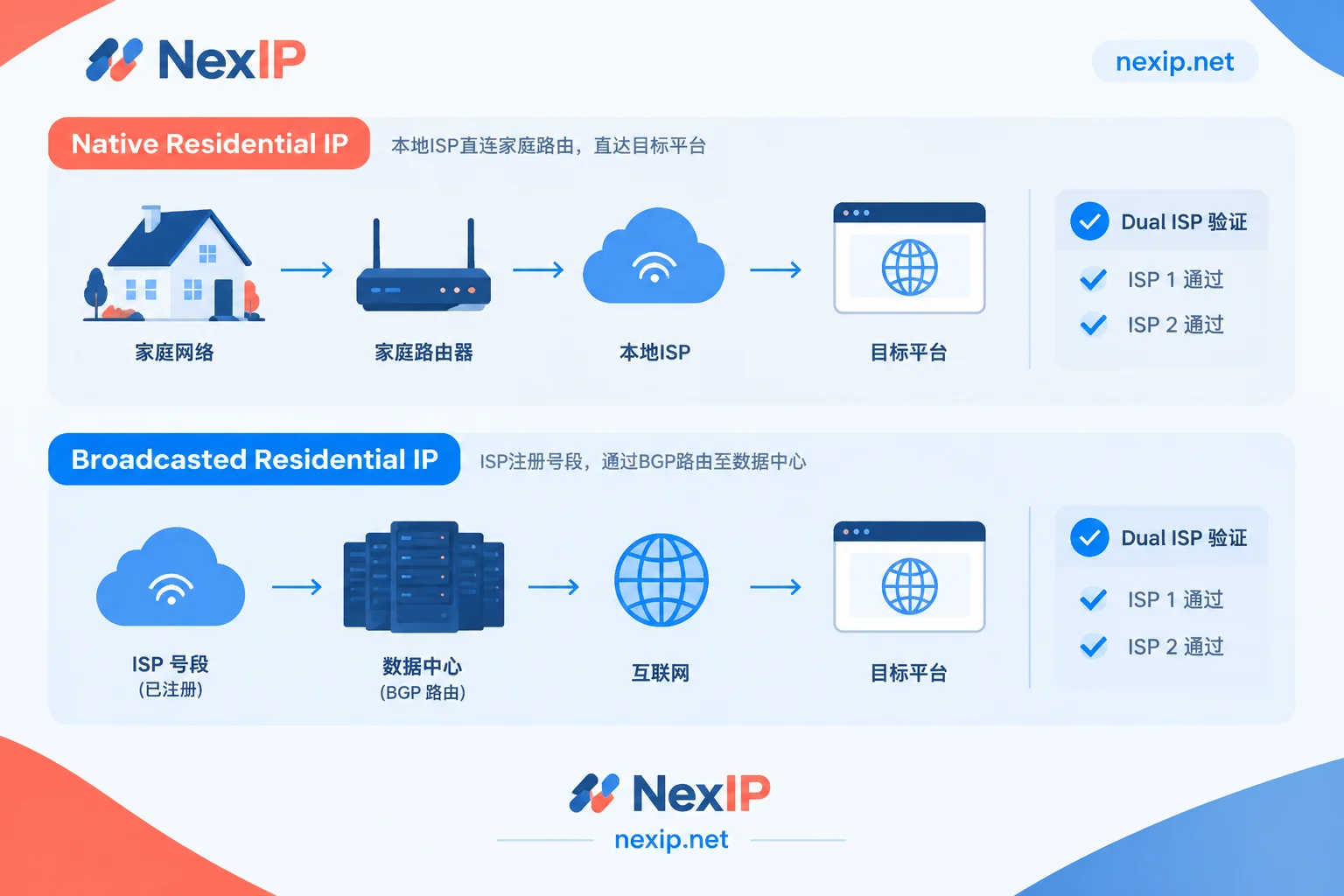
When choosing static residential proxies · long-lasting IPs billed monthly or annually, the most critical decision is distinguishing among three subcategories: "native residential broadband," "residential broadband broadcast," and "data center." For the underlying mechanisms of the first two, you can also directly view the official website's comparison of native residential broadband and residential broadband broadcast:
- Native residential broadband IP: Directly sourced from network resources allocated by local ISPs to home broadband, with registration location and actual usage location completely consistent, and supporting native dual ISP attributes.
- Residential broadband broadcast IP: The IP block itself is registered as residential (ISP), but is hosted and announced via BGP protocol in data centers in the target country or region. It also appears as residential ISP in most IP databases, while combining link stability and cost-effectiveness of data center hosting.
1. TikTok Operations and High-Risk Local Stores: Prefer Native Residential Broadband
When doing TikTok operations, the platform not only detects ASN type but also strictly verifies the IP's native attribution. The official solution clearly recommends: use native residential broadband IPs from static long-lasting options and strictly implement the "one account, one fixed IP" strategy to avoid association and zero-view risks from the network foundation. (If your team is expanding into Southeast Asian markets, you can plan egress for each site in conjunction with "How to Choose Southeast Asian Residential IPs: Proxy Egress Configuration from the Perspective of TikTok Shop and Shopee Six-Country Site Differences".)
2. Regular Cross-Border E-Commerce Backends and Daily Social Media Management: Mix Native or Broadcast as Needed
For regular cross-border store management and daily social media maintenance, the core requirement is "dedicated fixed egress + long-term online without jumping." If the target platform strictly verifies native registration location, configure native residential broadband directly; if you value connection response speed and cost control for daily backend operations more, residential broadband broadcast can also provide compliant residential attribute cover. In addition, NexIP's static long-lasting IPs are all unmetered and support free replacement upon failure, ensuring uninterrupted long-term operations.
3. Maintaining Long-Term Login Sessions for AI Accounts: Use Fixed Egress to Avoid Cross-Region Risk Control
In AI application scenarios, the responsibilities of network egress are very clear: if you are doing large model training corpus scraping, RAG real-time retrieval, or AI Agent access to public web pages, you should use dynamic residential proxies · traffic plans billed by GB (for related architecture, see "AI Agents and RAG Real-Time Retrieval Always Getting Fake Pages? Configuration Logic of Dynamic Residential IPs in AI Data Pipelines"); but if your team needs to maintain long-term login sessions for overseas AI accounts, frequent node switching can easily trigger platform security locks or even account bans. In this case, bind a dedicated static long-lasting IP so that each session originates from the same clean home broadband egress.
III. Static Short-Term vs. Static Long-Lasting: Don't Buy a Full-Month Plan for Temporary Tasks
Not all tasks requiring "dedicated fixed residential IPs" need to run across months. In the past, many developers doing short-term verification could only buy "sticky sessions" of dynamic residential proxies or reluctantly purchase long-lasting static IPs by the month. But as explained in "Are Session Stickiness and Static IPs the Same Thing: One Is Temporary Retention, the Other Is Fixed Allocation", sticky sessions are essentially temporary retention and may disconnect and change IPs at any time due to upstream home broadband re-dialing.
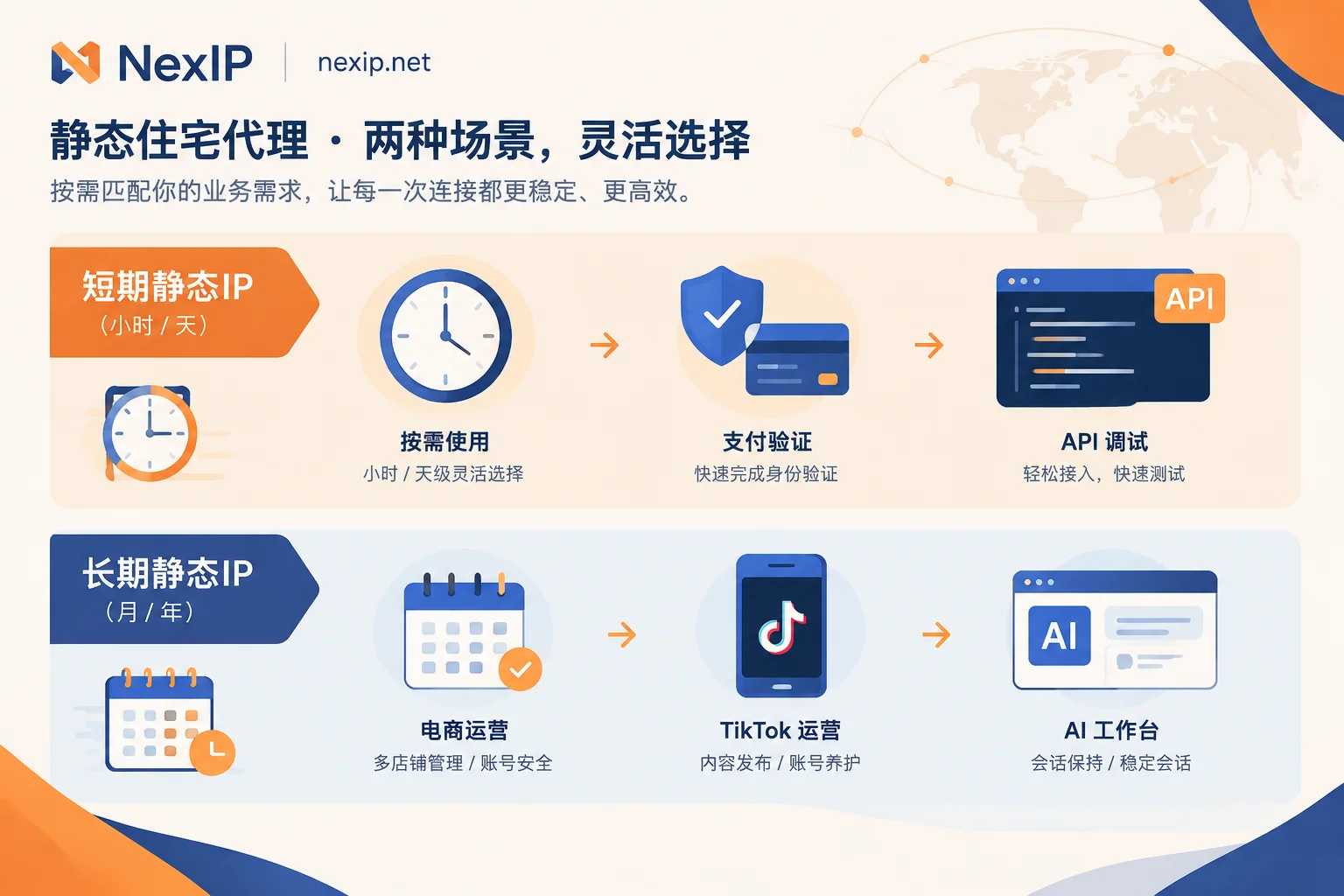
To fill this gap where "absolute fixed exclusivity is required during the lease term but monthly renewal is not needed," NexIP offers static residential proxies · short-term IPs billed by hour or day:
- Account verification and payment verification: When completing one-time or phased account security verification, billing address and payment channel verification, you need an absolutely clean dedicated static residential (ISP) IP that will not drift at all for several hours or days.
- Development testing and API integration: When R&D teams launch new cross-border business modules or test network compatibility for specific countries/operators, rent fixed ISP egress by day with unmetered traffic and per-IP billing; release it after integration testing, greatly reducing testing costs.
IV. Practical Implementation: How to Quickly Access and Manage Your Team's Static Residential IPs?
After choosing the right IP type, standardized access and permission management are equally critical:
- Precise targeting: Before purchasing, you can check the country and region coverage page to view local operators and available cities in target markets, and select egress that meets business requirements by country, city, ASN, or operator (subject to real-time inventory).
- Multi-protocol and flexible access: NexIP supports HTTP, HTTPS, and SOCKS5 protocols across the board, providing username/password authentication or IP whitelist authentication; it supports seamless integration into existing workflows via API extraction, username/password direct connection, port forwarding, or process proxy.
- Team collaboration and sub-account management: For cross-border teams with multiple stores and social media matrices, you can centrally manage IPs under your name through the official website panel or client, and use the sub-account feature to allocate egress permissions by business line or operator, avoiding cross-mixing.
If your business is facing upgraded platform risk control, you might first sort out your task list: assign public data scraping to dynamic proxies, short-term verification and testing integration to static short-term IPs, and entrust core stores, TikTok matrices, and long-term online accounts securely to static long-lasting IPs that support native dual ISP. You can now go to the NexIP user dashboard to register and view detailed access documentation, building compliant and stable overseas network egress for your team.



Comments(0)