 NexIP官方博客
Entering 2026, the operating model of cross-border sellers has long moved beyond "single-platform product listing" to a full-chain collaboration of "Amazon/independent site multi-brand matrix + TikTok Shop localized traffic + automated product selection and price comparison monitoring." Meanwhile, mainstream cross-border e-commerce and overseas social media platforms have fully upgraded their global composite risk control systems, which not only verify conventional IP ownership but also deeply cross-check network ASN attributes, subnet segment concentration, and request behavior consistency.
In actual business, many cross-border teams, despite purchasing so-called cross-border e-commerce proxy IPs, still frequently encounter secondary reviews for local stores, zero views on short videos, or crawler collection being blocked. The reason is often the mistake of "one-size-fits-all"—using the same proxy package to run completely different types of business.
To balance account asset security with operational cost reduction and efficiency improvement, the core lies in business-tiered management of network egress. This article will break down the egress requirements of four core cross-border e-commerce segments and provide a practical proxy IP combination solution.
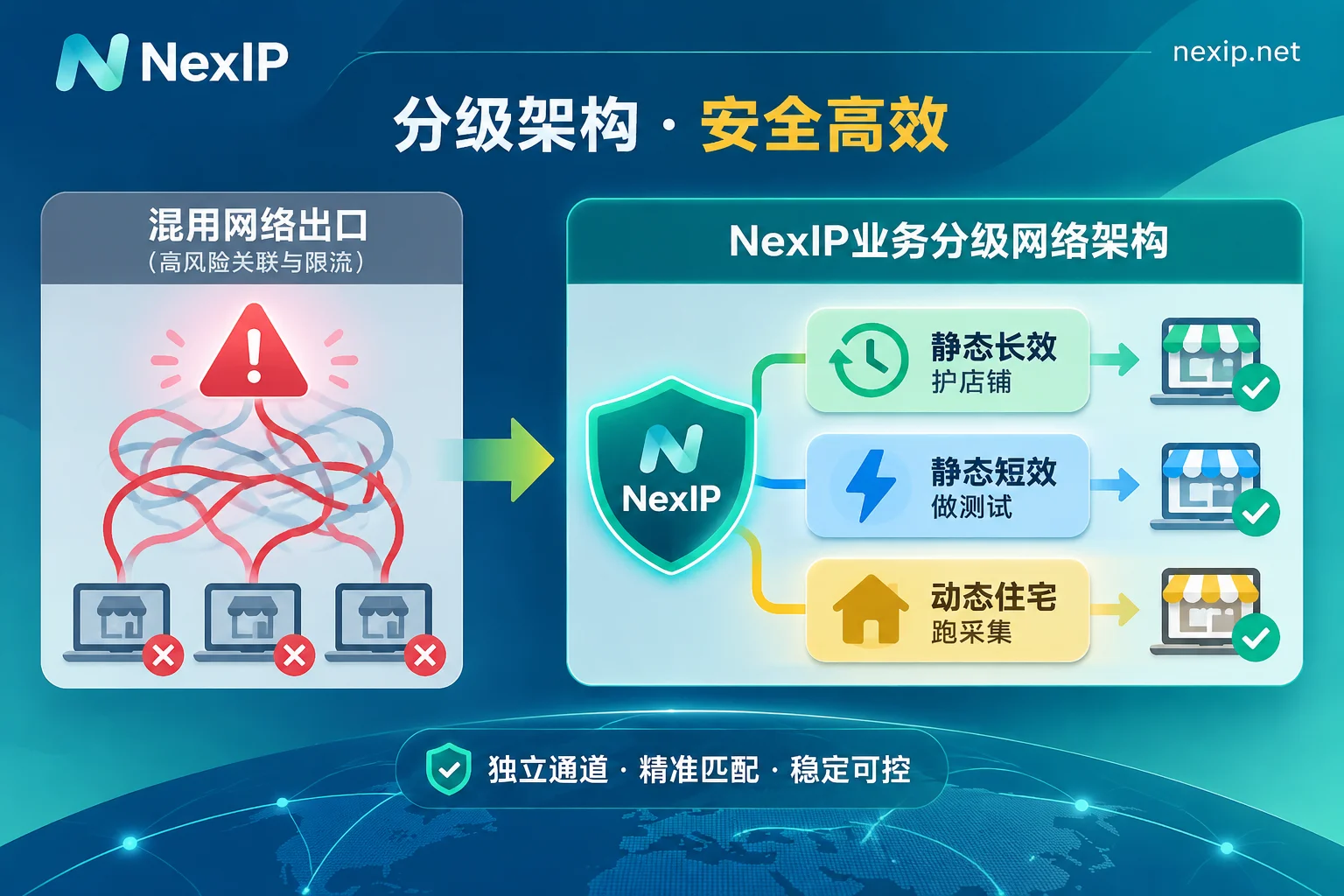
I. Why "One Proxy for All Business" No Longer Works in 2026
Many startups or transitioning cross-border teams easily fall into the following three typical pitfalls when building network environments:
- Batch store login with same C-segment data center IPs: Some sellers, to pursue low costs, purchase IPs from the same data center segment and distinguish stores only by different ports, resulting in the platform's underlying detection directly identifying them as the same operation source, triggering "joint liability" store bans.
- Running collection tasks on fixed store egress: Operations personnel, while logged into the main store backend network environment, simultaneously refresh competitor pages at high frequency or run product selection plugins, causing the static IP to trigger high-frequency access risk control and directly endangering store account security.
- Mixing local store and cross-border store networks: As emerging sites (such as Latin America, Southeast Asia, or European local stores) tighten verification of localized qualifications, using commercial data center or cross-regional broadcast IPs to log into local stores easily triggers "abnormal login activity" verification.
(For how platforms identify data center and residential network segments, you can further read our previous analysis: Why are you still rate-limited even when it shows residential? Starting from the risk control differences between native residential IPs and broadcast segments)
Only by completely separating "account assets requiring absolute stable identity" from "public data business requiring high-frequency identity changes" at the network egress layer can a truly secure cross-border network foundation be built.
II. Core Asset Layer: "One Store, One Fixed Egress" for Multi-Store Backends and Social Media Matrix
For Amazon, Walmart, Shopify independent site backends, and brand social media assets like Facebook and Instagram, the core logic of platform risk control is verifying whether the operator is a real local resident user or compliant merchant. Any frequent IP jumps or polluted routes shared by multiple users will be considered high-risk signals.
1. Precise Selection of Static Long-Acting IPs
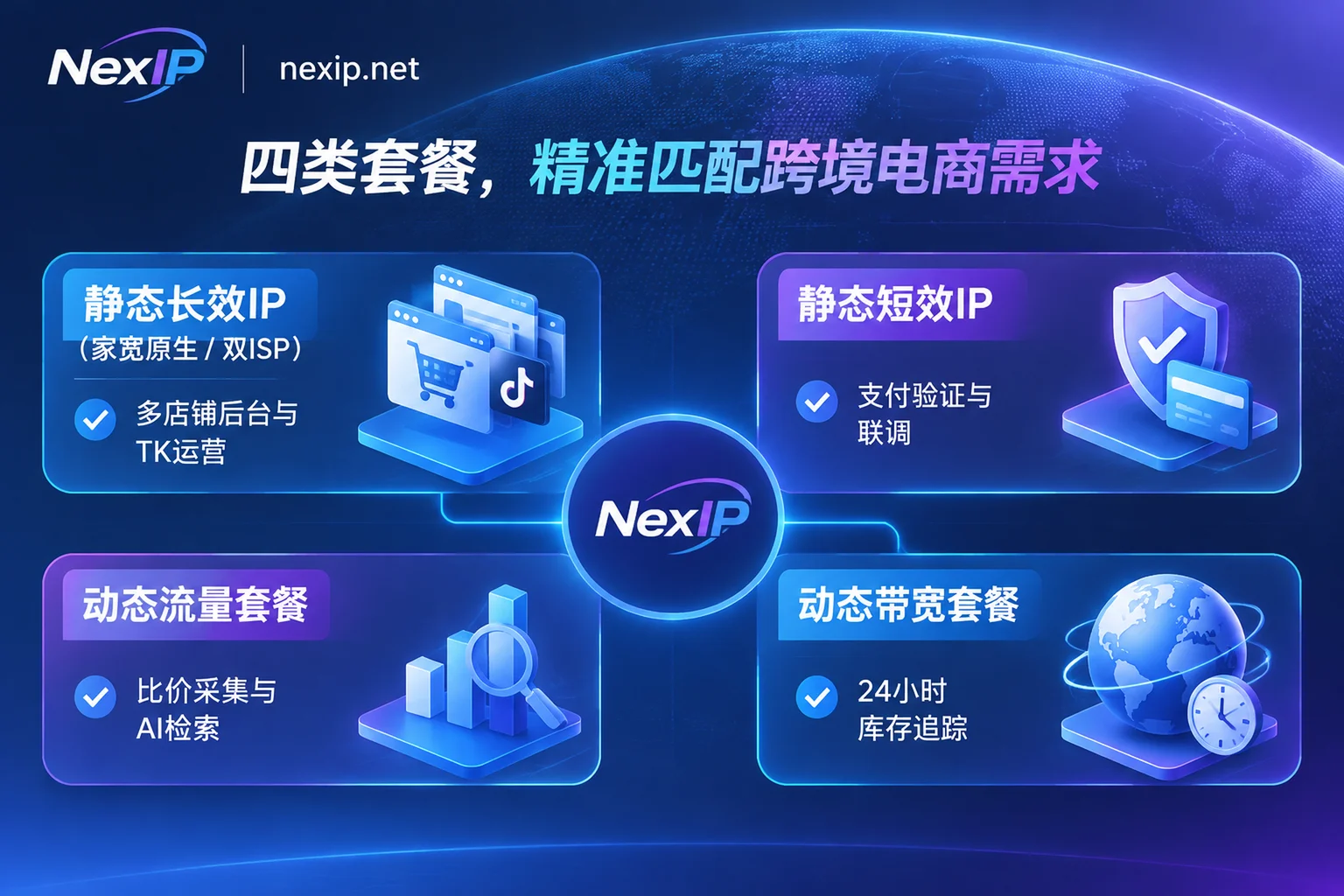
For store management and long-term account operations, it is essential to configure exclusive fixed static residential proxy · long-acting IP (billed monthly or annually, unlimited traffic). In terms of specific sub-categories, it can be further divided according to business risk control levels:
- High-risk local stores and main brand stores: It is recommended to directly choose the native residential sub-category and prioritize enabling native dual ISP attributes. Such IPs are directly allocated and announced by local real home broadband operators, with highly consistent geographic tags and operator endorsement, maximizing the reduction of review and secondary review triggers for local stores.
- Regular cross-border stores and auxiliary social media accounts: Can be paired with the more cost-effective residential broadcast sub-category (segments registered as residential attributes, hosted in data centers via BGP). If you still have questions about the underlying differences between the two, you can refer to the how to choose between native residential and residential broadcast comparison page, or review "Why do you still fall into pitfalls even when it shows dual-ISP residential IP? Unpacking the two technical meanings of dual-ISP and real home broadband configuration".
2. Special Configuration for TikTok Shop and Short Video Matrix
In the currently booming TikTok cross-border e-commerce ecosystem, the weight of the network environment even directly determines the initial playback pool of the account. For TK operations scenarios, the official standard practice is to use native residential IP from static long-acting, strictly implementing the strategy of "one account fixedly bound to one exclusive IP." Before selecting a target market, the operations team can first check the target country, city, and mainstream ISP inventory through the coverage and local operators by country page to ensure that the IP location perfectly matches the target audience's time zone and language.
III. Agile Verification Layer: Short-Term Isolation for Payment Integration and Temporary Risk Control Testing
In the daily advancement of cross-border e-commerce, not all tasks requiring a fixed residential identity last for months. For example:
- Localized settlement integration testing of cross-border payment gateways (Stripe, PayPal, etc.) before independent site launch;
- Testing the store onboarding process for new sites;
- Single compliance checks and temporary account verification for ad landing pages in specific cities.
If you purchase monthly long-acting IPs for these tasks that only last a few hours or days, it will cause unnecessary cost waste; while using dynamic rotating IPs can easily cause session interruptions due to egress changes during payment redirects or multi-factor verification.
For such agile needs, configuring static residential proxy · short-acting IP is the most cost-effective solution. It also provides exclusive fixed static residential (ISP) IPs with unlimited traffic, but supports flexible billing by hour or day, burn after use, ensuring absolute continuity of network identity during the verification period while achieving refined control of testing costs.
IV. Intelligence and Growth Layer: Product Selection Price Comparison, Ad Verification, and AI Data Pipelines
The second half of cross-border e-commerce competes on data granularity. Whether it's scraping Amazon competitor BSR rankings, monitoring real-time prices and reviews of overseas local e-commerce, verifying the actual display positions of Facebook/Google ads locally, or even using AI Agents to retrieve overseas social media trends in real-time to generate localized marketing copy, all require massive overseas real residential egress support.
At this layer, if a fixed IP is used for high-frequency requests, it will be banned by the target platform within minutes. The correct approach is to introduce dynamic residential pools and choose billing modes based on the throughput pattern of the task (for detailed calculation logic, see "How to choose between traffic-based billing and bandwidth-based billing"):
1. Discrete Collection and AI Retrieval: Dynamic Traffic Packages
For scheduled price comparison collection, multi-region ad verification, SEO/SERP ranking monitoring, and training corpus scraping and RAG real-time web retrieval in AI applications, it is recommended to use dynamic residential proxy · traffic packages. Billed by actual traffic consumed (GB), supporting precise targeting by country, city, ASN, and operator.
- When needing to traverse massive product lists, you can set rotate per request mode, allowing each scrape to be initiated with a brand new local real resident identity;
- When needing to simulate a complete shopping cart process or view reviews by page, you can switch to sticky session mode, temporarily maintaining the same egress for a specified time.
2. 7×24 High-Concurrency Monitoring: Dynamic Bandwidth Packages
If your technical team needs uninterrupted 24/7 tracking of real-time inventory of hot products, high-frequency API polling, or global overseas sentiment monitoring, traffic consumption is often huge and stable. In this case, choosing dynamic residential proxy · bandwidth packages is more cost-effective—billed by port bandwidth, unlimited traffic (subject to fair use policy), also supporting automatic rotation and sticky session configuration, completely eliminating traffic anxiety under high-throughput tasks.
V. Team Implementation: How to Efficiently Manage Cross-Departmental Proxy IP Assets?
When a cross-border enterprise operates the above three-layer network architecture simultaneously, how to avoid confusion among operations, media buyers, and R&D personnel when configuring proxies? You can start with the following three engineering details (for more architecture design ideas, refer to "Overseas Proxy IP Team Selection Guide: Egress Architecture from Overseas Sentiment Collection to Multi-Platform Account Matrix"):
- Seamless access with multiple protocols and methods: NexIP supports HTTP/HTTPS/SOCKS5 protocols across the board. Store operations personnel can directly fill fixed static IPs into mainstream fingerprint browser environments via username/password authentication or port forwarding; while data teams can seamlessly integrate dynamic proxy pools into automated collection scripts via API extraction or IP whitelist authentication.
- Sub-account permissions and quota isolation: Through the official website panel or client, enterprise administrators can create multiple sub-accounts, allocating static long-acting IPs for store anti-association to each site manager, and dynamic traffic/bandwidth pools to data and ad departments, achieving clear billing and non-interfering egress.
- Exception disaster recovery and smooth replacement: In long-term cross-border operations, if individual static long-acting IPs fail due to force majeure, NexIP supports a free replacement for failures mechanism, helping teams restore secure egress in the shortest time and avoid business interruption.
Conclusion
In the cross-border e-commerce competition of 2026, proxy IPs are no longer merely "networking tools" but infrastructure for ensuring digital asset security and obtaining overseas frontline market intelligence. Through the tiered strategy of "static long-acting residential for store protection, static short-acting for integration testing, dynamic pools for data and AI," cross-border teams can achieve secure expansion under strict platform risk control.
You can visit the solutions by industry, scenario, and platform page at any time to check customized network suggestions for e-commerce, brand protection, price monitoring, and major social media platforms, or directly log in to the NexIP user backend to register and test, building your own high-purity cross-border network matrix.




Comments(0)