 NexIP官方博客
In data-driven business decisions and cross-border e-commerce operations, SOCKS5 proxies remain the go-to choice for technical teams building network links because of their lightweight protocol, TCP/UDP support, and excellent penetration capabilities. However, a simple "successful connection" is only the starting point—how you fine-tune configuration for your business scenarios determines the stability and risk-control security of your operations.
Why Choose SOCKS5 as the Core Protocol?
Compared with traditional HTTP proxies, SOCKS5 proxies operate at the session layer and do not understand upper-layer application protocols, so they can handle all kinds of traffic requests more natively and transparently. For developers, this means lower latency and higher compatibility. When configuring with NexIP, developers can easily connect via username/password authentication or IP whitelisting, adapting to a wide range of needs from browser environments to automation scripts.
Tiered Configuration Strategy Based on Business Needs
Different tasks have completely different requirements for network egress, and NexIP offers a flexible product matrix to support these differentiated configurations:
- High-concurrency data collection scenarios:
When conducting price monitoring or SEO data analysis, we recommend the Dynamic Residential Proxy · Traffic Plan. When configuring SOCKS5, you can combine API extraction or process-level proxying to achieve high-frequency IP rotation and effectively avoid traffic limits imposed by target websites. - Continuous and stable API polling and public opinion monitoring:
For businesses that require long connections and high throughput, the Dynamic Residential Proxy · Bandwidth Plan is the better choice. It bills by port bandwidth and supports sticky session configuration, ensuring consistent identity markers throughout complex scraping processes. - Account management and cross-border e-commerce operations:
This is the scenario with the strictest risk controls. We recommend configuring Static Residential Proxy · Long-Acting IPs to bind a dedicated egress via native home broadband IPs for each store account.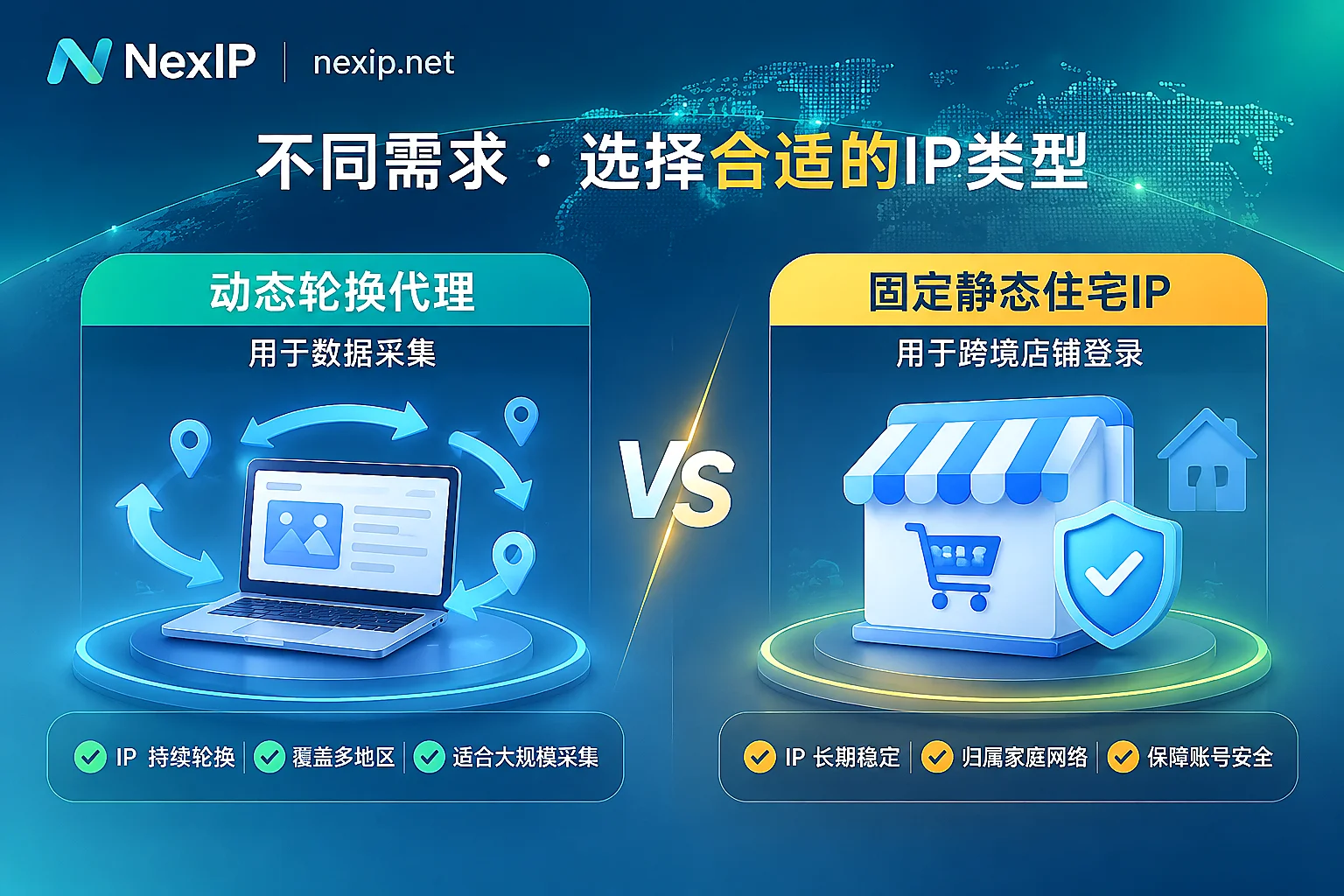
Configuration Pitfall Guide: Saying Goodbye to Failed "Disguises"
Even if you choose the right protocol, flawed configuration logic can still trigger risk controls. In daily operations, we often encounter the following issues:
- IP purity and ASN attribution: Many users only care whether an IP can connect, while ignoring the match between ASN attribution and business logic. NexIP's comparison of native home broadband and broadcast IPs helps you precisely avoid rate limiting caused by data center IPs being mass-flagged.
- Boundaries of session persistence: Do not confuse dynamic rotation with static fixation. If your business relies on cookies or login states, prioritize static long-acting IPs in your configuration, or manually control session cycles in collection tasks.
Conclusion
An excellent SOCKS5 proxy configuration is not just about establishing a connection—it is about isolating business risk. NexIP's username/password and whitelist access plus sub-account management features are designed to free teams from tedious IP maintenance.
Whether you are building an e-commerce matrix or training an AI data pipeline, choosing the network solution that best matches your business scenario is fundamental to improving your success rate. Visit the user dashboard now to start putting your configuration into practice.