 NexIP官方博客
Recently, the cybersecurity community and the proxy IP industry were hit by a major shock: Google's Threat Intelligence Group (GTIG), working with law enforcement agencies from multiple countries, announced the successful dismantling of a large-scale botnet codenamed "XCPE" that had infected over 1.3 million Android TV set-top boxes and IoT devices worldwide.
What's even more shocking is that this wasn't a case of hackers breaking into systems from the outside. The OEM/ODM manufacturer involved—Videostrong Technology Co., which had been certified as an Android TV partner—deliberately pre-installed backdoor software in the device firmware and sold access to external groups for profit. Through this backdoor, controllers could not only carry out ad fraud and remotely load malicious modules but also package these millions of home devices into a covert "Residential Proxy Network" to sell bandwidth. Google has now officially cut ties with the manufacturer and taken over and shut down the domains and server infrastructure controlling the botnet.
For cross-border e-commerce sellers, social media operations teams, and data collection developers who rely on overseas network exits every day, this incident is far more than just a tech news story—it's a direct challenge to daily business security: Is the cheap residential IP you're using actually a legitimate, compliant network node, or a compromised set-top box that could be uprooted at any moment?
1. 1.3 Million Set-Top Boxes Turned into Bots: The Business Time Bomb Behind Grey-Market Proxy Pools
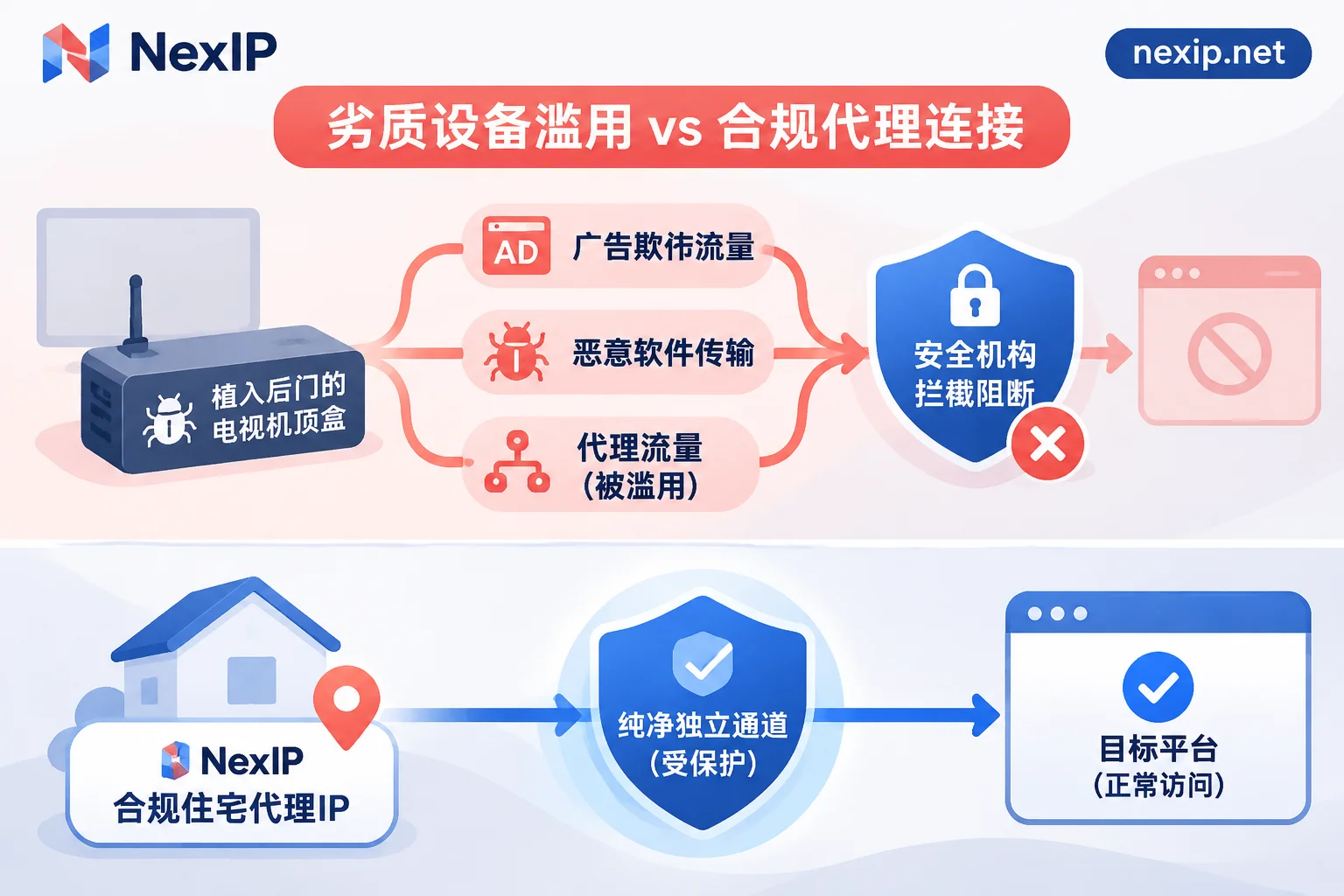
In the proxy IP market, some unscrupulous providers peddle so-called "real home broadband IPs" at extremely low prices. The exposure of Videostrong's XCPE botnet rips the cover off such grey-market resource pools—through supply chain backdoors or Trojans, they forcibly steal bandwidth from living room set-top boxes, karaoke machines, and even medical IoT devices without the homeowners' knowledge.
On the surface, the ASN of these IPs indeed belongs to local broadband ISPs, and they appear as standard residential IPs. But if you use them in legitimate business operations, you're essentially planting a time bomb under your business foundation:
1. Node Pools Vanish Instantly, Business Grinds to a Halt
As Google, Microsoft, and law enforcement agencies worldwide normalize their crackdowns on botnets, grey-market proxy pools face potential "doomsday" at any time. The takedown of the XCPE network not only directly severed backdoor connections for 1.3 million set-top boxes but, according to security experts, also disrupted access to tens of millions of other infected IoT systems. Proxy providers relying on such upstream sources can experience massive IP outages overnight, causing running data pipelines to break or bound store backends to suddenly lose their fixed exit.
2. Associated Black-Market Traffic Triggers Top-Level Risk Control Collateral Damage
As Google's investigation revealed, Videostrong sold backdoor access to multiple criminal groups simultaneously. The same set-top box you use to log into accounts or collect data might be executing high-frequency ad fraud, credential stuffing, or even keylogging in the background. In our article "How to Define Proxy IP Purity? Beyond ASN and Location, This Is the Truth Risk Control Can't Avoid," we analyzed in depth that major platforms' risk control systems have long moved beyond simple ASN database comparisons to real-time monitoring of IP behavior baselines and historical reputation. Sharing a set-top box exit with black-market actors means your legitimate business requests will be flagged as malicious traffic by major platforms, leading to CAPTCHA bombardments or instant account bans.
3. Traffic Hijacking and Enterprise Data Leak Risks
In the XCPE incident, investigators observed that backdoor operators could capture real-time device screens, inject keystrokes, and steal sensitive account and device information. If your requests pass through such a hardware channel riddled with malicious modules, unencrypted business data, API keys, and even account cookies face high risks of sniffing and man-in-the-middle attacks.
2. Why Choosing a Compliant Provider Is Always the Top Priority for Residential IPs
Whether you're a developer doing large-scale public data scraping or a cross-border team deeply engaged in local store operations, the predictability and long-term stability of your network exit always outweigh minor price differences.
Compliant residential proxy providers focus solely on delivering clean, transparent network exit services and never engage in hardware backdoor implantation or black-market channel mixing. In practice, sticking with a compliant provider means three core guarantees:
- Controllable Resource Lifecycle: Compliant channels have comprehensive upstream and downstream authorization and maintenance mechanisms for both dynamic and static resources, so they won't suddenly collapse due to an international cybersecurity enforcement action.
- Clean Historical Reputation: Compliant platforms enforce strict acceptable use policies and exit scheduling isolation, preventing your business from sharing the same exits with high-risk black-market activities like ad fraud or financial fraud.
- Transparent, Verifiable Network Parameters: Whether it's the risk control differences between native residential IPs and broadcast subnets or specific carrier ASN targeting, compliant providers lay all parameters on the table, allowing technical and operations teams to configure as needed based on actual business requirements.
3. Say Goodbye to High-Risk Wildcat Approaches: Tiered Configuration of Compliant Network Exits by Business Scenario
After eliminating low-price grey-market pools of unknown origin, how should enterprises and teams scientifically build their proxy IP architecture based on compliant industry and scenario solutions? The core logic remains: strictly isolate public data access tasks from core account assets, and match dynamic and static resources as needed.
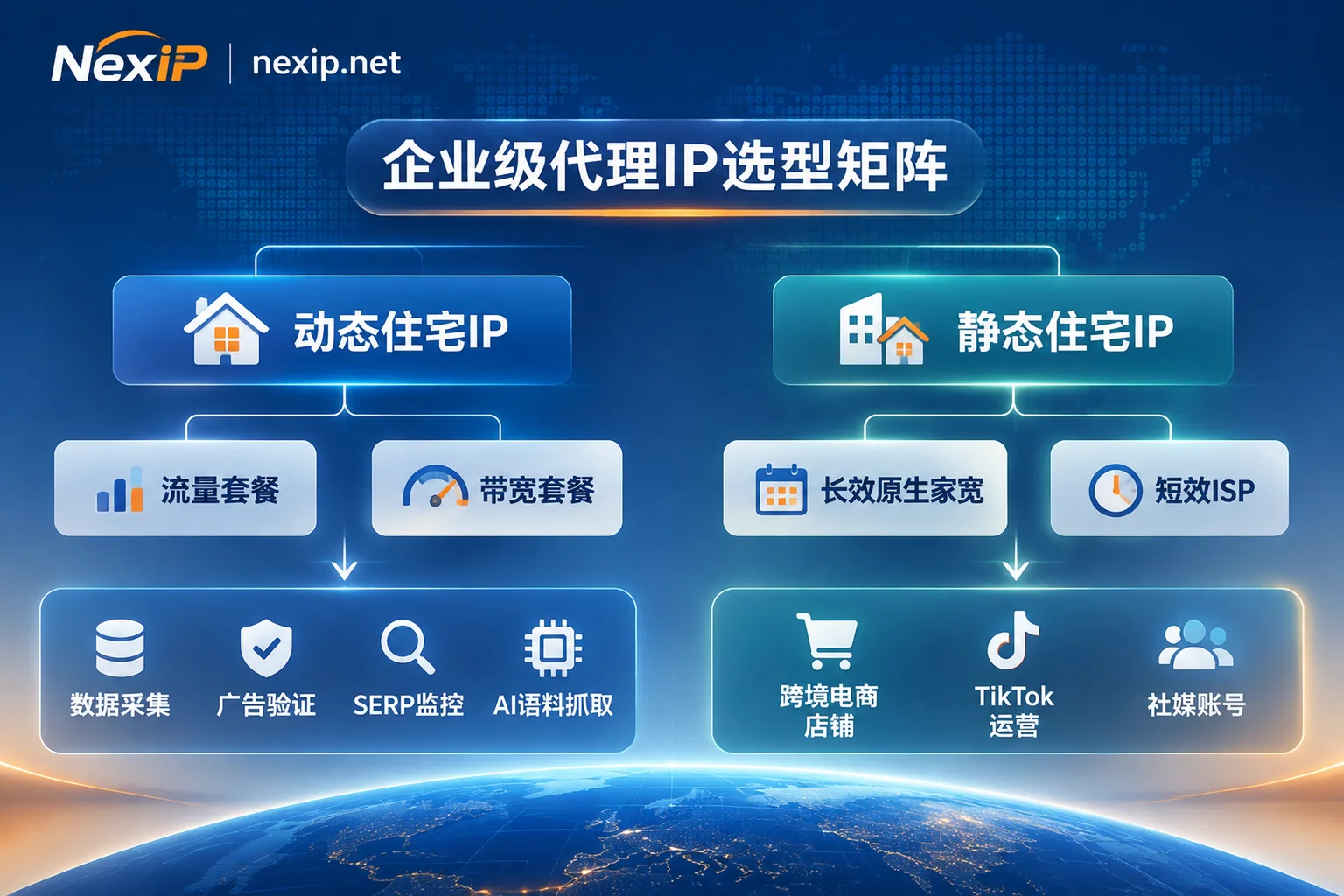
1. High-Concurrency Data Collection and Public Information Monitoring: Use Compliant Dynamic Residential IPs to Distribute Requests
For public data tasks such as price comparison scraping, regional ad verification, SEO/SERP monitoring, travel aggregation, and AI data collection (training corpora, RAG real-time retrieval, AI Agent web access), the pain point is that high-frequency access easily triggers per-IP rate limits and requires a real local user perspective.
For scenarios that don't require binding to a fixed account identity, use legitimate dynamic residential IPs and choose a billing model based on task patterns (for differences, see "How to Choose Between Pay-Per-Traffic and Pay-Per-Bandwidth"):
- Dynamic Residential Proxy · Traffic Plan: Billed by traffic (GB), supports automatic rotation per request or sticky sessions. Ideal for price comparison scraping, ad verification, and SERP monitoring where request frequency fluctuates and broad coverage of different regional exits is needed.
- Dynamic Residential Proxy · Bandwidth Plan: Billed by port bandwidth, unlimited traffic (subject to fair use), also supports automatic rotation or sticky sessions. If your team runs 24/7 continuous, high-throughput tasks like sentiment monitoring, real-time inventory tracking, or high-frequency API polling, the bandwidth model effectively locks in infrastructure costs.
2. Cross-Border Stores, Social Media Matrices, and TikTok Operations: Use Exclusive Static Residential IPs to Lock Identity
If your business involves managing cross-border store backends like Amazon or eBay, maintaining social media accounts on Facebook, Instagram, Reddit, Discord, or keeping stable login sessions for AI accounts, never use dynamic pools that may drop or change at any time (and absolutely avoid set-top box bot IPs). Instead, configure exclusive fixed static exits.
- Static Residential Proxy · Long-Lasting IP: Rent by month or year, exclusive fixed exit with unlimited traffic, free replacement if it fails. Subdivided into home broadband native, home broadband broadcast, and data center categories, with support for native dual-ISP attributes. For strictly risk-controlled TikTok operations and local store management, we recommend choosing home broadband native IPs from the static long-lasting lineup and strictly enforcing a "one account, one fixed IP" isolation strategy. For the underlying logic of native vs. broadcast subnets, see the official comparison of home broadband native and broadcast.
- Static Residential Proxy · Short-Lasting IP: Billed by hour or day, priced per IP with unlimited traffic, providing exclusive fixed static residential (ISP) IPs. Perfect for temporary account verification, payment verification, and short-term testing by development teams—stop when done, ensuring residential ISP attributes without wasting long-term budgets.
3. Fine-Grained Targeting and Standardized Integration
In actual engineering deployment, NexIP supports precise targeting by global country, city, local carrier, and ASN (subject to real-time inventory), fully compatible with HTTP, HTTPS, and SOCKS5 protocols. Whether your technical team integrates IPs seamlessly into self-built crawler architectures via API extraction, username/password authentication, IP whitelisting, port forwarding, or process proxying, or your operations team manages sub-accounts and fixed exits through the official dashboard and client, all can be configured standardly in the NexIP user backend.
Conclusion
The downfall of Videostrong's 1.3 million set-top box backdoor network once again confirms an industry iron law: any cheap resource built on illegal intrusion and supply chain black markets will ultimately cost users in the form of business interruption and asset damage. In today's climate of tightening platform risk controls and international cybersecurity governance, upholding compliance and configuring transparent, clean dynamic residential IPs and static residential proxies for data pipelines and core accounts is the fundamental path to long-term stability in cross-border and data businesses.