 NexIP官方博客
In the past, when talking about static residential IPs, the first reaction of going-global teams was often Amazon store anti-association or TikTok matrix account farming. But entering the second half of 2026, two types of high-frequency pain points have emerged in the tickets of technical and operations teams: first, overseas AI productivity accounts heavily relied upon by R&D and content teams frequently trigger secondary verification or even unexpected suspension; second, cross-border independent sites and SaaS teams are often stuck in the review process due to abnormal network egress signals when connecting to overseas payment gateways, testing checkout flows, and undergoing KYC re-verification.
When risk control algorithms no longer focus solely on e-commerce sellers but cover enterprise productivity tools and fund settlement links, the configuration logic of network egress also needs to be reorganized. This article will step out of the traditional store matrix perspective and focus on two emerging rigid demands: keeping overseas AI account login sessions alive and cross-border payment verification testing, and explain how to combine static residential proxies according to lease term and attributes.
I. The New Risk Control Reality in the Second Half of 2026: Dual Tightening of AI Productivity and Payment Gateways
Since the beginning of this year, the verification granularity of "network identity consistency" by mainstream overseas SaaS, AI platforms, and fintech service providers has significantly increased.
On the AI tool side, compliance reviews by top large model platforms have entered a stage of normalized high pressure. According to publicly disclosed transparency data, in the first half of 2026 alone, the number of violating and abnormal accounts banned by mainstream AI platforms reached tens of millions, while the appeal overturn rate was only about 10%; meanwhile, with the implementation of a new round of usage policy updates in November, platforms have become stricter in automatically intercepting shared credentials, data center proxy network segments, high-frequency cross-region IP hopping, and conflicts between billing address and login location. Many cross-border teams that legitimately use overseas R&D tools have had their core subscription accounts interrupted because of mixed public office network egress or frequent node switching, leading to being judged as abnormal sharing.
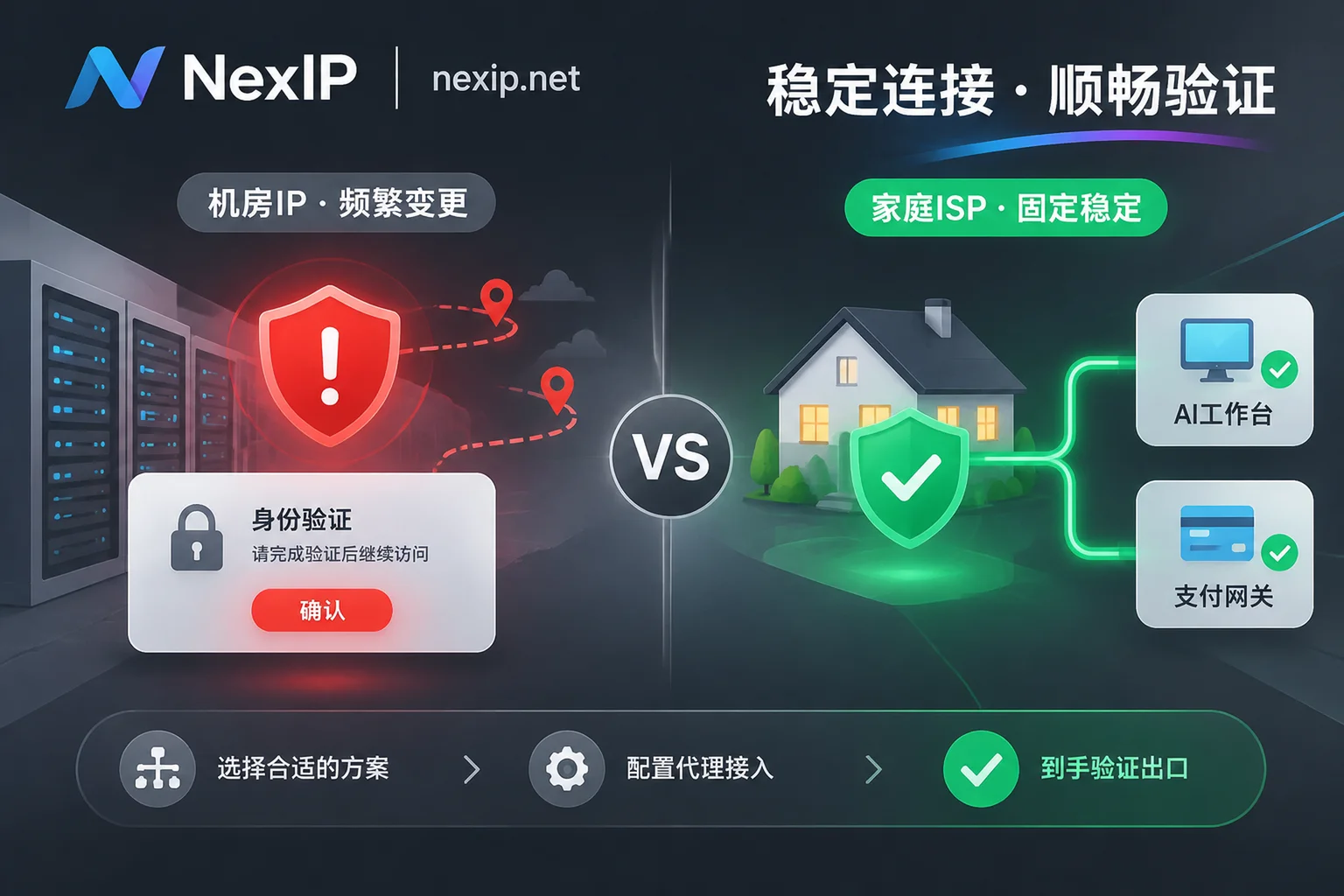
On the cross-border payment and collection side, in response to regulatory requirements from the UK FCA, Central Bank of Ireland, and various financial regulators in Europe and America, mainstream payment gateways continue to update KYC verification specifications for connected accounts and corporate entities (UBO) in 2026. Whether it's daily account checking and withdrawals by the main account, or checkout flow integration testing by the development team, the risk engine compares in real time the ASN attributes, geographic stability, and historical reputation score of the login IP. Once data center proxy characteristics or mid-session IP changes are identified in payment-adjacent steps, it is very easy to trigger additional risk control verification loops or even freeze settlement permissions.
Faced with these two types of high-value, low-fault-tolerance business scenarios, traditional "on-demand rotation" or cheap shared nodes can no longer serve as a qualified network foundation. Exclusive and authentic static residential IPs have become standard equipment for enterprise infrastructure.
II. Why Can't Dynamic Sticky Sessions Replace Static Residential IPs?
In actual selection, many developers still try to use "sticky sessions" of dynamic residential proxies to run AI platform web interfaces or log into payment backends, only to run into problems after a few days.
As we explained in Are Session Stickiness and Static IPs the Same Thing: One is Temporary Retention, the Other is Fixed Allocation, the essence of a sticky session is to "try to maintain" the same home broadband node within a specified time window; once the peer device goes offline or the session limit is reached, the egress IP is forcibly changed. This mechanism is very suitable for multi-step public web scraping, but for businesses that need to maintain Cookie and Token trust across weeks or months, every passive IP change is a risk exposure.
In contrast, exclusive static residential IPs are fully fixedly allocated during the lease term and have three irreplaceable advantages:
- Reproducible network identity: Platform risk control systems place great importance on "boring and predictable" login trajectories. Initiating access from the same city and the same residential broadband ISP every week and every day can continuously accumulate positive historical reputation for devices and networks.
- Avoid guilt by association with data center network segments: Authentic residential ISP attributes avoid the inherently high-risk label brought by cloud provider (Hosting) ASNs. For how to verify underlying attributes, you can refer to How to Check if an IP's ASN Belongs to an ISP: Look at the Announced ASN, Check IP Segment Ownership, Compare Multiple IP Databases.
- Exclusive and unlimited traffic: No need to worry about traffic anxiety caused by GB-based billing, and it eliminates the "predecessor violated rules, successor gets banned" problem caused by multiple people sharing the same egress.
III. Selection by Business Lifecycle: Long-Term Survival vs Short-Term Verification
Although both require fixed residential egress, the lifecycles of different tasks are completely different. If you buy monthly IPs for all temporary integration tasks, it will cause idle waste; conversely, using short-term nodes for core enterprise main accounts will bring the risk of renewal gaps. Coordinating long-term static residential IPs with short-term static residential IPs is a more cost-effective engineering practice.
1. Long-Term Residency for Core Assets: Static Residential Proxy · Long-Term IP
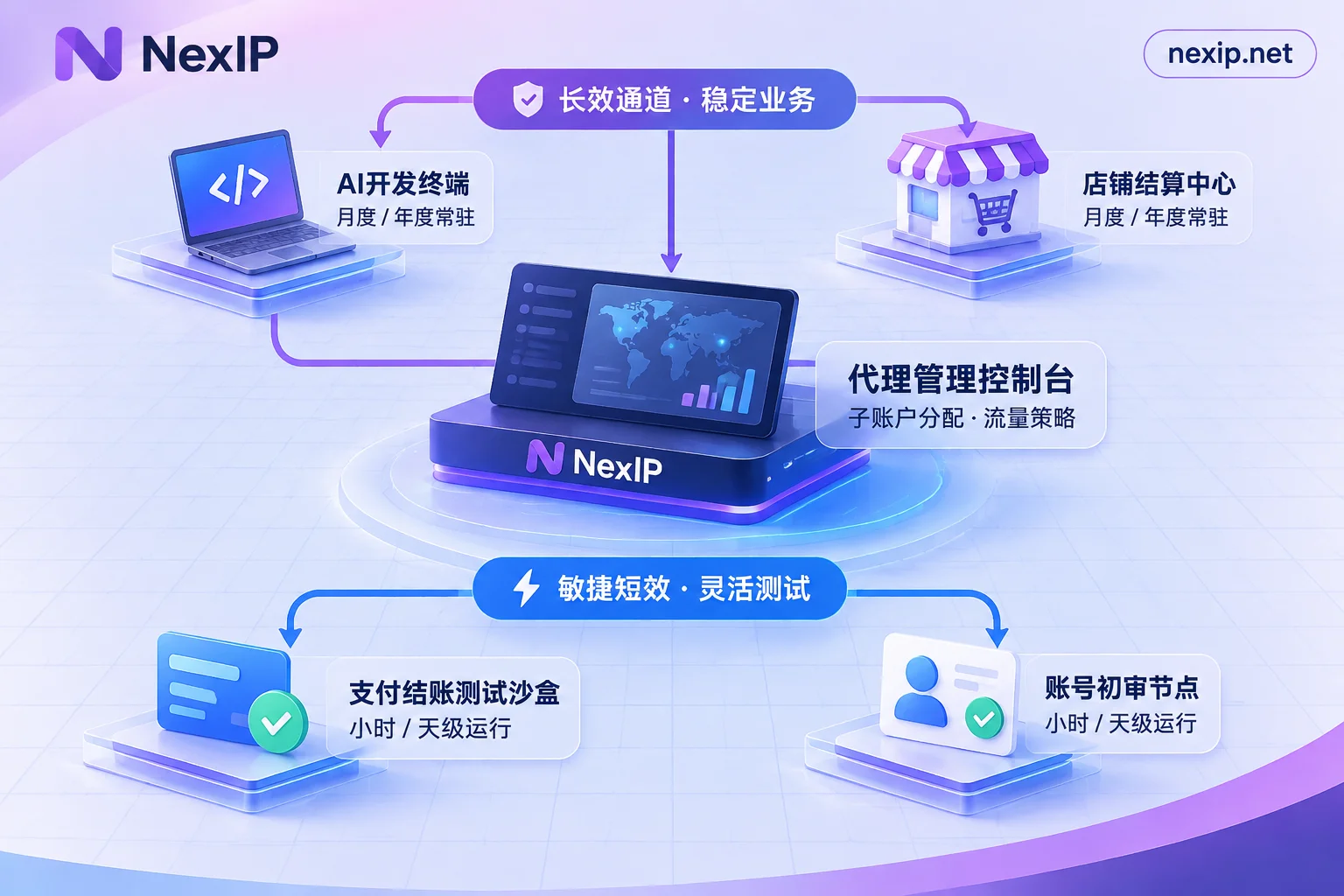
For high-value accounts that need continuous operation on a monthly or annual basis, the core demand is "absolute stability, no loss of login state." In the architecture recommendations of NexIP AI Application Solutions, we explicitly divide AI business into two parts: public corpus collection and RAG real-time web retrieval use Dynamic Residential Proxy · Traffic Package; while scenarios that require long-term maintenance of AI account login state, team development collaboration, or mounting automated workflows must bind to Static Residential Proxy · Long-Term IP.
Long-term static IPs are billed monthly or annually, exclusive fixed egress, and unlimited traffic. They are also suitable for cross-border collection main account management, independent site backend operations, social media and TK operations. In terms of sub-categories, NexIP provides clear granularity:
- Residential Native and Native Dual ISP: Real residential addresses directly allocated by local broadband operators, with attribution strictly consistent with the registration location, suitable for payment main accounts, top AI subscription accounts, and local stores that are extremely sensitive to native environments. If occasional network failures occur, free replacement is supported.
- Residential Broadcast and Data Center Sub-categories: For routine backend management with moderate risk control thresholds and greater emphasis on data center-level routing response speed, residential broadcast network segments can provide highly cost-effective residential attribute coverage. If you are not sure which one to use for your business, you can first read How to Choose Between Residential Native and Residential Broadcast and the previous in-depth analysis Why Are You Still Rate-Limited Even When It Shows Residential Attributes? Starting from the Risk Control Differences Between Native Residential IPs and Broadcast Network Segments.
2. Agile Testing and Phased Clearance: Static Residential Proxy · Short-Term IP
In daily R&D and operations, there are also many tasks that "require fixed, clean residential attributes but only need to be used for a few hours or days." For example:
- Cross-border checkout flow and payment verification integration: When launching a new multi-currency acquiring channel, QA and payment engineers need to simulate real consumers in specific cities such as the US, UK, Germany, and Japan, and complete the entire loop from adding to cart, 3DS verification, to deduction callback. Changing IP midway will trigger anti-fraud interception, but the node is no longer needed after testing.
- New business account registration and initial verification: When intensively performing batch account preliminary reviews, environment connectivity tests, or third-party service integration verification, independent fixed residential IPs are needed to maintain stable sessions for hours to days.
For such agile needs, Static Residential Proxy · Short-Term IP provides hourly or daily exclusive static residential (ISP) IPs, billed by the number of IPs and also with unlimited traffic. Teams can open them on demand according to schedules, complete high-standard payment verification and testing integration at a very low single-point cost, and naturally release them after the task ends, leaving no long-term billing burden.
| Selection Dimension | Static Residential Proxy · Long-Term IP | Static Residential Proxy · Short-Term IP | Dynamic Residential Proxy (Traffic/Bandwidth) |
|---|---|---|---|
| Lease Span | Monthly / Annual | Hourly / Daily | Rotating per request or temporary sticky session |
| Billing and Traffic | Billed per IP, exclusive unlimited traffic | Billed per IP, exclusive unlimited traffic | Billed by traffic (GB) or port bandwidth |
| Sub-Attributes | Residential Native (supports dual ISP), Residential Broadcast, Data Center | Exclusive static residential (ISP) IP | Real residential dynamic pool |
| Typical Scenarios | Long-term AI account survival, cross-border store backend, TK operations, enterprise fixed egress whitelist | Account verification, payment verification, checkout flow QA testing integration | Training corpus/RAG collection, price comparison and SERP monitoring, API polling |
IV. Four Engineering Details for Team Implementation
After selecting the right type of static residential IP, standardized access and permission management are still needed to avoid human errors destroying the clean egress environment. Previously, we discussed macro-level classification ideas in The Moat of Risk Control for Going-Global Business in 2026: IP Tiered Configuration from AI Data Feeding to Store Matrix. When it comes to specific static IP operations, it is recommended to focus on the following four points:
- Precisely align country, city, and ISP targeting: Whether binding cards to subscribe to overseas productivity tools or submitting corporate payment KYC materials, be sure to first check the available cities and local ISPs in the target region on the Global Node Coverage Page. Keep the proxy egress city, ASN, and billing address highly consistent to reduce additional scrutiny caused by cross-state or cross-country resolution.
- Match access protocols according to client characteristics: NexIP supports
HTTP,HTTPS, andSOCKS5protocols across the board, and provides two authentication methods: account/password authentication and IP whitelist. For example, some command-line R&D tools or enterprise SaaS only read standardHTTPS_PROXYenvironment variables; in this case, directly configuring HTTP/HTTPS account/password or port forwarding can run smoothly; for applications that need to carry complete underlying connections, SOCKS5 protocol with client or process proxy access can be preferred. - Use sub-accounts and APIs to achieve team isolation: Multiple people sharing one proxy backend is most prone to "collisions"—colleague A is using a static IP to log into the collection backend, while colleague B mistakenly extracts the same IP to run test scripts. When managing IPs through the NexIP official panel or API, administrators can open independent sub-accounts for different business groups, strictly achieving "one task/one account one fixed egress," and eliminating cross-contamination from the permission layer.
- Separate dynamic and static, dedicated use: Never use long-term static residential IPs bound to core accounts to casually run high-frequency crawler tasks. Once the target site adds that fixed IP to the rate limit blacklist, your normal login business will also be affected. Continuously running public opinion monitoring and inventory tracking tasks should be independently handled by Dynamic Residential Proxy · Bandwidth Package; more vertical platform configuration ideas can also be found as needed in Industry and Platform Solutions.
Conclusion
Risk control on overseas platforms in 2026 is essentially a long-term test around "authenticity and consistency." Whether protecting the AI R&D tool accounts that the team relies on or ensuring that every cross-border fund smoothly passes payment verification, separating long-term residency from short-term integration and using exclusive, clean static residential IPs to build a deterministic network egress is far more efficient than appealing for unblocking after the fact.
If you are sorting out your team's overseas account environment or preparing for a new round of payment link testing, you can now go to the NexIP User Backend to register and check inventory and access documentation in various regions, and equip your core business with a solid network foundation.