 NexIP官方博客
In the 2026 evaluation of data collection and cross-border operations infrastructure, a common confusion among technical leads and finance teams is: Why does the actual proxy IP bill always far exceed the budget estimated based on business data volume at project initiation?
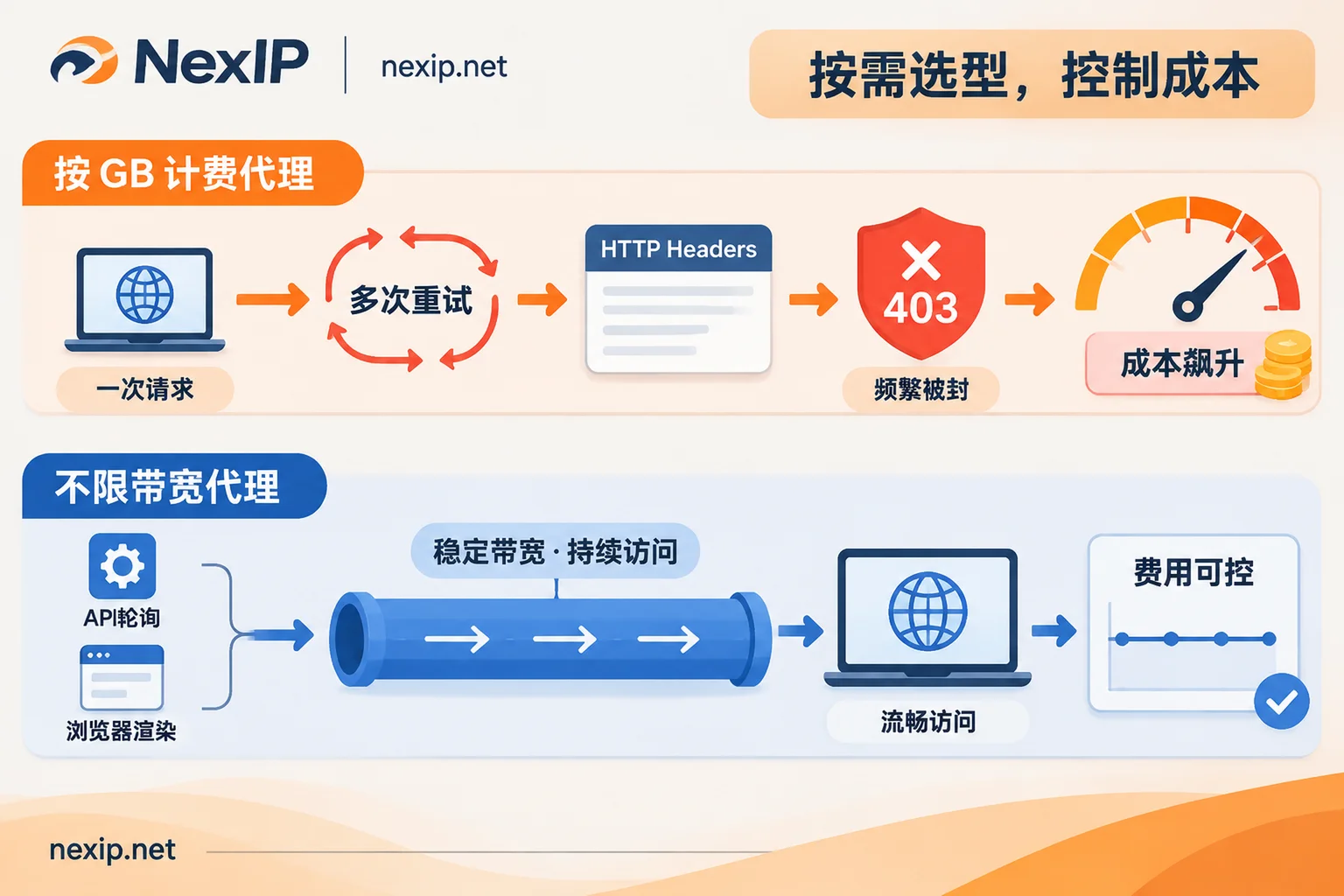
Recently, multiple overseas empirical reports on mainstream residential proxy networks have revealed the hidden cost truth of the industry: most gateways that charge by traffic (Per-GB) do not count the "valid business data rows" you ultimately store, but all bytes flowing through the network card—including request headers, POST payloads, response headers, and every failed retry after being blocked and static resource loading.
When target sites upgrade anti-crawling strategies, or when businesses introduce automated browsers and multi-step interactive workflows, per-GB billing quickly inflates due to the "Failure Multiplier." This is why more and more engineering and operations teams are re-examining unlimited traffic proxy IPs, attempting to convert uncontrollable "floating traffic expenses" into predictable "fixed infrastructure costs."
But "unlimited traffic" is not a universal label. In previous discussions, we analyzed why unlimited traffic proxy IPs have only one name but correspond to two completely different types of business, and compared how to choose between per-traffic and per-bandwidth billing. Today we take a different perspective—starting directly from the three major engineering black holes of bill overruns to dissect how to use different forms of unlimited traffic proxy IPs to reduce costs and increase efficiency.
I. Why Do Per-GB Proxy Bills Frequently Run Out of Control in 2026?
In the era of traditional static web scraping, a single HTTP request exchanged only a few KB of compressed text, making per-traffic billing very cost-effective. But in the current network environment, three variables have completely changed the traffic consumption model:
1. Failed Retries and Request Header Overhead (The Failure Multiplier)
According to trends disclosed by recent network security vendors (such as Akamai's Autumn 2026 report on intelligent agent and automated traffic governance), the granularity of platform blocking of unsigned automated traffic and high-frequency crawlers has been refined to the level of behavior and feature signatures.
If your scraping script encounters a 30%-40% 403/429 block rate or CAPTCHA challenges, your traffic bill will not just increase by 40%. Because the crawler framework will automatically initiate exponential backoff retries, each failed handshake, large TLS and HTTP headers, and even the returned block page HTML will be faithfully counted in the GB traffic meter.
2. Throughput Inflation from Headless Browsers and Full-Page Rendering
To cope with front-end JS obfuscation and dynamic rendering, real browser automation tools like Playwright and Puppeteer have become standard. Even with request interception, the huge JSON state trees, inline scripts, and long-polling packets that maintain long connections in modern web pages still cause the number of bytes per page visit to rise exponentially.
3. Repeated Authentication Consumption Caused by Session Interruptions
In multi-step operations (such as adding to cart to verify inventory, multi-level directory pagination, account backend inspections), if the proxy IP's sticky session unexpectedly interrupts or rotates too early, the system must go through the login or initialization process again. This "re-login loop" caused by unstable proxy links not only slows down the P95 response latency but also invisibly burns a large amount of traffic budget.
II. Breakthrough: Switch Evaluation Criteria to "Cost per Successful Request"
To plug the above cost black holes, engineering teams must not only look at the surface unit price when selecting and accepting proxies, but should calculate the Cost per Successful Request and the business's real demand for network throughput patterns.
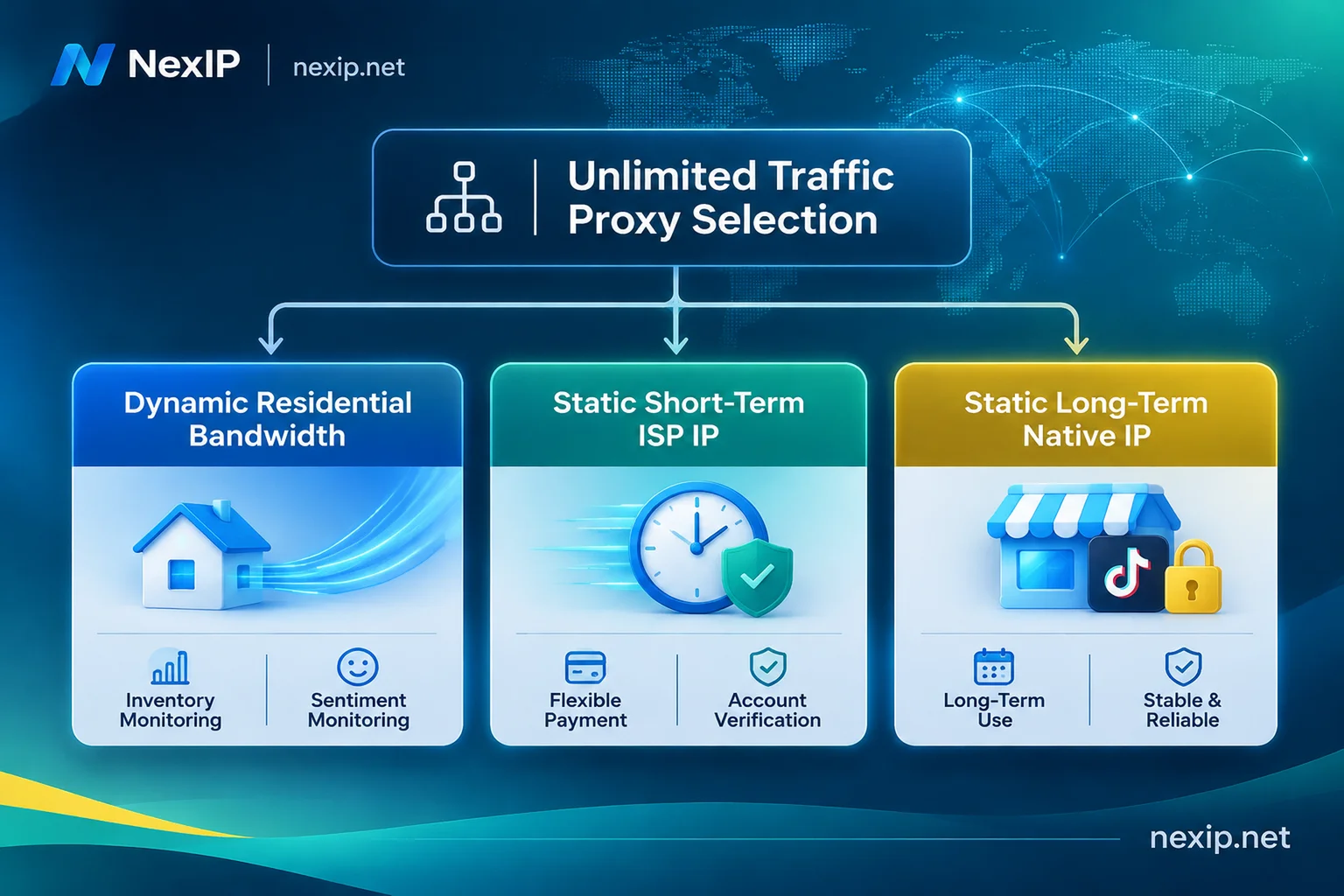
In NexIP's product matrix, "unlimited traffic" is not a single extensive package, but finely divided into three product lines based on whether IP rotation is needed and the lifecycle of fixed identities. Matching the right product to the right scenario is the key to truly cutting costs:
Scenario 1: 24/7 High-Throughput, Continuous Polling Data Pipeline
Recommended Solution: Dynamic Residential Proxy · Bandwidth Package
If your team is running round-the-clock public opinion monitoring, real-time e-commerce inventory tracking, or high-frequency API polling, your traffic curve is usually a high-level horizontal line.
- Why choose bandwidth billing: Such tasks have stable concurrency and long duration. If billed per GB, millions of polling responses per day will keep you in "traffic anxiety." Switching to NexIP Dynamic Residential Bandwidth Package, the per-port bandwidth billing with unlimited traffic (subject to fair use policy) allows you to completely lock down your monthly budget.
- Balancing rotation and stickiness: It still uses a real dynamic residential pool, supporting automatic rotation to distribute single-IP request pressure and sticky sessions for continuous pagination scraping. It is the main foundation in high-throughput crawler proxy IP integration architecture design.
Scenario 2: Intensive Interaction, High Time Consumption but Clear-Cycle Phased Tasks
Recommended Solution: Static Residential Proxy · Short-term IP
When doing account registration verification, cross-border payment channel verification, or testing and debugging before launching automated scripts, engineers often need to frequently refresh pages, load complete CAPTCHA components, or payment SDKs.
- Why choose static short-term: Such operations consume extreme traffic and must not have IP changes within hours or days (otherwise triggering cross-location risk control immediately). Using NexIP Static Residential Short-term IP, you can rent exclusive fixed static residential (ISP) IPs by hour or day. During the rental period, it's completely unlimited traffic. Testers can safely load the full front-end environment for debugging, and stop when done, ensuring the pass rate of residential ISP attributes while avoiding idle waste of long-term monthly subscriptions.
Scenario 3: Multi-store Anti-Association, Social Media Matrix, TikTok Operations, and Long-term AI Login Sessions
Recommended Solution: Static Residential Proxy · Long-term IP
For cross-border operations teams, daily work includes uploading large amounts of high-definition product images and texts, downloading backend reports, previewing social media videos, and maintaining long-term login sessions for AI tools or store backends.
- Why choose static long-term: If operations staff are assigned per-traffic proxies, watching a few videos or syncing a product library once will exhaust the quota. NexIP Static Residential Long-term IP uses monthly or yearly billing, provides exclusive fixed exit and unlimited traffic, and promises free replacement upon failure.
- Fine-grained attribute matching: To cope with different platform risk control intensities, this package further subdivides into home broadband native, home broadband broadcast, and data center subcategories, and supports native dual ISP attributes. For example, for the strict risk control of TikTok operations, the official website explicitly recommends using home broadband native IPs from the static long-term category, strictly implementing "one account one fixed IP" (for native determination logic, refer to how to choose between home broadband native and home broadband broadcast and two technical meanings of dual ISP and real home broadband configuration).
III. When Should You Still Keep "Per-Traffic Billing"?
Emphasizing the cost advantages of unlimited traffic proxy IPs does not mean abandoning traffic packages altogether. In a reasonable hybrid architecture, Dynamic Residential Proxy · Traffic Package still has an irreplaceable position:
- Pulsed, low-throughput but highly discrete tasks: Such as global ad verification, SEO/SERP ranking monitoring, price comparison collection, and travel aggregation run several times a day on schedule. These tasks exchange very little data per run but require massive IPs from different countries, cities, or even specific ASN operators globally at an instant.
- AI real-time retrieval pipelines: When building AI data collection and RAG real-time web access, AI Agents often trigger web page reads on demand, and traffic is fragmented. Using per-GB billing with per-request rotation dynamic traffic packages is clearly more economical than long-term port leasing (if you need to maintain long-term AI account login sessions, switch back to static long-term IPs).
IV. Engineering Implementation: How to Build a Cost-Controllable Proxy Architecture with NexIP?
Whether you are a data engineering team or a cross-border business department, to truly manage proxy costs, besides choosing the right billing model, you need supporting access and management capabilities:
- Flexible protocols and access methods: NexIP fully supports
HTTP,HTTPS, andSOCKS5protocols (for underlying protocol differences, see SOCKS5 proxy configuration guide), and provides four access modes: API extraction, username/password authentication, port forwarding, and process proxy. Whether written into Python async crawler configurations or bound to third-party fingerprint environments, it can seamlessly integrate. - Precise geographic and operator targeting: In the global node coverage page, you can pre-check local operators and available cities in target countries, and perform targeted scheduling by country, city, ASN, and operator (subject to real-time inventory), reducing invalid redirect traffic caused by regional mismatches.
- Sub-accounts and multi-dimensional management: Through the official website panel, client, or management API, team leaders can create sub-accounts, assign dynamic bandwidth packages to the crawler team for 24-hour public opinion and inventory monitoring, and assign static long-term IPs to the e-commerce and social media operations team for fixed store binding. Each business line accounts independently, completely saying goodbye to the muddled accounts at month-end reconciliation.
Conclusion
In 2026, proxy IP selection is no longer a word game of "whose claimed IP pool number is larger" or "whose GB promotional price is lower." Understanding the throughput pattern of business traffic, switching continuous high-throughput tasks to dynamic bandwidth packages, and anchoring fixed identity and high-frequency interaction needs to static short-term and long-term IPs is the fundamental solution to combat bill inflation and build a highly resilient network exit.
You can always visit the NexIP Industry and Platform Solutions Center to view detailed configuration suggestions for e-commerce, SERP monitoring, brand protection, and major social media platforms, or directly log in to the NexIP User Backend to check API documentation and start test acceptance.