 NexIP官方博客
In 2026 public data collection engineering, many crawler developers have encountered a frustrating dilemma: after discovering that traditional requests libraries frequently return 403, they stayed up all night refactoring code to support browser fingerprint spoofing with curl_cffi or modified headless browsers (like Patchright, Camoufox); or they gritted their teeth and purchased a batch of residential proxies to replace cheap datacenter IPs. As a result, the script ran for less than half an hour before either getting stuck on Cloudflare Turnstile or DataDome challenge pages, or seemingly full of HTTP 200 OK, only to find out during data cleaning that all the scraped data was "watered-down fake data" with incorrect prices and inflated inventory.
Today, the era of relying on "single-point breakthroughs" to fight anti-scraping has completely ended. Modern WAFs (Web Application Firewalls) and risk control engines look at the feature consistency of the entire request chain. If you only change client fingerprints without paying attention to the matching logic of network egress, or only pile up proxy pools while ignoring transport layer protocol exposure, even the best code and the most expensive IPs will become consumables.
This article starts from the frontline pain points of anti-scraping in 2026, analyzes how network egress is deeply bound to TLS/JA4 fingerprints and session states, and discusses how to properly configure crawler proxy IPs to build a scraping architecture that is both resistant to bans and cost-effective.
I. The New Normal of Anti-Scraping in 2026: From "Explicit Blocking" to "Silent Poisoning" and Full-Chain Verification
In the past, troubleshooting whether a crawler proxy IP was invalid was very simple: check if the status code was 403/429, or see if there were captcha keywords in the response body. But in 2026, the defense strategies of mainstream e-commerce, local life, and content platforms have undergone two core shifts:
1. Normalization of Hidden Leniency and "Data Poisoning"
Directly banning IPs only forces scrapers to accelerate rotation frequency. Today, risk control systems often do not immediately disconnect when they identify suspicious traffic, but instead adopt Silent Degradation:
- Return cached historical old data or randomly fine-tuned fake prices to suspicious IPs;
- Deliberately drop some JSON fields (such as hiding real review lists or promotional coupons);
- Increase response latency, slowing down overall crawler concurrency throughput.
This "silent poisoning" is extremely harmful to data teams—status codes are all 200, monitoring alerts show nothing, and it is not until the business side discovers price comparison distortion or AI training corpus contamination that they realize they have wasted a lot of computing power and proxy budget. (If you have encountered similar problems in AI real-time retrieval, you can refer to "AI Agent and RAG Real-time Retrieval Always Getting Fake Pages? Configuration Logic of Dynamic Residential IPs in AI Data Pipelines".)
2. The "Wooden Barrel Effect" of Three-Layer Linkage
Why can risk control precisely identify disguised crawlers? Because modern edge gateways (represented by Cloudflare, which has fully popularized JA4 fingerprint detection, and DataDome, which has dozens of behavioral models) simultaneously perform three-layer cross-verification within milliseconds of a request arriving:
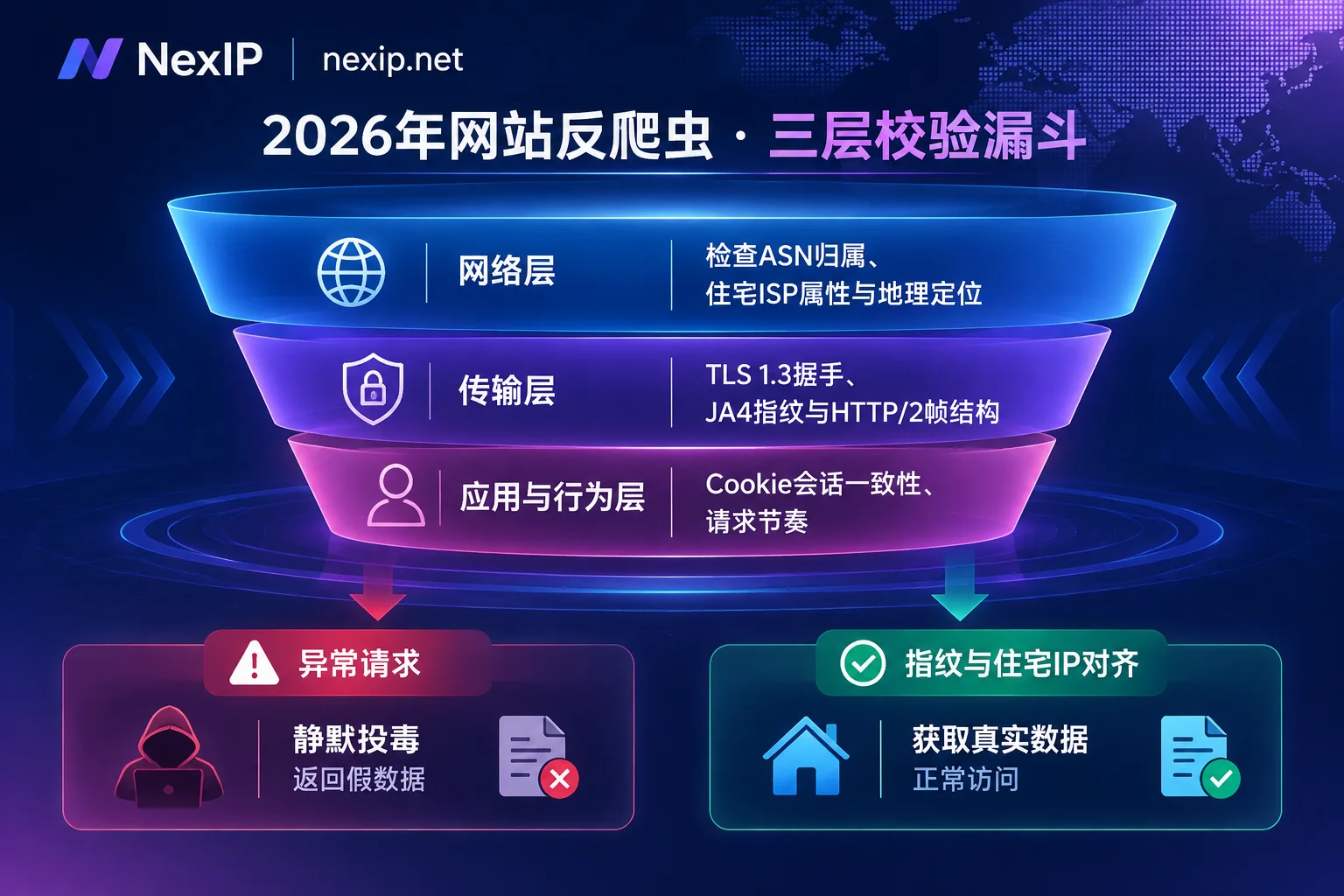
- Network Layer (IP Reputation and ASN Profile): Check whether the egress IP belongs to a datacenter subnet or a real home broadband ISP, whether there are recent high-frequency abnormal request records, and whether the IP geolocation matches the target site's business region.
- Transport Layer (TLS Handshake and HTTP/2, HTTP/3 Frame Features): Traditional JA3 fingerprints have gradually become ineffective due to browser extension order randomization. In 2026, defenders generally adopt JA4 fingerprints that hash after sorting extensions, combined with HTTP/2
SETTINGSframe parameters and window sizes to identify underlying network libraries. - Application and Behavior Layer (Environment Consistency and Access Trajectory): Verify whether request headers, timezone/language, Cookie tokens, and request interval rhythm conform to human browsing logic.
These three layers form a typical wooden barrel effect. Crawler proxy IP is the first threshold: if you use a shared datacenter subnet that has long been flagged, the request will be labeled high-risk at the connection establishment stage, and no amount of Canvas fingerprint obfuscation or mouse trajectory simulation later will help; conversely, even with high-purity real residential IPs, if you make low-level mistakes in proxy access methods and session scheduling, clean IPs will be quickly blacklisted within minutes.
II. Why Are Residential Proxies Still Exposed After Switching? Three Common "Fingerprint × IP" Mismatch Pitfalls
In actual engineering troubleshooting, many teams still get banned even after buying high-quality residential IPs. The problem usually lies in the coordination details between the client and the proxy egress:
Pitfall 1: Clearance Cookie and Egress IP Suddenly Unbound
When facing sites with a front-end 5-second shield or invisible verification, the client needs to first pass an environment check to obtain a pass Cookie like cf_clearance or datadome, and then request core business APIs.
Many developers configure "per-request rotation" dynamic proxies in their code: the first request uses US IP_A to obtain the pass token, and then the second request carries this token to scrape product details, but the underlying egress has changed to German IP_B (or even another IP in the same city with a different ASN). From the server's risk control perspective, the IP bound to the pass token and the TLS session features drift instantly, which is typical credential theft or distributed crawler behavior. Not only will the current request be blocked, but the newly switched IP_B will also be immediately linked and downgraded.
Pitfall 2: Improper Proxy Connection Protocol Breaks Underlying TLS and ALPN Negotiation
When you use curl_cffi to simulate Chrome's TLS handshake, the client expects to complete end-to-end TLS 1.3 handshake and HTTP/2, HTTP/3 (QUIC) protocol negotiation directly with the target server. If the crawler proxy IP is improperly configured (for example, the protocol is forcibly downgraded in some old intermediate forwarding architectures, or proxy-specific headers like Via, X-Forwarded-For are leaked), it will cause a tear between the User-Agent declared by the client and the transport layer fingerprint actually reaching the server.
Therefore, in high-risk scraping scenarios that are extremely sensitive to transport layer fingerprints, it is recommended to prioritize HTTPS CONNECT that supports native tunnel passthrough or directly use the underlying SOCKS5 protocol to ensure that the locally constructed cipher suite order, extension list, and ALPN negotiation parameters arrive at the target site intact. (For more on the advantages of SOCKS5 protocol in complex network architectures, see "SOCKS5 Proxy Configuration: From Protocol Basics to High-Performance Cross-Border Business Architecture".)
Pitfall 3: IP Geolocation/Carrier Attributes and Client Environment "Cross-Server Chat"
Full-chain verification places great emphasis on "logical consistency." For example, your crawler script hardcodes Accept-Language: ja-JP in the request header, or the headless browser injects Tokyo timezone, intending to scrape region-limited prices from Japanese local e-commerce platforms, but the proxy pool randomly assigns a UK or US egress IP. This cross-border feature conflict, even if the IP purity is high and the TLS fingerprint looks like a real device, will immediately trigger risk control's anomaly score and directly return default site fallback fake data. (For more on how to deeply inspect IP purity and ASN attribution, see "How to Define Proxy IP Purity? Beyond ASN and Geolocation, This Is the Truth Risk Control Can't Avoid".)
III. Practical Crawler Proxy IP Coordination Configuration: Match Egress Scheduling with Business Characteristics
To break out of the vicious cycle of "frequent bans—blindly changing IPs—exploding bills," the core is to finely schedule the session lifecycle, geographic targeting, and billing model of proxy IPs according to the target site's risk control mechanisms.
As a service provider focused on providing clean network egress infrastructure, NexIP offers a complete product line of dynamic and static residential proxies, fully supporting HTTP/HTTPS/SOCKS5 protocols, and providing four access methods: API extraction, username/password authentication, port forwarding, and process proxy, making it easy for development teams to seamlessly embed into existing Python, Go, or Node.js scraping frameworks.
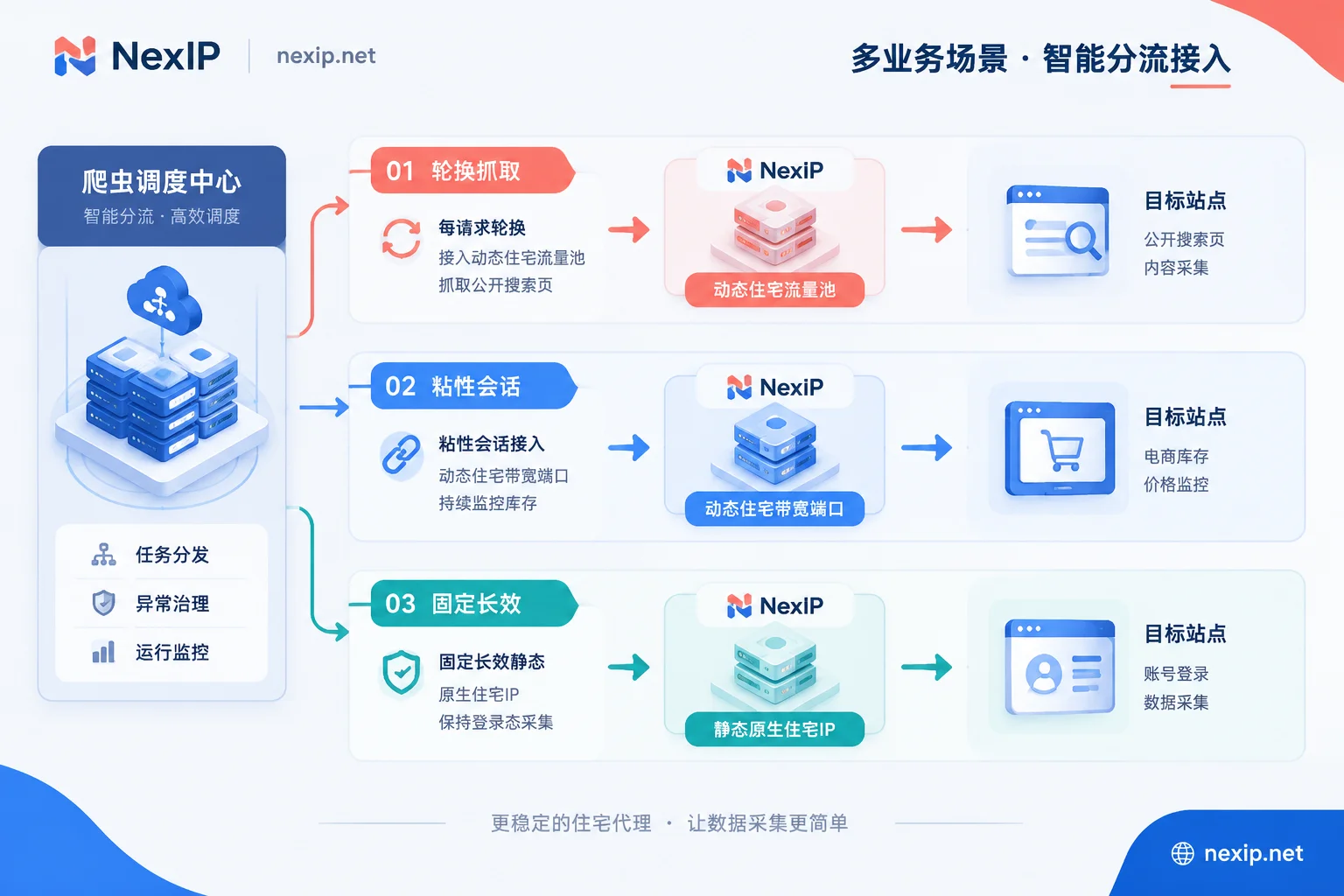
For different scraping tasks, we recommend configuring network egress according to the following strategies:
1. High-Concurrency Traversal of Public Pages vs. Multi-Step Interactive Scraping: Make Good Use of Rotation and Sticky Sessions
Not all crawlers are suitable for "one IP per request." When using dynamic residential proxies, you must set the session mode based on the business unit (for specific switching logic, see "How Often Should Dynamic IPs Be Changed: Change by Work Unit and Risk Control Signals, Not by Seconds"):
- Stateless single-page scraping (e.g., search engine SERP scraping, independent product snapshots): You can use per-request rotation mode, where each connection automatically assigns a brand-new real residential egress, evenly diluting high-frequency requests across a huge IP pool to avoid single-IP rate limits.
- Stateful continuous scraping (e.g., pagination after passing a shield, entering zip code to check inventory, multi-hop API calls): Be sure to enable Sticky Session. Within the same work unit (e.g., "load homepage to get Cookie → search keyword → paginate and scrape first 5 pages of details"), fix the same residential IP, same TLS fingerprint, and request headers; after the task unit is completely finished, destroy the session and rotate to the next IP and fingerprint combination.
2. Precisely Align Region, City, and ASN Carrier
When scraping region-sensitive businesses (such as localized ad verification, search engine ranking monitoring across countries, regional housing prices, and food delivery/hotel price comparison), you cannot rely only on coarse country-level targeting. Through NexIP Global Node Coverage, engineering teams can perform fine-grained targeting by country, city, and even specific ASN and local broadband carrier (subject to real-time inventory).
Before making a request, specify the target city's residential egress through proxy username/password parameters, and simultaneously load the corresponding city's language preferences, geographic coordinates, and timezone configuration in the crawler middleware, achieving seamless alignment from underlying network routing to upper-layer application features.
3. Choose by Task Throughput Pattern: Traffic Packages, Bandwidth Packages, and Static Residential IPs
After solving the pass rate, engineering managers are often most concerned about scraping costs. If you choose the wrong proxy billing model, budgets can easily spiral out of control when page sizes swell or retry rates fluctuate (see "Why Is Your Proxy Bill Always Over Budget? Deconstructing the 'Failure Multiplier' Trap and Cost Restructuring of Unlimited Traffic Proxy IPs").
In NexIP's product matrix, you can combine layers according to the operational characteristics of your data pipeline (for architecture design details, see "Crawler Proxy IP Access Architecture Design: Task Tiering, Cookie Binding, and Dual-Pool Scheduling Guide"):
| Scraping Task Type | Recommended NexIP Product Type | Core Features and Scheduling Method | Typical Use Cases |
|---|---|---|---|
| High discreteness, lightweight requests, requiring extremely high anonymity | Dynamic Residential Proxy · Traffic Package | Billed by traffic (GB); supports per-request rotation or sticky sessions; extremely low cost per request when using streamlined APIs or blocking heavy static resources | E-commerce price comparison scraping, ad verification, SEO/SERP monitoring, travel aggregation, and AI corpus collection and RAG retrieval |
| 7×24 continuous operation, high-throughput large-page scraping | Dynamic Residential Proxy · Bandwidth Package | Billed by port bandwidth, unlimited traffic (subject to fair use policy); supports automatic rotation or sticky sessions, fixed and predictable cost | All-weather public opinion monitoring, real-time inventory tracking, high-frequency API polling, headless browser clusters requiring full DOM rendering |
| Short-term exclusive verification, temporary testing and integration | Static Residential Proxy · Short-lived IP | Hourly or daily lease, billed by IP, unlimited traffic; exclusive fixed static residential (ISP) egress | Temporary account verification, payment process verification, targeted testing and integration before crawler script launch |
| Scraping and operations requiring long-term high-weight login state | Static Residential Proxy · Long-lasting IP | Monthly or yearly lease, unlimited traffic; exclusive fixed egress, including native home broadband, broadcast home broadband, and datacenter subcategories, supports native dual ISP, free replacement upon failure | Scraping closed-source platform data with old account Cookies, maintaining long-term AI account login state, cross-border store management, and TK operations |
Note: For businesses that require long-term fixed identity, if the target platform is extremely strict about network attribute review, it is recommended to understand in advance the difference between native home broadband IPs and broadcast home broadband subnets, and prioritize local ISP-direct native home broadband IPs to minimize the probability of account risk control anomalies.
IV. Pre-Launch Engineering Checklist: 4 Steps to Troubleshoot Network and Feature Leakage
Before pushing large-scale crawler clusters to the production environment, it is recommended that data engineers run a smoke test according to the following checklist to avoid consuming proxy resources with obvious flaws:
- Verify TLS/JA4 and HTTP/2 Handshake Consistency: Access a public fingerprint echo test site through the proxy, confirm that after the request passes through SOCKS5 or HTTPS proxy tunnel, the JA4 hash value, ALPN protocol version (whether normally negotiated as
h2) seen by the server completely match the locally declared User-Agent version. - Check Session Stickiness Period and Reconnection Logic: Simulate 10 consecutive stateful API requests, check whether the sticky session (Session ID) stably remains on the same egress IP; also write exception capture logic—once a sticky IP triggers 403 or a challenge, immediately proactively change the Session ID to switch to a new IP and clear the old Cookie container, never stubbornly retry in place.
- Establish Data Verification Sentinels for "Silent Poisoning": Do not use only
status_code == 200to determine scraping success. Add golden sample comparison or key field non-empty assertions at the parsing layer (for example, verify whether the product price range is reasonable, whether specific DOM nodes exist). When a batch of returned data shows structural degradation, promptly trigger alerts and adjust the proxy pool region or concurrency rhythm for the corresponding task. - Use Sub-Accounts and APIs for Multi-Team Isolation: If the team is simultaneously running "high-frequency public page scanning" and "high-value login-state scraping" tasks, do not mix the same batch of fixed egresses. You can create independent sub-accounts through the NexIP User Dashboard (user.nexip.net), and use the official panel or management API to allocate dedicated traffic pools, bandwidth ports, or static long-lasting IPs for crawlers of different priorities, achieving clear isolation of permissions, costs, and risk control boundaries.
Conclusion
The data collection offense and defense in 2026 is essentially a contest between detail authenticity and engineering cost efficiency. After you have used curl_cffi or a new generation of anti-detection browsers at the code level to fill the client fingerprint gaps, you need a clean, stable, and flexibly scheduled residential proxy foundation to handle these requests.
Now you can go to the NexIP User Dashboard to register and check the integration documentation, and flexibly combine dynamic traffic, unlimited-traffic dynamic bandwidth, or static residential IPs according to your scraping scenarios, so that every line of crawler code can stably and efficiently obtain real data.