 NexIP官方博客
With the explosive growth of the Southeast Asian e-commerce market, the Q4 peak season is not only a "gold rush season" for sellers but also a "training ground" for platform risk control systems. Recently, many cross-border operations teams have reported that TikTok Shop and Shopee have increasingly strict requirements for login environments. When your network exit is not clean, even if the account itself has high weight, it is difficult to escape throttling or risk control bans.
To deeply cultivate business in Southeast Asia, how to scientifically configure residential IPs? We recommend starting from business scenarios and carrying out refined architecture.
I. Cross-border Store Operations: Stability Above All
For refined operations of TikTok Shop and Shopee, "exclusive" and "native" are core indicators. Platform risk control systems detect the ASN attribution and geographic location of IPs in real time, and data center IPs are almost blacklisted.
- Selection Recommendation: Static Residential Proxy · Long-lasting IP
- Configuration Strategy: For high-value accounts, be sure to use native home broadband IPs to achieve a fixed exit of "one account, one IP", ensuring long-term stability of the login environment and avoiding association risks.
- TK Operations Suggestions: For TikTok live streaming and short video business, please refer to our TikTok Operations Zone for more robust account configuration strategies.
II. Market Data Collection: Balancing Efficiency and Cost
When conducting Shopee price comparison, competitor inventory monitoring, or SEO monitoring, using long-lasting IPs is not only costly but also difficult to cover the dynamic data needs of multiple locations across the six Southeast Asian countries.
- High-frequency Collection (e.g., price comparison, ad verification): We recommend Dynamic Residential Proxy · Traffic Package. Billed by traffic, supports rotation per request, and effectively solves anti-crawler blocking under high concurrency.
- Continuous Monitoring (e.g., inventory tracking, API polling): We recommend Dynamic Residential Proxy · Bandwidth Package. Unlimited traffic, stable throughput, suitable for automated tasks that require long-term data pipeline connectivity.
III. Why is there a huge difference between native IPs and broadcast IPs in the Southeast Asian market?
In Southeast Asia, many service providers offer so-called "residential IPs", but their underlying logic often differs. Simply put:
- Native Home Broadband: True local ISP broadband, highest trust, high risk control pass rate.
- Broadcast Home Broadband: Hosted in data centers via BGP; although labeled as residential, the probability of being judged as a data center by platforms still exists.
You can view detailed differences on the Native Home Broadband vs. Broadcast Home Broadband Comparison Page, and choose carefully according to your business risk control level.
IV. Advice for Developers: How to Access and Manage
NexIP supports HTTP/HTTPS/SOCKS5 protocols and provides a variety of access methods (API extraction, username/password, port forwarding, process proxy).
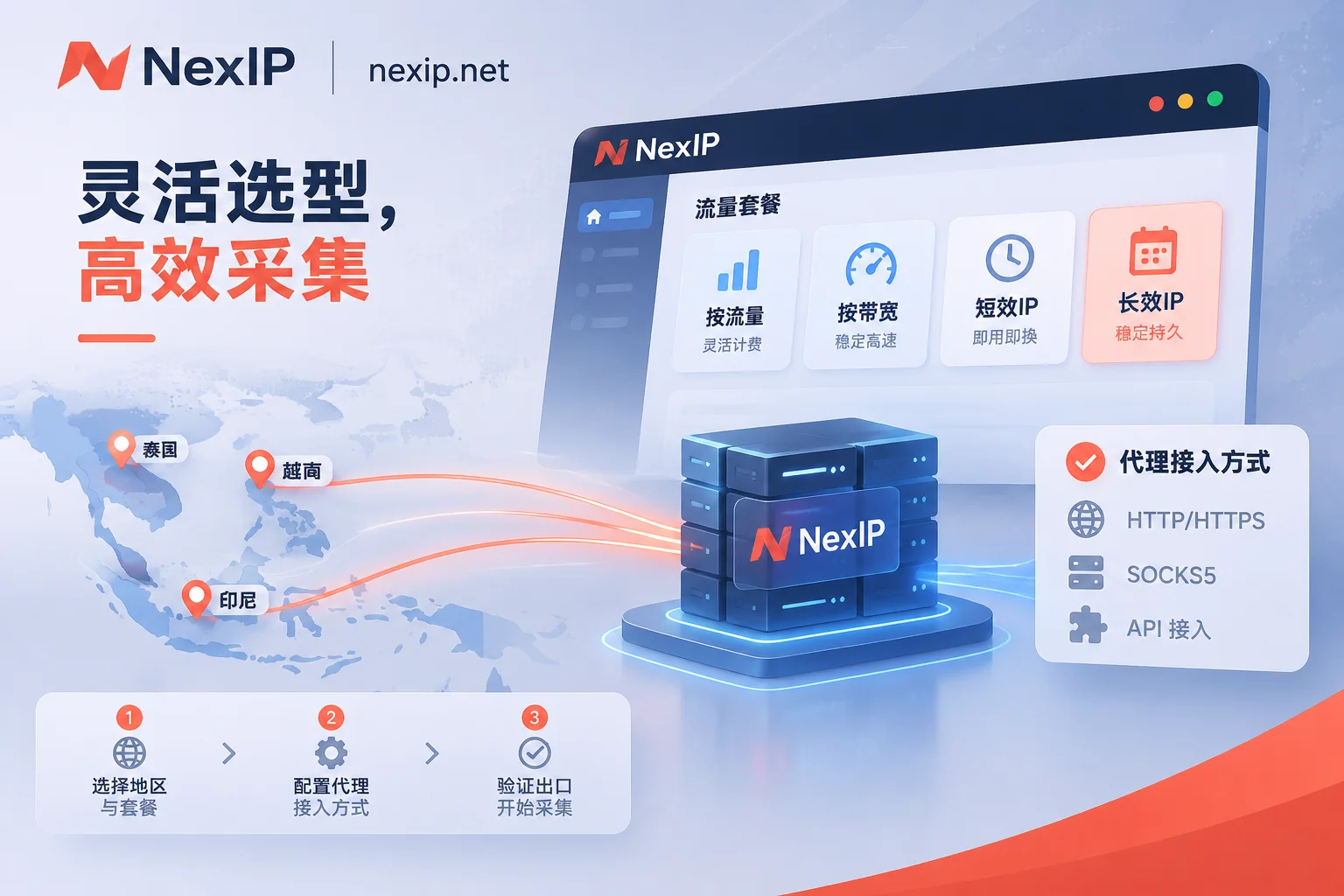
Whether you need to switch between multi-country nodes or targeted scheduling for specific ASNs, you can flexibly manage through the User Dashboard. For large-scale AI applications (such as AI data collection, RAG corpus acquisition), we also have targeted AI Application Solutions for reference.
Conclusion
The risk control logic in the Southeast Asian market is constantly iterating. As emphasized in our article "Why Am I Still Banned After Changing TLS Fingerprints?", simple IP changes are no longer sufficient to cope with the current environment. A reasonable exit architecture combined with risk control configuration is the key to reducing costs and increasing efficiency.
Want to configure the best network environment for your business? Welcome to visit our Country/Region Coverage Page to check inventory distribution in Southeast Asian countries, or directly contact the backend to activate your overseas dedicated line.