 NexIP官方博客
In scenarios such as multi-store management for cross-border e-commerce, overseas social media operations, market data collection, and ad verification, "US residential IPs" have long been a critical infrastructure for businesses to ensure smooth operations and account security, thanks to their authentic home broadband (ISP) network attributes. However, with the rapid evolution of target platforms' risk control algorithms, the traditional model relying solely on IP quantity can no longer meet high-level anti-fraud requirements.
In July 2026, security media Krebs on Security reported that smart TV manufacturer LG announced a comprehensive cleanup of unauthorized residential proxy SDKs embedded in its webOS app store. Earlier, a network measurement report by GreyNoise Intelligence indicated that approximately 39% of global edge threat traffic attempts to hide through abused residential networks. This trend shows that overseas mainstream platforms and risk control systems are shifting from simple "single-node IP blacklist" checks to multi-dimensional identification based on "ASN historical reputation, subnet purity, session stability, and protocol fingerprints."
Facing an increasingly stringent network auditing environment, this article will delve into the current state of the US residential IP industry and provide scientific selection and configuration guidance for enterprise teams.
1. Evolution of US Residential IP Risk Control and Network Status in 2026
With the advancement of technology, the dimensions by which target platforms identify proxies have fundamentally changed:
- From single-point blocking to ASN/subnet scoring: According to Databay's network reputation research, risk control systems, upon receiving a request, immediately score the IP based on the historical behavior of its autonomous system number (ASN) and /24 subnet. If there are numerous frequent abnormal requests within the same subnet, the entire IP range may be flagged with a higher risk level.
- Balance between dynamic rotation and session persistence: Blindly pursuing high-frequency IP rotation may cause jumps across different US ISP networks (e.g., switching from Comcast to AT&T instantly), triggering remote login alerts on target platforms. For businesses requiring continuous login, stable session stickiness becomes a core requirement.
- Compliance and source purity: The FBI's security advisory on residential proxies emphasizes that non-compliant IP sources can bring significant business uncertainty. When building overseas network infrastructure, companies must prioritize service providers with clear sources, stable nodes, and good network reputation.
2. Applicable Scenario Selection for US Dynamic vs. Static Residential IPs
Choosing the right proxy type based on specific business needs is key to reducing operational costs and improving success rates:
| Proxy Type | Network Characteristics | Applicable Business Scenarios |
|---|---|---|
| Dynamic Residential IP | Abundant nodes, supports high-concurrency access and automatic/on-demand rotation | Market competitor data collection, ad verification, SEO trend monitoring, large-scale public data analysis |
| Static Residential IP | Fixed US ISP broadband IP, remains unchanged for long periods, high reputation | Cross-border e-commerce platform store operations, overseas social media account nurturing and interaction, long-term business isolation |
For tasks that require both temporary high concurrency and phased continuous operations, enterprises can choose static short-term residential IPs or static long-term residential IPs based on their business cycles to balance cost and stability.
3. US Residential IP Purity Detection and Practical Configuration Steps
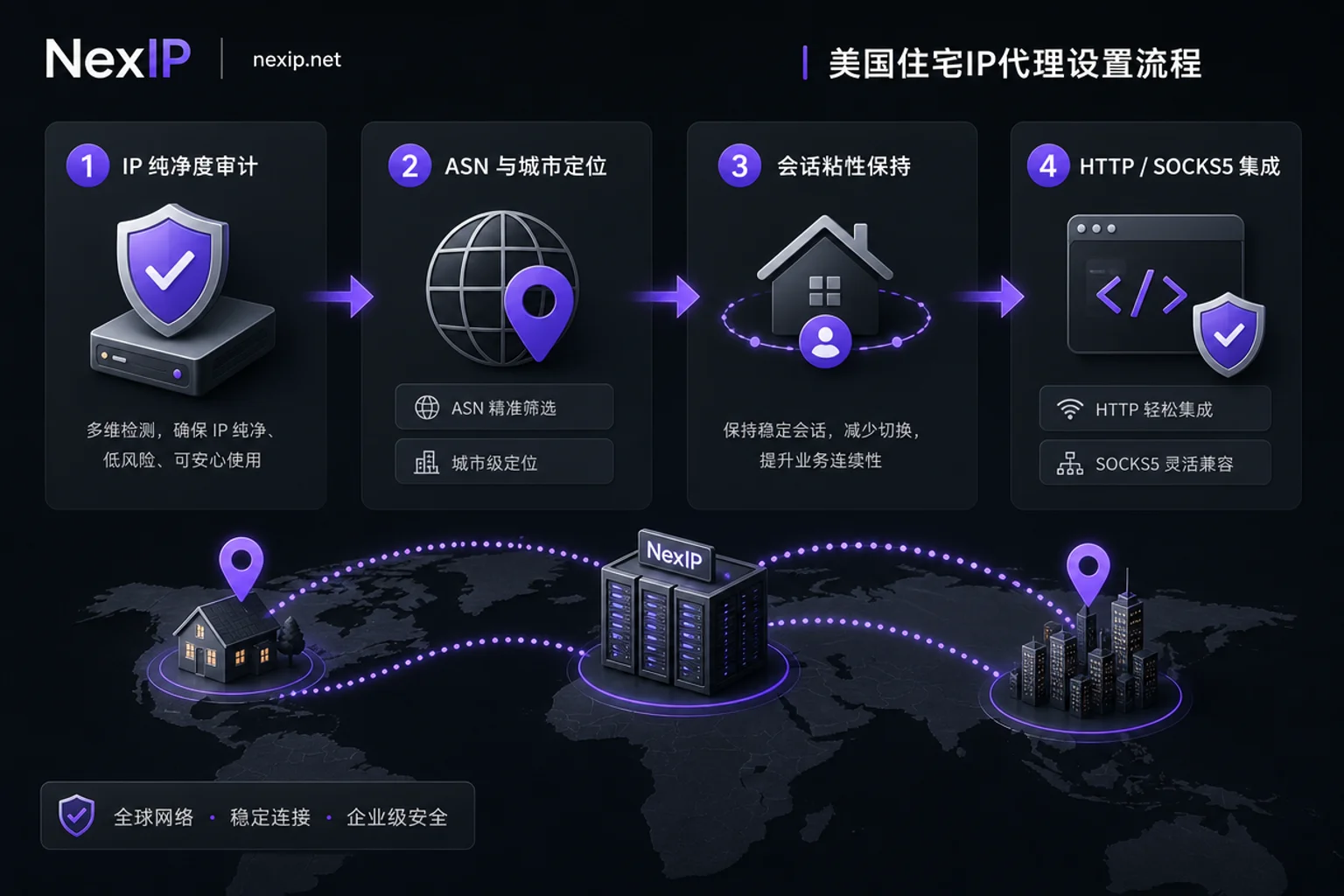
To ensure US residential IPs perform optimally in actual business, teams are advised to follow the standardized configuration process below:
Step 1: IP Geo-Location and ASN Reputation Check
After connecting to the proxy, first verify the IP's actual geographic location, ISP provider (e.g., Verizon, Charter, etc.), and whether it has any malicious flags using authoritative databases or testing tools, ensuring the node is not on known blacklists.
Step 2: Match Environment Fingerprint and Network Protocol
Ensure that the client (such as an anti-detect browser or automation script) has its timezone, language, WebRTC, and Canvas fingerprint consistent with the US geographic location of the proxy IP. For transport protocols, prioritize the compatible HTTP or efficient and stable SOCKS5 protocol.
Step 3: Precise City/ASN Targeting and Session Persistence
Based on the target business region (e.g., California, New York), add precise city or specific ASN targeting parameters to proxy requests. For sessions requiring continuous operations, enable session stickiness to ensure the IP remains unchanged within a specified period.
4. NexIP's Network Capabilities and Recommendations for US Residential Proxy Scenarios
Facing the complex and evolving risk control mechanisms of major platforms, choosing a service provider with mature technical architecture and diverse product offerings is crucial for business continuity. NexIP offers a variety of US residential IP solutions for enterprises and cross-border teams:
- Flexible Billing and Plan Types: For large-scale data scraping and high-concurrency scenarios, NexIP provides dynamic residential proxy traffic plans and dynamic residential proxy bandwidth plans, allowing businesses to control network costs on demand. For high-sensitivity scenarios requiring fixed identities, it offers static short-term residential IPs and static long-term residential IPs.
- Granular Network Targeting and Control: Supports global region selection and refinement to city/ASN targeting, combined with adjustable session stickiness, effectively reducing the risk of triggering cross-region login alerts.
- Efficient Protocol Support and API Integration: Fully supports HTTP/SOCKS5 proxy protocols and provides convenient API integration methods, seamlessly integrating into existing automation workflows and fingerprint browser environments.
Practical Advice: For cross-border e-commerce store maintenance and primary social media account management, it is recommended to use NexIP's static long-term residential IPs with fixed city/ASN nodes. For high-frequency data monitoring tasks, connect to NexIP's dynamic residential proxy traffic plans with appropriate session stickiness settings to maximize efficiency while maintaining purity.
5. Frequently Asked Questions and Compliance Advice
- Q: What is the difference between static residential IPs and datacenter IPs?
A: Datacenter IPs originate from data centers. Although they offer fast transmission speeds and lower costs, their obvious ASN labels make them easily identified and blocked by major platforms' anti-scraping mechanisms. In contrast, US residential IPs come from real home broadband ISPs, earning high trust in risk scoring. - Q: How can I ensure the legal compliance of residential proxy usage?
A: When using proxy networks, enterprises should strictly comply with target platforms' terms of service (ToS) and local laws and regulations. Use them only for compliant market research, data collection, and business isolation, and avoid credential stuffing, unauthorized scraping, or circumventing regulations.



Comments(0)