 NexIP官方博客
When conducting cross-border e-commerce operations in the UK market, overseas social media maintenance, and compliant public data collection, the authenticity and stability of network identity directly determine business delivery efficiency. With the upgrade of risk control strategies and network governance requirements on major platforms in 2026, traditional data center IPs, due to their obvious affiliation marks, are increasingly unable to meet the needs of high-quality business. More and more teams are turning to real UK residential IPs assigned by local network operators (such as BT, Virgin Media, Sky, etc.).
1. UK Network Environment Trends and Compliance Identification Mechanisms
According to the 2026 industry network measurement and proxy trend report, platforms' review of request sources has evolved from simple geographic location identification to comprehensive detection of ASN (Autonomous System Number) type, IP reputation score, and session coherence.
- Increased demand for native home broadband attributes: Target servers verify whether the IP belongs to a datacenter or residential ISP through databases. Real residential IPs have higher compliance reputation.
- Deeper geographic granularity: Not only precise location within the UK is required, but many local businesses need to be accurate to specific cities like London or Manchester, or even designated operator networks.
- Session stickiness stability: Frequent and irregular IP changes can trigger security alerts, while fixed single IPs in high-traffic scraping scenarios can cause concurrency bottlenecks.
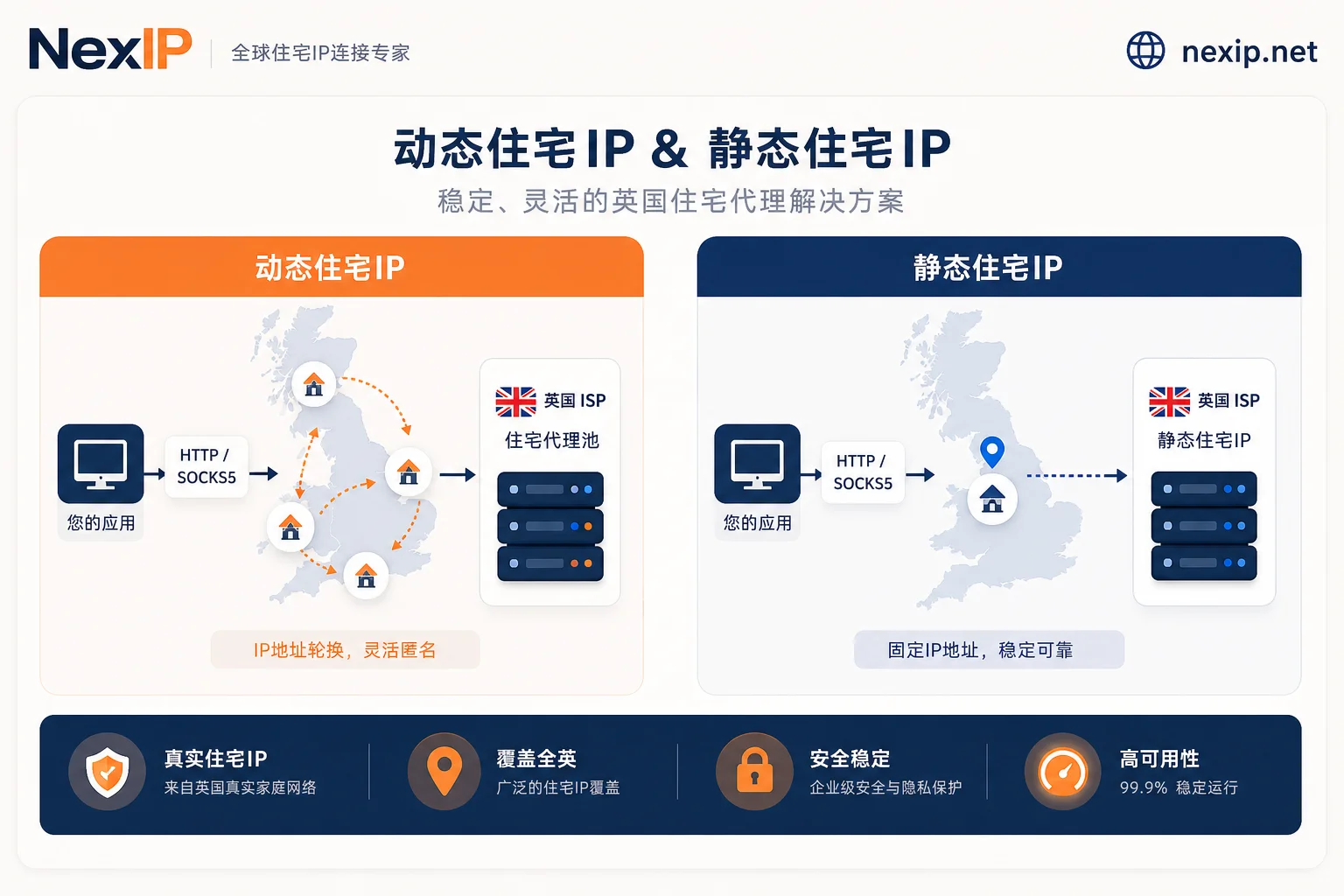
2. Scenario-based Selection of Dynamic and Static Residential IPs
When choosing UK residential IPs, it is necessary to find the best balance between "dynamic rotation" and "static fixed" based on business nature:
| IP Type | Key Features | Applicable Scenarios |
|---|---|---|
| Dynamic Residential IP | Automatic rotation or on-demand switching, large resource pool, hides real request source | Public market data scraping, brand monitoring, ad verification, high-concurrency analysis |
| Static Residential IP | Long-term fixed address, combines data center speed with home broadband reputation | Cross-border e-commerce store management, social media account daily operation, long-term authentication for specific businesses |
3. Building Compliant Network Architecture Based on NexIP
When constructing a UK network connection solution, enterprises can rely on the technical capabilities of professional proxy services to achieve flexible scheduling. NexIP provides multi-dimensional configuration options at the proxy infrastructure level:
- Data scraping and high-concurrency scenarios: Use NexIP's dynamic residential proxy traffic plan or dynamic residential proxy bandwidth plan. Utilize its API integration capabilities and global region selection to precisely target major UK cities and specified ASNs, ensuring compliant traffic usage while achieving high scraping success rates.
- Store and account management scenarios: For businesses requiring fixed network identity, access NexIP's static short-term residential IP or static long-term residential IP. Combined with session stickiness settings, ensure consistency of the login environment, effectively reducing risks caused by network environment changes.
- Multi-protocol adaptation: Flexibly switch between HTTP/SOCKS5 protocols in the NexIP centralized management platform according to the needs of business clients or fingerprint browsers, achieving seamless integration.
4. Brand Interaction: How to Verify Your UK Proxy Configuration?
Before formally deploying UK residential IPs, it is recommended that teams conduct an environment check using the following three-step checklist:
- [ ] Purity check: Use testing tools to confirm that the IP's ASN belongs to a UK local home broadband operator and is not on public blacklists.
- [ ] Protocol and port configuration: Confirm that the proxy access point supports SOCKS5 or HTTP protocol, and test latency and packet loss rate.
- [ ] Geographic location verification: Check if the GeoIP database returns location consistent with the target city.
To ensure stable business links, conduct small-scale testing combining NexIP's flexible dynamic plans and long-term static resources to verify session stickiness and network response speed before large-scale deployment.



Comments(0)