 NexIP官方博客
Japan Residential IP Selection Guide: Ensuring Cross-Border Business Stability Under Strict Risk Control
As anti-fraud and risk control scrutiny on platforms like Rakuten, Amazon Japan, Mercari, and TikTok Japan intensifies, cross-border merchants frequently encounter account association, traffic restrictions, or login verification blocks in the Japan region. The core root cause often lies in insufficient IP reputation at the network level. In the Japanese market, ordinary IDC data center IPs have been flagged as high-risk by most local platforms. The only IPs that can maintain long-term stability are Japan residential IPs sourced from local network operators (such as NTT, KDDI, SoftBank, etc.).
This article starts from the risk control logic of major Japanese platforms, outlines the applicable scenarios for Japan dynamic residential IPs and static residential IPs, and introduces how to combine enterprise proxy access solutions for efficient and compliant operations.
Why Does Japan-Region Business Heavily Depend on Japan Residential IPs?
In the Asia-Pacific region, Japan's digital infrastructure is highly centralized and strictly regulated. Platform algorithms have extremely high scrutiny standards for geographic consistency, IP fraud scores, and ISP fingerprints:
- Avoid IP segment association and data center flags: Data center IPs have transparent ASN fingerprints, making them easy for e-commerce and social media platforms to block in one click. In contrast, Japan residential IPs are allocated from physical broadband and carry authentic local residential characteristics.
- Unlock region-restricted resources: Platforms like Rakuten merchant backend, Yahoo! Shopping, and Japan local advertising systems enforce strict isolation policies for non-Japanese IPs.
- Boost account weight and recommendations: Real residential traffic significantly reduces abnormal login risks and makes user behavior align with local compliance standards.
Two Main Types of Japan Residential IPs and Scenario Matching
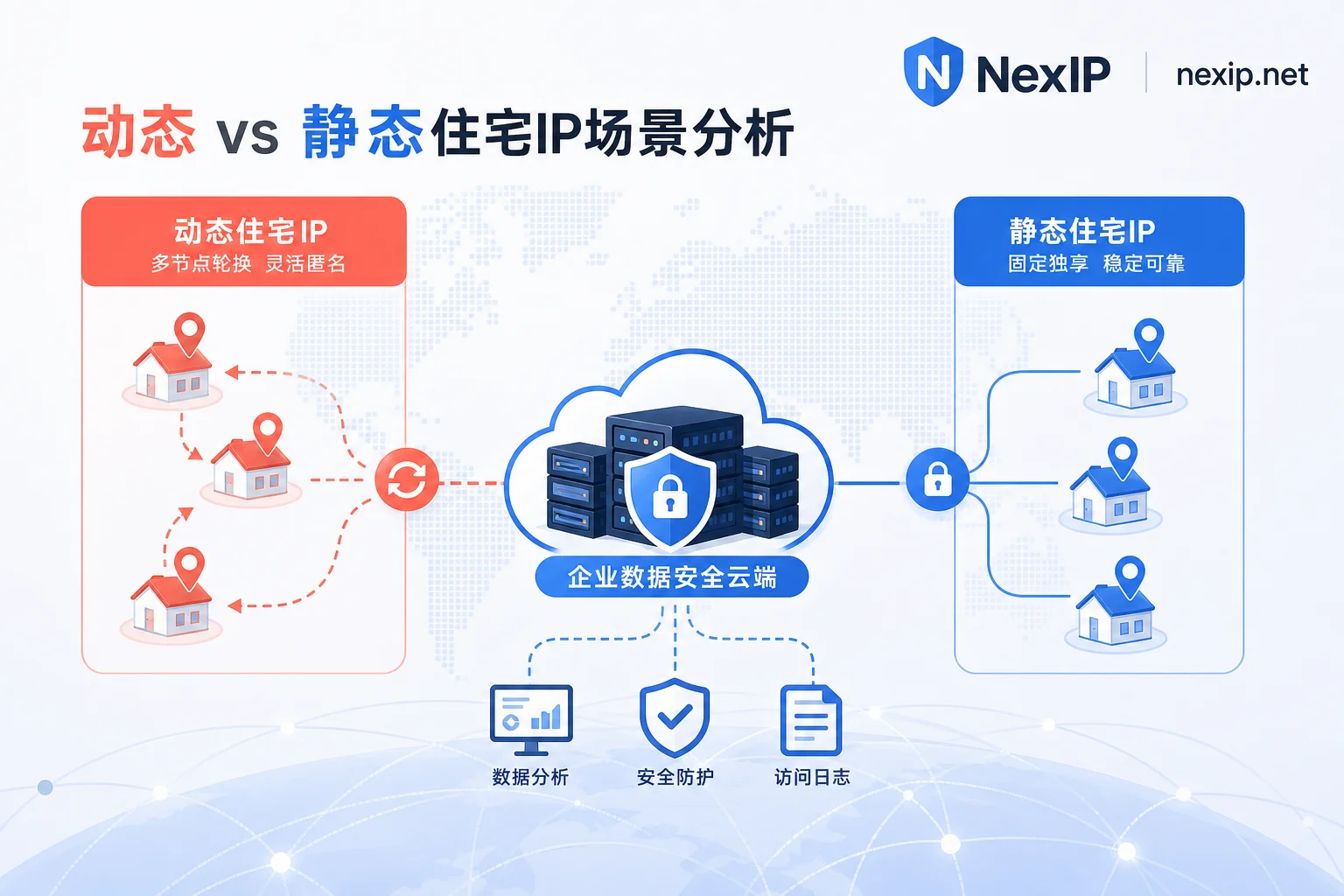
Facing different business scenarios, choosing the right type of residential IP balances cost and stability:
| IP Type | Features and Advantages | Recommended Application Scenarios |
|---|---|---|
| Dynamic Residential IP | Automatically rotates with each request or at fixed intervals, with a large local real pool | Large-scale Japan-region price monitoring, SERP data collection, competitor analysis |
| Static Residential IP | Dedicated single IP with fixed connection, maintaining consistent network environment fingerprint over time | Daily maintenance of Rakuten/Amazon shop backends, long-term operation of social media main accounts |
For teams that need to balance short-term automated verification and long-term main account maintenance, flexibly combining traffic and bandwidth modes is key to reducing overall operational costs.
Operator Identification and City/ASN Targeting Strategy
When selecting Japan residential IPs, you should not only look at “Japan as a country” but also pay attention to specific network operators (ISP) and geographic nodes:
- Core Operators (ASN): Such as NTT Communications (AS4713), KDDI/au (AS2519), and SoftBank (AS17676). IP pools from these national telecom providers have extremely high reputation scores.
- Precise City Targeting: For regional ad campaigns or offline promotion verification in Japan, the scheduling capability of IP nodes in Tokyo and Osaka determines the authenticity of test data.
How NexIP Helps Japan-Region Cross-Border Business Achieve Robust Efficiency
When facing frequently updated review mechanisms on Japanese platforms, enterprises need proxy infrastructure that combines high purity and flexible access. NexIP provides multi-dimensional Japan residential proxy support for cross-border teams:
- Diverse Product Portfolio: Includes dynamic residential proxy traffic plans, dynamic residential proxy bandwidth plans, as well as static short-term residential IPs and static long-term residential IPs suitable for fixed scenarios.
- Granular Targeting Capabilities: Supports precise global region selection, city and ASN-level targeting, coupled with flexible session stickiness settings, to meet diverse compliance access needs.
- Standard Protocols and Integration: Fully supports HTTP/SOCKS5 proxy protocols and standard API rapid integration, seamlessly connecting with fingerprint browsers, automated testing scripts, and enterprise internal network systems.
Brand Interaction: Find the Right IP Combination for Your Japan Project
If your team is preparing to launch a Japan-region e-commerce matrix or conduct market research, start by outlining your business request frequency and session duration requirements. For frequent data collection projects, it is recommended to connect to NexIP's dynamic residential proxy for on-demand calls. For daily login to important account assets, it is suggested to bind dedicated static residential IPs to establish an independent compliant network barrier.
Summary and Action Recommendations
Choosing high-quality Japan residential IPs is the foundation for safe operations in cross-border e-commerce, social media marketing, and data collection in the Japan region. It is recommended that enterprise teams consider the following when deploying network environments:
- Avoid shared data center proxies and prioritize residential resources allocated by native ISPs;
- Based on business requirements, make a clear architectural division between dynamic rotation and static long-term use;
- Establish standard IP risk detection and regular inspection mechanisms to ensure continuous, stable, and compliant network access.



Comments(0)