 NexIP官方博客
Germany Residential IP Selection Guide: Cross-Border E-Commerce and Localized Data Compliance Crawling Explained
In the European digital single market, Germany, with its massive e-commerce consumption and stringent network risk control standards, has become a key region for cross-border enterprises expanding their European business. Whether operating on local e-commerce platforms such as Amazon DE, Otto, and Zalando, or conducting European market competitor monitoring and SEO data scraping, high-quality and highly clean German residential IPs are an important network infrastructure to ensure business continuity and account compliance.
To help enterprises establish a robust network link under high-traffic access and risk control systems, this article will systematically analyze the selection logic and configuration strategies of German residential IPs from the perspectives of European network resource allocation policies (such as RIPE NCC regulations), carrier ISP characteristics, and business operations.
1. Why Do European Businesses Highly Depend on Real German Residential IPs?
In the European network environment, there is a significant difference in the risk control weight of data center IPs and real home residential IPs on target platforms. IP addresses assigned to home users by major local German telecom operators (such as Deutsche Telekom, Vodafone Germany, and Telefónica O2) naturally have a "real resident" attribute in IP databases.
1. Bypass Strict Risk Controls on E-Commerce and Social Platforms
Platforms such as Amazon DE and Otto are highly sensitive to multi-account association and abnormal remote logins. If data center IPs are used, it is easy to trigger secondary verification or restrictions because the ASN (Autonomous System Number) is flagged as a cloud provider. German residential IPs have a real Residential label, which can effectively reduce risk control systems' doubts about the device environment.
2. Obtain Accurate Localized SERP and Price Data
German federal states and major cities (such as Berlin, Munich, Frankfurt, and Hamburg) have regional differences in search engine results (SERP), ad displays, and dynamic pricing. Precise city-level and ASN-targeted residential IPs can help enterprises obtain unbiased local market intelligence.
2. Classification and Use Case Comparison of German Residential IPs
According to different business needs, German residential IPs are mainly divided into dynamic residential proxies and static residential IPs:
| Proxy Type | IP Rotation Mechanism | Core Advantages | Recommended Use Cases |
|---|---|---|---|
| Dynamic Residential Proxy (traffic/bandwidth-based) | Rotate per request or maintain session (e.g., 10-30 minutes) | Large IP pool, strong anti-ban capability, cost-controllable | Competitor price scraping, SEO monitoring, ad verification, bulk data collection |
| Static Short-Term/Long-Term Residential IP | Long-term allocated fixed IP address (single ISP or dual ISP) | Extremely stable environment, high reputation, avoids frequent remote logins | Cross-border e-commerce store management (Amazon/Otto), social media premium account operations, payment and compliance operations |
According to RIPE NCC's IPv4 allocation and management policies, IPv4 resources in Europe have entered a highly refined management stage. Choosing residential IPs with legal authorization, compliant sources, and high cleanliness is key to avoiding IP pollution and blacklist risks.
3. Industry Trends and Network Empowerment by NexIP
According to RIPE NCC and international IP market statistics, with the full implementation of European network security requirements (such as the NIS2 Directive) and RPKI route validation, enterprises have raised higher requirements for the legality of proxy networks, routing stability, and protocol compatibility. Simply pursuing the number of IPs can no longer meet high-end business needs; network cleanliness, session control, and precise targeting have become core indicators.
As a professional global network proxy provider, NexIP has built a residential proxy architecture with wide coverage and excellent performance for the complex network environment in Europe and Germany:
- Diversified Package System: NexIP offers dynamic residential proxy traffic packages and dynamic residential proxy bandwidth packages to meet the cost control needs of large-concurrency data collection enterprises; it also provides static short-term residential IPs and static long-term residential IPs, providing stable and lasting network identities for e-commerce store protection.
- Precise Granularity Control: Supports targeting at country, city, and specific operator ASN levels in Germany, combined with flexible session stickiness settings (Sticky Sessions), ensuring uninterrupted multi-threaded scraping or long-term management tasks.
- Multi-Protocol and API Seamless Integration: Full support for HTTP/HTTPS and SOCKS5 protocols, and provides a standardized API for development teams to quickly integrate into fingerprint browsers, automated crawlers, or internal enterprise networking systems.
Brand Interaction and Operational Recommendations
For enterprises conducting cross-border business in the German market, the NexIP team recommends the following compliant configuration:
- Store Operations Scenario: It is recommended to use static long-term residential IPs, combined with anti-association fingerprint browsers bound to fixed IPs and cookies, to simulate the daily login behavior of local German residents, avoiding store reviews triggered by frequent IP drift.
- Data Scraping Scenario: Integrate with NexIP's dynamic residential proxy API to rotate per request or maintain sessions per minute, and schedule traffic for major ASNs such as Deutsche Telekom (AS3320) or Vodafone (AS3209), greatly improving crawler success rates.
4. German Residential IP Configuration Checklist
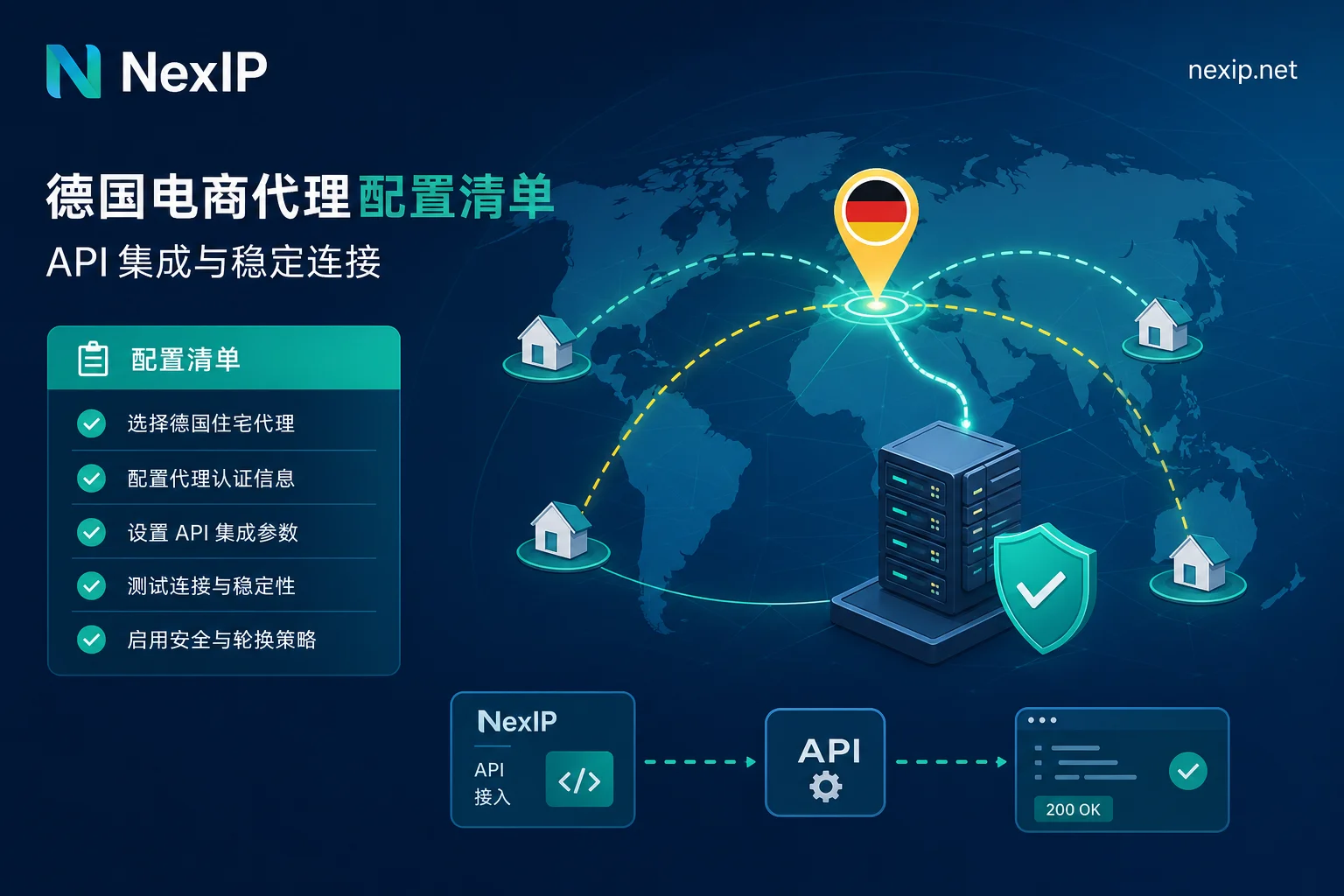
Before deploying German residential IPs, please refer to the following practical checklist to ensure a clean and compliant network environment:
- [ ] IP Geo-Location and ASN Verification: Verify that the IP's GeoIP database location is in Germany and that the ASN type is ISP/Residential.
- [ ] DNS and WebRTC Leak Prevention: Configure the browser environment to ensure that DNS resolution nodes and WebRTC-exposed IPs are consistent, with no local real IP leaks.
- [ ] Time Zone and Language Alignment: Adjust the client system time zone to
Europe/Berlin(UTC+1/UTC+2) and set the browser preferred language tode-DE, de. - [ ] Protocol and Secure Channel: Prioritize SOCKS5 or HTTPS encrypted protocols to reduce data transmission latency and the risk of man-in-the-middle interception.
Evaluate your current European cross-border business network configuration and rationally combine dynamic and static residential resources to help your team establish a safe, efficient, and sustainable competitive advantage in Germany and the entire European market.


Comments(0)