 NexIP官方博客
In 2026, for cross-border e-commerce, TikTok matrix operations, and high-frequency use of overseas AI tools, dual-ISP residential IPs have evolved from a "bonus" to a "standard" for many teams. In major review communities and tech forums, discussions about "US dual-ISP VPS" and "Taiwan/Japan native dual-ISP" remain heated.
The reason is simple: whether it's TikTok's 0-view throttling, Amazon and independent store payment risk control, or the wave of bans on mainstream overseas AI platforms, platform risk control systems cross-check ASN ownership and WHOIS registration attributes. When an IP is marked as ISP (Internet Service Provider) instead of Hosting (data center hosting) in both core fields, its trustworthiness as a real home broadband connection significantly increases.
However, in practice, many technical leads and operations teams fall into another dilemma: to obtain stable dual-ISP residential IPs, should you buy multiple dual-ISP VPS and build your own nodes, or directly purchase residential proxy services that support native dual-ISP?
If you have already read about the technical principles in Why You Still Get Burned Even When It's a Dual-ISP Residential IP, then today we will go beyond mere concept科普 and calculate the trade-offs between "self-built dual-ISP VPS" and "direct access to static residential proxies" from four dimensions: team engineering efficiency, hidden risk control costs, IP disaster recovery and replacement, and multi-scenario collaboration.
1. Why Is Everyone Racing for "Dual-ISP Residential IPs" in 2026?
Before diving into the comparison, let's quickly align on the real demands for dual-ISP residential IPs in frontline businesses in 2026. Current market demand for such high-trust exits is mainly concentrated in three high-value scenarios:
- TikTok localized account warming and live streaming matrix: Data center IPs are flagged immediately upon launch, and ordinary single-ISP broadcast IPs often encounter "silent throttling" or get stuck at a few hundred views. Only dual-ISP native home broadband with genuine local carrier attributes can reliably support account nurturing, product links, and daily video posting.
- Cross-border e-commerce store backends and payment verification: Multi-store anti-association not only depends on the environment but also on the stability and historical purity of fixed exits. Local store logins and card binding verification are extremely picky about IP registration ownership and usage type.
- Long-term survival of overseas AI accounts: Team-shared high-tier AI subscription accounts are highly prone to secondary verification or outright bans once the exit IP jumps or falls into cheap data center ranges.
Facing these demands, many individual players' first reaction is to search for "dual-ISP VPS," buy a cloud host for a few to a dozen dollars a month, connect to it, set up the environment, and configure protocols. But in team-based, matrix operations, this path often becomes increasingly burdensome.
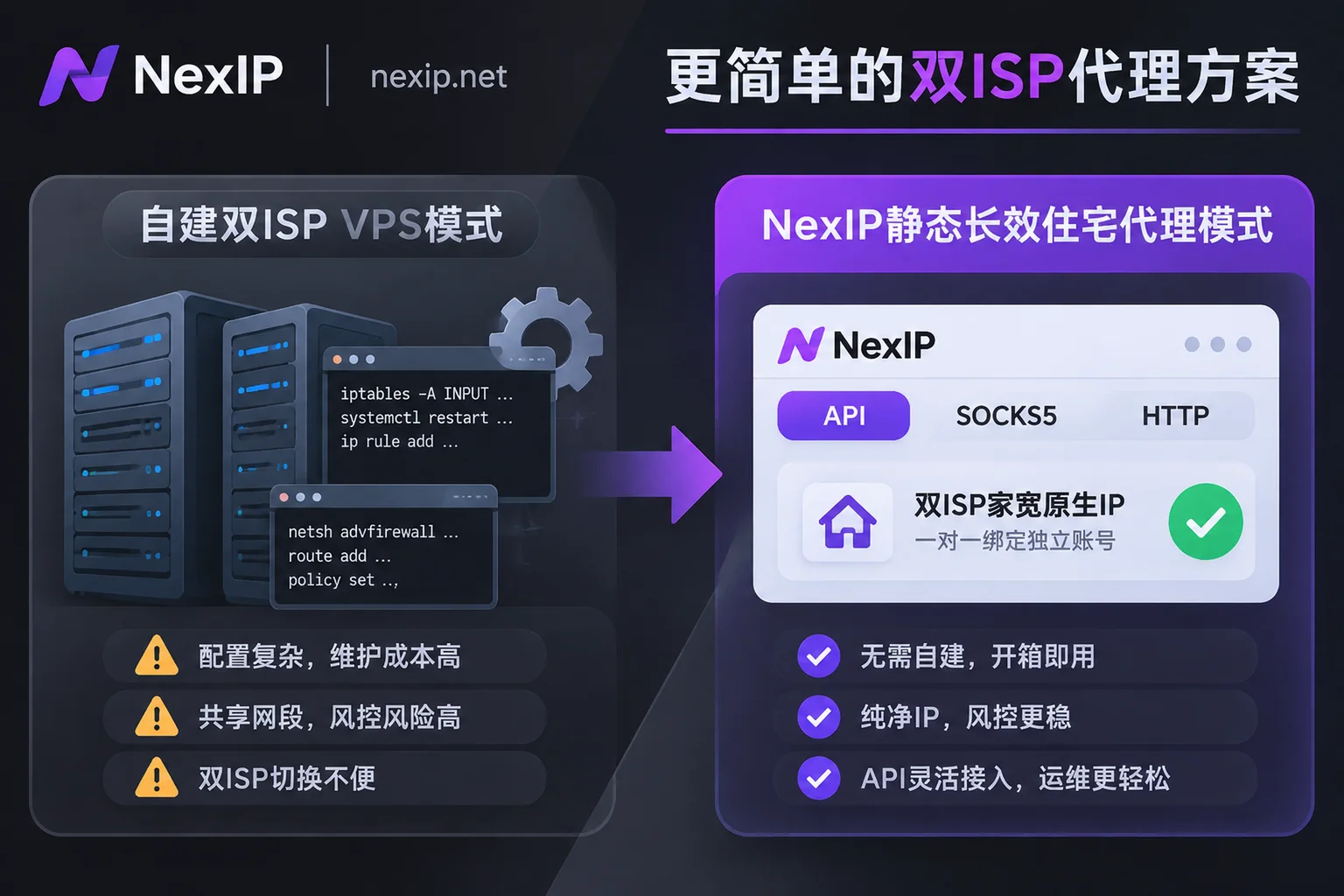
2. Three Hidden Costs of Self-Built Dual-ISP VPS: You're Not Buying IPs, You're Buying Ops Tickets
For individual developers with only 1-2 accounts, buying a dual-ISP VPS to run other services is understandable. But when your TikTok matrix expands to 20 accounts and cross-border stores increase to over 10, the shortcomings of the self-built VPS model quickly surface:
1. Compute Redundancy and Server Ops Burden
Your core need is actually just a clean, fixed network exit, but buying a VPS means you must pay for bundled CPU, memory, and disk. More importantly, you are responsible for each machine's Linux security updates, proxy server setup (e.g., configuring SOCKS5 or HTTP forwarding), port scan protection, and firewall rules. Once line fluctuations or server crashes occur, operations staff can only halt work and wait for technical troubleshooting.
2. "Fake Home Broadband" and Adjacent Subnet Contamination Risk
Many cheap "dual-ISP VPS" are essentially IP ranges registered as ISP attributes but broadcast via BGP to data centers (i.e., home broadband broadcast), and the same physical host or C-segment is often crowded with peers who also bought them for cross-border or TK purposes. We have detailed the fundamental differences in Why You Still Get Throttled Even When It Shows Residential? Starting from the Risk Control Differences Between Native Residential IPs and Broadcast Subnets. Once a neighbor on the same host engages in abusive email sending or high-frequency brute-force scraping, the entire subnet's reputation score is dragged down.
3. High Replacement Cost After IP Contamination
In long-term account operations, any IP may become invalid due to target platform policy adjustments or misjudgments. If you bought a VPS, changing the IP usually requires submitting a ticket and paying a "IP change fee" of tens of yuan; some discounted plans even explicitly state "no returns or exchanges."
3. Calculating the Engineering Bill: Self-Built Dual-ISP VPS vs. Direct Residential Proxy IPs
In contrast, residential proxy providers focused on network exits eliminate the cumbersome underlying host maintenance. Take NexIP's Static Residential Proxy · Long-acting IP as an example: it also provides exclusive fixed network exits and supports native dual ISP, but simplifies the delivery format directly to a standard HTTP/HTTPS/SOCKS5 proxy endpoint.
The following comparison table直观ly shows the differences between the two solutions in team实战:
| Comparison Dimension | Self-Built Dual-ISP VPS Host | NexIP Static Long-acting Residential Proxy (Native Dual-ISP) |
|---|---|---|
| Delivery and Access Efficiency | Requires SSH login, proxy service installation, port and security policy configuration | Ready to use, supports username/password authentication or IP whitelist, provides API extraction, port forwarding, process proxy |
| Transparency of IP Sub-attributes | Often packages "broadcast ISP" as real home broadband, causing beginners to fall into pitfalls | Clearly distinguishes native home broadband, broadcast home broadband, and data center subcategories, transparent purchase as needed |
| Failure Disaster Recovery Mechanism | Changing IP usually requires a paid ticket or forced purchase of a new machine | Supports free replacement upon failure, greatly reducing trial-and-error costs in long-term operations |
| Traffic and Billing Rules | Most limit monthly traffic packages (suspension or speed reduction upon excess), pay for redundant compute | Monthly or yearly rental of exclusive fixed exit, unlimited traffic, pay only for pure high-quality exit |
| Team Collaboration and Management | Dozens of VPS scattered across different panels, difficult to maintain passwords and expiration dates uniformly | Unified management via official panel and client, supports API management and sub-account permission allocation |
4. 2026 Practical Configuration Guide for Dual-ISP Residential Proxies in Cross-border and AI Businesses
After abandoning the heavy self-built VPS approach, how should teams use ready-made residential proxy product lines to build a network exit architecture that passes risk control without wasting budget? Based on our tiered approach in How to Choose Static Residential IPs, you can follow these three steps:
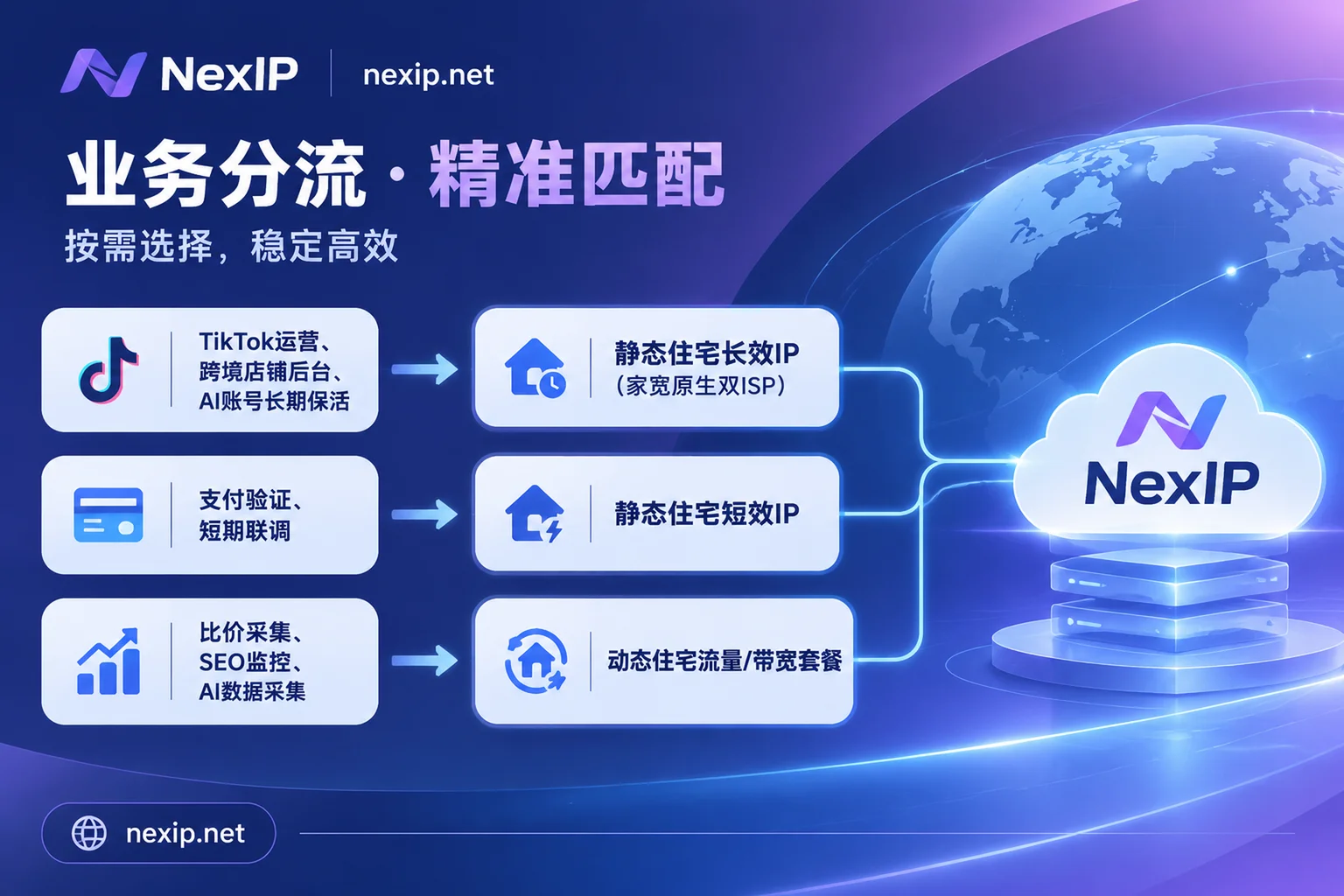
1. Core Accounts (TK Matrix, Main Stores, High-tier AI Accounts): Stick to "Static Long-acting + Native Home Broadband Dual-ISP"
For TikTok core accounts that directly determine revenue, Amazon/independent store backends, and overseas AI accounts that need long-term login sessions, the core principle is "one account fixedly bound to one exclusive native exit".
- Selection Advice: Directly choose the native home broadband subcategory in Static Residential Proxy · Long-acting IP and check resources that support native dual-ISP. If you're unsure which businesses can compromise with broadcast subnets to reduce costs, first read the official comparison page How to Choose Between Native Home Broadband and Broadcast Home Broadband.
- Special Optimization: For TK operations scenarios, using native home broadband IPs from static long-acting can most authentically replicate local home broadband internet characteristics; meanwhile, you can precisely target by country, city, ASN, and local carrier on the Global Node Coverage Page according to your target market (subject to inventory).
2. Temporary Joint Debugging and Sensitive Verification: Pair with "Static Short-acting IP" to Avoid Resource Idleness
Not all tasks requiring fixed residential exits need monthly or yearly subscriptions. If your team is conducting batch overseas payment interface integration, short-term account registration verification, or ad landing page testing, buying monthly VPS or long-acting IPs would cause idle waste.
- Selection Advice: Such scenarios can seamlessly switch to Static Residential Proxy · Short-acting IP. It is also an exclusive fixed static residential (ISP) IP with unlimited traffic, but supports hourly or daily billing, pay-as-you-go. For how to coordinate long and short-acting, refer to 2026 Practical Guide to Long-Short Acting Synergy of Static Residential IPs.
3. Peripheral Data Support (Price Comparison, Public Opinion, AI Corpus Retrieval): Leave to Dynamic Residential Pools
Many people, when searching for dual-ISP VPS, also mention "using it for batch data collection." Actually, using fixed IPs for high-frequency scraping is the most error-prone practice that easily triggers bans. When business involves public data collection, traffic should immediately be separated from static dual-ISP exits:
- Price comparison collection, ad verification, SEO monitoring, AI data collection (RAG and AI Agent real-time web access): Use GB-billed Dynamic Residential Proxy · Traffic Plan (see AI Application Solutions), supporting per-request rotation or sticky sessions.
- Continuous public opinion monitoring, inventory tracking, API polling: If task throughput is large and runs 24/7, to avoid uncontrolled traffic bills, it's recommended to use port-bandwidth-billed, unlimited traffic (fair use) Dynamic Residential Proxy · Bandwidth Plan.
5. Conclusion: Return Server Ops to Cloud Providers, Leave Pure Exits to Proxies
In the increasingly stringent platform risk control of 2026, dual-ISP residential IPs are indeed an important defense line for protecting core account assets. But the way to obtain this defense should never be to turn operations and development teams into "part-time Linux system administrators," spending daily effort maintaining dozens of scattered VPS.
By directly accessing static residential proxies that clearly distinguish native home broadband from broadcast attributes, support native dual-ISP, and offer free replacement upon failure, teams can not only equip compliant, stable fixed exits in a lighter way but also achieve efficient collaboration through unified panels and sub-account features. If you are planning a network foundation for multi-store anti-association, TikTok matrix, or more industry scenario solutions, feel free to visit the NexIP User Panel to check access documentation and configure your exclusive residential exit as needed.