 NexIP官方博客
No single detection website's score should be fully trusted on its own. The same proxy IP can be rated "green, extremely pure" on one site but "high-risk proxy" on another; one may show "residential broadband" while another labels it "IDC datacenter"—this isn't a tool malfunction, but because the industry has never had a globally unified "proxy IP purity" certification standard.
Each detection site essentially provides a "risk reference opinion" based on different intelligence sources, not a pass for the target platform. When scores diverge greatly, the correct approach is not to pick the site with the most favorable score for self-comfort, but to understand where the discrepancy comes from, break the total score down into underlying signals for cross-verification, and finally test on your business target site.
Why does the same IP show such different results across websites?
1. Each focuses on different "risk types" and database sources
The IP intelligence field suffers from a clear "data silo" effect; different websites connect to databases with completely different emphases:
- Anti-spam and network attack types: For example, Spamhaus mainly tracks spam sources, while AbuseIPDB focuses on port scanning, brute force, and web attack reports.
- Transaction fraud and anonymous network types: For example, Scamalytics, IPQualityScore (IPQS), or MaxMind pay more attention to payment fraud, bulk registration, and commercial proxy/VPN characteristics.
- Local connection and camouflage consistency types: For example, environment detection sites like Whoer focus on checking DNS resolution location, whether WebRTC exposes the real address, and whether system timezone and language match.
This easily explains why an IP can score 100% on Whoer but show a red flag on IPQS—the former is praising that your "proxy connection camouflage hasn't been exposed," while the latter is warning that "this address range has recent fraud or proxy records." They are not measuring the same thing at all.
2. Different data update times and "memory cycles"
IP addresses (especially dynamic residential pools and IP ranges recycled and reassigned by operators) circulate quickly, and detection sites have very different update rhythms:
- Some tools look at real-time reports from the last 7 days, some count the past 90 days, and some historical stains never decay;
- Some websites pull upstream interfaces in real time, while others display cached snapshots from days or even weeks ago.
If an IP was ruined by the previous user a few days ago and just completed recycling or settling yesterday, it's very normal to get vastly different scores on different websites today.
3. Different criteria for determining ownership type (residential vs datacenter) and geolocation
Many users are most confused by "I clearly bought a residential IP, why does one site show residential and another show datacenter":
- Look at "owner" or "actual usage": Some basic databases only check whether the ASN registrant is a telecom operator (ISP); as long as the number segment belongs to an operator, it's labeled residential. But some tools (like Ping0) further annotate the actual usage of specific IP ranges—even if the segment is under an operator's name, if it's found to be actually hosted in datacenter servers, it will be classified as IDC datacenter.
- Discrepancy between native and broadcast geolocation: The registered country of a broadcast IP may not match its actual BGP announcement and physical usage location. A lookup by registration database may show country A, while a lookup by routing latency or user reports shows country B. To further analyze the difference between these two types of network segments in the eyes of platform risk control, refer to "Why does a residential IP still get rate-limited? Discussing risk control differences between native residential IPs and broadcast network segments".
4. Different scoring weights and rules for handling "no data found"
For the same clues, each provider's scoring formula is completely different: some add up multiple blacklist scores directly, some only trust the heaviest evidence, and some give a high baseline risk score as soon as they see hosting datacenter attributes.
Another easily overlooked detail is how missing data is handled: when a data source times out or has no record of the IP, some detection sites default to "0 risk/normal," making the total score look exceptionally good; while more rigorous aggregation tools mark it as "pending verification" and won't treat it as clean evidence.
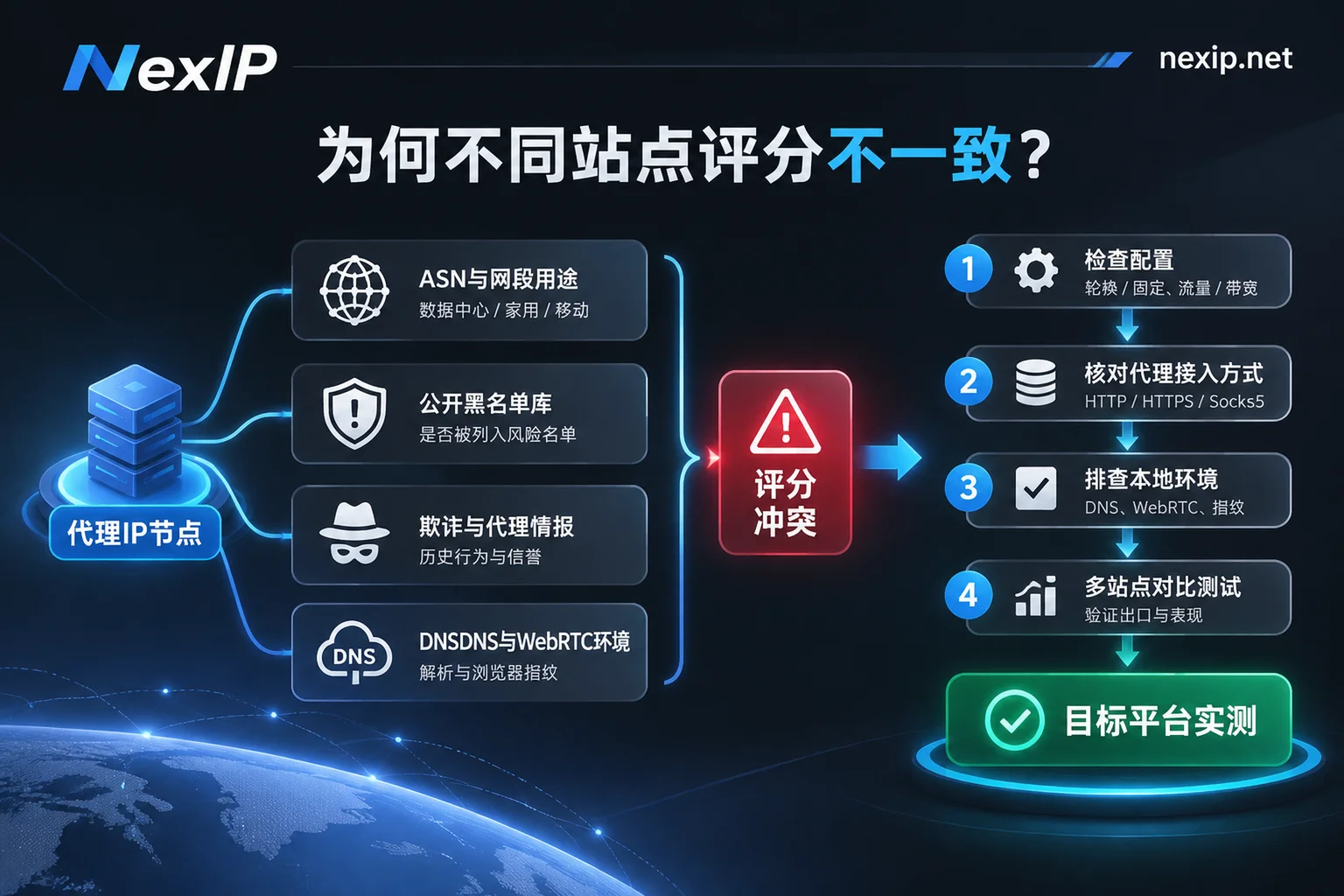
When scores conflict, how to judge? Follow these 4 steps
A premise must be clarified: Detection website scores are suitable for "mine detection (finding obvious problems)," not for "guaranteeing (proving you will never get banned)". There is no public evidence that mainstream cross-border e-commerce, social media, or overseas AI platforms directly copy the percentage scores from any free detection site; they all rely on comprehensive risk control combining device fingerprints, account behavior, and private intelligence.
When results from several sites contradict each other, cross-verify using the following 4 steps:
| Common discrepancy | Common underlying cause | Correct judgment and handling |
|---|---|---|
| Whoer 100%, IPQS/Scamalytics high risk | Whoer looks at browser and connection camouflage; the latter two look at fraud and proxy history | Review blacklist records; for high-sensitivity registration or account nurturing, consider replacement |
| One shows residential, another shows IDC datacenter | Only ASN owner vs actual network segment usage annotation | Check ASN organization name, reverse DNS, and whether it's a datacenter broadcast segment |
| Country/city inconsistent across sites | Database update lag, or broadcast IP segment | Rely on the region recognized by your target business site and actual routing latency |
| Only one site high risk, others all green with no blacklist | Single data source cache not updated or model bias | Test on a low-sensitivity page of your target business; don't rush to reject |
| Multiple sites simultaneously mark as Proxy/Tor or hit AbuseIPDB | Indeed high-frequency sharing or recent abuse history | This is a valid mine-detection signal; directly disable or replace the exit |
Step 1: Verify "hard identity" (ASN, ISP, region) first, ignore the total score for now
Use IPinfo or WHOIS/BGP lookup tools to verify two facts: whether the IP's ASN ownership is indeed an operator (ISP) in the target region, and whether the actual identified country matches expectations. For specific verification methods, refer to "How to check if an IP's ASN belongs to an ISP: look at announced ASN, verify IP segment ownership, compare multiple IP databases". If the underlying ownership doesn't match the purchase description, a green total score is meaningless.
Step 2: Separate "historical abuse records" from "proxy characteristic tags"
Open tools like AbuseIPDB, Scamalytics, and see what specific records are hit, rather than just staring at a big number in the top right corner:
- Multiple sites hit simultaneously: If multiple databases simultaneously flag recent abuse reports, spam blacklists, or public proxy/Tor exits, it means this IP has indeed been used repeatedly by many people and will likely frequently hit defenses in business.
- Isolated high score on a single site: If public blacklists are all empty and multiple sites give good results, and only one website gives a high score, it's usually just algorithm weight or cache time difference—no need to over-anxiety.
Step 3: Check if your own proxy environment is "leaking"
Sometimes the IP itself is clean, but detection sites keep reporting errors—actually it's a local connection configuration issue: for example, the browser goes through the proxy but DNS resolution is still direct, WebRTC leaks the real internal or public address, or system timezone and language don't match the exit city. First clean up these connection-layer issues, then evaluate IP quality.
Step 4: Do a "low-cost real test" on the target platform
You are not serving the detection website, but your business target site. Mount the IP in an independent blank test environment, visit the target platform's regular pages, search box, or pre-login page, and observe whether loading is smooth, whether human verification or 403 blocks pop up unexpectedly. For what underlying metrics platform risk control also jointly verifies, you can further investigate with "How is proxy IP purity defined? Beyond ASN and geolocation, this is the truth risk control can't avoid".
Stop fussing over detection sites: choose controllable exits based on business scenarios
Many people刷 back and forth between different detection sites every day, essentially because they use uncontrollable shared pools for high-sensitivity business, or don't match exit types to business lifecycle.
If your business is store backend management, cross-border e-commerce, TikTok operations, social media matrices, or long-term maintenance of overseas AI accounts, rather than repeatedly gambling on a dynamic score in third-party tools, it's more important to ensure exit independence and controllability from the source. In such long-cycle business, evaluating proxy IP purity should focus on "whether it's exclusive and fixed" and "whether the network segment source is clear." NexIP's Static Residential Proxy·Long-lasting IP provides exclusive fixed exits rented monthly or yearly (unlimited traffic), clearly divided into three subcategories: native home broadband, broadcast home broadband, and datacenter, and supports native dual ISP and free replacement upon failure. For TikTok operations or high-risk store backends, it's recommended to directly use native home broadband IPs and stick to one account one fixed IP; to understand the specific differences between native and broadcast segments, see the official website's comparison of native home broadband and broadcast home broadband.
If it's only for account registration verification, payment verification, or short-cycle testing and integration, you don't need to rent a fixed exit monthly. NexIP's Static Residential Proxy·Short-term IP provides hourly or daily exclusive fixed residential (ISP) IPs (billed per IP, unlimited traffic), avoiding session breaks from dynamic IP switching mid-way and not bearing long-term rental costs.
For public data tasks like price comparison scraping, SEO/SERP monitoring, ad verification, AI data crawling, or continuous sentiment tracking, the business itself doesn't need a single IP to score high on some free scoring site; it values rotation strategy, region/ASN targeting accuracy, and actual return rate from the target site. Such tasks can use NexIP's Dynamic Residential Proxy·Traffic Package (billed per GB, supports per-request rotation or sticky sessions) or the Dynamic Residential Proxy·Bandwidth Package suitable for high-throughput continuous tasks. All NexIP series support HTTP/HTTPS/SOCKS5, can target by country, city, ASN, and operator (subject to inventory), and provide four access methods: API extraction, username/password, port forwarding, and process proxy. Development teams can directly write automated target site liveness verification logic into scripts; specific pool coverage, lease terms, and billing specifications are subject to the official website and NexIP user backend.
It should be noted that proxy service providers solve compliance and stability issues at the network exit layer. Whether accounts and business can run smoothly long-term still requires you to cooperate on the business side with browser environment isolation, consistency of account information, and normal operation rhythm. Treat detection websites as mine-detection tools and target platform feedback as the ruler, so you won't be led by the nose by conflicting scores.