 NexIP官方博客
Conclusion first: You cannot use Singapore residential IPs to replace those of the other five Southeast Asian countries (Malaysia, Thailand, Vietnam, Indonesia, the Philippines); and the reason why the Southeast Asian residential IPs you buy often feel "slow and expensive, with location jumping around" is usually not that the residential network itself is unusable, but rather cross-border routing detours, providers using broadcast segments as native, and using rotating pools for long-session business.
Many teams, when first entering the Southeast Asian market, tend to treat "Southeast Asia" as a single region for buying egress—either directly connecting all lines to Singapore nodes for speed, or after buying residential IPs from Indonesia, Vietnam, or Thailand, finding that web pages load extremely slowly and are sometimes recognized by platforms as Singapore or Hong Kong. Below, we thoroughly explain the underlying network logic, pitfalls, and actionable selection and acceptance steps.
I. Why can't Singapore residential IPs "cover all" Southeast Asia?
Singapore is indeed the network and submarine cable hub of Southeast Asia, with abundant bandwidth from local operators such as Singtel, StarHub, and MyRepublic, and short links to neighboring countries. But this only means Singapore is suitable as an egress for local operations, regional hub testing, or Singapore-specific business, and does not mean it can "disguise" you as a home user in Jakarta, Bangkok, or Ho Chi Minh City.
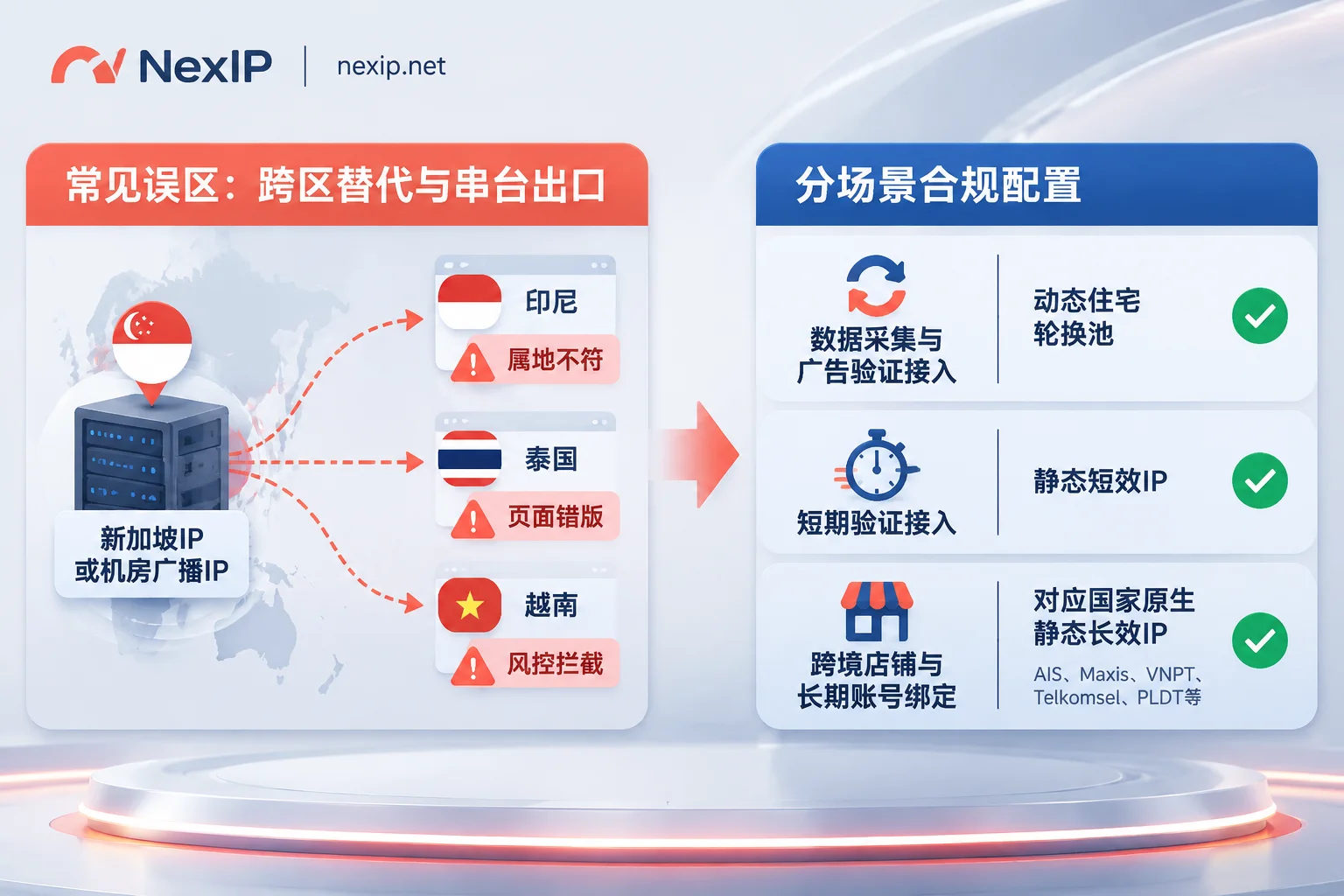
Using Singapore nodes across regions will immediately hit three hard walls under platform verification in 2026:
- Country database and localized content mismatch: Whether doing front-end price comparison on Shopee, Lazada, TikTok Shop, Tokopedia, or monitoring local Google SERP rankings and verifying ad landing pages, the currency, shipping templates, ad creatives, and search results obtained via Singapore IPs are completely different from what local users in Indonesia or Thailand see.
- Time zone, language, and location cross-anomalies: Singapore, Malaysia, and the Philippines are in UTC+8 (
Asia/Singapore,Asia/Kuala_Lumpur,Asia/Manila), Thailand and Vietnam are in UTC+7 (Asia/Bangkok,Asia/Ho_Chi_Minh), while Indonesia spans three time zones: West, Central, and East (Asia/Jakarta,Asia/Makassar,Asia/Jayapura). Using Singapore egress to log into local accounts in Thailand or Indonesia over time will show obvious foreign location characteristics. - Local risk control values operator matching: Platforms and payment risk control not only check that "it shows Southeast Asia" but also verify whether the ASN belongs to a real broadband operator in the target country.
II. Why do Southeast Asian residential IPs often have high latency and fast disconnections?
For the same residential proxy, many find US/EU nodes relatively smooth, but once in Thailand, Vietnam, Indonesia, or the Philippines, it becomes noticeably laggy. The reasons mainly lie in the following four aspects:
- Cross-region detours increase RTT: Some low-cost nodes do not connect to local networks nearby; packets may first detour through Hong Kong, Singapore, or even US West data centers before returning to Southeast Asia, directly doubling physical round-trip time.
- Local broadband infrastructure and evening peak congestion: Internet infrastructure varies greatly across Southeast Asian countries. In archipelago countries like Indonesia and the Philippines, and some regions, home broadband uplink pressure is high during local evening peak hours (19:00–22:00). Once link packet loss increases, frequent TCP retransmissions significantly slow down web page loading.
- Dynamic rotation breaks connection reuse: If scraping or verification tasks are configured to "change IP on every request," each request requires re-establishing TCP and TLS handshakes, naturally resulting in much higher perceived latency than sessions that reuse stable connections.
- Egress bandwidth and concurrency mismatch: Residential egress is meant to "act like a natural person"; a single home broadband egress is inherently unsuitable for simultaneously stuffing dozens of high-concurrency crawler threads. Forcing high concurrency will only saturate the channel, causing numerous timeouts.
If your nodes already show明显 high latency, it is advisable not to rush to change providers, but to troubleshoot segment by segment to determine whether it is the local egress, proxy relay, or target site throttling. For specific methods, refer to "How to Troubleshoot and Optimize High Network Latency in Residential Proxies? Locate by Four-Segment Link".
III. The most common pitfall: Southeast Asian "native home broadband" vs. "broadcast crossover"
Because clean native IPv4 home broadband resources in some Southeast Asian countries are relatively scarce and costly to maintain, many nodes labeled "Southeast Asian residential IP" on the market are actually broadcast segments or even data center disguised. Before choosing, you must distinguish three types of attributes:
| IP Attribute Type | Underlying Source Characteristics | Common Pain Points in Southeast Asia | Applicable Boundaries |
|---|---|---|---|
| Native Home Broadband IP | APNIC registered country, local ISP's ASN (e.g., Thailand AIS/True, Vietnam VNPT/Viettel, Malaysia Maxis/TM, Indonesia Telkomsel/IndiHome, Philippines PLDT/Globe) fully consistent with actual GeoIP location | Higher resource cost, inventory fluctuations in some cities | Store backend, TikTok operations, highly sensitive local social media and payment verification |
| Home Broadband Broadcast IP | Registered as residential, but hosted in data centers via BGP and broadcast to target region | Different IP databases may disagree on country attribution, prone to crossover drift where "Database A says Thailand, Database B says Singapore" | General web access, auxiliary business not sensitive to single-database attribution |
| Data Center Disguised Fake Residential | ASN is essentially Hosting/DCH data center, only shown in target country in a few GeoIP databases | Verification or direct blocking upon entering e-commerce backend, ad systems, or registration pages | Only suitable for public pages without risk control, not for impersonating residential use |
If you need to further understand the underlying differences between native and broadcast in routing announcements and IP database determination, you can directly consult NexIP's comparison of native home broadband vs. broadcast home broadband, or combine with the in-site practical article "What is the difference between native home broadband and broadcast home broadband for static long-term residential IPs" for pre-purchase differentiation.
IV. How to configure egress for different businesses in Southeast Asia? Don't use scraping lines to log into core accounts
The biggest taboo in Southeast Asian business is "using one plan for all tasks." Based on "needing breadth of coverage" or "needing fixed identity," egress can be divided into four tiers:
1. Public data scraping, price comparison, and ad landing page verification: Dynamic residential traffic or bandwidth
- Elastic scraping, SERP monitoring, ad verification, travel aggregation: These tasks require frequent switching of cities or ordinary visitor perspectives outside accounts. Prioritize NexIP Dynamic Residential Proxy · Traffic Plan. Billed by GB, supports per-request rotation or sticky sessions, allowing you to target by country/city/operator to get local ads and price pages as seen by real visitors, while keeping costs tied to effective data volume.
- 7×24 continuous sentiment monitoring, inventory tracking, API polling: If scripts run non-stop all day with stable throughput, traffic-based billing can easily inflate bills due to image loading or retries, so it is more suitable to switch to NexIP Dynamic Residential Proxy · Bandwidth Plan, billed by port bandwidth with unlimited traffic within fair use.
2. Short-term account verification, payment validation, and localization debugging: Static residential short-term IP
- Temporarily need a fixed egress in Manila, Philippines, Jakarta, Indonesia, or Bangkok, Thailand for a few hours or a day or two of payment channel testing, one-time account verification, or front-end regional adaptation debugging; no need to buy a full-month long-term IP. You can choose NexIP Static Residential Proxy · Short-term IP, hourly or daily exclusive fixed ISP egress, billed by IP, unlimited traffic, released after use.
3. Store backend, local social media, TikTok operations, and AI long-term login sessions: Static residential long-term IP
- Whenever involving Shopee/Lazada/Tokopedia local or cross-border backend, long-term social media account nurturing, or needing to maintain long-term login sessions for overseas AI tools, you must adhere to "one store one egress / one account one IP" to avoid shared pool contamination and IP jumps triggering secondary review. Such scenarios should be configured with exclusive fixed Southeast Asian residential IPs (NexIP Static Residential Proxy · Long-term IP), supporting monthly or annual leases, unlimited traffic, offering three sub-types: native home broadband, broadcast home broadband, and data center, plus native dual ISP options, with free replacement for line failures.
- If doing TikTok operations, NexIP officially also explicitly recommends for TikTok scenarios to use native home broadband IPs from static long-term and achieve single-account single-IP isolation (see NexIP TikTok Scenario Guide; for detailed parameter differences between Shopee and TikTok six-country sites, you can read further "How to Choose Southeast Asian Residential IPs: Proxy Egress Configuration from the Perspective of TikTok Shop and Shopee Six-Country Site Differences").
In terms of access capabilities, NexIP uniformly supports HTTP/HTTPS/SOCKS5 protocols, supports targeting by country, city, ASN, and operator (subject to real-time inventory), provides username/password or IP whitelist authentication, and four access methods: API extraction, username/password, port forwarding, and process proxy, as well as panel sub-account collaboration. Specific Southeast Asian country coverage, local partner operators, and popular cities can be queried on the NexIP Region Coverage Page. Industry and platform combination solutions can be browsed on the NexIP Industry Solutions Page. Activation and management are all done in the NexIP User Dashboard (for specific plan prices, city inventory, session duration, and bandwidth specifications, please refer to the official website and real-time display in the dashboard). Note that NexIP only provides clean and stable network egress; multi-open browser fingerprint isolation, SMS verification, and account entity compliance still require the team to manage according to norms on the environment side.
V. How to verify upon receipt? 4-step self-check list for Southeast Asian residential IPs
After receiving test nodes or正式 IPs, don't just look at the country flag on the panel. Before launching core business, it is recommended to spend 5 minutes completing the following four verification steps:
- Check ASN and Usage Type: Confirm the ASN belongs to a real broadband operator in the target country (e.g., Malaysia
Maxis/TM Unifi, ThailandAIS/True, VietnamVNPT/Viettel, IndonesiaTelkom/Telkomsel, PhilippinesPLDT/Globe, SingaporeSingtel/StarHub), and Usage Type should beISPor residential rather thanDCH/Hosting. For methods to check fields, refer to "How to Check if an IP's ASN Belongs to an ISP: Look at Announced ASN, Verify IP Segment Ownership, Compare Multiple IP Databases". - Cross-compare registered country and GeoIP location: Use at least two mainstream IP geolocation databases for cross-query to confirm there is no broadcast crossover situation where "the panel says Jakarta, but actual databases half judge Singapore, half judge Hong Kong" (for practical steps, see "How to Determine the Geolocation Accuracy of Overseas Residential IPs: Layered Criteria and 5-Step Verification Method").
- Test end-to-end connectivity during target country's evening peak: During local time 19:00–22:00, use the proxy to directly request the target platform's homepage or static interface, observe TTFB fluctuations and timeout ratios of consecutive requests, rather than only looking at the
pingvalue from your machine to the proxy gateway. - Calibrate local environment parameters: Before going live, confirm that the browser or device's system language, time zone (especially note the correspondence of Indonesia's three time zones), and egress city are consistent, and disable or isolate WebRTC and local DNS leaks to prevent the browser from exposing the real location even though the egress is accurately located locally.