 NexIP官方博客
Teams doing e-commerce, advertising, scraping, and social media operations often struggle not due to technical limitations, but three recurring issues:
- Frequent captchas, rate limiting, 403/429 errors shortly after access
- Unstable account environments: login anomalies, frequent verifications, triggering risk controls easily
- Same scripts and processes work today, break tomorrow
You might think "not enough IPs," but the real problem is often: network quality doesn't mimic real users + insufficient stability + high line fluctuation.
That's why more teams are shifting focus from "IP pool size" to "IP quality and network structure."
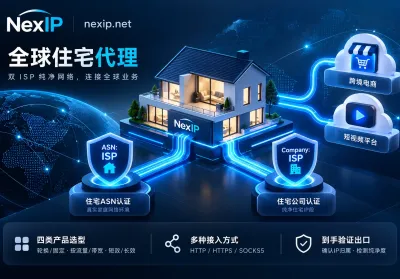
NexIP's core approach is clear: use native dual-ISP residential networks to boost stability and pass rates.
1. Risk Control/Blocking Essentially Identifies "Abnormal Networks"
Many platforms' risk control logic isn't about what you do, but whether you look like a normal user.
Common abnormal signals include:
- Network source "looks unnatural" (over-concentrated features, high reuse, abnormal links)
- Same business actions repeated in a short time
- Poor request stability (disconnections, jumps, high latency jitter)
- Same region access showing network distribution inconsistent with real users
At this point, you don't need "another batch of IPs" but a network form closer to real users: residential IP.
2. Why Does NexIP Emphasize "Native Dual-ISP"?
Many proxy IP pain points boil down to: single line.
Once congestion, fluctuation, or failure occurs, it leads to disconnection, timeout, decreased success rate, then captchas, rate limits, and escalated risk control.
NexIP native dual-ISP advantages:
- More stable: Dual-ISP redundancy and scheduling space reduce single-line fluctuation impact.
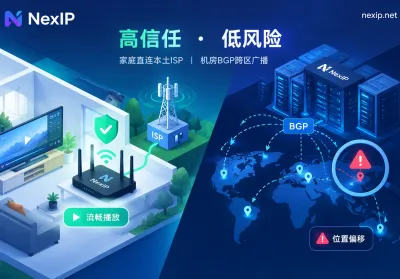
- More human-like: Matches common home broadband patterns, reducing abnormal features.
- Better for business continuity: Friendlier for long-running tasks (scraping, monitoring, ad verification).
Simply put: Your business needs more than just "connected"—it needs "stable for the long haul."
3. NexIP Suits These Four High-Frequency Businesses
1) E-commerce: Stable Access + Multi-Environment Isolation
- Smoother access to multiple stores/sites.
- More stable monitoring of products, prices, inventory.
- Easier verification of localized display differences.
2) Advertising: Multi-Region Verification and Review Previews
- Landing page display, redirect chains, ad review previews.
- Multi-region A/B testing and effect verification.
- Fewer captchas interrupting workflows.
3) Scraping: Higher Success Rate, Lower Blocking
- Reduce 403/429 errors and captcha frequency.
- Support more stable session and rotation strategies.
- Suitable for public data monitoring and compliant scraping.
4) Social Media: More Authentic Regional Network Environment
- Multi-region content viewing, operations verification.
- Cleaner network environment for multi-account operations.
- Reduced abnormal login/verification interference.
NexIP supports only legal and compliant use cases. It rejects black-hat, gray-hat, and any destructive behavior.
4. A Test Method to Avoid IP Pitfalls
Don't be misled by "parameter tables." Validate with real business:
- Run success rate on target sites: Check success rate, captcha rate, block rate (403/429).
- Test two session strategies: Long vs. short sessions, see which is more stable.
- Run continuously for 24–72 hours: Observe fluctuation, disconnections, failure cause distribution.
- Check business metrics: Task completion rate, manual intervention count, account anomaly rate.
If a provider significantly improves these metrics, it's truly "good to use."
5. NexIP: Turning Residential IP into a Stable Productivity Tool
NexIP's goal isn't "giving you a pile of IPs," but making key businesses worry-free:
- Native dual-ISP residential IP: More stable, closer to real user networks.
- Practical strategy suggestions for e-commerce, advertising, scraping, social media.
- Support common integration methods: quickly integrate into your systems and tools.
- Technical support response: timely problem identification and optimization advice.