 NexIP官方博客
When keeping a login session alive on cross-border e-commerce platforms or managing multiple accounts on overseas social media, you may notice that some IP addresses remain constant while others change periodically—this is the most obvious difference between static and dynamic IPs. The core difference between static and dynamic IPs is that static IPs maintain a fixed egress address and ownership during a session, while dynamic IPs rotate the egress by session or time—but what truly determines business success is the stability of the egress identity (e.g., ASN, subnet, fingerprint consistency), not just the address digits themselves.
First, Distinguish Two Things: Whether the Address Changes and Whether the Egress Identity Changes
The first layer of difference between static and dynamic IPs is whether the address changes: static IPs maintain the same public egress during the lease period, while dynamic IPs are assigned a "currently available" egress by the proxy pool based on session or time cycles. The second, more critical layer is whether the egress identity is stable. The so-called "egress identity" refers to the ASN (Autonomous System Number), subnet (e.g., /24 block), and TLS fingerprint behind the IP. Even if two IP addresses are numerically unrelated, as long as they belong to the same ASN or a similar subnet, defenders can correlate them.
A threat research report released by DataDome on May 5, 2026, shows that attackers used a highly distributed proxy network covering 16,000 ASNs and 1.2 million IPs to launch Layer 7 requests, rendering traditional per-IP frequency limits ineffective. Defenders have shifted to comprehensive scoring using ASN structure, TLS fingerprints, and behavioral telemetry. This indicates that in multi-IP rotation scenarios, egress identity consistency matters more than the address itself.
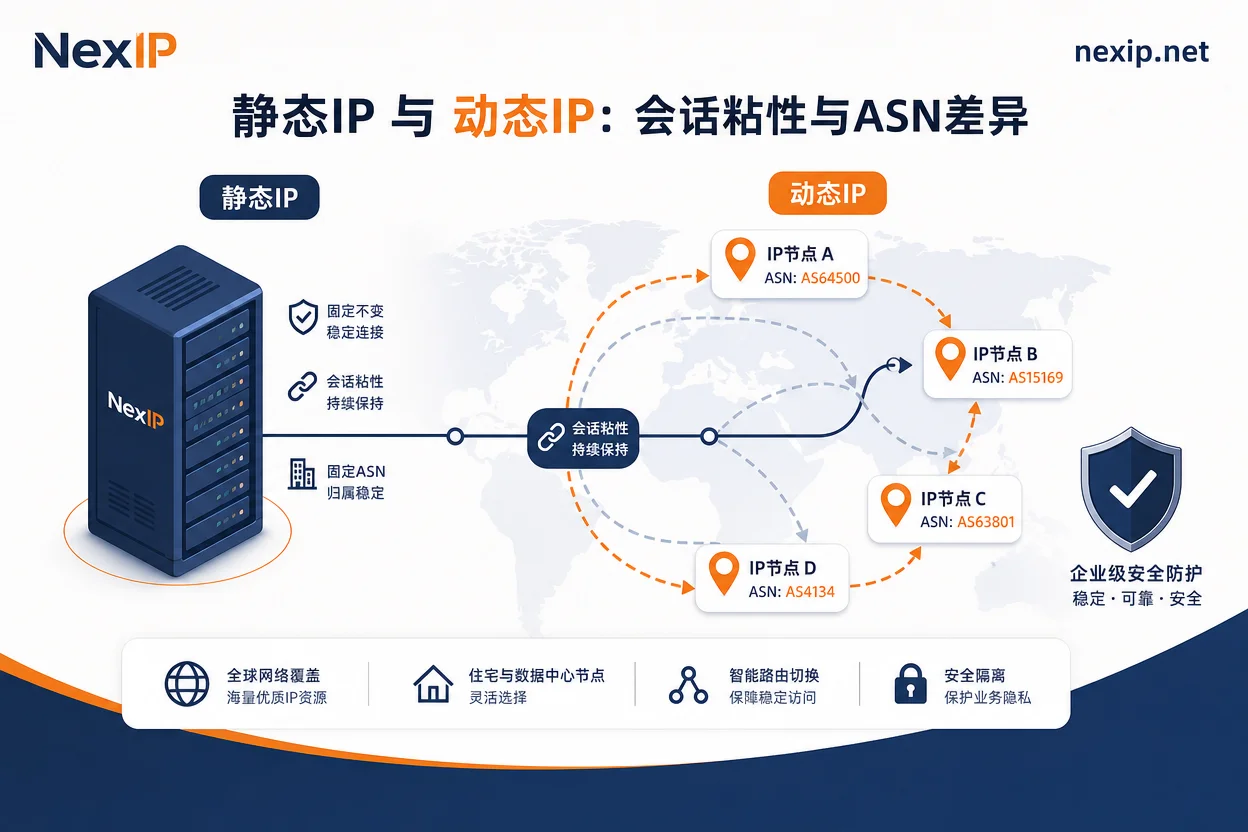
Dimension 1: Session Stickiness and Login Status—Differences in Account Lifecycle
"Sticky session" refers to the characteristic where the egress IP remains unchanged during the same session. Static IPs naturally have high session stickiness, making them suitable for accounts that need to maintain a login state for a long time. Dynamic IPs may change egress after a session ends, and if the account is still logged in at that time, the new IP inconsistent with the original session behavior may trigger risk control.
"Can dynamic IPs be used for accounts with login status?"—Yes, but only if the proxy session's stickiness policy is strong enough to ensure the egress does not drift while the account is active. As for "how often does a static IP change?", static IPs generally do not change during the lease period, while dynamic IPs switch according to the provider's rotation policy. Specific trigger conditions and thresholds for each platform are not publicly available; here we only describe the mechanisms.
Dimension 2: Egress Ownership Stability—Whether ASN and Subnet Drift During Tasks
Static residential IPs, static datacenter IPs, and dynamic residential IPs differ significantly in ASN ownership and subnet distribution: static residential IPs typically come from real home broadband ASNs with stable subnet ownership; static datacenter IPs come from cloud provider ASNs, which are identifiable despite fixed addresses; dynamic residential IPs may drift across multiple ASNs or /24 subnets during a task.
"Are static residential IPs and static datacenter IPs the same?"—No. The ASN of static residential IPs belongs to telecom operators, making them appear more like "real users" from a risk control perspective. The ASN of static datacenter IPs belongs to data centers, and although the address is fixed, the attributes are easily identifiable, which is why static datacenter IPs typically have higher block rates in high-risk scenarios. Meanwhile, the purity of egress ownership directly affects risk control performance; proxy IP purity provides more details. The aforementioned threat research shows that defenders have incorporated ASN structure into comprehensive scoring, making ownership drift an observable variable.
According to a practical guide published by competitor Kookeey in July 2026, in strict risk-control scenarios such as Reddit registration and Amazon data scraping, datacenter and shared IPs have significantly higher block rates; there is no publicly available official data on block thresholds for specific carrier ASNs.
Dimension 3: Billing Models—Per IP vs. Per Traffic/Bandwidth
The difference between static and dynamic IPs is also evident in billing logic: static IPs are typically billed per IP plus duration, suitable for long-term account occupancy; dynamic IPs are more often billed per traffic or bandwidth, better suited for short-cycle, high-concurrency scraping tasks.
| Billing Model | Typical Products | Suitable Scenarios | Cost Sensitive Points |
|---|---|---|---|
| Per IP + Duration | Static residential IP, static datacenter IP | Long-term login, store backend, account farming | Number of accounts, holding duration |
| Per traffic or bandwidth | Dynamic residential IP, datacenter dynamic IP | Public data scraping, short-cycle tasks | Per-task traffic, concurrent peak |
"Is it more cost-effective to pay per traffic or per IP?"—Depends on your business model: if you have a small number of accounts that need to stay online for a long time, per-IP billing is more controllable; if scraping tasks have high traffic and high concurrency, per-traffic billing may be more flexible, but be mindful of additional costs from bandwidth peaks. It is recommended to estimate total costs using four variables: concurrency, per-task traffic, number of accounts, and holding duration, then compare the two models. For a trade-off between account count and holding duration, refer to dedicated vs. shared IP differences.
Dimension 4: How Risk Control Views These Two Egress Types—From Per-IP Frequency to TLS Fingerprints and Behavioral Telemetry
The DataDome research from May 5, 2026, reveals a fundamental shift in risk control identification: the traditional "per-IP request frequency" metric is no longer effective, as attackers can easily distribute requests across millions of IPs. Defenders now combine ASN structure, TLS fingerprints, and session behavior, scoring each request with AI models. Static and dynamic IPs fare differently under this mechanism: static IPs with clear ownership and normal behavior are more likely to accumulate a "good" track record; dynamic IPs that change frequently but maintain consistent TLS fingerprints or behavioral patterns may still be correlated across IPs.
This is the truth behind "Will frequently changing IPs get banned more easily?": not necessarily banned, but it does not mean safer either. If you change IPs without simultaneously adjusting client fingerprints and operational behavior, defenders can stitch scattered requests back into the same behavioral chain.
Correction: Why "The More Frequently You Change, the Safer" No Longer Holds
High-frequency rotation of dynamic IPs does not equal more security. For example, if an account logs in with IP A and then switches to IP B a few minutes later, if both have the same ASN and TLS fingerprint, risk control will consider it the same person deliberately changing IPs, making it more suspicious. Of course, static IPs do not guarantee security either; the goal in selection is only to reduce suspiciousness.
How to Choose for Four Business Scenarios: Registration, Long-term Login, Live Streaming, and Public Data Scraping
| Business Scenario | Recommended Type | Core Requirements |
|---|---|---|
| Account registration, short-cycle tasks | Short-term static IP | High purity, low reuse rate |
| Long-term login, store backend | Long-term static residential IP | Session stickiness, ownership stability |
| Live streaming | Long-term static residential IP | Stable bandwidth, low latency |
| Public data access, high-concurrency scraping | Dynamic residential IP (traffic/bandwidth) | High concurrency, low per-IP frequency |
For long-term login scenarios, stable egress identity and service provider capabilities are key. The difference between dual-ISP and single-ISP proxies helps further understanding.
Mapping to Product Tiers: Recommendations for Long-term Static, Short-term Static, and Dynamic Residential
After understanding the differences between static and dynamic IPs, you can map your needs to specific tiers: for long-term login and store backend, choose long-term static residential IPs; providers like NexIP support global region selection and city/ASN targeting to ensure ownership stability. For registration and short-cycle tasks, choose short-term static IPs that are discarded after use to reduce association risk. For public data access and high-concurrency scraping, choose dynamic residential traffic/bandwidth packages with HTTP/SOCKS5 protocol support and API integration for easy architecture integration. Taking NexIP as an example, its cross-border e-commerce proxy IP solutions cover both static and dynamic product lines.
Pre-Selection Checklist and FAQs
Before you start, answer these five questions:
- What is my concurrency level?
- How long does a single account need to stay online?
- Do I need a fixed city or ASN ownership?
- What is my approximate monthly traffic?
- Does the protocol (HTTP or SOCKS5) match my fingerprint browser?
After answering these five questions, you can initially determine whether to lean toward static or dynamic. It is recommended to run a small-scale test first, validate session stickiness and ownership stability with real business data, and then decide on bulk purchasing.
FAQs
Which is better for account farming, static or dynamic IP?
The core of account farming is stability: after registration, accounts need to log in with the same IP for a long time, and static residential IPs better meet this session stickiness requirement. Dynamic IPs with frequent egress changes may trigger "abnormal login location" risk control. However, if you can ensure that the dynamic IP's session stickiness policy is strong enough and ASN ownership is stable, it can be a backup option.
Do dynamic residential IPs automatically change IPs?
Yes, dynamic residential IPs automatically change egress addresses according to the provider's rotation policy, with common triggers including session timeout, traffic limits, or time window switches. However, some providers offer a "sticky session" option that keeps the IP unchanged for a period, which you can configure in the console.
Are static residential IPs and static datacenter IPs the same?
No. Static residential IPs have ASNs belonging to telecom operators, appearing more like real home broadband. Static datacenter IPs come from cloud data centers; although the address is fixed, the ASN attribute is easily identifiable and has a higher block rate in high-risk scenarios. Therefore, they cannot replace each other in applicable scenarios.
Which is more cost-effective, paying per traffic or per IP?
It depends on the task pattern: if you have a small number of accounts that occupy IPs for a long time, paying per IP is more economical. If traffic is high, concurrency is high, but per-IP usage time is short, paying per traffic is more flexible. It is recommended to estimate with "concurrency × duration" and "per-task traffic × monthly requests" respectively, then compare the total cost of the two packages.
Will frequently changing IPs lead to a ban?
Not necessarily, but the risk is higher. As described in Dimension 4, current risk control can correlate TLS fingerprints and behavioral features across IPs. High-frequency rotation without adjusting fingerprints and operational patterns may actually be identified as intentional evasion by the same entity. The key is to make each switch look like natural user behavior.


Comments(0)