 NexIP官方博客
Let’s get straight to the point: the difference between dedicated and shared IPs isn’t about “how many people use it,” but about the exclusivity, traceability, and associated risk boundaries of the exit behavior. Since Q2 2026, mobile proxy supply has tightened, and residential proxy prices have stabilized after a decline. Buyers are shifting their focus from IP pool size to static dedicated stability and compliance capability. The answer to this question directly affects how you allocate your budget.
Clarify Two Things: Are You Exclusively Using the IP Address or the Exit Behavior?
When discussing the difference between dedicated and shared IPs, you must first clarify whether the exclusivity applies to the address itself or the usage behavior on that exit. Many buyers interpret “dedicated” as “only I can dial in,” but platform risk controls don’t see the number of dial-in users; they see the identity consistency behind the exit. Address-level exclusivity, port-level exclusivity, time-slice exclusivity, and behavioral exclusivity are four levels: address exclusivity only ensures the IP isn’t shared with others; port exclusivity might just be logical isolation; time-slice exclusivity means the same address is reused at different times; and behavioral exclusivity requires that the entire exit behavior (traffic patterns, session duration, access patterns) belongs only to you. Only behavioral exclusivity creates a single, stable identity profile in the eyes of platforms.
Criterion 1: How to Verify You’ve Got a Real Dedicated IP—Continuous Sampling of the Exit
The first step to verify “true dedicated” is to continuously sample the exit IP under a fixed session. Use the same session–keeping tool to record the exit address every few minutes over several hours. You need to distinguish between normal rotation (when a session expires and the IP changes) and “undisclosed mid–session drift”—the latter means your session has been silently switched to another node. The direct impact of drift on your login state is a sudden change in the environment fingerprint, which can trigger secondary verification or even temporary bans.
Criterion 2: Can Shared Residential IPs Get You Banned by Association—Check the /24 Subnet
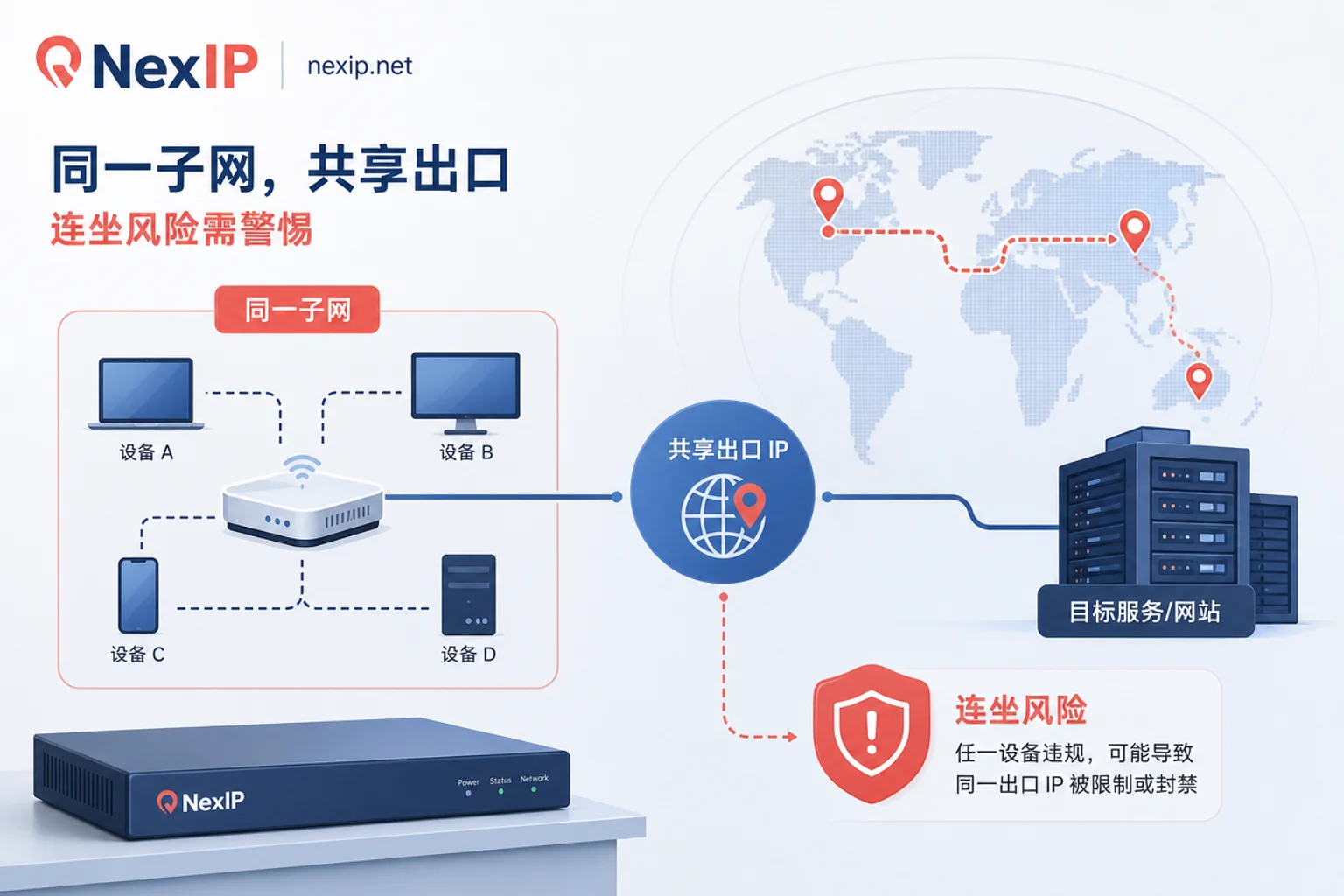
Can shared residential IPs cause you to be banned by association? The key is the subnet dimension. In a shared pool, neighbors’ behavior can be transmitted through the same /24 subnet or ASN to your exit. The verification method is to query the subnet ownership, ASN, and risk score of your exit IP, then check whether the same subnet has traffic characteristics from multiple entities. This is the hardest risk to control in shared tiers: you can’t choose your neighbors or control their behavior.
Criterion 3: Is the Historical Use Traceable? Why Ownership Is Becoming a Question
According to Proxyway’s 2026 Annual Report, static dual–ISP residential IPs with clear ownership are increasingly seen as a baseline by overseas teams. In July 2026, law enforcement and mainstream platforms intensified crackdowns on unauthorized P2P residential nodes. Residential IPs without proof of ownership pose both business association and compliance risks. Therefore, when purchasing, you must ask about node sources, historical usage, and recycling policies—not just rely on the “dedicated” label on the page.
Criteria 4 through 6: Session Stickiness Control, Authentication Methods, and Billing Models
Whether session stickiness duration can be customized, whether authentication is username/password or IP whitelist binding, and whether billing is based on IP count/duration or traffic/bandwidth—these three dimensions directly reflect the supply model. Billing model can also reverse–engineer the supply: charging per IP/duration suggests you have a dedicated address, while charging per traffic/bandwidth suggests a shared exit. This is also the core of understanding “why dedicated static residential IPs are expensive.”
| Dimension | Dedicated | Shared |
|---|---|---|
| Session Stickiness | Customizable, supports long durations | Usually fixed, or affected by pool scheduling |
| Authentication | IP whitelist binding supported, also account/password | Mostly username+password, limited whitelist support |
| Billing Model | Per IP/duration | Per traffic/bandwidth, or per address in pool |
| Subnet Risk | Independent subnet or controllable neighbors | Neighbors not selectable, risk contagion |
Supply–Side Changes: Mobile Proxy Tightening and Budget Shift Toward Dedicated Stability
Starting in April 2026, Bright Data, a leading proxy provider, stopped offering mobile proxies to new customers and restricted social media automation account management in its AUP. Combined with the residential proxy price stabilization noted in Proxyway’s 2026 Annual Report, buyers are shifting their evaluation focus from IP pool size to static dedicated stability and compliance capability. For operations teams, this means reallocating budgets: previously, large budgets went to dynamic pools; now, more should go to verifiable dedicated static residential resources.
Allocate by Scenario: Which Tier to Use for Registration, Long–Term Login, and Public Data Access
Applying the dedicated vs. shared IP difference to your business means splitting your budget by scenario. For account scenarios requiring long–term stable login states and exclusive exits (e.g., main stores, primary social media accounts), prioritize dedicated static. For one–time verification, price comparison, and public data scraping, shared exits are acceptable. To answer “Does one store need a dedicated IP?”—it depends on whether the store carries long–term login states and core operational actions. As for “What’s a reasonable price difference between shared and dedicated IPs?” there’s no fixed number; you should assess whether the premium is justified based on billing model and resource supply.
Implementing with NexIP’s Tiers: How to Combine Static Long–Duration, Static Short–Term, and Dynamic Residential
With NexIP, static long–duration residential IPs suit core accounts needing exit exclusivity and stable login; static short–term IPs are for periodic tasks and controlled rotation; dynamic residential traffic/bandwidth plans fit public data access where shared exits are acceptable. Combined with global region selection, city/ASN targeting, and session stickiness, you can align different business needs to the right tier without paying for unused features. For more on selection, see Residential IP Provider Comparison and How to Choose Overseas IPs.
Pre–Purchase Self–Checklist: A One–Page Verification Guide
Use this checklist when talking to providers to quickly filter out fake “dedicated” claims.
- Exit sampling log: observe for several hours to confirm no undisclosed mid–session drift.
- Subnet check: query /24 subnet ownership and ASN to see if neighbors are controllable.
- Ownership and history: request node source, authorization, and recycling policy details.
- Stickiness configuration: whether session stickiness duration is customizable.
- Authentication: whether IP whitelist binding is supported.
- Billing model: per IP/duration or traffic/bandwidth.
- Replacement and liability after ban: clarify the handling process for associated bans.
I recommend first checking the exclusivity of your current proxy with this checklist, then splitting your budget into dedicated static and shared dynamic tiers. When confirming available tiers by region or city/ASN, run a small–scale test before scaling up.
FAQ
Which is better for account nurturing: dedicated or shared IP?
Account nurturing requires IPs with long–term stability and exclusive exit behavior, so dedicated static residential IPs are more suitable. Shared IPs have uncontrollable neighbor behavior, which may lead to collateral bans due to others’ violations. Dedicated IPs provide a consistent environment fingerprint, reducing the chance of risk control false positives.
How to verify you’ve got a real dedicated IP?
Use Criterion 1: continuously sample the exit IP to see if there’s undisclosed drift; then check the /24 subnet for other entities’ traffic characteristics; finally, ask the provider for ownership and historical usage details. Combining these three will basically determine if it’s truly dedicated.
Can shared residential IPs get you banned by association?
Yes. In a shared pool, behavior within the same subnet or exit can be transmitted; if a neighbor is flagged by risk control, it may affect your exit reputation. If your business is sensitive to account security, prefer dedicated IPs.
Why are dedicated static residential IPs expensive?
The cost comes from exclusive resource usage, traceable ownership, controllable session stickiness, and stable exit behavior. These features reduce the probability of risk–control association, making them a necessary investment for high–value accounts.
Is it necessary to have one dedicated IP per store?
If the store requires long–term login, frequent operations, and high association risk costs, then yes. One dedicated IP per store ensures complete independence of exit behavior, but you should also assess the store’s value and operational frequency to evaluate the cost.



Comments(0)