 NexIP官方博客
Cross-border e-commerce teams often find during month-end reviews that despite the low unit price of their proxy packages, the effective data actually stored falls far below expectations, with a significant portion of the budget consumed by failed retries and CAPTCHA interruptions. This phenomenon—appearing cheap but actually expensive—often stems from a mismatch between the exit type and the task scenario.
To determine whether dedicated or shared IPs are more cost-effective for data collection, you cannot just look at the price per GB of traffic or per IP; you need to delve into the comprehensive cost that includes retry loss, session stability, and associated risks.
Three Symptoms of Uncontrolled Collection Costs: Retries, CAPTCHAs, and Bills
In actual operations, cost overruns typically manifest in three recognizable symptoms. First, the total number of requests does not significantly increase, but retry counts double, causing task completion times to stretch significantly. Second, the same script frequently triggers human verification on certain target sites, or sessions drop mid-task for login-required operations. Third, the end-of-month bill exceeds budget, especially for traffic-based plans, as fees are repeatedly consumed by failed requests and retries.
These three symptoms point to three different layers: exit attribution, session stability, and billing method. Observe the retry rate, the proportion of blocked requests, and the ratio of effective data to total consumption. If the effective output rate declines, it indicates that the current exit type may no longer support your collection intensity, and you need to re-evaluate the match between exit type and billing method.
Layer 1: How to Calculate Effective Cost per Request
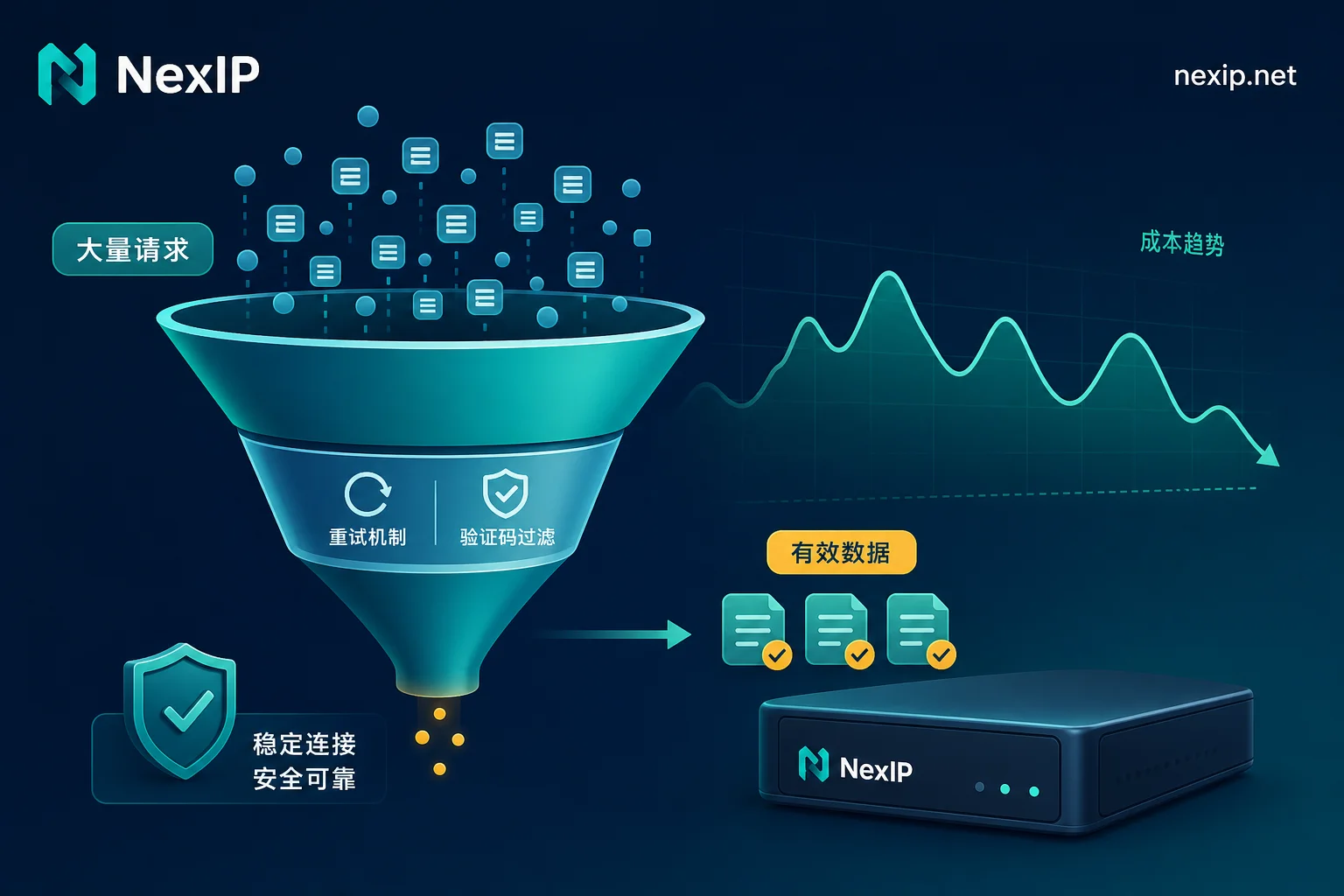
A more meaningful metric than unit price is the "effective cost per request." The formula should be: total package expenditure divided by the number of effective requests successfully stored, not by the total number of requests sent or the purchased traffic allowance.
When calculating the denominator, you must deduct the following ineffective consumption: automatic retries after failures, CAPTCHA pages returned after blocking, resend requests after timeouts, and hidden time costs from waiting and reduced concurrency to bypass blocks. When the proportion of effective requests drops to a level where you need to increase concurrency and unlimited retries to maintain output, the unit price advantage of cheap exits has been offset. At this point, switch to comparing based on effective cost per request rather than dwelling on superficial quotes per GB or per IP.
Layer 2: How Shared Pool Neighbor Behavior Affects Your Success Rate
The cost structure of shared exits includes an uncontrollable factor: the behavior of other users in the same pool. If other users on the same pool or subnet are conducting high-intensity or abnormal scraping, the target site and its protection layers will accumulate flags on the entire exit, causing your legitimate requests to also enter stricter verification paths.
Cloudflare's Adaptive Intelligence engine, launched on August 31, 2026, intensifies this transmission effect. This engine targets attackers who use residential proxy networks to distribute low-frequency requests across multiple IPs to evade rate limits. It autonomously generates one-time defense rules based on real-time traffic meta-signals and rotates them at random intervals. This means that if your script's success rate fluctuates wildly at different times without changes in your own request pace, it is highly likely due to the influence of pool neighbors rather than your own parameter settings.
Previously, the cost logic of rotating shared pools relied on diluting the exposure of individual IPs through a vast number of IPs. However, with the proliferation of one-time, randomly rotated defense rules, the marginal effectiveness of this dilution logic is declining. Switching subnets no longer reliably buys a clean request opportunity, especially on login and critical transaction paths, where penetration effectiveness is more noticeably weakened, while public static pages are less affected.
The judgment criterion is to observe whether the first request's success rate after switching subnets is significantly higher than before. If the improvement from switching is minimal, it indicates that the request loss and scheduling complexity paid for rotation are no longer worthwhile. For such scenarios, consider migrating tasks to fixed exits to reduce uncertainty overhead from frequent IP changes.
What the Premium for Dedicated IPs Buys: Bandwidth Exclusivity and Session Persistence
Dedicated exits are priced higher, but the premium corresponds to verifiable capabilities: the exit is determined solely by you, bandwidth is not contended, and sessions can maintain the same exit over long periods without switching.
According to Bright Data's 2026 selection guide (note: this is a specific vendor's classification), dynamic residential proxies derive from real home terminal Wi-Fi and are suitable for large-scale distributed scraping but experience periodic disconnections and IP changes. In contrast, static ISP proxies are hosted in data centers and registered with residential ASNs via local broadband providers, offering high trust, fixed session persistence, and exclusive bandwidth. Therefore, purchasing a dedicated IP essentially buys certainty: predictable success rates and a simple architecture without needing complex compensation code to handle IP rotation. For technical details on the differences between API-extracted proxy IPs and account-bound IPs, these further illustrate configuration differences among exit types.
| Attribute Dimension | Shared Exit | Dedicated Exit |
|---|---|---|
| Exit attribution | Influenced by other users in the same pool | Determined solely by the current user |
| Bandwidth contention | Contends with others during peak times | Exclusive bandwidth, no external interference |
| Session persistence | Periodic disconnections or random IP changes | Can maintain the same IP for long periods |
| Common billing basis | Traffic or IP pool size | Fixed bandwidth or single IP rental |
| Risk source | Neighbor malicious behavior can restrict the entire subnet | No neighbor interference, independent and controllable risk |
| Retry loss | Failures due to others' pollution are borne by you | Failures mainly stem from your own strategy or the target site |
Tiered by Task: Public Scraping, Login-Session Access, and Scheduled Tasks
Proxy selection can be divided into three tiers based on different business scenarios. Below is a detailed comparison:
| Task Type | Characteristics | Recommended Exit Type | Core Evaluation Metrics |
|---|---|---|---|
| Large-scale public page scraping | Highly parallel, short sessions, tolerant of failed retries | Dynamic rotating exits | Traffic consumption cost, IP pool size |
| Restricted pages requiring login | Session switch causes login failure or risk control triggers | Fixed exits (dedicated) | Session stability, ASN trustworthiness |
| Long-cycle scheduled tasks | Fixed targets at fixed times, pursuit of result consistency | Fixed exits (dedicated) | Exit stability, long-term availability |
Between tiers, the approach is to split exits by task rather than using one type for the whole site. For example, the decision on whether to choose static or dynamic residential IPs for TikTok follows the same logic, depending on the platform's session stickiness requirements.
Per Traffic, Per Bandwidth, or Per Exit Rental: How to Choose Billing to Avoid Losses
Each billing method has its pitfalls. With per-traffic billing, failed requests and CAPTCHA pages are also billed; if the retry rate is high, the bill will significantly diverge from effective output. With fixed bandwidth billing, costs are independent of request count but limited by concurrency peaks; if task traffic is uneven, you may waste idle capacity. With per-exit rental, costs scale linearly with IP count, making it worthwhile only when sessions truly require long-term fixation.
The selection basis is as follows: first, check whether the effective traffic ratio is stable; second, observe whether request distribution is uniform or has spikes; third, confirm whether sessions must be fixed. The answers to these three questions determine which billing method to adopt. If you are unsure why data center IPs are easily identified as high-risk, you need to carefully evaluate the potential impact of exit attributes on billing.
What to Verify After Changing Exit Types and Which Metrics to Monitor Long-Term
After adjusting exit types, first conduct small-scale validation before full rollout. Validation actions include: confirming the exit IP and ASN registration entity match expectations, continuous sampling within one session cycle to see if IP changes occur, running a comparison batch with the same set of target URLs to compare effective request ratios, and verifying new billing actuals align with estimates.
Long-term monitoring should focus on the following metrics: weekly trend of effective request ratio, distribution of blocked target sites, frequency of IP changes and interruptions in login sessions, and monthly changes in effective cost per request. If deviations occur, revisit the earlier layers to re-evaluate rather than simply increasing budget.
Common Questions
For hundreds of thousands of daily requests, which exit type is more economical?
For large-scale public data scraping with hundreds of thousands of daily requests, dynamic rotating exits are typically more economical, as such tasks tolerate some failed retries and single sessions are short. The key is to monitor the effective request ratio; if retries cause wasted traffic exceeding the saved IP rental costs, consider a hybrid strategy or optimize concurrency logic.
Why do shared proxy IPs often trigger CAPTCHAs during scraping?
This is usually due to "neighbor pollution" in the shared pool. Abnormal high-frequency behavior by other users on the same subnet can be flagged by target site protection systems, lowering the reputation of the entire IP range. Additionally, new defense engines like Cloudflare dynamically generate rules based on traffic meta-signals, causing even legitimate low-frequency requests to be misjudged and trigger human verification.
Can high-intensity scraping by others in the same pool harm my tasks?
Yes. The core risk of shared IPs is collateral impact. If other users in the pool conduct malicious scraping or violate terms, the target site may block the entire IP range or impose strict rate limits. Even if your requests are fully compliant, you may suffer from decreased success rates or connection interruptions due to the uncertain exit attribution.
How to choose between traffic-based and bandwidth-based billing for large-scale collection?
NexIP's dynamic residential proxy traffic/bandwidth plans are suitable for large-scale public page scraping, while its static long-lasting residential IPs serve tasks requiring login sessions and long-cycle scheduled operations. When configuring, ensure that session stickiness and geographic/ASN targeting parameters are set in the application layer or proxy gateway layer to match the correct billing model.
Should I switch to a dedicated exit if fraud scores are high?
If existing shared IPs frequently trigger risk controls, switching to dedicated IPs is a common solution. Dedicated IPs avoid pool interference, but you need to confirm the IPs provided are truly residential or ISP-based, not disguised high-risk data center IPs. Additionally, establish an independent monitoring system to track the IP's reputation changes on target sites. You can refer to the troubleshooting approach in how to resolve excessively high proxy IP fraud scores to first determine whether it is an IP attribute issue or a behavioral pattern issue.
What exactly does the price difference for dedicated exits buy?
The higher price for dedicated exits primarily buys "certainty" and "isolation." Certainty refers to sessions maintaining the same IP over long periods, avoiding login loss; isolation means not being implicated by neighbor malicious behavior, ensuring stable success rates. For tasks requiring long-cycle scheduled operations or sensitive login transactions, these two points are core values that shared pools cannot provide.
It is recommended to first classify existing collection tasks into public scraping and login-session categories according to the methods in this article, run a comparison batch for each to calculate effective cost per request, and then decide whether to split exits. For task-tier configuration, refer to NexIP's dynamic and static long-lasting residential IPs, and confirm before purchasing that region, ASN targeting, and session stickiness parameters cover your target sites.




Comments(0)