 NexIP官方博客
The specific difference between API-extracted proxy IPs and account-bound IPs is that the former is an interface-level action for batch address retrieval per task, while the latter is an exit-address assignment for long-term login sessions. Starting August 2026, major proxy providers have intensively updated their session control and selection documentation, and the industry has begun to standardize these two usage methods into dual-track invocation.
When you copy an API extraction link from a proxy provider's dashboard and plan to plug it into your crawler script to batch-pull IPs, what you're actually getting is a task-level exit address, not a fixed line that will hang on some account for the long term.
First, clarify two things: API extraction solves "getting an address," while account binding solves "keeping the exit identity unchanged long-term"
The essence of API extraction is that you send a request to the proxy gateway, and the gateway randomly or conditionally (by region, city, ASN) picks an exit address for you from its large IP pool. The lifecycle of this address is typically task-level—one extraction corresponds to one or a batch of requests, and it's discarded after use; the next extraction might yield a completely different exit.
Account binding is entirely different. It's a specific exit IP that is leased and attached to a particular login state, such as your cross-border e-commerce store, social media account, or fingerprint browser environment. This IP remains fixed during the lease period, with no drift in exit IP, ASN, or subnet.
Comparison Point 1: Session lifecycle determines the first layer of difference between API extraction and account binding
Conclusion first: API-extracted sessions are measured in "tasks," while account-bound sessions are measured in "account lifecycles." The duration and stability requirements are completely different.
API extraction supports a mechanism called "Sticky Session." Oxylabs' official documentation from August 2026 states clearly: adding a sessid parameter to the reverse proxy authentication username can route multiple requests to the same IP. But the cost is—there's a default idle timeout limit. Once the underlying P2P residential node goes offline (home broadband device disconnects, reboots, lease expires), the system automatically assigns a new IP to you. To keep the API-extracted proxy IP stable within a task, you rely on this parameter, but don't expect it to last a whole day.
If the extracted proxy IP becomes invalid within minutes, first check if the sessid parameter was added, or if the interval between two requests was too long, triggering the idle timeout.
Comparison Point 2: Whether the attribution drifts—do ASN, city, and subnet change between batches?
Conclusion first: For extraction-type usage, it may change every time; for binding-type usage, it remains fixed during the period.
It's normal that each extraction yields a different IP. The residential nodes in the extraction IP pool come from thousands of home broadband connections, with nodes coming online and going offline frequently, so the address assigned each time will naturally vary. Even if you use session stickiness to lock an IP, once that node goes offline, your exit ASN, city, or even subnet may change after reconnection. To judge whether the exit attribution is reliable, you can also first understand the fundamental difference between native IP and non-native IP.
This is the source of risk signals for abnormal login detection. If your store account logs in from city A today, city B tomorrow, and a different subnet the day after—the platform's risk control model will flag it as abnormal, potentially requiring re-verification at best, or directly restricting at worst. As for whether dynamic residential IPs can be fixed-bound to an account, it's technically impossible: dynamic residential IPs originate from P2P home broadband nodes that go online and offline, not designed for "long-term fixation."
Comparison Point 3: Billing and quota—how traffic/bandwidth usage vs. exit lease is calculated
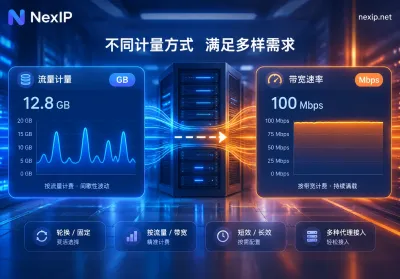
Conclusion first: Extraction-type is billed by traffic or extraction batches; binding-type is billed by IP quantity and lease period.
Billing terms best reflect the commercial logic difference between the two usage methods:
| Billing Dimension | API Extraction (Dynamic) | Account Binding (Static) |
|---|---|---|
| Unit of Measure | Traffic (GB) or extraction batches | IP quantity × lease period |
| Cost Elasticity | Fluctuates with request volume and retries | Fixed, paid even when idle |
| Budget Predictability | Low, requires monitoring traffic consumption | High, can budget monthly/yearly |
| Typical Scenarios | High-concurrency crawling, bulk data collection | Store login, fingerprint browser account management |
Comparison Point 4: Retry cost—how automatic retries amplify actual consumption for extraction-type usage
Conclusion first: For extraction-type usage, the cost is automatically amplified during failed retries; you need to set retry limits and backoff controls on the client side.
KuaiDaili's August 2026 practical guide specifically reminds: for dynamic extraction billed by traffic/concurrency, when the target site throttles or nodes go offline, clients typically trigger automatic retries. Each retry is a new traffic consumption point. If the script has no retry limit, a simple request failure can balloon into dozens of times the cost. Control approach: set a retry limit (e.g., max 3 times) and exponential backoff, try to reuse the same session (sessid); and distinguish between "node offline" (retry with new IP) and "target site rejection" (should pause). For binding-type exits, failures are more about troubleshooting the link, not retrying with a different address.
Can dynamic residential IPs be fixed-bound to an account? Common mismatches and symptoms
Plugging API-extracted dynamic IPs directly into a fingerprint browser as fixed exits is the most common mistake for beginners. Typical symptoms include:
- Dropping mid-login, requiring re-verification.
- Multiple geolocations appearing for the same account in a short period, triggering risk control.
- Multiple accounts running in the same extraction pool, colliding on the same IP, leading to association.
Industry position changes: why providers emphasize the boundary between dynamic extraction and static binding
In August 2026, KuaiDaili's practical selection guide and Oxylabs' session control documentation gave consistent boundary statements in the same period: short-lived dynamic extraction is suitable for high-concurrency, short-lifecycle data scraping and batch testing, while long-term store management relies on static dedicated IPs to avoid geolocation drift. At least in these two leading providers' public statements, the applicable boundaries for dynamic extraction and static binding are written separately; whether this constitutes a unified industry standard is not yet proven by any public cross-sectional statistics. This is also why the specific difference between API-extracted proxy IPs and account-bound IPs is now fixed at the engineering level.
Match your business: which type to use for public data collection, registration verification, and long-term login states
| Business Type | Recommended Usage | Justification |
|---|---|---|
| High-concurrency public data collection | API extraction (dynamic) | High request volume, no fixed exit needed, cost controllable per traffic |
| Batch testing, short tasks | API extraction (dynamic + sticky session) | IP stability within a single task window is sufficient |
| New account registration and verification | Short-term static | Needs short-term fixed exit, but not long-term holding |
| Medium-term operations (weeks to months) | Short-term static | Avoid frequent IP changes triggering verification |
| Long-term stores, social media logins | Long-term static (one account one exit) | Exit IP, ASN, subnet do not drift throughout |
If your task is Amazon store operations, check out how to configure IP for Amazon stores; if you're worried about the authenticity of exit IPs, refer to how to detect if a residential IP is a real dual-ISP.
Mapping to NexIP: the division of dynamic traffic/bandwidth, static short-term, and static long-term, and where to set parameters
Bringing the four points above to NexIP's publicly available capabilities, the division is as follows:
- Dynamic residential traffic/bandwidth packages: Used with API integration, supports session sticky parameters, suitable for task-based extraction.
- Static short-term residential IPs: Suitable for registration verification and medium-term tasks, with relatively fixed exits.
- Static long-term residential IPs: Suitable for one-account-one-exit long-term binding, e.g., multi-account fingerprint browser environments.
For extraction-type, region/city/ASN targeting is written in the extraction parameters or auth string; for binding-type, it's determined when the exit is activated. Additionally, choose HTTP or SOCKS5 based on business protocol needs—for web scraping and most API requests, HTTP is more direct; for TCP-level forwarding or specific application protocols, choose SOCKS5. Both are supported in NexIP packages; you can compare SOCKS5 vs. HTTP proxy protocol performance in cross-border business to decide.
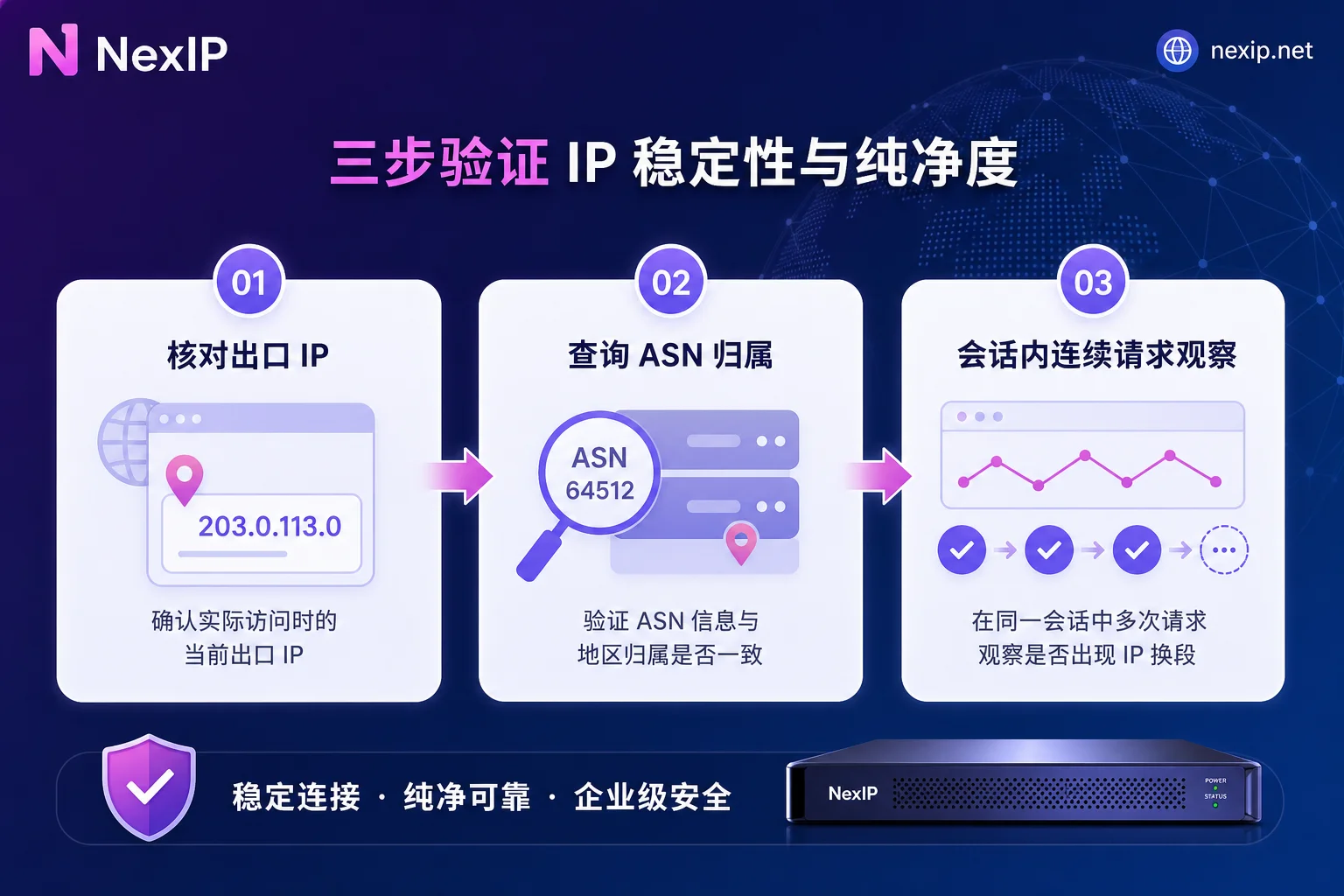
Three-step verification after configuration: exit IP, ASN attribution, and whether it changes within a session
After configuration, don't run directly; do three things first:
- Verify the actual exit IP: Visit
ipinfo.ioor similar services to confirm the exit IP matches expectations. - Check ASN and geolocation: Confirm ASN and city fall in the target region; don't end up with "selected USA but exiting in Europe."
- Session continuity test: Send multiple requests within a session period to see if the IP changes segments or cities.
For binding-type, all three should be stable; for extraction-type, stability only needs to last within a single session window. If extraction-type also requires long-term stability, you've chosen the wrong usage method.
FAQ
Will using API-extracted proxy IPs for store operations cause problems?
Referring back to the specific difference between API-extracted proxy IPs and account-bound IPs: dynamic extraction does not undertake long-term login states. It's not recommended to use API-extracted dynamic IPs directly for store operations; even with session sticky parameters, node disconnection will change the IP, repeatedly triggering abnormal login verification for the store. Long-term store operations should use static long-term IP binding.
Why do extracted proxy IPs expire in a few minutes, and how can I extend them?
First, confirm whether you added a session sticky parameter (like sessid) in the auth username, then check if the interval between two requests exceeds the idle timeout threshold. Even with the parameter, the underlying home broadband node going offline will cause the IP to change, which is a physical limitation of dynamic residential IPs.
Which is more suitable for API extraction: whitelist authentication or username/password authentication?
API extraction is better suited for username/password authentication because you need to carry session parameters like sessid in the auth string; whitelist mode doesn't support this dynamic control. Whitelist authentication is suitable for fixed exits that don't change often, like static binding.
Can static and dynamic residential IPs be mixed on the same account?
It's not recommended. Mixing means the account's exit IP and geolocation will vary, which is no different from using dynamic IPs directly. One account corresponding to one fixed exit IP is the safest approach.
How do I know if my exit IP is truly fixed without drift?
After configuration, record the exit IP and ASN daily for several consecutive days. If they are completely consistent, the binding is effective; if changes occur, the binding configuration has issues or the underlying node is unstable, and you need to contact the provider to troubleshoot.


Comments(0)