 NexIP官方博客
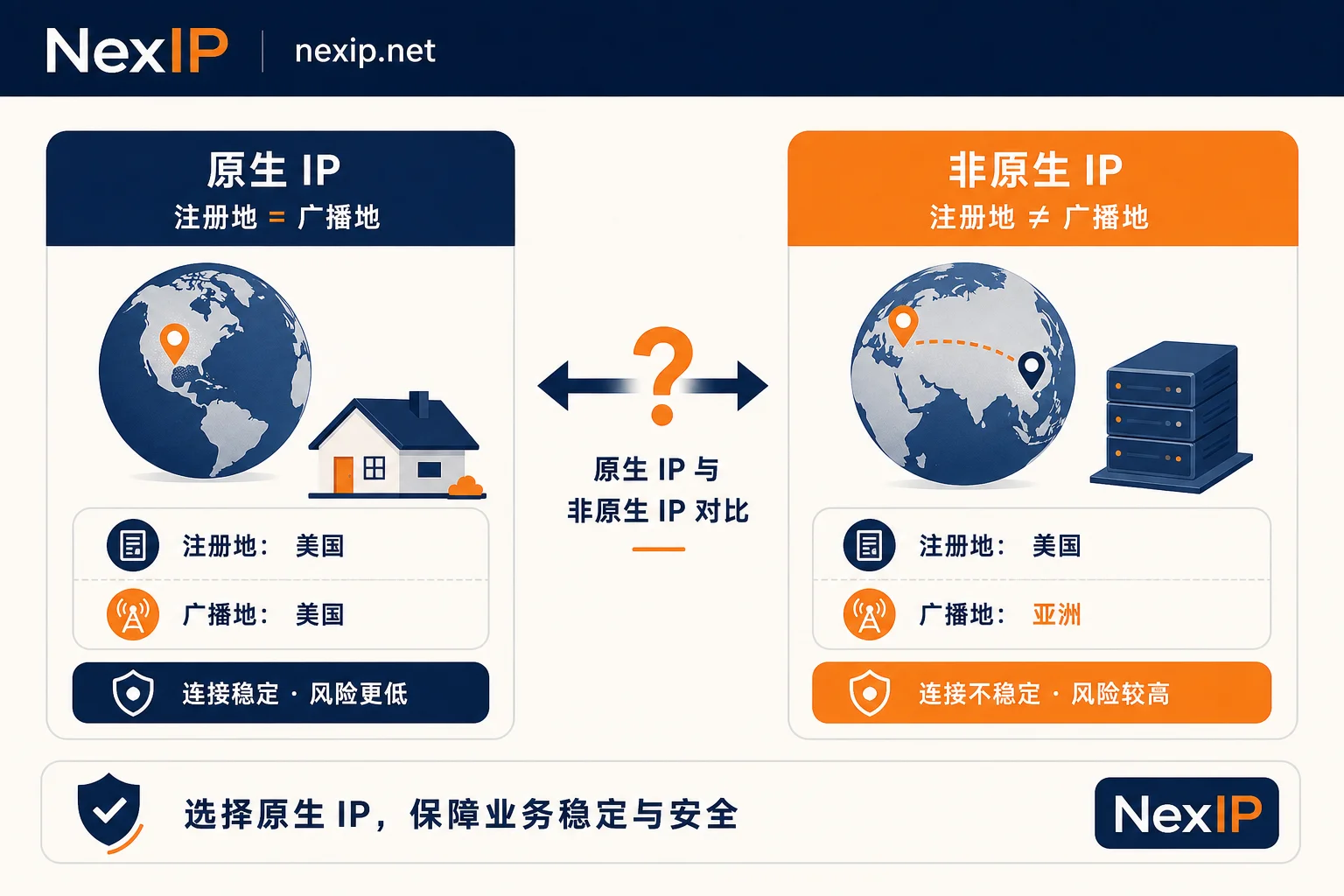
What is the fundamental difference between native IP and non-native IP? There is only one fundamental difference: whether the registered location of the IP segment matches the actual broadcast location, and whether the registered entity is the local network operator. Non-native IP (broadcast IP) is registered in location A but broadcast from location B. This difference is not about speed, nor is it a distinction between residential and data center. In essence, it is about whether the regional identity that platforms perceive is self-consistent.
Today, cross-border teams, before launching multiple accounts, commonly use multiple IP intelligence databases (such as Scamalytics fraud score, IPinfo's ASN and Hosting/ISP type, and IP2Location's geographic precision) to cross-verify IP purity and location accuracy. This has become a standard anti-risk workflow in 2025-2026. This difference is increasingly easy for platforms to detect, so learn to self-check first.
What is the fundamental difference between native IP and non-native IP: whether the registration location and broadcast location belong to the same region
A native IP is "locally born and raised": the IP segment is allocated by a local institution to a local operator for use. A non-native IP is like a "business trip": the address segment is registered in location A but deployed to broadcast in location B. Platforms can determine whether your IP's "residence" and "current location" are consistent by querying these data.
Field 1: How to check the Country/Region and Organization recorded in Whois
Open any Whois lookup tool (such as ARIN or RIPE's official database), enter your IP, and look at the "Organization" and "Country" fields. Note the difference between "allocated to whom" and "who is using it": sometimes an IP segment is allocated to one company, but the actual broadcast is done by another operator. In this case, the registered organization and the using entity differ, indicating possible non-native.
Self-check sequence: First, check if the registered country is the target country. Then, check if the registered organization is a local broadband operator or a cloud service provider. If the registered country is A, but your target region is B, it is likely non-native.
Field 2: Is the registered entity of the ASN a local broadband operator or a cross-border Hosting provider?
The ASN (Autonomous System Number) is the most informative field for determining ownership. Use IPinfo or BGP tools to query the ASN of the IP and check the organization type: whether it is classified as ISP (Internet Service Provider) or Hosting (data center). Local broadband ISPs (such as Comcast, AT&T in the US) have ASNs that represent residential or local networks; while cross-border Hosting providers (such as DigitalOcean, AWS) have ASNs that are often used for data centers. If the query result shows an organization type of ISP (like a local broadband operator) rather than Hosting (like a cloud host provider), it is closer to a native residential IP.
Field 3: Whether multiple databases show consistent labels; what divergence indicates
Use three different IP intelligence databases to check the same IP: Are the countries consistent? Is the city precise? Is the organization type ISP or Hosting? It is recommended to check at least three databases: if the country labels are consistent across all three, and only the city differs slightly, it is usually a location precision difference and is acceptable; if the country or ASN type contradicts between databases—for example, IPinfo labels it "United States - Los Angeles - Hosting" while IP2Location labels it "Germany - Data Center"—treat it as non-native and request a replacement IP segment from your provider.
Field 4: Whether the ownership drifts during a session; how to perform continuous sampling
The time dimension is also important: in a fixed session, sample the exit IP and its country, city, and ASN every few minutes, and record whether there are jumps. Industry anti-risk guidelines generally point out that if a rotating proxy frequently drifts IPs mid-session, platforms will often interpret it as an abnormal login from a different location, potentially triggering additional verification. Therefore, long-term login sessions generally require high-sticky sessions (Sticky Sessions) or static residential ISPs to maintain consistency.
Sampling method: After connecting, use an IP detection website to record the country and ASN every 5 minutes for 30 consecutive minutes; if there is a jump in country or ASN mid-session, the session stability fails.
Correction 1: Native IP is not equal to residential IP; data center segments can also be native
"Native" and "residential" are two independent dimensions. Native means registration location equals broadcast location, while residential means the ASN belongs to a broadband operator targeting individual users. So there are four combinations:
| Type | Registration = Broadcast | ASN is Residential ISP | User Experience |
|---|---|---|---|
| Native Residential IP | Yes | Yes | Closest to real local users, suitable for social media, e-commerce |
| Native Data Center IP | Yes | No | Regional identity is consistent, but data center attributes may be detected |
| Non-Native Residential IP | No | Yes | Broadcast to a different location, regional identity conflict |
| Non-Native Data Center IP | No | No | Double risk, easily flagged |
When purchasing, make separate requirements: "I want a US native residential IP" and "I want a US data center IP" are two different things. Don't let providers confuse them. To further confirm the authenticity of a residential IP, refer to How to Detect Whether a Residential IP Is Real Dual-ISP.
Correction 2: Non-native IP does not mean it will be banned; it affects regional identity judgment
Non-native IPs usually still connect and access fine. The problem arises when the regional identity that the platform perceives does not match the region you claim. For example, if you use an IP broadcast from the US but registered in Germany, the platform may think you are accessing US services from Germany, causing certain region-specific features to be unavailable or triggering additional human verification. Blocking is the result of a combined scoring of IP attributes, client fingerprints (WebRTC, timezone, Canvas), payment methods, and behavior. The network layer does not provide a guarantee against bans, and platforms do not publicly disclose their specific determination rules. The standards in this article are based on third-party detection tools and practical tests from practitioners. To further understand why data center IPs are easily identified, check Why Data Center IPs Are Easily Identified as High-Risk IPs.
Why This Difference Is More Valued in 2026
Whether the registration location and broadcast location are consistent is more strictly scrutinized in 2026 because IP quality assessment has shifted from "whether it is blacklisted" to multi-dimensional cross-checking of Scamalytics fraud score, ASN organization type, and geographic precision. If you find a high risk score in self-checks, refer to How to Solve High Proxy IP Fraud Scores.
Tiering by Business Scenario: Which Scenarios Require Native IP and Which Do Not Matter
| Business Scenario | Native Requirement | Core Needs | Procurement Criteria |
|---|---|---|---|
| Region-restricted service activation (e.g., US-region accounts) | High | Registration location = broadcast location | Require Whois registered country = target country, ASN as local ISP |
| Long-term login state for stores/social media main accounts | High | Ownership stability prioritized | Fixed exit, sticky sessions, no mid-session jumps |
| Live streaming and content publishing | Medium-High | Local ISP attributes + session continuity | Dynamic residential + Sticky Sessions to avoid drift |
| Public data crawling | Low | Rotatable, large exit scale | Dynamic IP, no need to worry about native, focus on stability and speed |
For whether data crawling requires residential IP, see Why Residential IP Is Needed.
Corresponding to NexIP: Division of Labor Among Location/ASN Targeting, Dynamic, Static Short-term, and Static Long-term
In NexIP's product selection, you can turn the four self-check fields into order requirements:
- Dynamic Residential (Traffic/Bandwidth plans): Supports global region selection and city/ASN targeting, suitable for crawling and batch tasks that require frequent exit changes, with configurable session stickiness to avoid drift.
- Static Short-term: Suitable for medium-cycle projects (e.g., staged verification, event page testing), relatively stable ownership, but with a usage period.
- Static Long-term: Suitable for store main accounts that need long-term ownership stability; IP is fixed long-term, ASN and region do not drift.
NexIP provides HTTP/SOCKS5 and API integration. You can write the self-check steps into a script to batch verify the Whois, ASN, and regional consistency of each exit. Start with a small batch sample, then scale up.
What to Ask the Provider Before Ordering
Back to the question of the fundamental difference between native IP and non-native IP: procurement is not about listening to sales saying "native," but about making data-driven decisions. You can copy the following questions directly to ask:
- What is the Whois registered country and organization name for the IP segment in the target region?
- Can you provide the ASN and its type (ISP/Hosting)?
- Do you support targeting by city or ASN?
- What is the maximum duration for session stickiness (Sticky)?
- Within the same order, will the exit IP jump across countries?
- Can you provide a sample first for me to test before batch purchase?
Require them to provide a sample that can be self-checked, rather than just verbal promises. If the provider cannot even provide the ASN, it is likely not truly native.
Common Questions
How to check native IP vs non-native IP?
Mainly use Whois to check the IP's registered country and organization, then use tools like IPinfo to check the ASN type, compare multiple databases for country and city labels, and finally sample continuously during a session to see if ownership drifts. If the registration location matches the broadcast location and the ASN is a local ISP, it is native.
How to determine if the IP you bought is native?
Self-check with four fields: Is the Whois registered country your target country? Is the ASN registered entity a local broadband operator? Do two or more IP intelligence databases contradict each other? Does the country jump during continuous sampling in a session? If all are consistent, it can be basically determined as native.
What is the difference between US native IP and US data center IP?
A US native IP has its registration and broadcast locations both in the US, and the ASN may belong to a local ISP (residential) or a hosting provider (data center). A US data center IP may be registered overseas and only broadcast from US data centers, with the ASN often being Hosting type. This results in inconsistent regional identity and makes it more likely to be identified as a data center IP.
What does it mean when the broadcast location and registration location are inconsistent?
It means the Whois registered country/region differs from the actual routing broadcast region. For example, an IP registered in Germany but routed to the US; platforms will see contradictory signals of German registration and US broadcast, possibly flagging it as a proxy or non-native.
Is a native IP necessarily a residential IP?
Not necessarily. Native only concerns the consistency between registration and broadcast locations, unrelated to residential. Native IPs can be data center IPs (like IPs from a local data center) or residential IPs (like IPs from a local broadband operator). Residential IPs must satisfy the ASN being an ISP and provided to individual users.
Can a non-native IP be used to register overseas accounts?
Yes, but with higher risk. The regional identity conflict may trigger additional verification or cause certain region-specific features to be unavailable. If the account requires a specific regional identity, it is recommended to use a compliant native IP or at least ensure the IP ownership matches the target region.
Why is native IP more expensive than regular IP?
Native IP resources are scarce, especially residential native IPs that require cooperation with local ISPs, so supply is limited. Additionally, their ownership is stable and low-risk, suitable for high-demand business, hence the higher price. Non-native IPs are cheaper but may bring risk control issues.



Comments(0)