 NexIP官方博客
Many people assume that as long as a cloud server or commercial overseas node can reliably open web pages and handle API requests, their overseas network is "up and running." But according to the latest updates from third-party IP intelligence providers on data center detection datasets, these capabilities have been strengthening throughout the second half of 2026. An increasingly common phenomenon is: web pages load fine, but accounts are blocked by CAPTCHAs, or silently throttled after login. The problem isn't connectivity—it's that the exit identity is untrustworthy. That's why residential IPs are needed: they don't patch the link, they patch the exit identity.
The Bottom Line: Residential IPs Don't Solve "Can You Connect" but "Is Your Exit Identity Trustworthy"
Why do you need residential IPs? Because server IPs only handle link reachability, while residential IPs solve the problem of your exit identity being recognized by platforms as a genuine local broadband user. In the second half of 2026, major IP intelligence providers further upgraded their datasets for identifying data center and hosting proxies, making the phenomenon of "web pages open but accounts are restricted" more common in cross-border businesses. To judge whether an exit is trustworthy, you need to look at three layers: link reachability, exit identity attributes, and neighbor connotation. Of these, only the first layer is covered by server IPs; the other two require changing the exit type to resolve.
Layer One: Reachability—What Server IPs Solve and What They Don't
Cloud servers and commercial overseas nodes solve link establishment, routing, and bandwidth. If pages load and APIs respond, the network layer is working. But platform risk control happens in the assessment stage after connection establishment. Reachability is just an entry ticket; it doesn't add any trust points. Transmission performance and reputation assessment are two independent tracks—no matter how low the ping or how high the bandwidth, it has nothing to do with whether the platform trusts this exit.
Layer Two: Exit Identity—How ASN Registration and Hosting Tags Determine Initial Trust Scores
This is the core mechanism for understanding why residential IPs are needed. Platforms and security services (like IPinfo, Cloudflare) identify exit types through ASN (Autonomous System Number, the identifier for network operators on the internet) and network ownership data. IPs from cloud providers and data centers are directly tagged as Hosting/Datacenter, while residential IPs are tagged as telecom broadband operators (ISP). This tag takes effect at the very start of the session, independent of user actions afterward.
The root cause of different treatment for the same account operations under data center exits versus residential exits lies here: data center IPs are placed into high-risk assessment models at the connection establishment stage, leading to higher probabilities of triggering secondary verification. Residential IPs, because their registered entity is a local broadband operator, naturally receive a higher initial trust score. This is a difference in exit type attributes, not a judgment on the user. For a more intuitive understanding of this layer, you can read the article Why Data Center IPs Are Easily Identified as High-Risk IPs. If your exit is marked and has a high fraud score, refer to the troubleshooting ideas in How to Solve High Fraud Scores on Proxy IPs.
Layer Three: Neighbors and Connotation—Why Data Center Subnet Blocks Cause Mutual Implication for Multiple Accounts
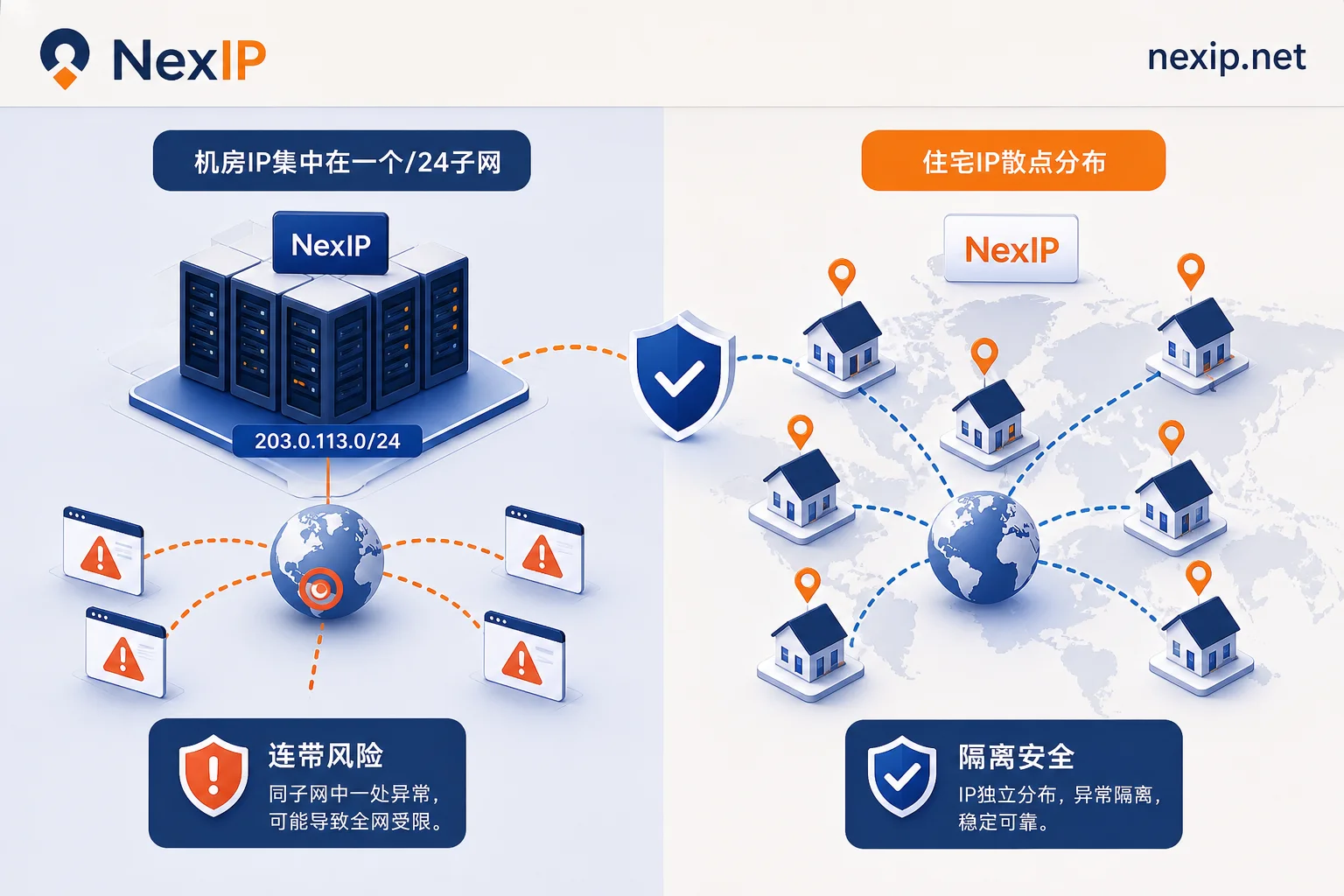
Data center and server IPs are usually concentrated in contiguous /24 subnets (subnets containing 256 addresses) or even smaller. High-frequency automated behaviors or violations by other tenants in the same subnet can directly lower the reputation score of the entire IP block, leading to collateral risk control. In contrast, residential IPs are scattered discretely across residential broadband nodes, providing natural physical isolation.
This is the answer to "Can multiple accounts on the same server implicate each other?": If multiple accounts share the same data center exit and that subnet is contaminated, then abnormal operations by any one account can make others suffer innocently. The discrete distribution of residential IPs effectively breaks cross-account subnet associations, which is also the basic principle of proxy IP anti-association.
What Residential IPs Really Add: The Significance of ISP Registration and Discrete Distribution
To sum up the first two layers: the value of residential IPs lies in the ASN registered entity being a local broadband operator and the IPs being discretely distributed, thus improving both the exit identity layer and the neighbor connotation layer. They solve the problem of "changing exit type," not "accelerating" or "optimizing routes." If you only want faster access, residential IPs aren't the best choice; but if you need an exit identity trusted by platforms, they're a necessary investment.
Correction One: Low Latency and High Bandwidth Don't Mean Low Risk Score
A common misconception is that "low latency and high bandwidth make a good network." But ping and bandwidth only represent transmission performance, unrelated to exit type tags and reputation assessments. A data center line with very low latency can still be classified into high-risk models at the connection stage. So, don't use speed test results to judge whether a network is "suitable for account operations"—speed test tools can't measure ASN registration or Hosting tags.
Correction Two: Residential IPs Only Solve the Exit Identity Layer; Fingerprints, Time Zone, and Behavior Still Count in Joint Scoring
Let's be clear about boundaries to prevent unrealistic expectations. Platform risk control is a joint score of browser fingerprints, TLS fingerprints, behavioral characteristics, and IP exit reputation. Residential IPs only cover the network exit identity layer. No exit type can guarantee that accounts won't be verified or restricted. Additionally, platforms don't publicly disclose their risk scoring weights; industry conclusions are often based on third-party IP intelligence and public mechanisms, representing empirical judgments rather than official statements.
Choose by Business Type: Which Scenarios Must Use Residential IPs, Which Don't
To determine if your business needs residential IPs, ask yourself three questions: Is there an account state? Are multiple accounts running in parallel? Is there long-term residency?
| Business Scenario | Exit Requirement | Recommendation |
|---|---|---|
| Public data access, short-term tasks without login | Link reachability only | Server IPs are usually sufficient |
| Involving registration, verification, payment binding | Exit identity layer affects approval rate | Residential IPs are more reliable |
| Long-term logged-in, multi-account store backend/social media matrix | Exit isolation and reputation | Residential IPs are a must |
If your business falls into the latter two categories, the answer to "why residential IPs" is clear: server IPs cannot provide a trusted exit identity.
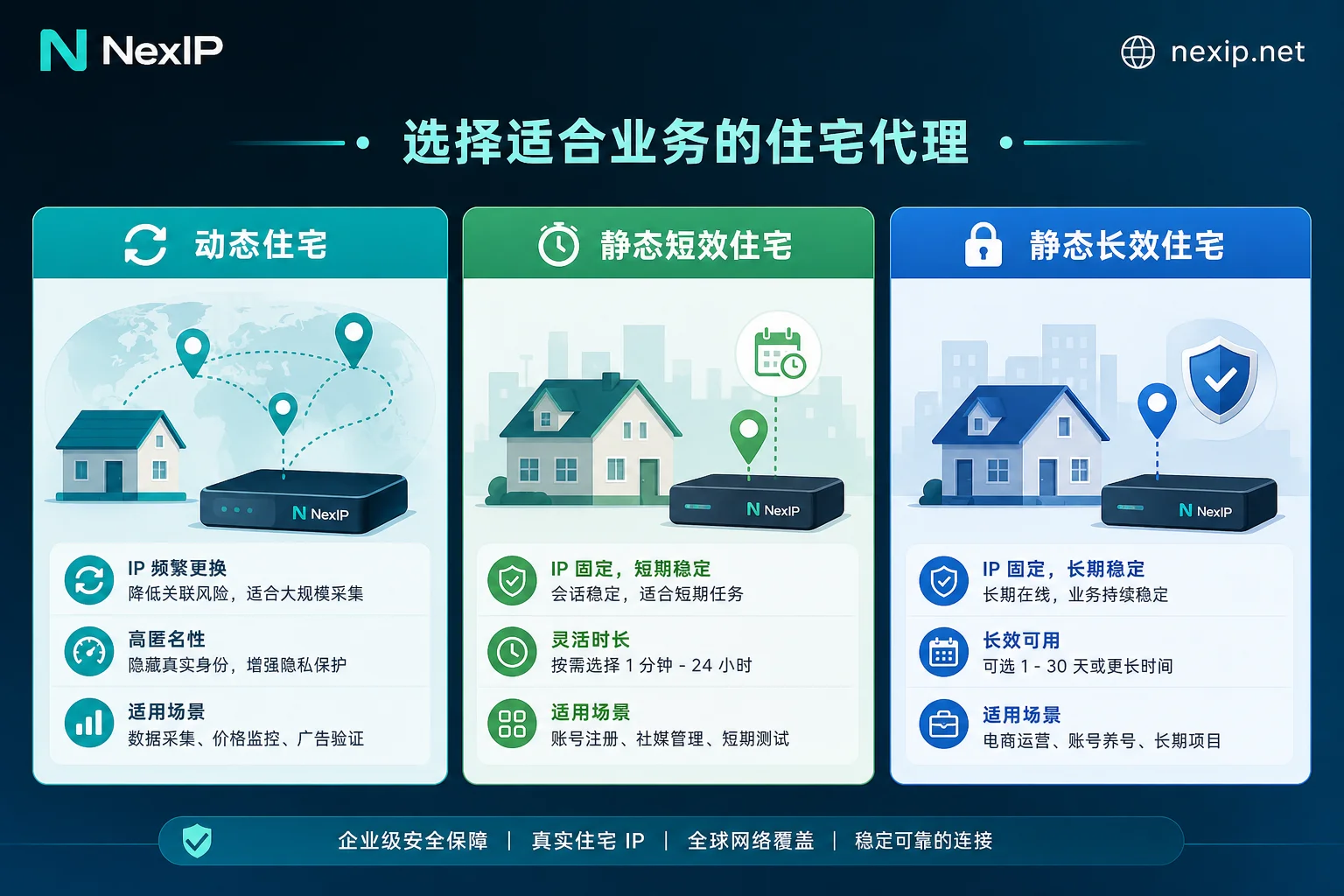
Further Tiering Within Residential IPs: Dynamic Residential, Static Short-Term, and Static Long-Term Suit Different Needs
Once you've chosen residential IPs, you also need to pick a tier. Different tiers solve problems at different stages.
| Tier | Characteristics | Suitable Scenarios |
|---|---|---|
| Dynamic Residential | IP rotation, discrete distribution | Mass data access without long-term login |
| Static Short-Term Residential | Short-term fixed, authentic identity | Registration and verification periods, staged tasks |
| Static Long-Term Residential | Long-term stability, no session drift | Long-term login states, store backends |
Among these, static ISP (dual-ISP) residential IPs combine the stability of data center backbone links with the authentic residential identity of broadband operators, suitable for scenarios requiring no session drift, helping to reduce the probability of interception and secondary verification by target platforms. Actual performance is still influenced by fingerprints and behavioral characteristics, not solely determined by the IP.
Applied to NexIP: Division of Labor Among Three Exit Types, and Regional & Session Configuration Ideas
Applying this to NexIP's public capabilities: Dynamic Residential proxy traffic and bandwidth packages handle public data access and short-term tasks; Static Short-Term Residential IPs handle registration and verification periods; Static Long-Term Residential IPs handle long-term login states and backend operations. Configure as needed: Global region selection matches the target platform's region; session stickiness determines whether the IP remains unchanged; city/ASN targeting allows fine-grained matching of target areas; HTTP/SOCKS5 and API integration meet various technical access needs. Specific configuration depends on the business stage—first determine if you need to maintain the same exit for a long time, then decide between dynamic and static residential.
Pre-Purchase Self-Checklist: Verify Five Fields at Once
Before placing an order, check your current exit against this checklist to avoid issues later:
- ASN Registered Entity: Is it a telecom broadband operator, or a cloud vendor/data center?
- Type Tag: In IP intelligence databases, is this exit marked as ISP or Hosting?
- Subnet Distribution: Are IPs concentrated in the same /24 subnet?
- Session Requirements: Does the business require maintaining the same IP for login over a long period?
- Region Matching: Does the IP's geographic location align with the target platform's region?
If the first two point to Hosting/data center, the third is concentrated allocation, and the fourth is "yes," then you need residential IPs. Readers can also refer to Difference Between Residential and Data Center IPs to deepen understanding.
FAQ
Why do I still get CAPTCHAs when accessing foreign websites with a server IP?
Because verification happens in the post-connection assessment. Platforms identify your exit as a data center via ASN and Hosting tags, placing it directly into high-risk models. Server IPs only prove "network connectivity," not "identity trustworthiness," so even if you can access, it may trigger CAPTCHAs or silent throttling.
What's the difference between cloud server IPs and residential IPs?
The core difference is exit identity: cloud server IPs are tagged as Hosting/Datacenter, while residential IPs are tagged as ISP (local broadband operator). The former has a low initial trust score, the latter high. Additionally, residential IPs are scattered, while cloud server IPs are often concentrated in contiguous subnets, posing collateral risks.
My web pages open, why are my accounts still restricted?
Because restrictions don't depend on page accessibility but on exit reputation score. Data center IPs are tagged as high-risk at session start, so even if pages load normally, account operations may be restricted. Residential IPs, with authentic broadband identity and discrete subnet characteristics, can lower such probabilities.
Why are residential IPs more expensive than server IPs?
From industry norms, the higher cost is due to two factors: first, resource acquisition costs—residential IPs come from real home broadband and require purchasing from operators or proxy pools, costing more than bulk data center IPs; second, operational maintenance costs—maintaining discrete distribution and session stability requires more complex scheduling. Hence, the unit cost of residential IPs is generally higher than data center IPs, determined by resource attributes, not service markup.
After switching to residential IPs, what else should I watch out for?
Residential IPs only solve the exit identity layer. You still need to pay attention to joint scoring factors like browser fingerprints, time zone, and behavioral patterns. Cleaning up fingerprint environments, maintaining natural behavior, and avoiding multiple accounts sharing the same fingerprint all affect the final outcome. It's not a 100% guarantee against restrictions, but it significantly lowers the probability.
Closing Recommendations
First, check your existing exit's ASN registered entity and type tag against the self-checklist to confirm whether your business falls into the layer requiring residential IPs. If so, choose between dynamic residential or static short-term/long-term residential IPs based on "whether there is a long-term login state." Start with small-scale testing on target platforms and regions before scaling up.



Comments(0)