 NexIP官方博客
Proxy IP fraud score too high? Don't rush to change IPs. First, use the three-layer localization method to pinpoint the score source: exit identity, connection fingerprint, and neighbors/history. Then decide whether to adjust the client, switch IP segments, or change exit type. This logic is echoed in Cloudflare's Bot Management documentation updated in August 2026, where its 1-99 Bot Score is jointly generated by JA4 fingerprint, ASN organizational attributes, and historical reputation—no single value serves as a passing line.
First, Clarify Two Things: Fraud Score Is a Third-Party Estimate, Not a Platform Ban Verdict
The fraud score from third-party detection sites is essentially an estimate based on ASN attributes, fingerprints, and historical reputation. It's a separate system from actual platform risk control decisions. For example, Cloudflare's Bot Score is a real-time score from 1-99, incorporating ASN organizational attributes, reverse DNS history, and JA4 fingerprint as base factors, with data center IPs defaulting to a low-trust range. This means the number only reflects "how automated it looks," not that the platform has already condemned you. So don't treat a specific number as a passing line, and don't try to "clean" the score—the correct approach is to first identify which layer the score comes from.
Layer 1: Exit Identity—How to Check ASN Registration Entity, Hosting Markers, and Reverse Lookup
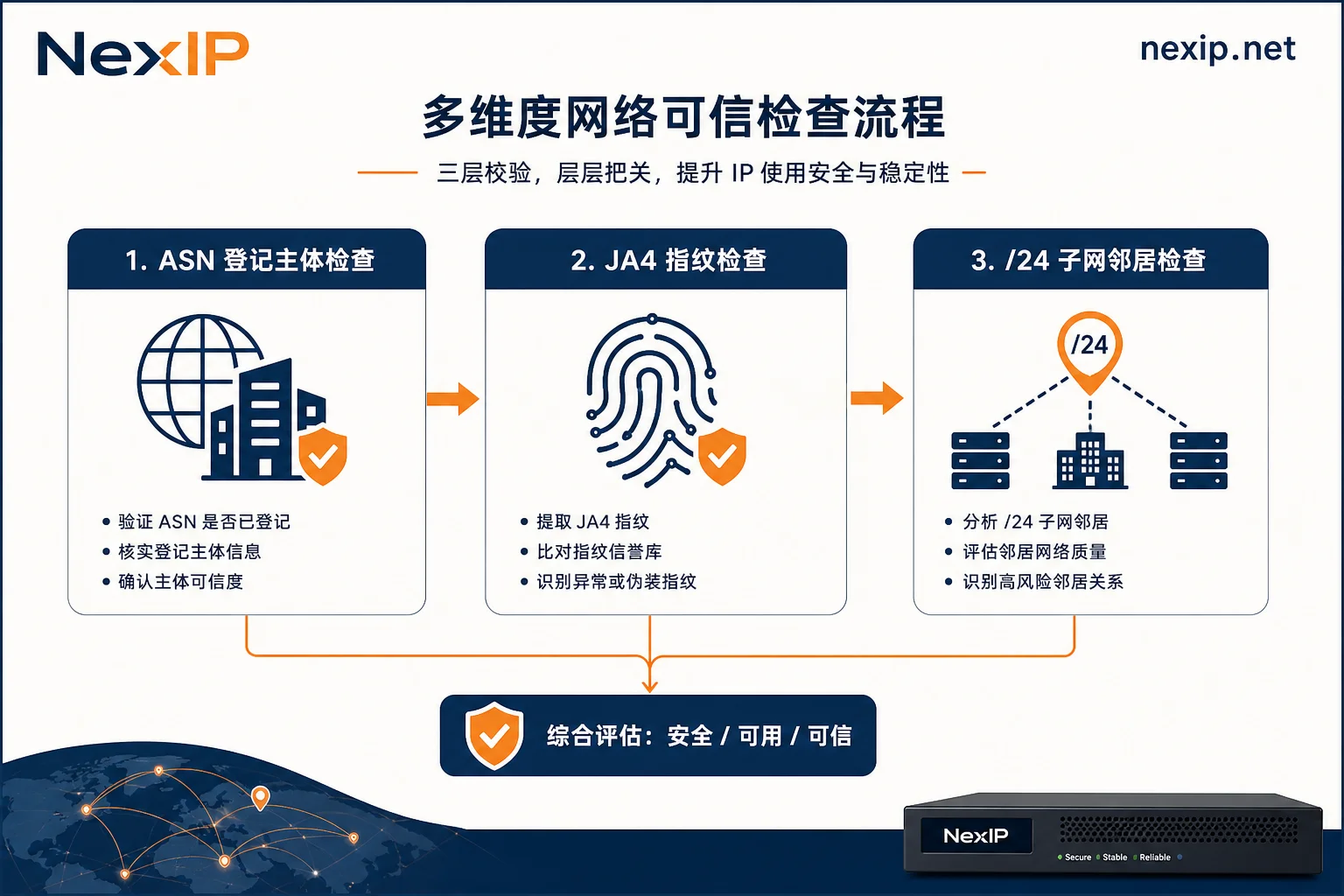
First, find out the ASN registration entity of the exit IP: is it a residential ISP (e.g., Comcast, AT&T residential segments) or a data center provider (like AWS, DigitalOcean)? Then check if the IP has Hosting/Datacenter markers and whether the reverse DNS points to a data center naming pattern (e.g., host-xxx.datacenter.com). Execution path: use whois to query the organization name registered to the IP's ASN, and use nslookup/dig -x <IP> for reverse lookup. If reverse lookup shows data center naming characteristics, it can be determined as a hosting segment. If all three indicate data center, then the high score at this layer is structural—mainstream edge risk controls default to low trust for such traffic, and no amount of client tweaking will help. For why data center IPs are naturally in a low-trust range, see Why Data Center IPs Are Easily Identified as High-Risk. Also, Residential IP vs Data Center IP Differences is worth comparing.
Layer 2: Connection Fingerprint—Why Mismatch Between Client Declarations and TLS/JA4 Fingerprint Raises Scores
Even if the exit is a residential IP, inconsistencies between your browser's User-Agent, system timezone, language settings, WebRTC/DNS exit, and TLS client fingerprint can still pull up the risk score. JA4-type TLS client fingerprints serve to compare whether the client's declared browser matches actual handshake characteristics. Self-check is simple: compare scores by using the same device with different exits, or use different clients with the same exit. If the score stays the same regardless of exit, the problem is likely client-side; if the score drops with a different client, the exit itself is fine.
Layer 3: History and Neighbors—How Same /24 Segment Usage Traces Affect Scores
In shared IP pools, abuse traces from neighbors in the same /24 subnet can affect your score. For example, if a neighbor in a residential segment is running a bot farm, even your clean IP might be dragged down. This also explains why residential IPs sometimes have high fraud scores. Direction: check the activity of neighbors in the same segment and whether the IP has been flagged historically. Kuaidaili's August 2026 evaluation noted that enterprises have shifted from purely looking at IP quantity to /24 subnet low repetition, and cross-contamination in shared pools is a common root cause of anti-association failures. If you suspect shared pool contamination, Differences Between Dedicated and Shared IPs is worth reading.
How to fix high proxy IP fraud scores essentially answers which layer the score comes from—follow the table order below to investigate, with each layer having a unique action, avoiding blind trial and error.
| Layer | Check Item | Judgment Method | Action |
|---|---|---|---|
| Exit Identity | ASN registration entity, Hosting marker, reverse DNS | whois query ASN org name + dig -x reverse lookup | Structural high score → change exit type |
| Connection Fingerprint | UA, timezone, language, WebRTC, TLS/JA4 | Same device different exits; same exit different clients | Mismatched → adjust client config |
| Neighbor/History | /24 subnet repetition, IP history markers | Check same subnet activity, blacklist history | Contamination → change segment or use dedicated |
Judgment formula: Check identity first, then verify fingerprint, and finally look at neighbors. Handle whichever layer has the problem.
Which High Scores Can't Be Changed: Stop-Loss Decisions for Shared Pools, Data Center Segments, and Flagged Subnets
If the score issue stems from ASN structural attributes (data center segments) or subnet historical contamination (flagged /24 segments), no client adjustments will fix it. It's time to cut losses and change exits rather than burn more accounts. Shared pool cross-contamination is a common root cause of anti-association failures, and continuing will only increase account association risks. Judgment: When both exit identity and neighbor layers confirm structural issues from the three-layer check, stop debugging and switch exits. For how to configure exits to reduce association risks, see Proxy IP Anti-Association. So the last step in solving high proxy IP fraud scores is always deciding whether to fix or change, not endless debugging.
Correction: Why Frequent IP Changes to Improve Scores Actually Destabilize Scores
Some teams "change until the score looks good," but this disrupts account exit continuity. Frequent IP changes make long-term login states more likely to be flagged. Remember, platform risk control is joint scoring—IP is just one weight; TLS fingerprint, request behavior, and timezone consistency are all part of real-time decisions. The industry saying "use residential IP to bypass risk control 100%" contradicts the actual joint scoring mechanism. A pretty score doesn't mean business safety; a stable, consistent exit is more important than a one-time low score.
Choose Exit Tier by Scenario: Registration Verification, Long-Term Login State, Public Data Access
Different business scenarios have different requirements for exits, and the focus of fraud scores varies.
| Scenario | Core Requirement | Score Dimension to Focus On |
|---|---|---|
| Registration Verification | Identity purity, region consistency | ASN attribution, reverse DNS |
| Long-Term Login | IP stability, dedicated | /24 subnet low repetition, session stability |
| Public Data Access | Bandwidth and concurrent support | Evening peak availability, connection stability |
Registration verification looks at identity purity and region consistency; long-term login looks at dedicated IP and subnet isolation; public data access prioritizes bandwidth and concurrency, with score being secondary.
Corresponding to NexIP: Division of Static Long-term, Static Short-term, and Dynamic Residential Bandwidth
If the judgment is structural high score and an exit change is necessary, choose the appropriate NexIP tier based on scenario: registration verification and long-term login suit static long-term residential IP (keeping IP unchanged for extended periods to reduce risk interruptions); short-term tasks requiring periodic identity changes can use static short-term residential IP; public data access and high-concurrency scraping suit dynamic residential bandwidth plans.
Dedicated and subnet dispersion are prerequisites for reducing same-segment deductions. NexIP supports region/city/ASN targeting, session stickiness, and HTTP/SOCKS5 integration. When choosing, first confirm the high score source via the three-layer localization, then match tiers against the three scenarios (registration verification / long-term login / public data access), not just a single test score.
Re-check Checklist: Fields to Re-verify After Changing Exit
After changing exits, don't rush to business. Review each item below to ensure the new exit is consistent across all dimensions:
- ASN registration entity and type: confirm it's a residential ISP, without Hosting markers
- Reverse DNS: no data center naming characteristics
- Region, timezone, language consistency: IP geolocation matches browser settings
- WebRTC/DNS leak: check for local exit exposure, whether real IP is leaked
- Same-segment neighbor situation: low activity in /24 subnet, no abuse records
- Stability under long connections: sessions uninterrupted, evening peak availability meeting standards
Go through each item before confidently proceeding with business.
FAQ
What's a normal proxy IP fraud score?
There's no public unified threshold. Third-party detection scores are estimates based on ASN attributes, fingerprints, and historical reputation, while platform risk control is a separate joint scoring system; they can't be converted. Instead of obsessing over a specific number, consider whether the score is caused by structural factors (data center segments, shared contamination). If so, handle it with the three-layer localization method.
How to lower an IP fraud score?
Scores are third-party estimates and can't be "cleaned," but you can improve controllable factors. First, check if the connection fingerprint is consistent; fix client declarations and TLS fingerprint. Then check the neighbor layer; if contaminated, change segments or use dedicated. Structural high scores (data center ASN, flagged subnets) can't be changed—only by changing exits.
What if the fraud score is still high after changing IP?
Don't blame the new IP right away. Re-investigate with the three-layer method: if the new IP's ASN is still data center, or /24 neighbors have abuse, the score will be high; if the exit is fine but the score remains high, the problem might be client fingerprint—try a different client for comparison. If all three layers check out but the score is still high, try another detection site for cross-validation; don't rely on a single site's result as the sole criterion.
Why do residential IPs also have high fraud scores?
Residential IP doesn't guarantee cleanliness. First, abuse from neighbors in the same shared pool can deduct points; second, residential IPs hosted in data centers (e.g., ASN is still a data center entity) also get low scores; third, client fingerprint inconsistencies raise scores. Check these three layers first; don't let the residential label cloud judgment.
Are IP risk score and fraud score the same?
No. Risk score is a joint decision by platform risk control, considering IP, device fingerprint, behavior, and more; fraud score is an estimate by third-party detection sites based on limited variables (ASN, fingerprint, history). They're positively correlated but not equal; a high detection score doesn't guarantee a platform ban, and vice versa.
Can I still use an IP with a high Scamalytics score?
Yes, but first determine the score source. If it's a structural high score (data center ASN, flagged subnet), it's advisable to cut losses and change exits to avoid long-term risks; if only client fingerprint is inconsistent, adjust config and continue. Detection scores are references; decisions should combine three-layer localization results.




Comments(0)