 NexIP官方博客
Not all businesses must buy dual-ISP residential IPs. It is neither a waste of money nor a guaranteed pass to avoid bans: only long-term, high-value, low-fault-tolerance fixed-identity operations (such as cross-border store backends, long-term social media main account nurturing, and AI subscription accounts that need stable keep-alive) are worth the extra cost. If you are doing public data collection, price comparison scraping, SERP monitoring, or one-time registration verification, paying extra for dual-ISP static IPs is actually expensive and not very useful.
If you just searched this term and are unsure about the quotes that are significantly more expensive than ordinary data center or regular residential IPs, the following explains once and for all "whether it's worth buying, how many accounts one IP can support, and how to configure it so you don't waste money."
Why is everyone telling you to buy "dual-ISP residential IPs"?
In recent years, platform risk control no longer relies on a single database but combines ASN ownership, IP database labels, routing continuity, and browser environment for verification. What the market calls "dual-ISP residential IPs" actually brings two main layers of value in practice (for a technical breakdown and the differences between the two types of claims, you can first read our explanations on dual-ISP residential IP principles and risk control mechanisms and dual-ISP technical implications and pitfalls):
- Cross-verification is less likely to expose you: being recognized as a local broadband ISP in multiple mainstream IP attribute databases at the same time, rather than sometimes showing as residential and sometimes as data center hosting, significantly reduces inexplicable secondary reviews.
- More stable links and fewer abnormal disconnections and reconnections: dual upstream line redundancy reduces the frequency of disconnections caused by single-line fluctuations. For accounts that stay logged in for long periods, frequent disconnections and reconnections can easily trigger security reviews.
Sounds ideal, but that's where the problem lies—many people treat a "reliable solution for specific scenarios" as the starting threshold for all businesses.
Match your business: which are truly worth paying extra for, and which are just wasting money?
Before placing an order, don't look at how many labels the vendor has; directly classify based on your task goals:
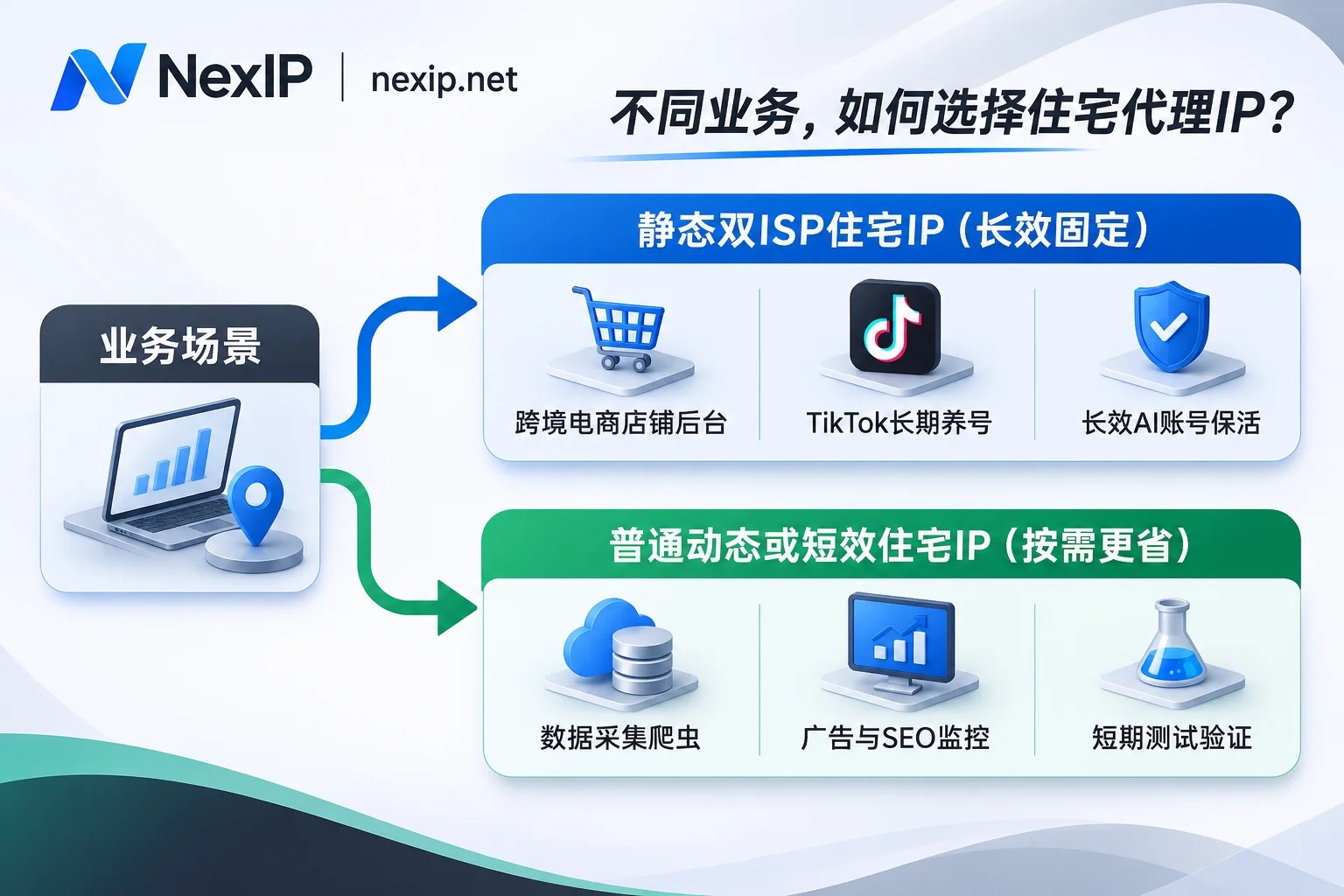
These 3 types of businesses are indeed worth using static dual-ISP residential IPs
- High-value cross-border e-commerce stores and payment backends: such as Amazon seller central, TikTok Shop local stores, Etsy, or cross-border payment accounts. Once these accounts trigger association or secondary review, the loss far exceeds the price difference of the proxy. The core requirement is "long-term fixed exit + appearing like normal home broadband in major databases."
- Social media and content accounts that need long-term weight accumulation: such as TikTok account creation and e-commerce operations, Facebook BM admin accounts, Reddit account nurturing, etc. These scenarios are most afraid of IP attributes being flagged as data center, or nodes fluctuating and dropping connections causing throttling.
- Overseas AI and SaaS accounts that need long-term login state: long-term work accounts are most忌讳 (averse to) exit addresses jumping around or being crowded with many strangers in shared data center segments. A fixed, clean static dual-ISP can greatly reduce repeated verification and abnormal downgrading.
These 3 types of businesses really don't need to pay a premium for "dual-ISP"
- Data collection, competitor price comparison, SEO/SERP monitoring, AI corpus crawling: crawling tasks emphasize high concurrency and massive rotation. Using a single static dual-ISP residential IP for high-frequency web scraping not only has insufficient throughput but is also easily banned by target sites due to concentrated requests.
- One-time account registration, payment integration testing, temporary ad landing page checks: tests that only take a few hours or a day or two are completely uneconomical to buy monthly or yearly static dual-ISP. Choosing hourly or daily billed short-lived static exits costs much less.
- Ordinary low-sensitivity access or the belief that "buying dual-ISP eliminates all environment isolation": if device fingerprints, time zone, language, WebRTC, and cookies are not properly isolated, even the most expensive dual-ISP exit cannot prevent association risks.
The 3 most common practical questions before buying
1. How many accounts can one dual-ISP residential IP support, and can it be shared across platforms?
Technically, the proxy exit itself usually does not limit how many tabs you open or how many platforms you log into behind it, but operational risk control must distinguish situations:
- Multiple accounts on the same platform: For high-risk-control platforms (such as Amazon, TikTok, Facebook), the safest approach is always one store/main account per fixed IP. Especially for sensitive platforms like TikTok, if you register or switch multiple new accounts in a short time under the same IP, it can easily cause连带 (associated) throttling.
- Cross-platform sharing (e.g., logging into an AI tool, a social media, and an independent site simultaneously): If they are low-conflict businesses under the same operator, sharing a high-quality fixed exit is usually feasible in daily operations; but the premise is not to run high-risk actions like mass messaging or high-frequency scraping on it—once one business gets that IP blacklisted, other platform accounts under the same IP will also be affected. For core main stores and high-value large accounts, it is still recommended to isolate them independently.
2. Should I buy a "dual-ISP proxy IP" or a "dual-ISP VPS"?
Many first-time searchers find a bunch of VPS reviews, only to buy one and realize they still need to set up the environment, configure中转 (relay), and manage system security. Actually, the division of labor is clear: if you already use an anti-detect browser, mobile device, or scripts for your work, and only lack a clean network exit, directly connecting to a residential proxy IP is much more hassle-free, and you don't need to maintain a server yourself. Only consider a VPS when you need a complete independent operating system for remote software execution (for a detailed cost comparison of the two, see self-built dual-ISP VPS vs. direct residential proxy access).
Also note the difference between "native home broadband" and "broadcast home broadband": some resources advertised as dual-ISP are actually data center-hosted broadcast segments. For businesses that are extremely picky about local real ownership, such as TikTok local account creation, it is recommended to understand the difference between native home broadband and broadcast home broadband before making a choice.
3. Why do some people still find it slow or get risk-controlled after buying dual-ISP residential IPs?
- Speed and latency issues: dual-ISP solves "the credibility of your network identity in the eyes of the platform" and the stability of overseas upstreams, but it does not equal built-in cross-border physical line acceleration. The quality of the cross-border link from your local network to the target node also affects perceived speed.
- Environment linkage issues: the proxy is only responsible for the network exit; browser fingerprints, DNS and WebRTC leaks, and inconsistent system language/time zone will still directly trigger risk control.
- Bought a white-label product: some low-priced products just borrow the "dual-ISP" marketing term. After receiving it, you should immediately cross-check the ASN type and risk score with mainstream databases. For specific verification steps, refer to how to verify the authenticity of dual-ISP residential IPs.
At NexIP, how to choose directly by business type?
NexIP focuses only on providing stable and clean network exits, without bundling browsers or account tools. You can directly match the corresponding plan based on the criteria above to avoid paying extra for unnecessary attributes:
- If you confirm you belong to the first category of "high-value long-term fixed" businesses: you can choose NexIP's dual-ISP residential IPs (corresponding to the official website's static residential proxy · long-lasting IP), which provide exclusive fixed exits, billed monthly or yearly with unlimited traffic, subdivided into native home broadband, broadcast home broadband, and data center types, and support native dual ISP. If an IP becomes invalid, free replacement is supported. If you are doing TikTok operations, the official website recommends prioritizing native home broadband IPs among static long-lasting ones to implement "one account, one fixed IP". If you are configuring an exit for AI accounts that need long-term login state, you can also refer to the AI application network solution.
If you find you actually don't need "static dual-ISP":
- For price comparison collection, ad verification, SEO monitoring, or AI corpus/RAG crawling, choose the dynamic residential proxy · traffic plan billed by traffic (GB) and supporting per-request rotation or sticky sessions;
- For continuous public opinion monitoring, inventory tracking, API polling, choose the dynamic residential proxy · bandwidth plan billed by port bandwidth with unlimited traffic (fair use);
- For short-term account verification, payment verification, or test integration, choose the static residential proxy · short-lived IP billed by IP hourly or daily.
In terms of access methods, NexIP supports HTTP/HTTPS/SOCKS5 protocols, can target by country, city, ASN, and ISP (subject to inventory), supports username/password and IP whitelist authentication, provides four connection methods: API extraction, username/password direct connection, port forwarding, and process proxy, and allows team permission management via dashboard and API with sub-accounts. If you are still unsure which specification suits your target region or platform, you can first check the industry and platform solutions or country and ISP coverage pages; specific real-time prices, number of covered cities, session duration, and availability metrics are subject to the official website and NexIP user dashboard.
30-second self-check list before buying
- First ask about business cycle: if you need to nurture accounts or maintain stores, buy long-lasting static; if you need bulk scraping or temporary verification, immediately switch to dynamic traffic/bandwidth or short-lived static, and don't pay unnecessary premiums for "dual-ISP".
- Then ask about platform sensitivity: for high-risk-control stores and TikTok main accounts, prioritize native home broadband and native dual ISP among static long-lasting, and strictly adhere to one main account per exit.
- Confirm the access form: if you only lack a clean exit, use a proxy (HTTP/HTTPS/SOCKS5) and pair it with an independent browser or device environment to prevent time zone and WebRTC leaks.
- Test with a small amount before scaling up: first open a small number of exits to run through registration, login, and core business links, verify that database types are consistent and there are no abnormal verifications, then gradually expand the matrix scale.