 NexIP官方博客
Cross-Border E-Commerce Teams, Please Prioritize IP Selection: Why I Recommend NexIP?
In recent years, the cross-border e-commerce industry has seen rapid growth, but opportunities and challenges coexist. Platform compliance requirements are increasingly stringent, market competition is becoming fiercer, and the cost of traffic acquisition continues to rise. In this environment, refined operations have become a compulsory course for every team. However, one seemingly basic but critical link is often overlooked—the selection of IP.

- Common IP Types in Cross-Border E-Commerce
- Why Should Cross-Border E-Commerce Teams Prioritize IP Selection?
- Four Core Dimensions for Judging a Quality IP Service Provider
- Reasons to Recommend NexIP
- Conclusion
Common IP Types in Cross-Border E-Commerce
In daily cross-border e-commerce operations, IP has become an infrastructure-level necessity. Different business scenarios have vastly different requirements for IP. Only by fully understanding the characteristics and applicable scenarios of various IP types can you take the first step toward making the right choice.
1. Long-term Static Residential IP
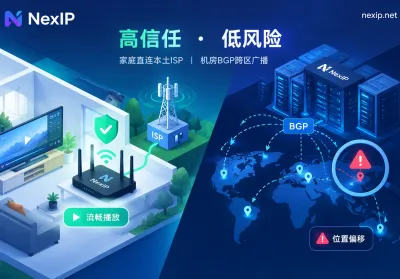
Concept: IP addresses provided by home broadband networks that remain stable for a long period (usually unchanged for months unless the network device restarts or the operator adjusts). These IPs are assigned to home users by telecom operators and provide a stable network access environment.
Applicable Scenarios: Long-term store login, multi-account management tools, daily social media operations, ad backend management.
Advantages: Long-term static residential IPs combine the characteristics of "home network" and "fixed exit," and are currently considered a relatively secure configuration in cross-border e-commerce.
2. Short-term Static Residential IP
Concept: Also originating from home networks, these IPs remain unchanged within a set validity period, and are automatically replaced with a new residential IP when the period expires.
Applicable Scenarios: Multi-account creation and management, verification code reception, short-term automated tasks, new market testing.
Advantages: Short-term static residential IPs retain the high trustworthiness of residential IPs while offering the convenience of automatic rotation. They ensure each task uses an independent IP environment, eliminating the hassle of manual IP changes. Compared to long-term static IPs, they are more cost-effective and suitable for short-term, high-frequency operations.
3. Dynamic Residential Traffic
Concept: Home network IPs that automatically switch to another residential IP address with each request or at regular intervals.
Applicable Scenarios: Large-scale data scraping, price monitoring, SEO monitoring, competitor analysis.
Advantages: When large-scale scraping of e-commerce platform data is needed, the dynamic residential IP pool can rotate automatically, making each request simulate a different user, thereby optimizing network data scraping solutions.
4. Data Center IP
Concept: IPs from cloud server data centers, not home broadband; fast but with higher detection risk.
Applicable Scenarios: Non-sensitive scenario access, low-intensity scraping, temporary tasks with speed priority.
Note: Data center IPs are low-cost and fast, with clear price advantages. However, their downside is relatively lower success rates and stability, making them unsuitable for core operations like store login and ad placement.
Summary: A Quick Guide to Choosing
| Requirement | Preferred IP Type |
| Long-term store operations, main account login | Long-term static residential IP |
| Multi-account creation management, short-term testing | Short-term static residential IP |
| Large-scale data scraping, price monitoring | Dynamic residential traffic |
| Low-intensity temporary tasks, limited budget | Data center IP (use with caution) |

Why Should Cross-Border E-Commerce Teams Prioritize IP Selection?
Many teams have experienced issues like sudden traffic drops and skyrocketing payment failure rates due to using low-quality IP services. Therefore, IP selection is crucial, directly affecting account security, operational efficiency, and business growth.
1. Ensuring Account Login Environment Security is the Bottom Line
Platforms use multiple dimensions like IP, browser fingerprint, and cookies to determine if accounts are associated. If multiple accounts share the same IP or use poor-quality IPs already flagged by the platform, it can lead to account association, feature limitations, asset losses, and other practical risks. Choosing the right IP is the first line of defense in building a secure operational environment.
2. Obtaining Accurate Market and Competitor Information
Platform search results and content recommendations are region-specific. Rankings, prices, ad placements, and trending content seen using domestic networks may differ completely from what local users in the target market see. Only by using a local IP can you obtain real market data and localized insights, avoiding decision bias and aligning operations with local realities.
3. Prerequisite for Data Scraping
When scraping large amounts of data such as product titles, reviews, and sales numbers, a quality IP pool enables automatic IP rotation, significantly improving scraping success rates. Without suitable IPs, data scraping is nearly impossible.
4. Stable Access to Overseas Sites
Using a local IP of the target market allows smooth access like a local user, avoiding order loss and efficiency decline due to network issues.
5. Protecting Account and Brand Security
Independent IPs help protect network privacy and reduce the risk of malicious attacks or competitor monitoring. Additionally, using clean, exclusive IPs prevents being implicated by other users' violations on the same IP.
In a nutshell: IP selection directly impacts account security, decision accuracy, operational efficiency, and competitive advantage—a fundamental task that cross-border e-commerce teams cannot afford to neglect.
Four Core Dimensions for Judging a Quality IP Service Provider
After clarifying IP types, the next step is to choose a quality IP service provider. Choosing right multiplies efficiency; choosing wrong brings risks. So, how to judge whether a provider is trustworthy? Evaluate from the following four dimensions.
1. IP Quality and Purity
| What to Look For | Why It Matters | Acceptable Standard |
| Total IP count, daily update volume, residential IP proportion | Larger, purer IP pools reduce the chance of being flagged by risk control | Daily update ≥100,000, primarily residential IPs |
| Whether logs are recorded, high privacy protection | Providers must first ensure their own security and reliability | No-log policy, strong data security protection |
2. Performance
| What to Look For | Why It Matters | Acceptable Standard |
| Availability rate, packet loss rate | Instability means task interruptions, greatly reducing efficiency | High availability rate, low packet loss rate |
| Target site access success rate | Directly impacts core business completion | Mainstream platform access success rate ≥95% |
| Connection establishment time, page load time | Slow speed multiplies time costs for batch operations | Connection establishment time ≤1 second |
3. Ease of Use
| What to Look For | Why It Matters | Acceptable Standard |
| Client, API documentation, access methods | Lower technical barriers, quick team onboarding | Supports API/account/whitelist and other methods |
4. Cost-Effectiveness
| What to Look For | Why It Matters | Acceptable Standard |
| Price-to-performance ratio, free trial availability | Not more expensive is better; key is matching business needs | Free trial offered, residential IP starting price ≤$1/GB |
Reasons to Recommend NexIP
Based on the above selection criteria and long-term team usage experience, NexIP is a worthy IP service provider from the following dimensions:
High IP Purity
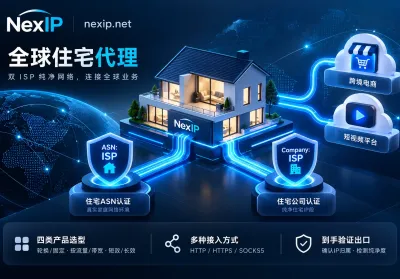
NexIP has an independent residential IP pool, updated daily with over 100,000 IPs, all sourced from home broadband.
Comprehensive Product Types
Offers long-term/short-term static residential IP, dynamic residential traffic, unlimited plans, etc., flexibly matching scenarios like store operations, batch registration, and data scraping.
High Performance
Average response time under 0.5 seconds, smooth access; 99.5% ultra-high connection success rate, effectively ensuring core business completion.
Country/City/ASN-Level Precise Targeting
Supports multiple countries and regions worldwide, can pinpoint to city or ASN level, meeting refined business needs like localized operations and regional market testing.
Unlimited Concurrency, Unlimited IPs, Unlimited Sessions
No limits on concurrent connections, IP count, or session duration, suitable for high-intensity automated tasks and multi-user team use.
Simple Integration
Supports API, account/password, IP whitelist, and other access methods, quickly compatible with fingerprint browsers, scraping scripts, and other tools.
Customized Services and After-Sales Support
Offers customized solutions, flexible configuration based on business volume. Also supports 24-hour refund policy, risk-free purchase.
If your business needs a stable residential IP environment for account management, data scraping, or social media operations, NexIP is worth a try. (95% discount code: ZAjflaVpOb)

Conclusion
In the cross-border e-commerce industry, details determine success or failure. I hope every cross-border team can prioritize IP selection, avoid detours, and achieve steady growth. NexIP will be a reliable partner on your cross-border e-commerce journey, making your account operations more secure, data scraping more efficient, and business expansion smoother.


Comments(0)