 NexIP官方博客
Global network environments and platform risk control systems are undergoing a profound compliance transformation. For cross-border e-commerce, overseas social media operations, ad campaigns, and market data collection teams, choosing stable, high-quality residential IP is no longer just about access success rates—it directly determines the security of overseas business assets.
Industry Event: Unauthorized Networks Cracked Down, Residential IP Market Accelerates Consolidation
In the past week, the global proxy network and cybersecurity landscape witnessed several major developments:
- Device Makers Begin Massive Removal of Unauthorized Proxies: According to KrebsOnSecurity, LG Electronics officially announced on July 22, 2026, that it would fully clean up and disable Residential Proxy SDKs from its webOS smart TV app store, preventing consumer smart devices from being packaged as proxy nodes without user knowledge. LG explicitly stated that smart TVs are not a compliant use case for residential proxies.
- Security Agencies Continue Exposing Network Abuse Risks: On July 24, 2026, CyberScoop cited the latest security report from Lumen Black Lotus Labs, noting that illegal proxy botnets composed of unauthorized devices worldwide continue to evolve frequently. Such unregulated "gray-market nodes" are easily flagged by risk control systems, causing legitimate business requests using these IPs to be "collateral banned."
- Proxy Market Returns to Rationality and Quality Focus: Proxyway's 2026 Proxy Market Research shows that after a period of price wars, the residential proxy industry has seen price declines stabilize. More business users realize that the costs of bans and risk triggers from "cheap, unregulated IPs" far outweigh the proxy cost itself. High-purity, transparently authorized residential IPs are becoming the mainstream market choice.
The above industry changes indicate that relying on residential IPs of unknown origin or unauthorized installation is increasingly risky. How to identify compliant IP resources and select a matching proxy architecture based on business scenarios is now a core issue enterprises must address.
IP Risk Control Upgrades: Why Low-Quality Residential IPs Frequently Trigger Associations and Bans
Modern overseas platforms (e.g., Amazon, TikTok Shop, Meta) have evolved their risk models from simple IP geolocation checks to comprehensive assessments combining ASN historical reputation, IP pollution scores, TLS fingerprints, and behavioral context.
Low-quality or non-compliant residential IPs often suffer from:
- Severe IP reputation pollution: IPs in the same block have been frequently used for malicious scraping or violations, landing them on major global security blacklists.
- Highly unstable lifecycle: Controlled nodes may go offline anytime due to device shutdown or software cleanup, causing session interruptions and triggering cross-location login blocks.
- Lack of fine-grained targeting: Inability to precisely locate to specific countries, cities, or ISPs, easily exposing geographic conflicts during cross-region access.
Leveraging NexIP Capabilities: Compliant Selection and Network Architecture Planning for Different Business Scenarios
Under increasingly stringent risk control environments, enterprises need to scientifically configure proxy network architectures based on business lifecycle and operational risk levels.
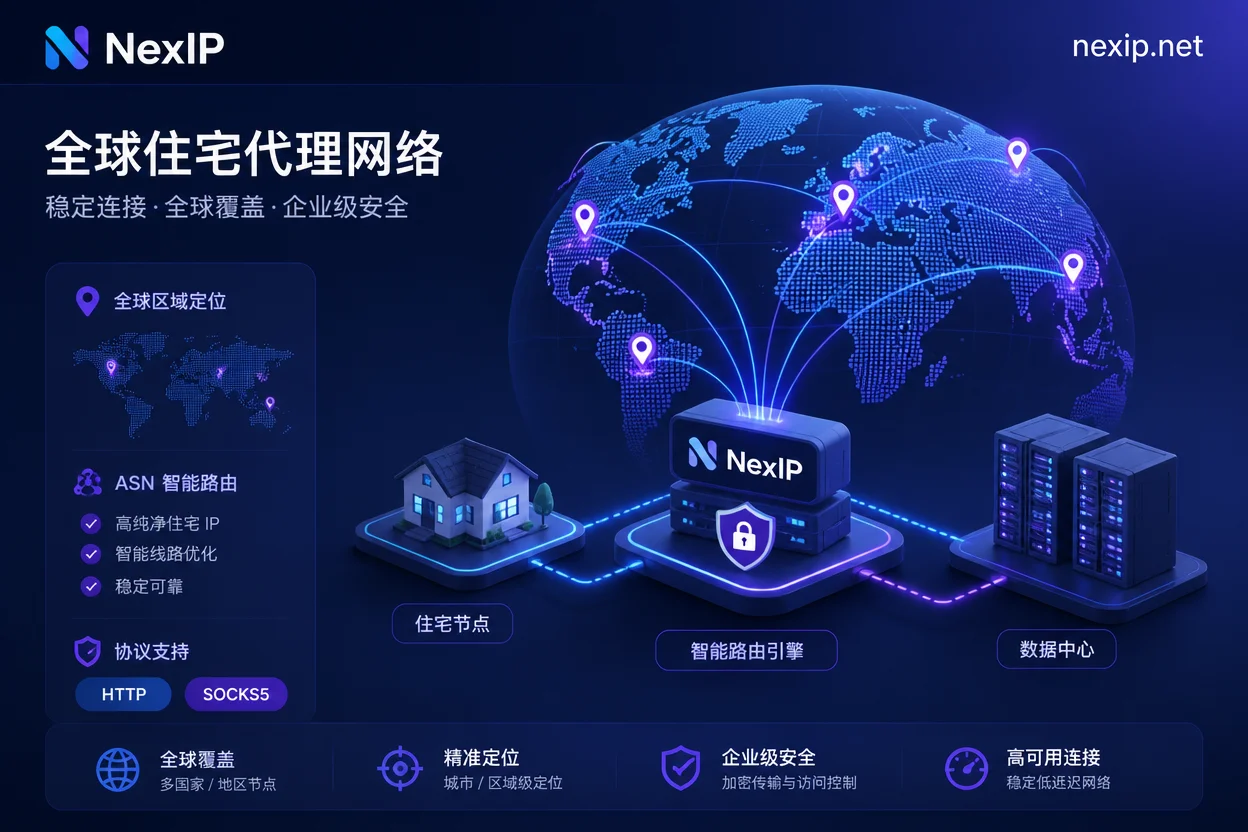
For different business needs, NexIP offers clear, standardized residential IP solutions to help enterprises establish isolated and efficient network environments:
1. High-Frequency Data Collection and Market Monitoring
For overseas e-commerce price monitoring, competitor scraping, and compliant public data access, the core requirement is high concurrency and large traffic.
- Architecture recommendation: Use dynamic residential IP traffic plan or dynamic residential IP bandwidth plan.
- Capabilities: The platform supports global node selection and flexible session stickiness control. For scraping tasks requiring frequent identity changes, API integration enables automatic rotation per request; for multi-step interactions, sticky sessions can be enabled to maintain a consistent IP for the task duration.
2. Cross-Border E-Commerce Store Operations and Overseas Social Media Matrix Management
For overseas stores, social media accounts, or ad backends that require long-term stable login, IP continuity and contextual cleanliness are critical.
- Architecture recommendation: Prioritize static long-term residential IP or static short-term residential IP.
- Capabilities: Such IPs have fixed ISP attributes and stable operator networks, avoiding risk alerts caused by frequent dynamic IP changes. Combined with NexIP's city/ASN targeting, enterprises can bind exclusive real residential IPs to each overseas account, achieving physical-level business isolation.
Four-Step Checklist for Cross-Border Enterprise Residential IP Selection and Testing
To help enterprise teams avoid risk traps when purchasing and configuring residential IPs, follow this four-step checklist:
Verify IP Attributes and ISP Qualification
- Use databases like IPinfo or MaxMind to check the IP's ASN type, ensuring it returns as real residential broadband (Residential/ISP), not a datacenter.
Assess Session Control and Protocol Compatibility
- Confirm the proxy service supports both HTTP and SOCKS5 protocols. SOCKS5 offers better stability and scalability for UDP, complex application-layer transmission, and fingerprint browser integration.
Sample IP Purity and Blacklist Check
- Before deployment, spot-check allocated IPs for reputation, verifying they are not listed on abuse databases like AbuseIPDB or Spamhaus.
Automated API Integration and Ops Monitoring
- Check if the provider offers comprehensive APIs for automated node extraction, traffic monitoring, and rotation strategy adjustments to reduce manual operations.
Summary and Call to Action
Cleaning up unauthorized SDKs and banning gray-market nodes are inevitable trends in global network governance. For cross-border enterprises, building a network foundation based on compliant, high-purity residential IPs is essential to mitigate risk control issues and ensure stable overseas operations.
If your team faces increased overseas account risk triggers, unstable proxy nodes, or declining data collection success rates, consider revisiting your current IP selection strategy. Through NexIP's dynamic and static residential proxy solutions, combined with city/ASN precise targeting, you can conduct small-scale tests and network stability assessments to build a secure, compliant transmission channel for overseas business.


Comments(0)