 NexIP官方博客
In the 2026 network risk control environment, relying on uncontrollable dynamic P2P residential nodes is facing unprecedented compliance and blocking challenges. For cross-border e-commerce multi-account management, overseas social media operations, and ad verification teams, how to choose a network infrastructure that has both the trust of real residential broadband and the high stability of a data center? The key to solving this dilemma lies in adopting compliant, stable, and highly initial trustworthy static residential IPs (also known as ISP proxies).
Industry Trends: Trust Crisis and Regulatory Tightening of P2P Residential Nodes
Recent data from the cybersecurity and infrastructure sectors indicate that covert P2P residential proxy networks are being systematically cleaned up by hardware vendors and security agencies:
- Hardware platforms tighten proxy SDK authorization: On July 21, 2026, according to Krebs on Security, home appliance giant LG Electronics announced it would fully clean up and remove Smart TV applications embedded with residential proxy SDKs from its webOS app store, preventing third parties from turning smart TVs into proxy nodes without authorization. Previous research found that over 42% of apps on the webOS platform had unauthorized proxy components.
- Botnet and P2P risks intensify: A security report released by Lumen's Black Lotus Labs on July 24, 2026, showed that botnets built on unauthorized P2P nodes have approached 60 million victim IP addresses, causing major platforms' risk control engines to significantly raise the risk score for dynamic P2P residential IPs.
These industry changes indicate that major internet platforms are increasing their interception of "lost/uncontrollable P2P nodes." If businesses continue to use low-reputation, frequently drifting P2P dynamic IPs in sensitive operations, they can easily trigger risk control systems to block with CAPTCHA verification, secondary identity verification, or even account bans.
Core Mechanism: How Static Residential IPs Balance Trust and Stability?
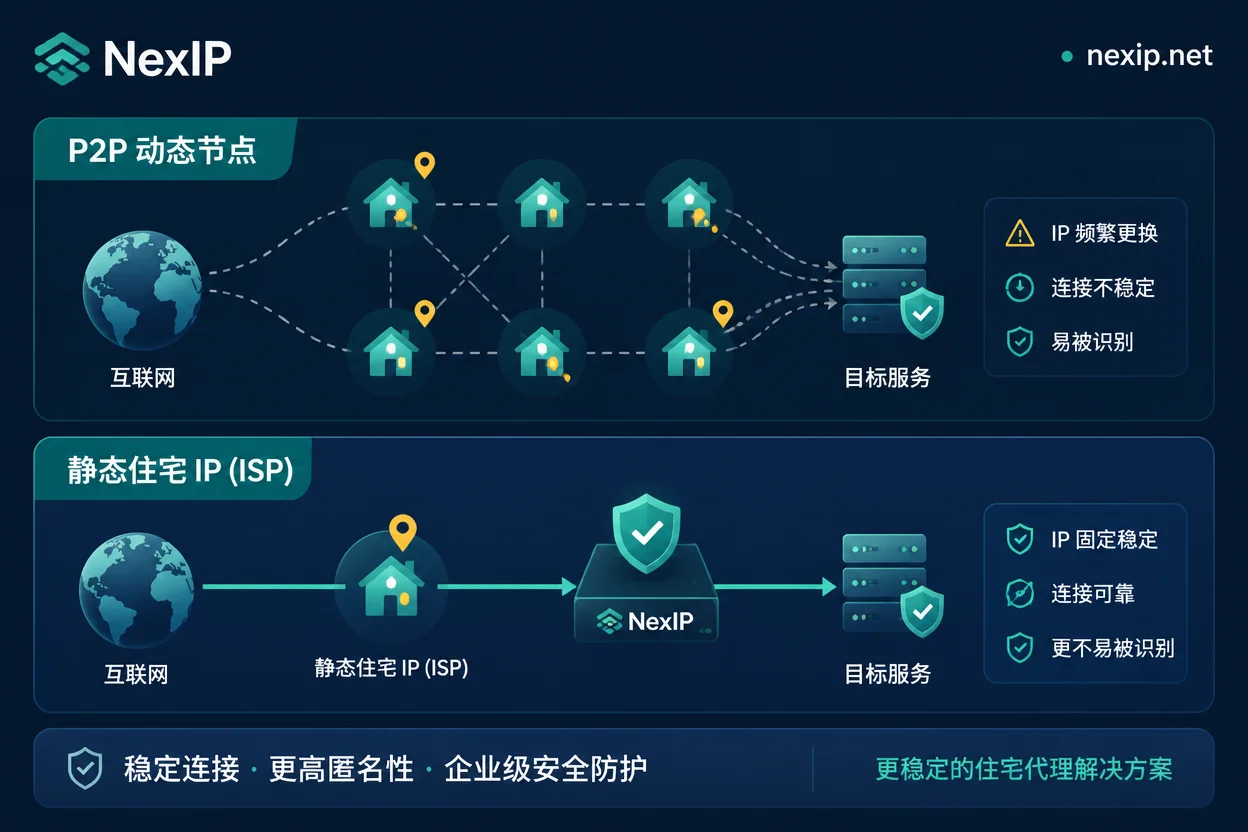
Static residential IPs do not rely on ordinary end-user personal devices. Instead, they are legitimate residential IP addresses directly allocated by real internet service providers (ISPs such as Comcast, AT&T, Lumen, etc.) and hosted on highly available data center server hardware.
This structure perfectly addresses the pain points of traditional proxies:
| Evaluation Dimension | Static Residential IP (ISP Proxy) | P2P Dynamic Residential IP | Traditional Data Center IP |
|---|---|---|---|
| IP Source & ASN | Residential ASN from top broadband operators | Personal broadband/IoT devices | Data center and cloud provider ASN |
| Session Stickiness | Long-term fixed (indefinite/long duration) | Frequently changed or interrupted due to device offline | Long-term fixed |
| Risk Control Block Rate | Very low (high whitelist trust) | Medium/High (susceptible to 'bad neighbor effect') | High (easily identified as server) |
| Transmission Latency | Low latency, high bandwidth | Depends on host device network fluctuations | Very low latency |
Business Scenario Practice: Differentiated Deployment of Static and Dynamic Proxies
Different business scenarios have varying requirements for IP fixity and concurrency:
- Cross-border e-commerce and social media multi-account anti-association: These businesses have extremely high demands for IP stability. Login environments require long-term fixed 'digital network IDs.' Frequently changing IPs can trigger platform alerts for abnormal logins. Using static long-lasting residential IPs is key to maintaining environment consistency.
- Enterprise-level compliant data collection and API access: When retrieving high-value data, the stability of long connections directly determines data scraping success rates. Static residential IPs provide continuous communication sessions, significantly reducing retry costs.
- Large-scale public data scraping: For high-concurrency, stateless scraping tasks, combining dynamic residential proxies with pay-per-traffic remains the most cost-effective choice.
Brand Interaction: NexIP's Network Adaptation in the Era of Risk Control Upgrades
In the context of platform anti-association and high risk control, relying solely on a single proxy type cannot meet complex business needs. NexIP provides enterprise teams with multi-layered compliant network infrastructure support.
Facing the dual requirements of static fixed IPs and high-concurrency scraping, NexIP offers static short-term residential IP and static long-term residential IP services, supporting major global regions and precise city/ASN targeting. Business teams can flexibly choose HTTP/SOCKS5 protocols and seamlessly integrate via API with fingerprint browsers or data collection systems.
At the same time, for business scenarios requiring large-scale rotation scraping, the platform also offers dynamic residential proxy traffic packages and bandwidth packages, helping enterprises achieve elastic network switching between 'high-trust fixed identities' and 'high-concurrency dynamic coverage.'
Static Residential IP Configuration and Selection Checklist
To ensure compliance and stability of enterprise network deployment, follow these steps for configuration and verification:
- Step 1: Verify ASN Attribution and IP Type
Use databases like IPinfo or MaxMind to query the assigned IP, confirming itsTypeis marked asISPorResidential, and the ASN belongs to mainstream telecom operators, avoiding fake proxies that are 'data center IP disguised as residential.' - Step 2: Evaluate Protocol and API Integration
Ensure the proxy network supports both HTTP/SOCKS5 protocols and has API batch extraction and management capabilities for smooth integration with existing automation tools or anti-association browsers. - Step 3: Match Business Lifecycle
Choose an appropriate static strategy based on the business operation cycle: use static short-term IPs for short-term testing or time-specific tasks, and static long-term IPs for core asset account management.
Facing tightening hardware regulation and evolving platform risk control models, upgrading to compliant, transparent, and high-trust static residential IPs is key to ensuring continuous business operations. It is recommended that teams evaluate network needs based on specific business cycles to establish a safe and stable enterprise-level network access system.


Comments(0)