 NexIP官方博客
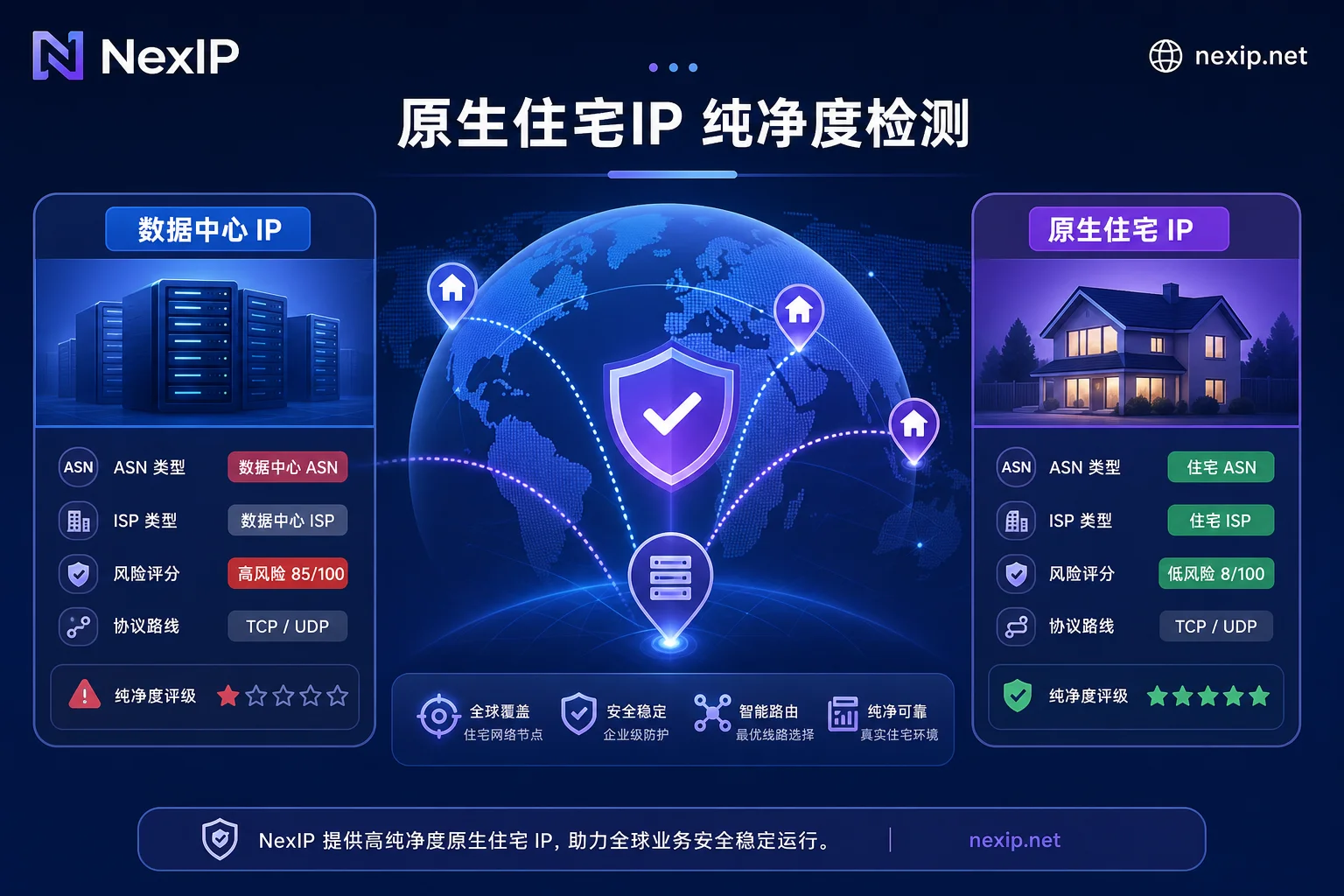
A true Native Residential IP is a real IP address directly assigned by a base telecommunications operator (e.g., Comcast, AT&T, Deutsche Telekom) to a household broadband user in the target country or region. In IP geolocation and risk control databases, the ASN of such IPs is clearly marked as ISP (not DataCenter), granting them high network reputation and characteristics of real local users.
Since July 2026, with major platforms and security agencies accelerating the upgrade of network risk control systems, proxy nodes relying on "low-quality data center masquerading" or "unauthorized routing" have faced unprecedented blocking pressure. Cross-border e-commerce, overseas social media operations, and data collection teams must deeply understand the core value of native residential IPs and establish scientific selection and configuration standards.
1. New Trends in Residential Proxy Risk Control in 2026: Law Enforcement Crackdowns and Data Source Upgrades
Recently, global network infrastructure risk control has shown two significant changes:
- Unauthorized proxy nodes face severe crackdowns: On July 2, 2026, Google, in collaboration with law enforcement and security research teams, announced the successful takedown of the NetNut proxy network control server, disposing of millions of rogue endpoints; subsequently, on July 22, LG announced the cleanup of third-party apps on its smart TV app store that had embedded unauthorized proxy SDKs. A CyberScoop feature on July 24 also noted that as underground proxy pools are continuously swept, the stability of publicly available gray-market proxies has plummeted.
- Risk control detection engines evolve toward multi-dimensional fingerprinting: Risk control service providers such as Cloudflare, IPinfo, and MaxMind updated their detection algorithms in 2026, no longer relying solely on static blacklists but integrating TCP/IP protocol stack consistency, TLS/JA3 fingerprints, geographic routing latency, and ASN registration type for comprehensive scoring.
This means that past methods of masquerading as residential IPs via data center IP broadcasting have become completely ineffective. Proxy resources lacking legitimate authorization and true ISP qualification are now being flagged as high-risk on a large scale.
2. Key Identification Criteria for Native Residential IPs
To determine whether an IP is a true native residential IP, the following indicators must be carefully examined:
- ASN and Organization Ownership: Using authoritative databases, the IP must belong to a local telecommunications operator (e.g., Verizon, BT, Vodafone), not a cloud service provider (AWS, GCP, DigitalOcean, etc.).
- Broadcast and Registration Location Consistency: The IP's BGP announcement routing path should be consistent with its geographic location in the database, with no cross-border broadcasting or unauthorized cleaning traces.
- Fraud Score: On platforms like IPQS or IPinfo, the Fraud Score must be maintained at a very low level, with no Spam/Proxy historical marks.
3. NexIP Solution Matching and Compliant Selection
Faced with increasingly stringent platform risk control environments, enterprises need to select compliant and continuously stable network support based on specific business scenarios. This platform offers a clear product structure in the residential proxy domain to help enterprises address network needs at different levels.
NexIP provides Dynamic Residential Proxy Traffic Plans, Dynamic Residential Proxy Bandwidth Plans, Static Short-Term Residential IPs, and Static Long-Term Residential IPs. Combined with its global region selection, session stickiness, city/ASN targeting, HTTP/SOCKS5 usage scenarios, and API integration capabilities, enterprises can achieve precise network link planning:
1. Overseas Social Media Operations and Cross-Border Live Streaming (High Stickiness Requirement)
Social media platforms (TikTok, Facebook, Instagram, etc.) are extremely sensitive to IP changes. For such scenarios, it is recommended to use NexIP's static long-term residential IPs. With fixed, unchanging real ISP addresses and SOCKS5 protocol support, these IPs can effectively avoid account risk controls triggered by frequent IP changes, ensuring high-bandwidth live streaming and long-term account nurturing continuity.
2. Market Competition Monitoring and Compliant Data Collection (High Concurrency Requirement)
For large-scale data scraping and price monitoring, it is recommended to use NexIP's dynamic residential proxy traffic or bandwidth plans. Leveraging its city-level and ASN targeting capabilities, combined with flexible API calls, efficient acquisition of real local data can be achieved while complying with platform rate limits.
4. Actionable Configuration Recommendations for Cross-Border Teams
To enhance overall network stability and security, teams are advised to implement the following operational checklist:
- Pre-Launch Purity Check: Integrate proxies into automated workflows via API, automatically verifying the IP's ISP attribute and risk value before binding business accounts.
- Environment Fingerprint Isolation: Combine native residential IPs with fingerprint browsers to ensure Canvas, WebGL, time zone, and WebRTC fully match the IP's physical geographic information.
- Establish Regular Self-Inspection Mechanism: Periodically check the connection quality and reputation of static residential IPs. If an anomaly is detected, seamlessly switch via API.
By compliantly procuring native residential IPs and leveraging NexIP's dynamic and static capabilities, cross-border teams can build a robust, high-stability network moat in the ever-changing risk control environment.



Comments(0)