 NexIP官方博客
In cross-border e-commerce and overseas marketing, network stability and compliance directly impact the security of account assets. As platforms like Amazon, TikTok Shop, Etsy, and various overseas social media sites continuously upgrade risk control and device fingerprint verification algorithms, traditional data center proxy IPs can no longer meet the demands of high-risk-control environments. How to match high-purity cross-border e-commerce proxy IPs for different business scenarios has become a core topic in network planning for overseas teams.
Industry Risk Control Trends: From Single Geolocation to Deep Environment Verification
According to industry community updates and platform risk control dynamics, modern e-commerce platform detection mechanisms have evolved from simply checking IP geolocation to comprehensive cross-verification of IP type (ISP residential vs. data center), network session stability, DNS/time zone consistency, and device fingerprints. If multiple store accounts are logged in under the same network environment, or if high-frequency, low-reputation data center IPs are used, it can easily trigger risk control blocks and account association risks.
For cross-border sellers, ensuring independent and compliant network identities for business operations is a baseline requirement for stable store management and effective advertising campaigns.
Core Types of Cross-border E-commerce Proxy IPs Comparison
When choosing a proxy service, understanding the underlying mechanisms of different IP types is crucial:
| Proxy Type | IP Stability | Detection Risk | Typical Use Cases | Selection Suggestions |
|---|---|---|---|---|
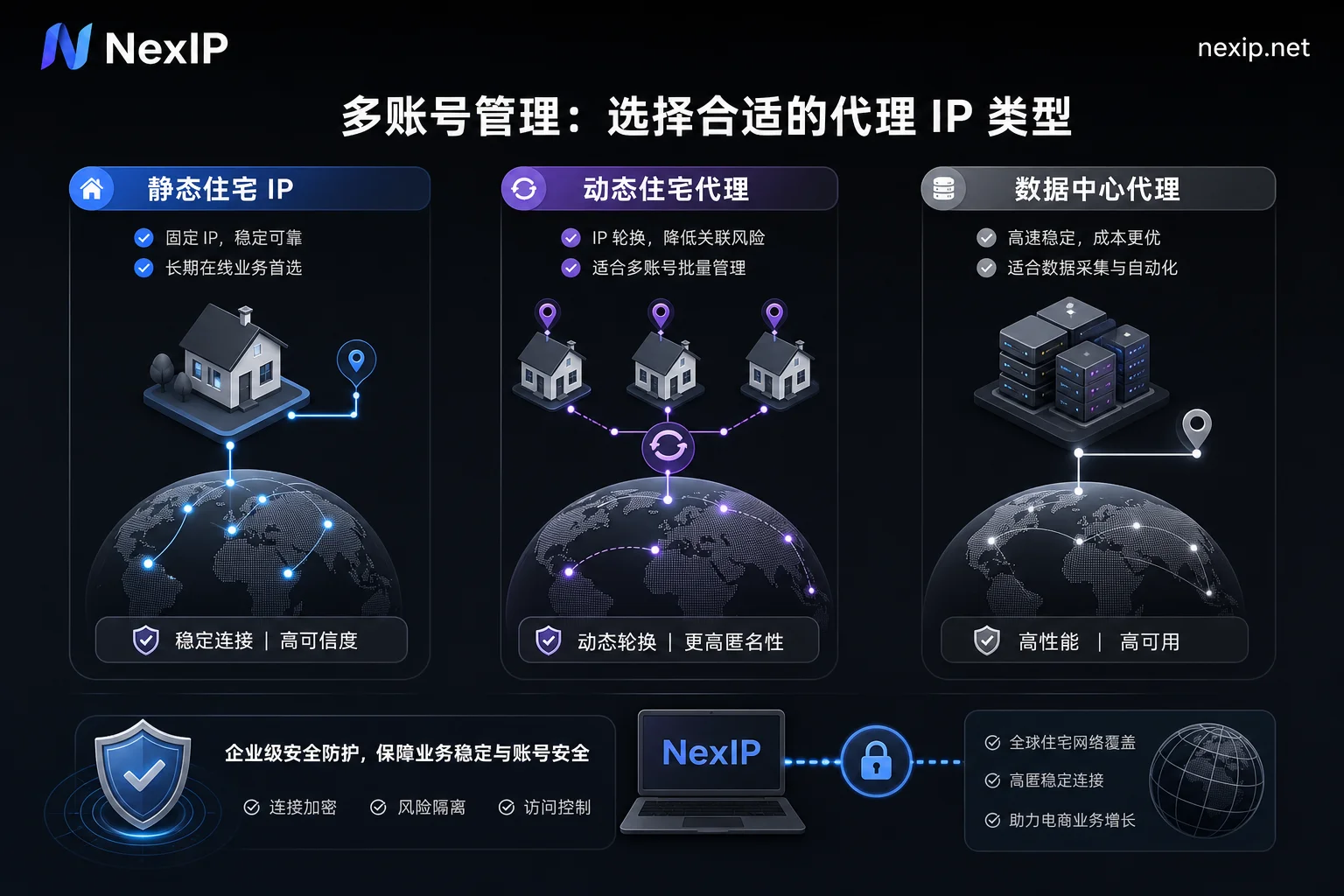
| Static Residential IP (ISP) | Fixed for long term | Very Low (recognized as real home broadband) | Main store login, payment binding, ERP integration | Suitable for high-value account management under strict risk control |
| Dynamic Residential Proxy | Rotates per connection or time | Low (high anonymity) | Competitor price monitoring, bulk scraping, ad verification | Suitable for high-concurrency, short-duration tasks |
| Data Center Proxy | Fixed or allocated on demand | Higher (data center IP ranges are easily flagged) | Basic testing, low-risk web browsing | Not recommended for important platform store operations |
For long-term store accounts and payment interfaces, static residential IPs can continuously build platform trust; for market research and traffic collection tasks, dynamic residential proxies offer more flexibility and cost control.
Multi-Account Isolation and Anti-Association Network Configuration
In multi-brand or multi-store refined operations, sellers should follow these network isolation principles:
- One account, one IP principle: Each core store account should be bound to an independent static residential IP. Never share a single network exit for multiple accounts.
- Environment parameter consistency: Ensure that the device's system time zone, language, and DNS address fully match the proxy IP's actual geographic location.
- Protocol and tool combination: Combine HTTP/SOCKS5 proxy protocols with anti-association browsers or automation scripts to achieve full-chain isolation of cookies, Canvas fingerprints, and IPs.
NexIP Network Infrastructure Solutions and Business Adaptation
To address the needs of cross-border e-commerce at various stages, NexIP provides multi-dimensional proxy network infrastructure support:
- Static Residential IP (long-term and short-term): Provides independent static IPs based on real local ISP assignments. For Amazon main store operations, overseas payment channel binding, and ERP system integration, it ensures network session consistency and reduces verification code pop-ups or remote login alerts caused by environmental changes.
- Dynamic Residential Proxy (traffic and bandwidth packages): Covers global region selection, city/ASN targeting, and flexible session stickiness control. Suitable for market monitoring, price tracking, and social media marketing teams conducting high-concurrency data requests.
- Standard API Integration and protocol support: All products support HTTP and SOCKS5 protocols, seamlessly integrating with mainstream anti-association browsers and self-developed seller tools, helping teams quickly build compliant and efficient cross-border network systems.
By using stable fixed IPs for long-term store management and dynamic IP resource pools for high-frequency testing and scraping, teams can protect account assets while optimizing overall network costs.
Cross-Border Seller IP Configuration Pitfall Checklist
- [ ] Are data center IPs completely eliminated for core store accounts?
- [ ] Has each main account been assigned a dedicated static residential IP?
- [ ] Does the browser time zone and language perfectly match the current proxy IP's geographic location?
- [ ] Are dynamic proxy scraping tasks configured with reasonable rotation rules and API request rate limits?
- [ ] Have you chosen a professional proxy service provider (e.g., NexIP) that supports global city/ASN targeting and is compliant and traceable?
Scientific proxy IP configuration is not only a barrier against risk but also the infrastructure for localizing cross-border business. Choosing the right network architecture enables steady progress in overseas expansion.


Comments(0)