 NexIP官方博客
In May 2026, Bright Data launched an MCP-based proxy server that allows LLMs and AI Agents to automatically call proxy infrastructure for real-time web retrieval and data extraction (Bright Data official blog, May 2026). The proxy layer interface and governance boundaries must be rewritten accordingly.
What's changing: which parameters went from config items to runtime decisions
Previously, engineers hardcoded egress regions, session durations, retry strategies, and concurrency quotas in code; now, Agents can dynamically decide these parameters at runtime. Specifically, these include: egress region (chosen by task destination), session duration (long-lived sessions for login vs. short polling), retry and backoff (how long to wait before switching IP after a failure), and concurrency quota (how many requests allowed simultaneously). These were once static configurations, now they are decision variables for the Agent, requiring the proxy gateway to provide corresponding interfaces and governance capabilities.
First distinguish two paths: managed unlocking / MCP server vs. self-built enterprise proxy network
To answer "what's the difference between MCP proxy server and self-built proxy pool", compare across four dimensions:
| Dimension | Managed unlocking / MCP server | Self-built enterprise proxy network |
|---|---|---|
| Integration cost and time-to-live | Low, quick to attach | Higher, requires self-building and maintenance |
| Parameter controllability | Limited by provider abstraction | Can precisely specify city/ASN, session duration |
| Cost structure | Per-request pricing | Per-bandwidth or package pricing |
| Log ownership and audit | Relies on provider logs | Self-owned logs, easier for compliance audits |
The weight of these dimensions depends on the number of business lines, whether you need to own raw request logs, and whether you have city/ASN-level targeting needs. For example, a single business line seeking quick validation might prefer a managed solution for lightness; when multiple business lines need unified procurement and full request logs with fine-grained control over egress identity, a self-built gateway is more controllable. The practices of Bright Data and Oxylabs are their product choices and do not constitute industry standards or platform mandates; MCP only standardizes the tool-calling protocol, while billing and authentication are still implemented by each provider.
Four engineering decisions: IP rotation decision authority, session holder, concurrency measurement, request traceability
No matter the choice, the architecture design of an enterprise proxy network must answer four questions:
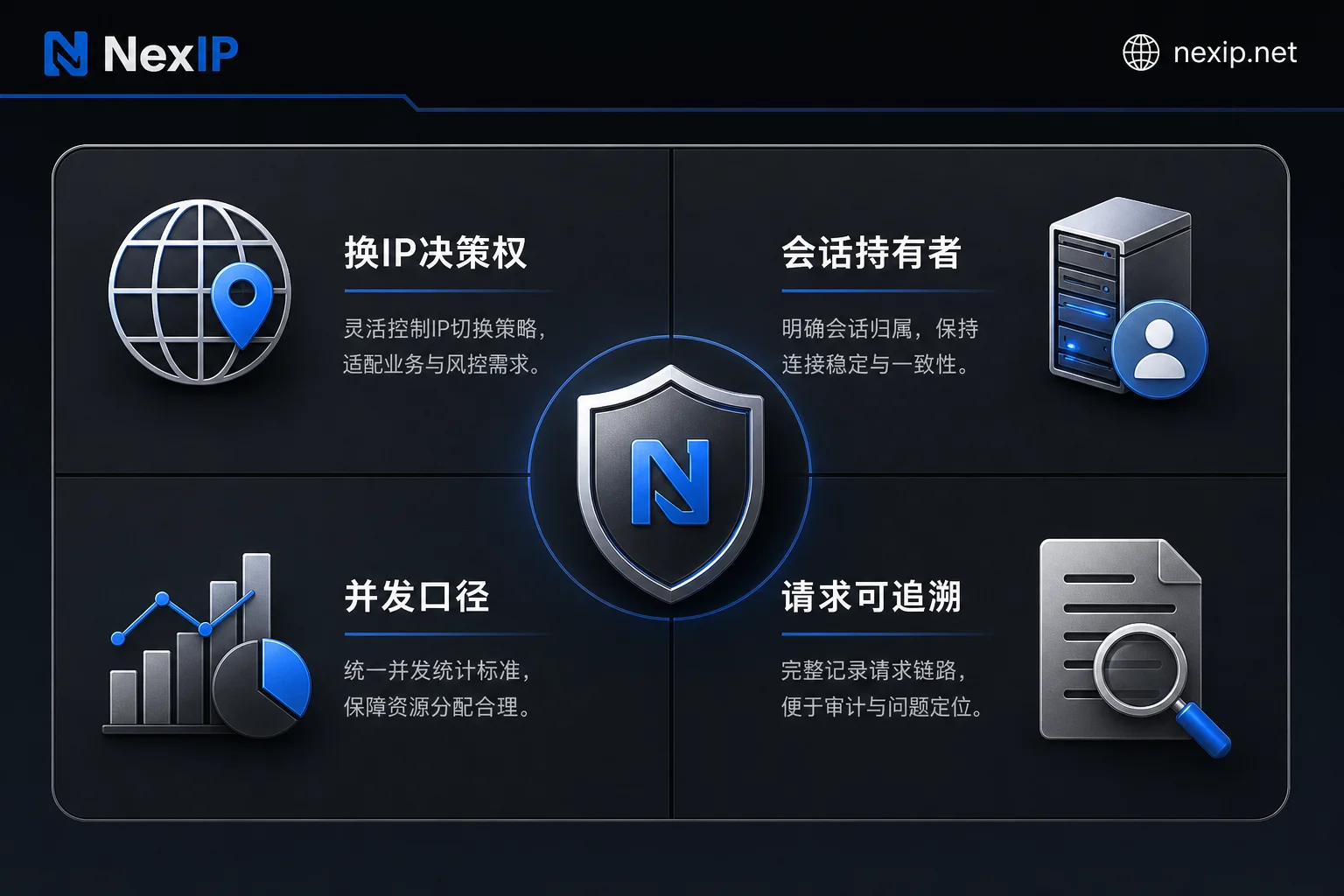
Who holds the IP rotation decision authority
It's recommended that the proxy gateway side uniformly implement backoff and rotation strategies, with the Agent only declaring the task type. The reason is that the failure signals seen by the Agent differ significantly from those seen by the gateway: the Agent typically only sees timeouts, 4xx/5xx status codes, or abnormal response body characteristics, while the gateway can observe finer connection quality, target site status code distribution, and subnet health. For example, if an egress subnet is rate-limited due to high-frequency requests, the Agent will only notice some timeouts and might incorrectly retry the same subnet; the gateway, however, can detect the subnet's failure rate spike and automatically switch to other subnets with backoff. Centralizing backoff policies at the gateway avoids the Agent equating failure with "just switch IP", reducing ineffective retries.
Who holds session affinity: how to maintain session stickiness in proxy API integration
Login-based tasks need session stickiness, which can be held by the Agent side via a session ID or by the gateway side via a session table. For a login-state shopping cart task, if the Agent holds the session ID, as long as the ID is unchanged when the Agent instance restarts or migrates, the gateway can restore the same egress IP, and the user's login state remains uninterrupted. If the gateway holds the session table, the gateway can recover sessions by task ID after an Agent crash, but additional synchronization mechanisms are required. Stateless list scraping is different; each request is independent, without session needs, so the Agent can randomly select an egress. Therefore, the ownership of session affinity depends on the task type: for login-based tasks, prefer Agent holding; for stateless tasks, gateway-side management is simpler.
Concurrency budget allocated by bandwidth or IP count
The number of IPs is not a reasonable measure of concurrency limits. The same egress IP can handle multiple concurrent requests, but page sizes vary greatly—a 10KB JSON API request vs. a 5MB HTML page differ by 500 times in bandwidth consumption. If concurrency is limited by IP count, bandwidth pressure might be underestimated, leading to latency spikes or rate limiting. It's recommended to allocate concurrency budgets based on bandwidth/traffic packages, for example, setting a maximum bandwidth consumption per minute and then converting that into a request number limit. This better aligns with the real resource bottleneck and facilitates cost control.
Request traceability
The minimum viable fields include: task ID, egress region, session ID, retry count, and bandwidth consumed. These fields are used for post-hoc attribution and cost auditing. With these fields in place, teams can optimize resource allocation, identify anomalous traffic, and form the foundation for corporate proxy network audit and cost control.
The Proxyway 2026 market report indicates that real-time AI data demand is driving enterprise proxy networks toward high integration and team-level governance (Proxyway "Proxy Market Research 2026", May 2026). This means the above decisions are not one-time designs but require ongoing governance.
Amplified old problem: how automatic retries raise effective collection costs
Low-purity IPs under high-frequency AI Agent retries can lead to higher effective collection costs and anti-bot interception rates (Proxyway "Proxy Market Research 2026", May 2026). Simply connecting an Agent to an as-large-as-possible dynamic IP pool, without gateway-layer backoff and subnet isolation, does not solve the problem; it quickly burns clean quotas and triggers cascading anti-bot measures on target sites. Engineering countermeasures include:
- Set retry limits and exponential backoff;
- Isolate different tasks' egress by subnet groups;
- Trigger degradation when failure rate thresholds are exceeded, rather than simply scaling up.
The specific decision sequence could be: first lower concurrency (reduce simultaneous requests), then switch subnets (switch to backup egress pools), and finally scale up (add new IPs or bandwidth). This avoids testing the waters at the edge of target site anti-bot thresholds. This article discusses resource efficiency and stability, not bypassing any platform's anti-bot measures; even with MCP integration or changing egress IPs, TLS fingerprinting and behavioral sequence scoring will still intercept non-compliant Agent requests. Compliant collection scope should be limited to public data and adhere to target site terms.
Integration design: issuing egress parameters by task type, and the rationale for HTTP vs. SOCKS5
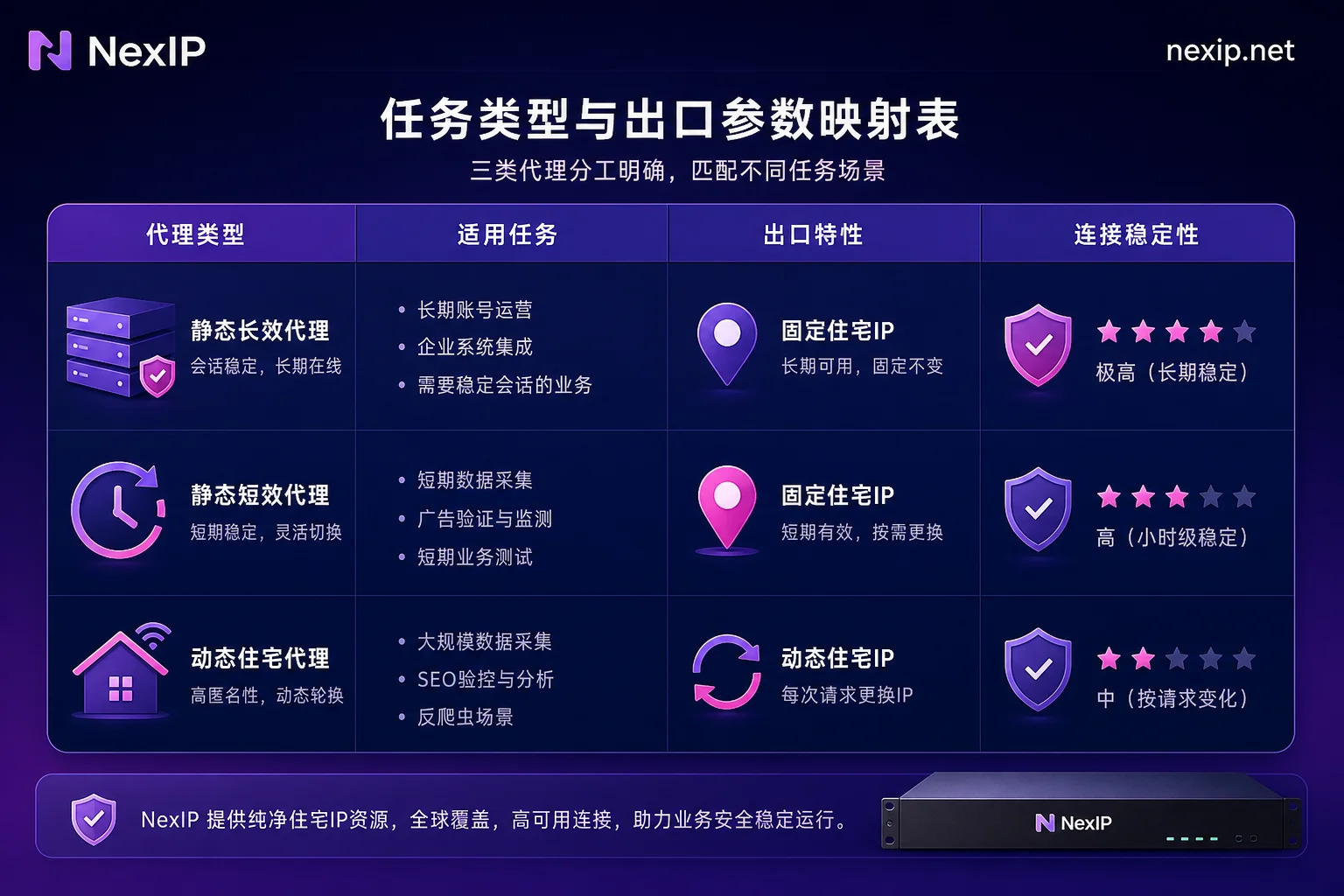
To answer "how AI Agents call proxy IPs": The Agent only issues a task type enum, while IP selection remains at the proxy layer. A feasible parameter mapping table:
| Task Type | Egress Type | Session Policy | Billing Method | Notes |
|---|---|---|---|---|
| Long-session login tasks | Static long-lived egress | Long-session stickiness, fixed city | — | Maintain identity consistency |
| Short-cycle verification tasks | Static short-lived egress | Medium-short sessions | — | Fast refresh |
| High-concurrency public data collection | Dynamic residential proxies | Stateless or short sessions | Traffic/bandwidth packages | Strict concurrency and retry limits |
The specific billing terms depend on the provider's plan; it's recommended to base selection on actual quotes. As for "which proxy to use for LLM web browsing", it depends on whether the task requires login and concurrency scale: if login is needed, use static long-lived; if high-concurrency public data, use dynamic residential. The choice between HTTP and SOCKS5 depends on protocol compatibility, whether non-HTTP traffic needs to be transmitted, and client support.
Combined solution with NexIP capabilities
The long-session login tasks in the previous table can be handled by NexIP's static long-lived residential IPs; short-cycle verification tasks by static short-lived residential IPs; high-concurrency public data collection by dynamic residential proxy traffic/bandwidth packages, whose bandwidth packages help constrain cost fluctuations from automatic retries. Additionally, NexIP offers global region selection and city/ASN targeting, which can serve as the value range for Agent request parameters; session stickiness features can maintain task-level consistency; HTTP/SOCKS5 and API integration support allows incorporating the above parameters into a unified gateway. NexIP currently does not provide an MCP server or official AI Agent plugin; if Agent scheduling is needed, consider integrating via API in a self-built gateway to issue the above parameters.
Pre-launch self-check checklist
- [ ] Is the integration method and authentication clear?
- [ ] Is the session duration setting differentiated by task type?
- [ ] Are concurrency limits and retry counts configured?
- [ ] Does region/timezone consistency meet business needs?
- [ ] Is subnet group isolation in effect?
- [ ] Are log fields complete (task ID, egress, session, etc.)?
- [ ] Are bandwidth and cost alert thresholds set?
- [ ] Are failure rate and interception rate monitored?
- [ ] Are canary and rollback paths ready?
It's recommended to first check the existing proxy integration for session duration, concurrency metrics, and log fields per the checklist, then trial-run one egress path by task type. If you need to evaluate the division of labor among static long-lived, static short-lived, and dynamic residential bandwidth packages, you can conduct small-scale validation against NexIP's capabilities based on your task structure.


Comments(0)