 NexIP官方博客
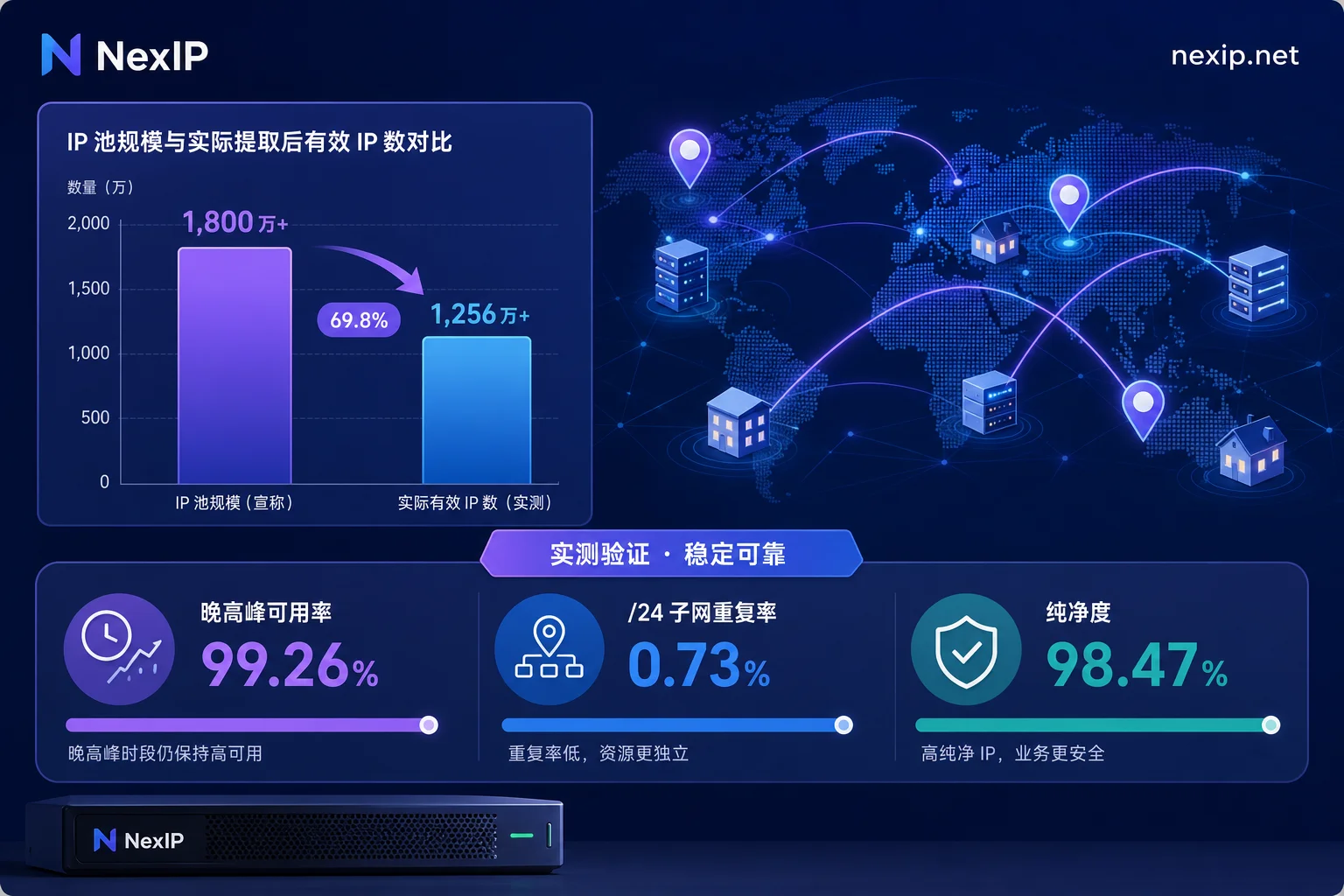
In August 2026, evaluation reports published by peers like KuaiDaiLi noted that enterprise users are no longer swayed by marketing claims of "billion-level IP pools," but instead focus on "business peak-hour availability" and "low /24 subnet repetition with high dispersion" (KuaiDaiLi, August 2026). Independent review agencies Proxyway and Thunderbit further revealed in their selection guides that month: some providers boasting massive IP pools often serve IPs concentrated in a few /24 subnets, which, under peak concurrent requests, can trigger risk control systems to block entire subnets together (Proxyway, Thunderbit, August 2026). This shift from marketing to measurable metrics is reshaping the fundamental basis of "residential proxy comparisons."
Selection Criteria Are Changing: Why 'Billion-Level IP Pools' Are No Longer a Valid Selling Point
In past years, the conventional approach in residential proxy comparisons was to tout who had the bigger IP pool—"X billion residential IPs" became almost standard phrasing. But there can be a clear gap between the advertised "billion-level IP pool" and actual effective availability. Pool size has become a marketing item that cannot be independently verified, whereas peak-hour availability and /24 subnet dispersion are acceptance metrics that can be checked through sampling, statistics, and re-verification.
Breaking Down the Two New Metrics: What Peak-Hour Availability and /24 Subnet Dispersion Measure
Since the comparison standard is shifting, we first need to understand what these two new metrics really measure.
Peak-Hour Availability: Real Experience Under Concurrent Load
Peak-hour availability refers to the connection success rate and response stability of residential proxy nodes during actual high-concurrency business periods (for example, from 8 PM to 11 PM). It does not reflect the data you might get from a test account during off-peak hours, but rather the real performance when many users simultaneously make requests and resources are contended. KuaiDaiLi proposed a reference threshold of greater than 98% availability in its August 2026 report (KuaiDaiLi, August 2026 evaluation report). This value is a reference threshold proposed in KuaiDaiLi's August 2026 evaluation report, not an industry-wide standard, and does not represent any service provider's commitment.
/24 Subnet Dispersion: The 'Collateral Risk' from a Risk-Control Perspective
/24 subnet dispersion, also called Class C segment repetition rate, measures the distribution of your extracted IPs across Class C subnets. If out of 1000 extracted IPs, 600 fall within the same /24 subnet, that subnet repetition rate is high. Why does this matter? Proxyway and Thunderbit analyzed in their August 2026 selection guides that when a large number of requests come from the same /24 subnet, risk control systems are more likely to flag them as abnormal traffic, triggering collateral bans (Proxyway, Thunderbit, August 2026 selection guides). In other words, even if a provider has a "billion-level" IP pool, if its IPs are concentrated in a few C segments, your requests may be batch-blocked during peak hours due to collisions, significantly reducing actual availability.
Both Metrics Must Be Considered Together
Looking only at peak-hour availability, you might choose a provider with high node uptime during off-peak hours but frequent bans during peak hours due to subnet concentration. Looking only at /24 subnet dispersion, you might overlook node connection stability during peak times. Only when both metrics are satisfied does it indicate that the provider's IP pool has both "breadth" (C segment dispersion) and "resilience" (peak-time presence). This is why evaluation agencies in August 2026 unanimously emphasized that buyers must combine both as core acceptance criteria.
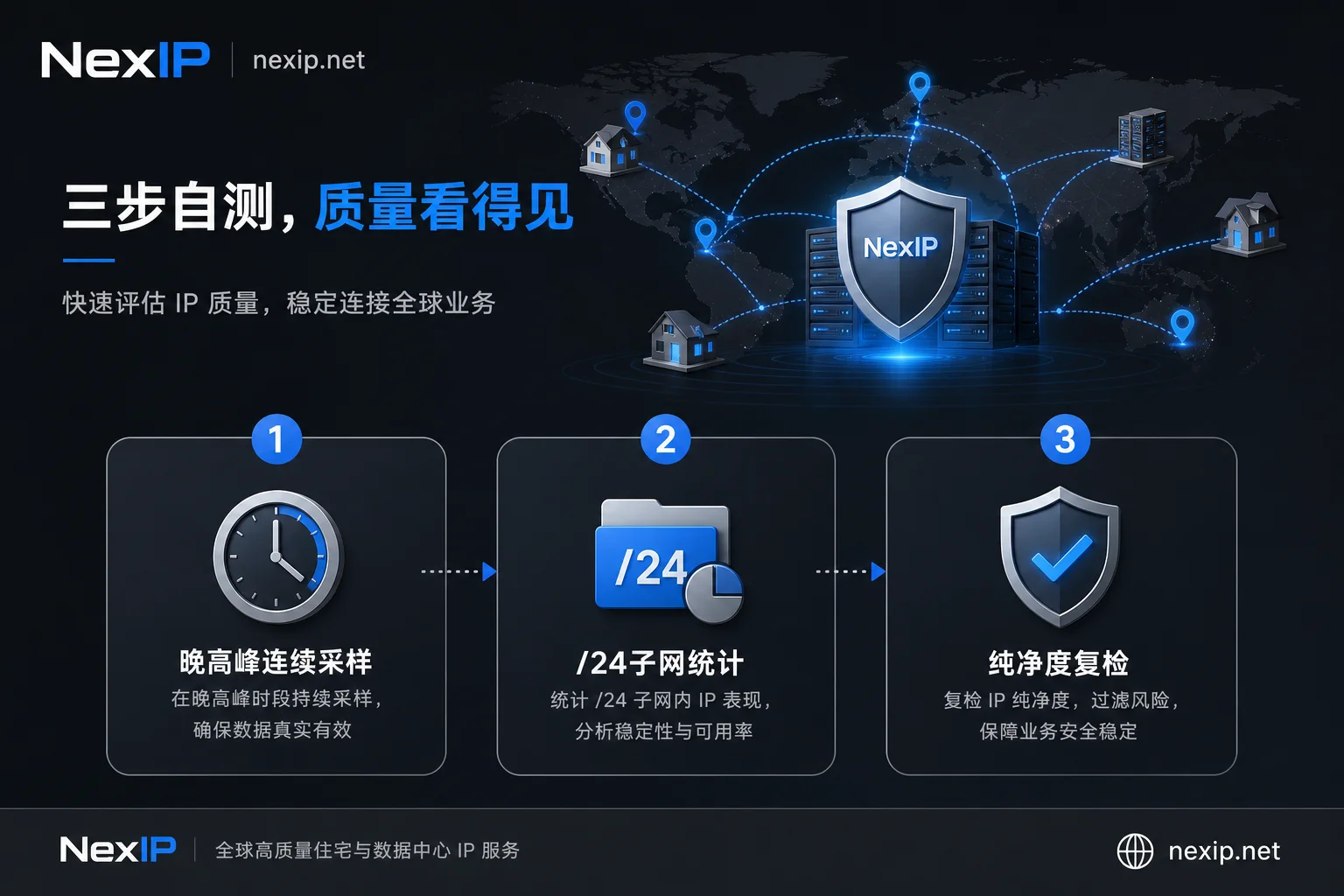
Buyer's Self-Test in Three Steps: Continuous Sampling of Availability, /24 Subnet Repetition Statistics, and Purity Re-check
To ensure that "residential proxy comparison" doesn't just remain a slogan, here is an executable self-test process you can run during your own business peak hours.
Step 1: Continuous Sampling of Peak-Hour Availability
Don't test only once, and don't only test during off-peak times. During the real business peak (e.g., 8 PM to 11 PM), make a request to a target website at fixed intervals (e.g., every 5 minutes) and sample continuously for at least 2 hours. Record success/failure status, response time, and timeouts for each request. Aim for at least 200 requests to have statistical significance. You don't need the provider to give you a test account; instead, use the plan you intend to purchase and run it in your real business scenario. That way, the availability you get is the "business peak-hour availability," not the "lab data" the provider advertises.
Step 2: /24 Subnet Repetition Statistics
After batch extracting IPs, aggregate them by the first three octets (e.g., a.b.c.0/24). Count the number of IPs per /24 subnet and calculate the repetition rate: repetition rate = IP count in the most frequent C segment / total extracted IPs. There is no universal threshold; it's recommended to use your own historical ban rate as a baseline and compare multiple providers' most frequent C segment share and the cumulative share of the top 10 C segments. Specific judgments should be based on actual tests. A more detailed approach is to calculate the cumulative share of the top 10 C segments to assess overall dispersion. Sample multiple times at different times and with different extraction strategies to avoid randomness in a single sample.
Step 3: Purity Re-check
Use third-party IP reputation query tools or blacklist databases to re-check the extracted IP samples for known malicious flags, spam blacklist records, etc. Record the first extraction time and the interval until an IP is re-extracted to assess whether the same IP is frequently reused. After these three steps, you will have availability curves, C segment distribution tables, and purity hit records—together forming a complete residential proxy procurement acceptance.
Comparison Dimension Table: Put Pool Size, Availability, Subnet Dispersion, Session Stickiness, Targeting Granularity, and Billing Metrics in One Table
To facilitate your actual comparison of multiple providers, here is a comparison dimension table template. Each row lists "Provider's Marketing Claim," "Buyer's Measured Metric," and "Acceptance Determination Method." You can use it directly.
| Comparison Dimension | Provider's Marketing Claim | Buyer's Measured Metric | Acceptance Determination Method |
|---|---|---|---|
| IP Pool Size | Claims "billion-level residential IPs" | Actual number of unique IPs after extraction and deduplication | Down-weight; do not use as core decision basis; reference only |
| Peak-Hour Availability | Often stated as "high availability," but usually without specifying test time and concurrency | Continuous sampling during business peak, record success rate | The sampling period, concurrency, and sample size must match the claim; otherwise, rely on measured data |
| /24 Subnet Dispersion | May claim "global coverage," but does not disclose C segment distribution | Statistics on C segment repetition rate of extracted IPs | Calculate the most frequent C segment share and re-test multiple times to observe distribution stability |
| Session Stickiness | Claims session persistence, but duration unknown | Test whether IP remains unchanged under the same session ID | Record IP changes during continuous requests to confirm stickiness duration meets business needs |
| Targeting Granularity | Claims city/ASN targeting | Test actual city-level IP geolocation accuracy | Use IP geolocation services to verify the location of targeted IPs and compare claims vs. reality |
| Billing Metrics | Billed by traffic or IP count, but may have hidden conditions | Calculate actual consumption and effective IPs to determine unit cost | Clarify whether billing is by time, traffic, or IP count, and check the minimum metering unit |
| Purity | Provides a single test screenshot | Actively re-check and record blacklist hit rate | Use multiple reputation databases to cross-validate and record historical false positives |
This table integrates core comparison dimensions, and naturally raises the question: "Is IP pool size useful?" When measured metrics show that the pool is large but concentrated in a few C segments, this dimension should be down-weighted.
Common Discrepancies Between Marketing Claims and Measured Metrics, and Procurement Question Scripts
In actual comparisons, you will encounter typical "claim vs. reality" discrepancies. Understanding these scenarios and preparing question scripts will help you quickly filter out reliable providers.
Discrepancy 1: Claims of a Billion-Level Pool, but Extraction Concentrated in a Few /24 Subnets
This is the most common scenario. The provider advertises "X billion IPs globally," but your tests show that in your targeted region, IPs are concentrated in a few C segments. This has been repeatedly pointed out in August 2026 evaluations (Proxyway, Thunderbit, August 2026 selection guides).
→ Question script: "What is your /24 subnet repetition rate in the target country/city? Can you provide a daily C segment distribution report for the last month?" If they cannot provide it, that itself reflects a lack of transparency.
Discrepancy 2: Only Off-Peak Test Accounts Provided
Some providers offer test accounts before purchase, but only during daytime off-peak hours, avoiding peak times. The availability you get from off-peak data will naturally look "good."
→ Question script: "We plan to trial from 8 PM to 11 PM. Please enable access during that period, and we will request continuously at a rate of once per minute for 2 hours. Please confirm the service supports this concurrency." If they refuse or impose restrictions, their peak-hour capability is questionable.
Discrepancy 3: Availability Claims Without Specifying Time and Concurrency Conditions
"Availability >98%" is a marketing slogan, but it never specifies under what period and concurrency it was measured. KuaiDaiLi emphasized "business peak-hour availability" as a reference in its August 2026 report (KuaiDaiLi, August 2026 evaluation report). This reference threshold does not constitute a commitment from any provider; actual measured data for each provider must be based on real tests.
→ Question script: "Please provide raw continuous sampling data for a specified time period (e.g., 20:00-22:00) and specified concurrency (e.g., 100 threads), including success/failure records at each time point." This is the strongest evidence.
Discrepancy 4: Purity Shown Only Through a Single Screenshot
The other party shows a screenshot of an IP reputation check, claiming "100% purity," but without specifying the test time, sample size, or method.
→ Question script: "Please provide daily purity sampling reports for the last week, including the number of IPs sampled, the whitelist/blacklist sources used, and hit rates." If they can only produce a single screenshot, you should proactively re-check.
At the same time, you need to correct a common misconception: there is no factual basis that "a large enough pool immunizes against bans". Proxyway and Thunderbit analyzed in their August 2026 selection guides that collateral bans caused by subnet concentration do not automatically disappear just because the total pool number is large; specific behavior varies by provider and target site, and should be based on actual tests (Proxyway, Thunderbit, August 2026 selection guides). So stop being swayed by "X billion pool" marketing. Focus on verifiable metrics—that is the correct way to "compare residential proxy providers."
Assign Acceptance Priorities by Business Type: Dynamic Residential Traffic/Bandwidth, Static Short-Lived, Static Long-Lived
Different business scenarios have different sensitivities to the above metrics, so you need to adjust your acceptance focus accordingly.
High-Concurrency Data Scraping: Focus on /24 Dispersion and Peak-Hour Availability
For cross-border e-commerce data scraping, social media monitoring, and other high-frequency request businesses, your biggest fear is that same-subnet collateral bans disable your entire batch of IPs. Therefore, during acceptance, focus on /24 subnet dispersion to ensure extracted IPs are spread across different C segments, and demand sustained stability in peak-hour availability.
Account Operations and Live Streaming: Value Session Stickiness and Exit Stability
These businesses need to maintain the same IP session to avoid frequent disconnections that affect live streaming or login states. Therefore, acceptance should focus on session stickiness, testing how long an IP remains unchanged and whether sessions are interrupted during peak hours.
Long-Term Ad Placement and Admin Logins: Emphasize Ownership Stability of Static Long-Lived IPs
For scenarios like long-term ad placement or admin logins that demand high IP purity and geolocation stability, you need static long-lived IPs to ensure they are not frequently rotated, which could trigger risk controls. During acceptance, check that the IP remains stable over time (e.g., availability, subnet stability) and confirm the IP's geolocation matches your business target.
How to Apply This to Specific Plans and Configurations
Dynamic residential traffic/bandwidth plans are suitable for high-concurrency scraping; you should focus on verifying peak-hour availability and /24 subnet dispersion. NexIP's global region selection, city/ASN targeting, HTTP/SOCKS5, and API integration capabilities can help adjust extraction strategies on demand to meet dispersion requirements. Static short-lived or long-lived IPs are suitable for scenarios requiring session persistence or long-term stability; NexIP's session stickiness and targeting capabilities can assist in configuration. The above capabilities only describe features and suitable scenarios; specific results should be based on actual tests. Regardless of the plan you choose, run the three-step self-test during your real business peak hours and make final decisions based on measured data, not marketing claims.
Pre-Procurement Checklist: A One-Page Acceptance Action List
Finally, here is a checkbox list summarizing the entire article. We recommend confirming each item before procurement:
- □ Have you obtained trial access during peak hours (e.g., 20:00-22:00) and performed continuous sampling during that time?
- □ Have you analyzed the /24 subnet distribution of extracted IPs and calculated the most frequent C segment share?
- □ Have you re-checked IP purity using third-party reputation databases and recorded the test time and sample size?
- □ Have you clarified billing metrics (by traffic or IP count), session persistence duration, and other details?
- □ Have you selected the appropriate IP type (dynamic/static, short-lived/long-lived) based on your business type?
- □ Is the provider willing to provide continuous sampling data for specified time periods and concurrency levels?
If all answers are "yes," then your "residential proxy comparison" is solid enough. We recommend you first run the three-step self-test during your real business peak hours, then discuss the comparison dimension table with providers. If you need to match dynamic/static, short-lived/long-lived solutions and targeting granularity based on business type, you can refer to NexIP's plan descriptions or contact the team for configuration guidance. After all, vendor selection is not about who shouts louder, but whether measured data stands up to scrutiny.


Comments(0)