 NexIP官方博客
You see a high score for an IP on a detection site, the blacklist shows clean, the ASN is labeled "ISP", but as soon as you go online, the target website pops up a CAPTCHA or even returns 403. This isn't bad luck; it's because the logic of risk control in 2026 has changed: the definition of proxy IP purity is no longer whether you're on a blacklist, but whether your exit identity, protocol fingerprint, and behavioral characteristics are aligned. This article is based on mechanism explanations from public technical reports and official blogs; the judgment criteria and self-test process are reusable analytical frameworks, and specific values should be based on your own business testing.
Why the Old Definition Fails: A Clean Blacklist Doesn't Mean Qualified Purity
Let's put the conclusion first: according to an anti-crawler mechanism analysis by industry research site ScrapeBadger in May 2026, systems like DataDome and Cloudflare have adopted multi-dimensional joint verification using JA3/JA4 TLS fingerprints, ASN identification, behavioral analysis, and real-time IP risk scores. Their observations show that the default interception rate for data center IPs has risen to over 85%. Note that this figure is from third-party observations, not official platform announcements; it varies significantly across sites and time periods. The past static judgment of "not on blacklist equals clean" is being replaced by real-time, multi-dimensional joint scoring.
You might have encountered this: a newly purchased IP is "clean" on blacklist services like Spamhaus and Barracuda, but when placed on a cross-border e-commerce platform, it immediately triggers a slider CAPTCHA or requires secondary authentication. The reason is simple: platforms no longer look at whether this IP is "known" alone, but whether it "looks like a real user accessing naturally." A data center IP, even if never recorded, has its ASN attribution and traffic characteristics already labeled as "high risk" by models.
The 2026 Judgment Model: How TLS Fingerprints, ASN Attributes, and Real-Time Risk Score Work Together
To understand "why an IP shows clean but still gets blocked," you need to break down the platform's judgment chain. According to a technical analysis by Scrappey in May 2026, TLS fingerprints (such as JA3/JA4) are extracted during the ClientHello phase of the network handshake, when the data is unencrypted. This step is crucial: you can disguise the User-Agent in HTTP headers as the latest Chrome, but the underlying cipher suites, extension order, elliptic curve parameters, and other features already reveal whether you're using Python's requests library or Node.js's axios.
According to Cloudflare's official technical blog, security platforms have deeply correlated JA4 fingerprints with signals such as client IP count and ASN network attribution for scoring, enabling millisecond-level identification and precise classification of automated traffic with cross-IP rotation. This means that even if you switch to a different "clean" residential IP for each request, as long as these IPs belong to the same ASN and their TLS fingerprints point to the same automation library, the model can link these requests together and judge them as "one person using a script to rotate IPs."
This explains why many teams use proxy pools with rotation but still fail to bypass CAPTCHAs—because risk control doesn't just look at your individual IP's "reputation," but at the "identity consistency" of the entire exit network.
Redefining Proxy IP Purity: A Three-Layer Framework of Exit Identity, Protocol Fingerprint, and Behavioral Characteristics
Based on the above mechanisms, I suggest redefining proxy IP purity as a three-layer joint score, rather than a static attribute of the IP:
Exit Identity Layer: Are ASN Attribution and IP Type Trustworthy?
This layer corresponds to "who issued this IP." Residential IPs (like US AT&T home broadband) and data center IPs (like AWS, DigitalOcean) have fundamental differences in ASN attribution. In 2026, risk control models have a default interception rate of over 85% for data center IPs (according to ScrapeBadger analysis, third-party observation), so even if an IP is never blacklisted, if its ASN is recognized as "data center," it already suffers a significant disadvantage in the starting score.
Protocol Fingerprint Layer: Does the TLS Handshake Match the Client's Claim?
This layer corresponds to "does this IP look like a real person?" If you use a residential IP but the TLS fingerprint reveals you're using Selenium or Puppeteer, the risk control system will still judge it as "mismatched coordination," leading to blocking or challenges. Note that this layer is unrelated to the IP itself; it's a client-side issue.
Behavioral Characteristics Layer: Request Rhythm and Cross-IP Correlation
This layer corresponds to "does your pace of action look human?" According to Cloudflare's official technical sharing, platforms can now correlate JA4 fingerprints with client IP counts and ASN attribution for scoring. If you use the same automation script to rotate multiple IPs in a short period, even if each IP is a high-purity residential node, the system can identify you as a batch script through the pattern of "same fingerprint + multiple IPs," rather than multiple independent users.
Layered Self-Test Process: What to Check in Each Layer, How to Verify, and How to Interpret Results
Knowing the three-layer framework, the next step is how to self-test. Here's a code-free layered process:
Exit Identity Layer: Verify ASN and IP Type
Use tools like IPInfo or ipapi to check the ASN attribution and "IP type" field. If it shows "hosting," "data center," or "business," it's basically equivalent to "low purity" in 2026 risk control. Only when the ASN points to ISPs like telecom or cable TV, and the type is "isp" or "residential," does it pass the first layer. According to ScrapeBadger analysis, data center IP interception rates exceed 85% (third-party observation), so this layer must be strictly judged.
Protocol Fingerprint Layer: Compare UA with TLS Handshake Characteristics
This layer is slightly more technical but can be done. The simplest way: use a real browser to visit self-disclosure endpoints like tls.peet.ws or tlsfingerprint.io, record the browser's own JA3/JA4 values; then have your proxy script request the same endpoint and compare cipher suites, extension order, and elliptic curves. Note that the comparison is between "two clients of your own," not related to the target website. If there are obvious differences, it means your client fingerprint is inconsistent with the browser. According to Scrappey's analysis, this inconsistency will be extracted during the ClientHello phase, and even the most expensive residential IP cannot bypass it. It's recommended to directly modify the client environment, such as using Playwright's channel parameter to specify Chrome instead of the default headless shell.
Behavioral Characteristics Layer: Observe Subnet and Fingerprint Correlation
Export the IPs in your proxy pool and check if they are concentrated in a few /24 subnet segments. If 90 out of 100 IPs fall into the same C segment, you're exposing yourself to the "cross-IP rotation" risk model. According to Cloudflare's official blog, platforms can already correlate JA4 fingerprints with IP count and ASN for scoring, so even if these IPs' ASN are all residential ISPs, if the subnets are too concentrated, risk control will still suspect you're doing "batch operations."
Finally, compare the results of these three layers with the actual business feedback from the target site. If the detection score is high but you're still blocked, prioritize checking the protocol fingerprint and behavioral characteristic layers, rather than rushing to change IPs.
Common Misjudgment Scenarios: Typical Reasons for Detection Passing but Business Blocked
With the three-layer model, you can now reasonably explain "detection passes but business gets blocked." Typical reasons include:
Reason 1: Client Fingerprint Mismatch with IP Identity
This is the most common case. Your IP is a clean residential IP, but the TLS fingerprint reveals automation libraries, and risk control judges it as "a person using a script to disguise," so it blocks. Detection sites won't check your client, so you see a high score but business still suffers.
Reason 2: ASN Recognized as Data Center Network
Some IPs show as "residential" but are actually IP segments broadcast from IDC data centers, with ASN type labeled as "hosting" or "business." You can check the type field on ipinfo for "hosting" and look at the ASN name for keywords like "AMAZON," "DIGITALOCEAN," "OVH"—these are basically data center segments, which have high default interception rates under 2026 risk models (according to ScrapeBadger analysis). Detection sites might only check blacklists and not ASN type, giving you a high score.
Reason 3: Cross-IP Rotation Linked by Same Fingerprint
Platforms can already correlate JA4 fingerprints with client IP counts. Even if each IP is "clean," if their ASN is the same and your script fingerprint is the same, risk control will group these IPs into a set and collectively raise the risk score. In this case, detection sites' scoring for individual IPs can't reflect the overall risk. You can self-check request intervals and concurrency; if concurrency is too high or intervals too short, risk control is more easily triggered.
Reason 4: IP Pool Subnet Concentration (Industry Observation)
There has been a long-standing industry observation that some providers claiming "billion-level residential IP pools" actually extract IPs heavily concentrated in a few /24 subnet segments, and during peak hours, risk control's collateral blocking rate noticeably increases. This is empirical judgment and common feedback in public discussions, not targeting specific providers. If your proxy pool is like this, even if each IP is initially clean, you're prone to being implicated due to "collateral risk."
What to Do When Detection Tools Are Inaccurate: How to View Risk Scores Correctly
Many teams' first reaction to "high detection score but business blocked" is to switch tools. But actually, detection sites can only cover the exit identity layer; they can't see protocol fingerprints or behavioral characteristics. So detection results should be used as a screening threshold, not as acceptance criteria. Specifically, for "how to view proxy IP risk scores," it's recommended to focus on three explainable fields: ASN type, IP type annotation, and historical abuse flags. These three have clear logic to guide your judgment on whether the IP fits your business scenario; for comprehensive scores without stated basis, don't over-rely on them.
From Detection Results to Selection: Which Layer Each IP Type Solves
The three-layer framework isn't just for self-testing; it can also guide selection. Different types of proxies solve problems at different layers:
Exit Identity Layer: Choose Residential IPs with Real ISP Attribution
If your business mainly involves account registration and social media management, and you need stable IP identity, prioritize static long-term or short-term residential IPs with real ISP attribution. These IPs' ASN points to telecoms, cable TV, etc., giving them an advantage in the exit identity layer. When choosing, you can ask providers for "city-level" or "ASN-level" targeting to ensure IPs fall into mainstream operator segments in the target region.
Behavioral Characteristics Layer: High-Concurrency Crawling Needs Subnet Dispersal and Dynamic Rotation
If your business is data crawling or price monitoring, static residential IPs alone can't support high concurrency. You'll need dynamic residential IPs or bandwidth plans, and check if the provider can offer sufficient subnet dispersion. According to Cloudflare's official blog, risk control can already identify scripts through cross-IP rotation, so proxy pools must have both "fingerprint dispersion" and "subnet dispersion" as double insurance.
Protocol Fingerprint Layer: Needs Client-Side Correction
This layer is a blind spot for many teams. No matter how expensive your residential IP, if your TLS fingerprint doesn't match, changing IPs won't help. The solution is to use a real browser environment (like Playwright + Chrome) or a dedicated fingerprint browser to ensure UA, TLS, Canvas, and other characteristics are unified.
For the above layered needs, NexIP publicly offers dynamic residential traffic/bandwidth plans, static short-term and long-term residential IPs, with support for global region selection, city/ASN targeting, session stickiness, HTTP/SOCKS5, and API integration. You can use NexIP for small-scale gray-scale validation based on your business type: select a batch of IPs, test which layers meet the criteria using the three-layer framework, and then decide whether to use them formally.
Procurement and Acceptance Checklist: A One-Page Purity Re-Check Action Plan
Finally, here's a checklist you can post at your workstation:
- ASN Verification: Use IPInfo to check each IP's ASN attribution; it must be "isp" or "residential," excluding "hosting" and "business."
- IP Type Confirmation: Confirm the IP type is "residential," not "data center" or "mobile" (unless you deliberately need mobile IPs).
- Subnet Dispersion Sampling: Randomly sample 50 IPs from the pool and count the number of /24 segments. Use the count of /24 segments covered by the sampled IPs as the dispersion baseline; if the number is too small (e.g., single digits), ask the provider to explain the pool structure—this threshold is a self-defined operational baseline, not an industry standard.
- Client Fingerprint Consistency: Use both a browser and a proxy script to grab the TLS fingerprint of the target page once and compare whether they belong to the same client type.
- Target Site Gray-Scale with Small Traffic: Run real business with a small percentage of traffic, record relative changes in blocking rate and CAPTCHA trigger rate (compared to direct connection or control group), focusing on trends rather than absolute values.
- Periodic Re-checks: Weekly spot checks, because IP pool quality changes and risk control strategies are dynamically adjusted (according to Cloudflare's official blog).
This process doesn't cost much, but it helps you turn "proxy IP purity" from a slogan into a quantifiable metric. Next time you encounter "detection passes but blocked," you'll know where to troubleshoot. 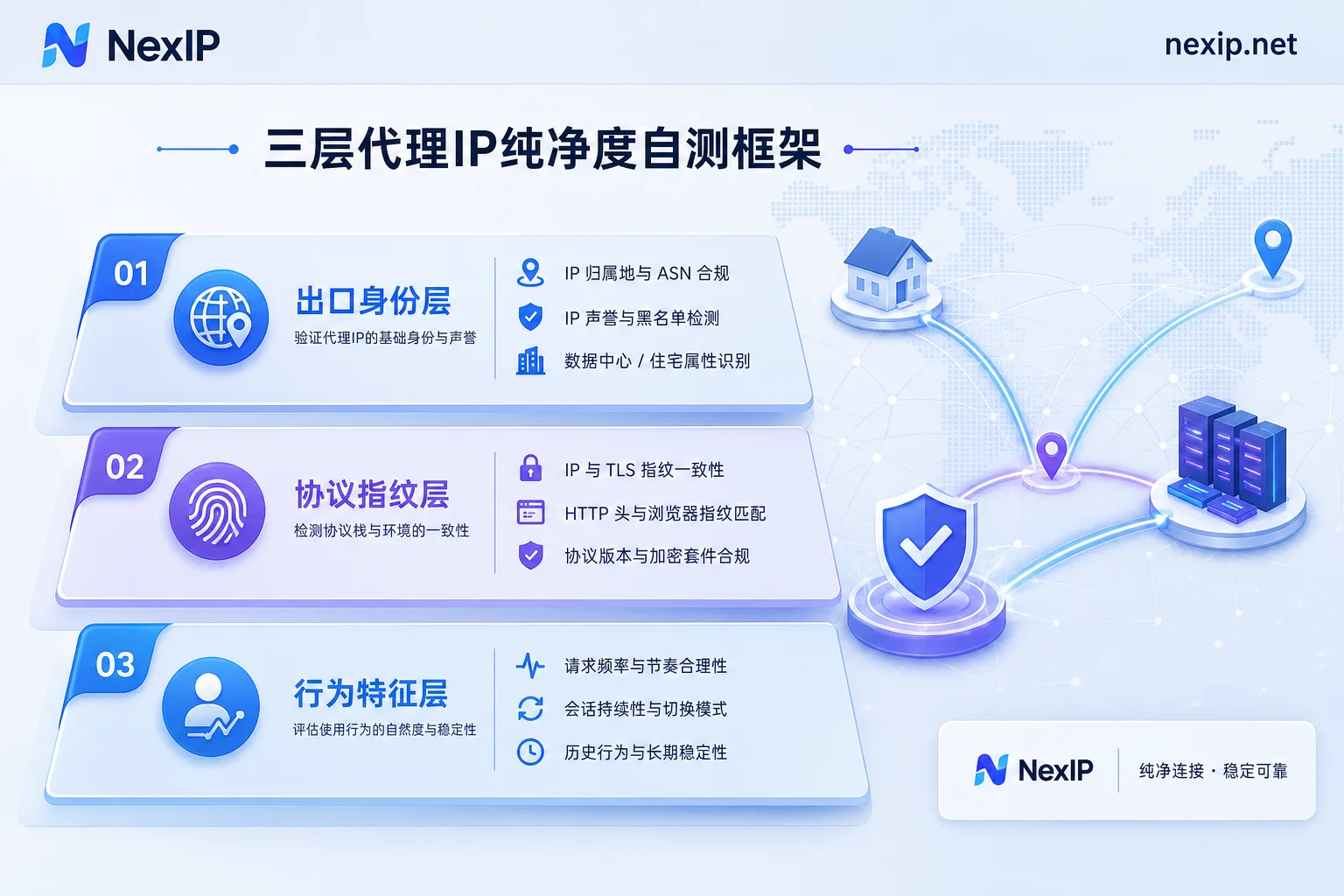


Comments(0)