 NexIP官方博客
Here's the conclusion first: the risk control systems of cross-border e-commerce platforms mainly look at two things when judging an access exit—who owns this IP, and whether this identity is stable over the long term. Static dual ISP residential IPs exactly satisfy both: in IP databases, both the autonomous system number (ASN) and the company/usage type fields point to a local home broadband provider; simultaneously, the IP is statically allocated, enabling long-term binding to the same store environment. Additionally, these IPs are typically hosted in data center facilities with backbone link optimization, offering throughput and packet loss performance superior to real home broadband nodes. Thus, along the primary line of "registration—login—long-term operation," they require less effort than other IP types.
However, this does not mean they suit every cross-border scenario. Below we clarify the criteria, comparisons, and tiered selection.
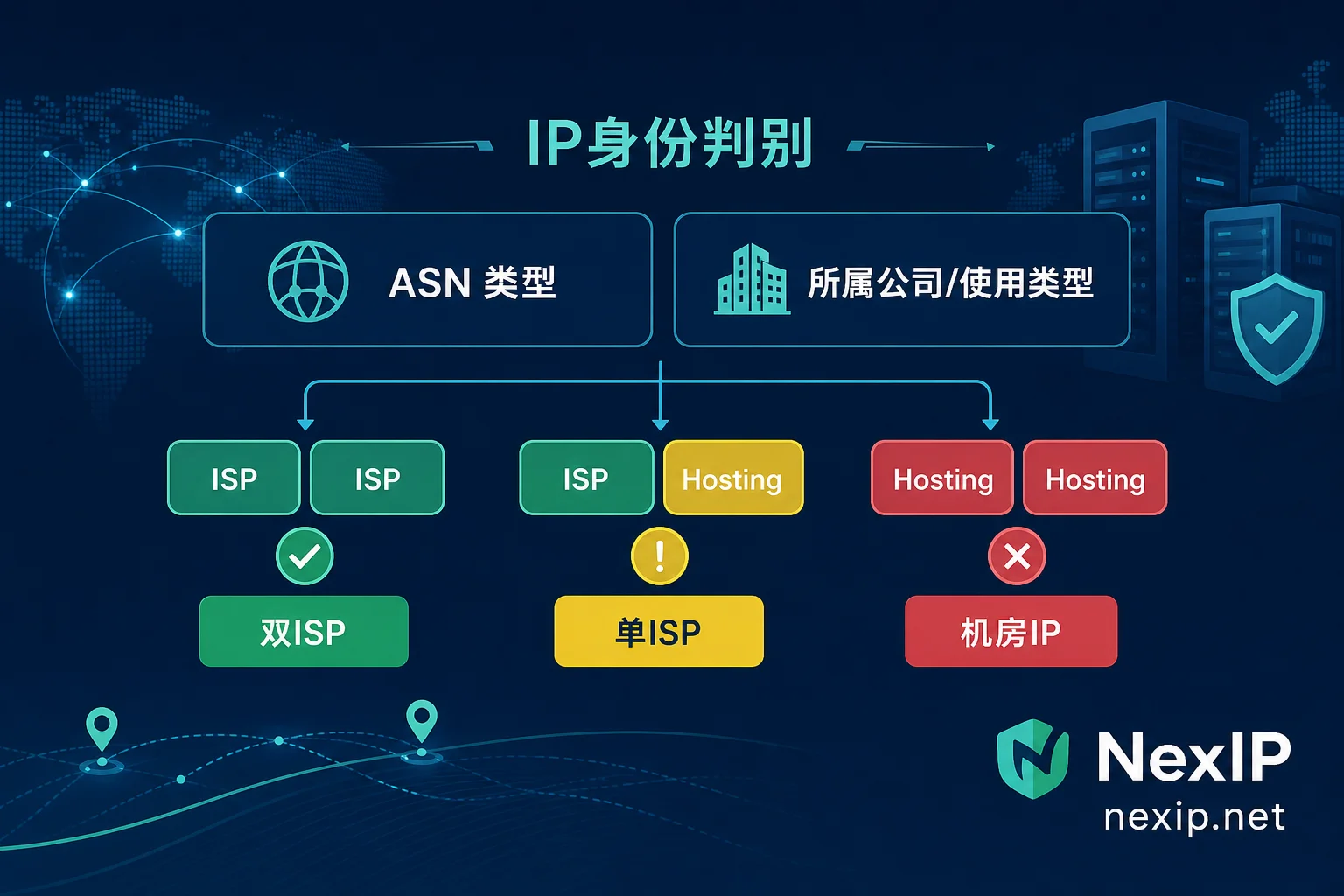
What Exactly Does "Dual ISP" Mean
In IP quality detection tools, an IP has at least two independent identity fields:
- ASN type: Which autonomous system the IP range belongs to, often taking values like ISP, Hosting, Business, Education.
- Company / Org type: The organization to which the IP range is currently registered for actual use.
Dual ISP means both fields both show a local home broadband provider (ISP / Residential).
Single ISP is common in another scenario: data centers bulk-purchase residential IP ranges from providers, making the ASN appear to be an ISP, but the company attribute still labels them as Hosting or Business. Such IPs can pass lenient checks but may still be classified as "data center leased IP" under strict risk control.
It is worth noting that this judgment relies entirely on third-party IP databases (IPinfo, IP2Location, MaxMind, etc.), whose update progress and classification criteria are inconsistent. The same IP might show as ISP in database A and Hosting in database B. Hence, during validation, cross-check at least two or three databases, and do not rely on a single screenshot. For specific operational steps, refer to the verification process in How to Verify Real Dual ISP Residential IPs.
Actual Differences Among Four Types of Exits
| Type | ASN / Organization Type | IP Fixed? | Typical Risk Control Behavior | Better Suited For |
|---|---|---|---|---|
| Data Center IP | Hosting / Hosting | Fixed | Directly recognized as server traffic, with high risk of collateral block within the same subnet | Internal systems, no risk-controlled APIs |
| Dynamic Residential IP | ISP / Residential | Rotates every session or at intervals | Identity is credible, but frequent changes can trigger abnormal login, cookie invalidation, two-factor authentication | Crawling, price comparison, ad creative validation |
| Static Single ISP | ISP / Hosting or Business | Fixed | Session stable, but organizational attributes still expose hosting characteristics | Budget-sensitive businesses or platforms with lenient detection |
| Static Dual ISP | ISP / ISP | Fixed | Residential identity + stable session, minimal risk signals | Store registration, back-office persistent login, multi-store isolation |
For the mechanism behind data center IP detection, see Why Data Center IPs Are Easily Identified as High-Risk.
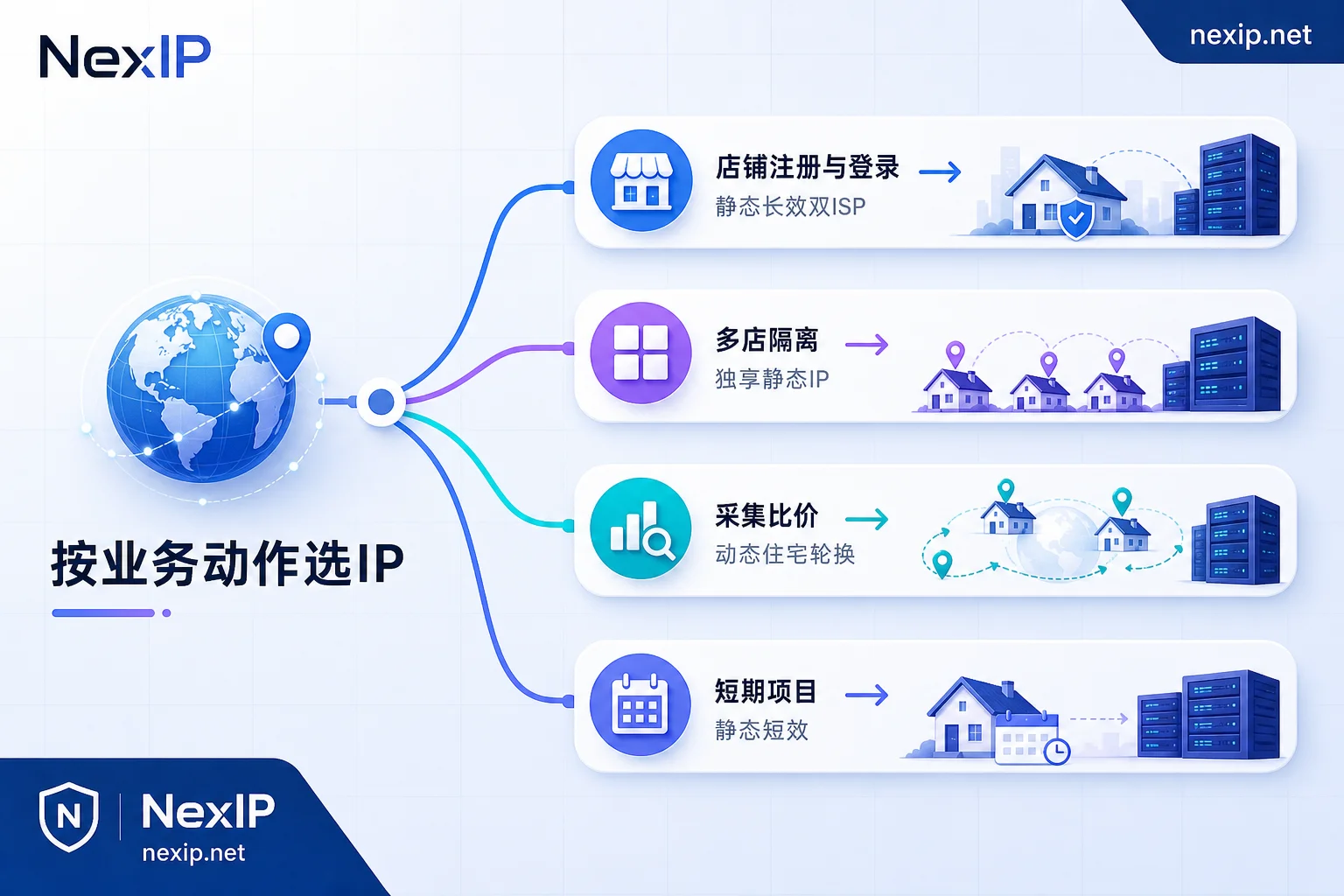
What Each of Four Business Actions in Cross-border E-commerce Requires
1. Store Registration and Daily Login: Need "Constancy"
During registration and early account nurturing, platforms record the IP as part of the account environment. If dynamic residential IPs are used, each login exit changes, easily triggering abnormal login detection, and then CAPTCHA, two-factor authentication, or even requests for KYC materials. Static dual ISP IPs excel by fixing this variable—one store consistently uses the same exit. Similar logic applies to AI services; see Network Exit Troubleshooting and IP Selection Guide for Claude Triggering KYC Verification.
2. Multi-Store Matrix: Need "Isolation"
The common principle for a store matrix is "one store, one browser environment, one dedicated IP." Risks come from two ends: data center IPs in the same subnet may be blacklisted and cause collateral damage; shared proxy pools have cross-provider reuse issues. Threat intelligence shows that the same residential exits can be reused across different proxy providers at a fairly high rate, meaning you and unknown sellers might land on the same contaminated IP. Hence, this layer demands exclusivity, not just "residential." For a cost-benefit analysis of exclusive vs. shared IPs, see Is It More Cost-effective to Use Exclusive or Shared IPs for Data Collection.
3. Localized Advertising and Competitor Monitoring: Need "Consistent Location"
When running ads or checking competitor prices, the IP's city of origin must match the target market, as well as the browser timezone and language. What to verify isn't just the city listed in the database but also actual routing latency to ensure consistency with that city. For comparison criteria, see IP Location Accuracy: Check Database or Measure RTT Latency.
4. Cross-border Live Streaming and Long-duration Tasks: Need "Stable Bandwidth"
P2P residential nodes actually running in people's homes may disconnect due to the host shutting down, network outages, or upstream congestion—a critical issue for live streaming. Most static ISP IPs are hosted in enterprise-grade data centers with optimized routes, retaining a residential identity while offering commercial-grade throughput. For full setup guidance, see How to Build a Stable Cross-border Live Streaming Network.
When You Should NOT Use Static Dual ISP
Treating it as a universal solution wastes money and may backfire:
- Large-scale crawling, price comparison, SERP scraping: Static IPs are limited; high-frequency requests concentrated on a few exits hit rate limits faster. These tasks need a rotatable dynamic residential pool.
- Localization checks requiring broad city or ISP coverage: Static resources typically offer less city coverage than dynamic pools.
- Accessing internal systems, CDN testing, or no-risk-control APIs: Data center IPs suffice at much lower cost.
- Short-term one-off verification: Purchasing long-term static IPs for a few days is uneconomical; short-term static IPs are preferable.
For a more detailed tiered decision between static and dynamic in specific scenarios, see TikTok Residential IP: Static or Dynamic.
Six Acceptance Checklist Items Before Going Live
- Cross-check two fields across multiple databases: Are both ASN type and Company/Org type ISP/Residential, with at least two databases agreeing?
- Confirm native attributes: Whether the registration location and broadcast location match, to avoid "ISP identity but non-native" cases. Criteria found in What Is the Fundamental Difference Between Native and Non-Native IPs.
- Focus on risk scores, not just type: If fraud scores are high, identify whether the issue lies in IP range history, geographical mismatch, or port characteristics. See How to Resolve High Proxy IP Fraud Scores.
- Confirm exclusivity and usage history: Whether it is exclusively allocated, and whether you can check if it was previously used for high-risk activities.
- Test on the target platform: Before final binding, open the target platform in a clean browser environment to see if verification prompts appear.
- Monitor stability continuously: Over several days, record whether the exit changes and whether packet loss and jitter meet standards. Also disable WebRTC leakage to prevent real IP exposure (see Detection and Fix Steps).
Configuration Details
- One IP per store, and do not change it for the long term. If a change is necessary, prioritize a backup IP in the same city and ASN to minimize jump magnitude.
- Align environmental elements with the IP: Match browser timezone, system language, currency preference, and IP's city of origin.
- Choose the protocol based on usage: HTTP(S) is common for browser environments; use SOCKS5 when UDP or non-HTTP traffic is required.
- Differentiate "API extraction" from "account binding" methods of obtaining IPs, as their session behaviors differ. For details, see Specific Differences Between API-Extracted Proxy IPs and Account-Bound IPs.
Combine Resources Based on Business Needs
In practice, most cross-border teams do not choose one over the other but layer configurations:
- For back-office persistent login and multi-store isolation: Use static long-term residential IPs for long-term binding—one per store—with city/ASN targeting to align the origin with the target market.
- For short-term projects, temporary verification, and new store trials: Use static short-term residential IPs to avoid locking long-term resources for just a few weeks.
- For crawling, price comparison, and ad creative localization checks: Use dynamic residential proxies (billed by traffic or bandwidth, depending on whether the task is long-duration low-speed or short-duration high-concurrency), leveraging session stickiness to keep the exit consistent within a task.
NexIP's product line exactly covers these three layers: static long-term and short-term residential IPs, dynamic residential traffic and bandwidth packages, with selection across 200+ countries/regions, city & ASN targeting, session stickiness settings, and HTTP/SOCKS5 and API integration. When selecting, first categorize your tasks according to the business actions above, then decide which parts need fixed exits and which need rotation.
One final practical reminder: IP type is only a variable in the account environment. Browser fingerprints, payment information, and business behavior equally factor into platform assessment. Choosing the right IP reduces unnecessary friction, but it cannot replace compliant operation; specific risk-control thresholds of platforms are trade secrets, and any claim of "100% no ban" is invalid.




Comments(0)