 NexIP官方博客
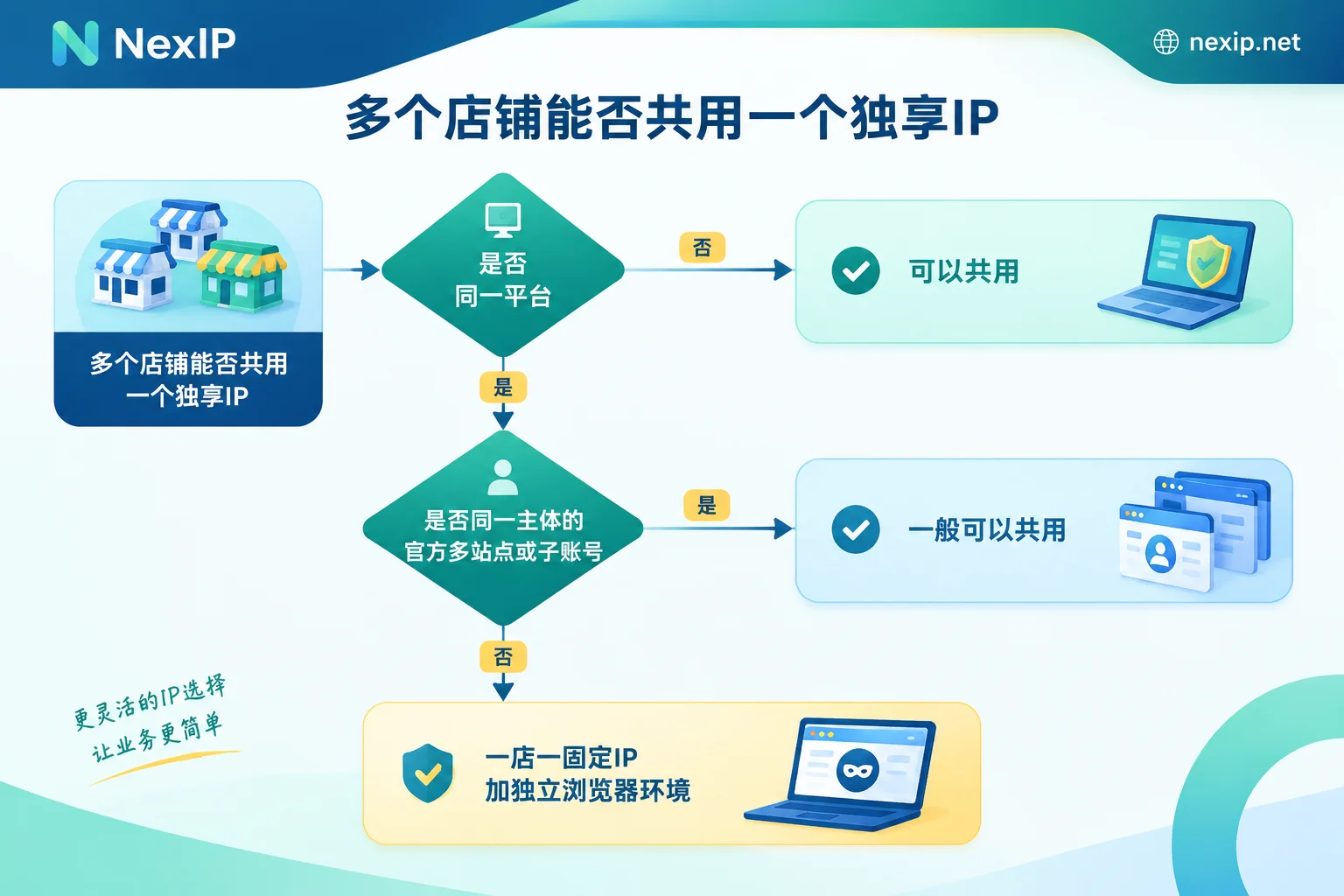
Conclusion: Whether shops can share an IP mainly depends on two things: whether they are on the same platform, and whether they are seen as the same business entity by the platform.
- Shops on different platforms: They can share. For example, one Amazon store, one eBay store, and one independent site using the same dedicated IP. The risk-control data of each platform is not interconnected, so there is no mechanism for cross-platform association.
- Shops on the same platform and under the same entity, opened through official multi-site or sub-account methods: They can generally share. For example, the North America and Europe sites of the same entity under Amazon Global Selling, or sub-accounts assigned to employees through Amazon User Permissions or eBay Multi-User Account Access. These are structures the platform already allows, and logging in from the same network egress is normal.
- Multiple independent shops on the same platform: Sharing is not recommended. This commonly includes shops under different company entities, or multiple client shops managed by a service provider. A dedicated IP has a fixed egress and no other people's traffic on it. If multiple shops on the same platform log in from this one address for a long time, it becomes a very clear association signal. If one shop has a problem, the others may be reviewed together.
There is also a prerequisite to think through first: if the platform itself does not allow you to open multiple accounts, changing IPs will not solve the problem. Take Amazon as an example. Seller Central has specific rules and an application process for multiple seller accounts, and you need a legitimate business reason. First confirm that your multi-shop structure is compliant, then consider how to configure network egress. This article discusses how to assign egress to each shop under the premise of compliance, and does not involve ways to bypass platform review.
Why “dedicated” IPs require extra caution
Many people think a dedicated IP is safer than a shared IP, so it is fine for several shops to share one. In fact, the opposite is true.
On a shared IP, traffic is mixed, and it is difficult for the platform to determine who is behind the address based only on it. A dedicated IP is used only by you, with a fixed address and no other traffic. From the platform's point of view, it is equivalent to a stable identity marker. This characteristic is good for a single shop: the login environment is stable and does not keep changing. But once multiple shops on the same platform are attached to the same marker, that relationship is also easy to identify.
In addition, IP is only one of the signals platforms use to determine association, not the only basis. Device and browser fingerprints, cookies, payment accounts, contact information, and legal representative qualifications all participate in the judgment. Therefore, if multiple shops on the same platform are handled together, it is not necessarily caused by IP. Conversely, even if IPs are separated, if other information is still mixed together, association can still occur. The issue of being implicated by others on a shared IP follows a different logic; you can refer to Will a shared IP get your account banned along with someone else's?.
Spend five minutes first to confirm which situation you are in
Before configuring IPs, answer the following three questions:
- Which platforms are these shops on? If there is one shop per platform, they can share one egress, and most of the content below can be skipped.
- Are the shops on the same platform under the same business license or legal representative? For the same entity, and if they were opened through the platform's official multi-site or multi-user permissions, it is usually unnecessary to deliberately split IPs. Different entities, or cases where it is unclear whether they are the same entity, should be treated as independent shops.
- Does the platform have clear rules on multiple accounts? Platforms vary in strictness. Platforms such as Amazon and Temu are relatively strict about multiple accounts, while eBay is relatively lenient toward multiple accounts registered under the same entity. The seller help center of your platform should be the standard; third-party articles can only serve as reference.
If the answers to questions 2 and 3 are still unclear, it is advisable to clarify compliance issues first before purchasing IPs.
Independent shops on the same platform: how to configure one fixed egress per shop
A common industry practice is “one shop, one IP, one environment.” Specifically, do the following.
Choose static long-term IPs, not rotating dynamic IPs. The shop backend needs to maintain the same login environment for a long time. Dynamic residential proxies change egress by request or session, making them suitable for scraping and monitoring, not for logging into backends. Short-lived static IPs are rented by the hour or day and are suitable for temporary tasks. For long-term shop operation, you should rent fixed egress by the month or year.
The IP region should match the shop's actual situation. The egress region should correspond to the shop's registration information and the team's real operating situation. Once determined, do not change it frequently. A shop that is in the US today and Germany tomorrow will itself trigger abnormal judgment.
Isolate IPs together with browser environments. Each shop should log in within its own browser environment, with cookies, time zone, language, and device fingerprint separated from one another, and fixedly bound to that shop's egress IP. If browser environments are not separated and only IPs are separated, the effect will be greatly reduced. Browser environments can be managed with an anti-detect browser, such as NexBrowser.
Separate business information. Payment accounts, contact emails, phone numbers, and legal representative materials should all correspond one-to-one with the shop's real entity. Network egress is only one layer.
Control credentials when multiple team members operate. The proxy account credentials for each shop should only be given to the person responsible for that shop, and should not be passed around in group chats. Otherwise, it is easy for someone to use shop A's egress to log into shop B. For details on how to divide permissions, refer to How to configure proxy IP permissions for team collaboration.
How to verify after receiving the IP
- Confirm that the IP is truly dedicated. First clarify whether “dedicated” means exclusive egress or only exclusive ingress ports. For specific inspection methods, see How to tell whether the IP you bought is truly dedicated.
- Check the egress IP separately in each shop's browser environment. Open an IP lookup page, confirm that the displayed address, country, and ISP match the allocation record, and that different shop environments show different IPs.
- Check whether any traffic bypasses the proxy. Check whether the browser's WebRTC and DNS expose the local real network, to avoid the proxy taking over only part of the traffic.
- Make a comparison table. Record the shop, platform, entity, egress IP, region, browser environment number, and person responsible. In the future, when an IP fails and needs to be replaced, or when a new colleague takes over, operate according to this table to avoid mixing things up.
Several common misconceptions
- Putting a dozen shops on the same platform under one dedicated IP. This is equivalent to telling the platform that these shops are operated by the same person.
- Using dynamic rotating IPs to log into the backend for convenience. The egress changes frequently, which is itself abnormal.
- IPs are separated, but all shops switch accounts within the same browser. IP isolation basically has no effect.
- Temporarily borrowing another shop's IP after an IP fails. You should switch to a new dedicated IP and update the comparison table.
- Buying a separate IP for every shop even on different platforms. This is not wrong, but it is usually unnecessary. If the budget is limited, prioritize spending on isolating independent shops on the same platform.
Choosing egress: configure according to shop count and region
After making the judgment, the requirements are usually clear: each independent shop on the same platform needs an exclusive, fixed, long-term egress. Shops on different platforms, or official multi-sites and sub-accounts of the same entity, can share one.
NexIP's static residential long-term IPs are exactly for this type of use: IPs are exclusive and fixed, rented by the month or year, and available in three types: native residential broadband, broadcast residential broadband, and data center. Failed IPs can be replaced for free; remember to update the comparison table after replacement. They support username-password or whitelist authentication, with HTTP/HTTPS/SOCKS5 protocols, and can be filled directly into the proxy settings of an anti-detect browser. If you are doing TikTok operations, the official website recommends using static native residential broadband IPs, which can be viewed by country on the TK operations solution page. IPs are only responsible for network egress; they do not determine whether a shop is compliant, nor can they guarantee that an account will not have problems. The platform rules and entity information mentioned above still need to be verified by yourself first.


Comments(0)