 NexIP官方博客
Many people buy proxy IP for the first time out of necessity:
Multiple accounts to open, regions to switch, data to monitor, ads to verify… Without IP, nothing works.
But after doing it for a while, you realize:
Proxy IP is never a 'buy and use' consumable, but the infrastructure that determines your business stability, efficiency, and cost structure.
- IP unstable → access failure → retry pile-up → manual intervention → cost surge
- IP not real → risk trigger → more verification → account loss → business interruption
- IP uncontrollable → random region hopping → data bias → poor decisions → wasted ad spend
So choosing proxy IP isn't about 'who's cheaper' but: who makes you more stable, saves you more trouble, and is more replicable.
1. What Proxy IP Really Solves Is Not 'Connectivity' but 'Risk Control and Scaling'
You need proxy IP usually not just for 'access,' but for three things:
1) Stability: Can the business run continuously
E-commerce monitoring, content monitoring, ad verification, social media operations are not 'one-time tasks' but long-term runs.
Once proxy fluctuates, disconnects, or jitters, the business becomes daily firefighting.
2) Authenticity: Does it look like a normal user
Many platforms' risk control doesn't look at 'whether you use a proxy' but 'whether you look like a real person.'
Whether the network source is natural, whether reuse is too high, whether it's abnormally concentrated—these determine the probability of captchas, rate limiting, and bans.
3) Controllability: Can you standardize the process
When the team grows, account matrix expands, and collection scale increases, if IP cannot be stably allocated by region, session, and strategy, it's hard to turn the process into a 'replicable SOP.'
2. Why Many Proxy IPs 'Seem Usable' but Become More Expensive Over Time?
Because hidden costs are huge:
- Retry cost: Low success rate, retries multiply, throughput actually drops
- Manual handling cost: Captchas, abnormal logins, account appeals all require people
- Account loss cost: Once an account is blocked, all efforts in nurturing and content become zero
- Data bias cost: Inaccurate region, unstable environment lead to collected data distortion
- Opportunity cost: You spend time firefighting, leaving no time to optimize growth
A truly reliable proxy IP should help you 'push down' these costs, not hide them.
3. NexIP's Answer: Native Dual ISP, Turning 'Usable' into 'Reliable'
In the proxy IP industry, the core difference often lies not in how fancy the dashboard is, but in the underlying network:
Is the link stable? Is the environment real? Does scheduling have redundancy?
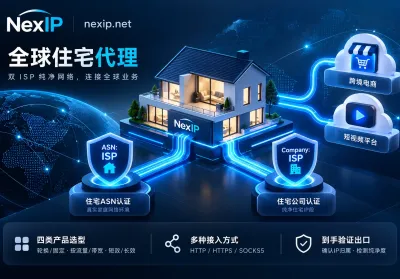
NexIP focuses on native dual ISP proxy networks, with straightforward value:
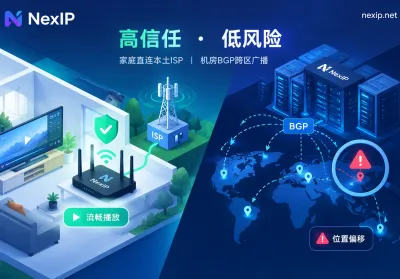
- More stable: Dual ISP provides more scheduling room and redundancy, reducing fluctuations from single-line congestion/failure
- More like real person: Closer to real user network patterns, fewer abnormal features
- Better for long-term business: More friendly to continuous running tasks (monitoring, scraping, operations, verification)
- Better for scaling: When you go from 10 accounts to 100 accounts, from 100K to 1M daily scrapes, stability is your moat
You'll find:
Stability isn't just 'good experience'—it's 'higher ROI.'
4. How to Choose Proxy IP? These 5 Points Will Help You Avoid Most Pitfalls
1) Ask yourself: Do I need 'short-term volume' or 'long-term stability'?
- Short-term: focus more on usability and cost
- Long-term: focus more on stability, cleanliness, risk-control friendliness, and sustainability
2) Look at 'success rate' instead of 'IP count'
No matter how large the IP pool, if the success rate is low, it's just decoration.
You should care about: 2xx success rate, 403/429 ratio, captcha rate, timeout rate.
3) Look at 'session capability'
Does it support sticky sessions? Does it support reasonable rotation?
Operational tasks need more consistency; scraping tasks need strategic rotation.
4) Look at 'geo-location capability'
Does it cover the countries/regions you need? Is geo-targeting stable? Does it randomly jump?
Random geo-hopping is a common cause of data distortion and risk triggers.
5) Look at 'whether the provider understands your business'
Those who only say 'we have many IPs' may not help you succeed.
A reliable provider should give you: test methods, strategy advice, and problem diagnosis ideas.
5. Which Teams Are NexIP More Suitable For?
If you fall into these scenarios, NexIP is likely a better fit:
- E-commerce: multi-store/multi-site long-term monitoring and operations
- Ads: multi-region verification, landing page preview, creative review chain
- Scraping: long-term stable public data monitoring, price/inventory/sentiment tracking
- Social media: multi-account matrix, regional operations, high environmental consistency requirements
NexIP only supports lawful and compliant use, rejecting black/gray market and destructive activities.