 NexIP官方博客
Friends who just entered the industry last week often ask: now that there are "million-level residential IP pools" everywhere, can I just pick any one? A practical comparison of multiple service providers in mid-July pointed out that the residential proxy market is more saturated than it appears on the surface. Everyone advertises pool size, coverage countries, and success rates in highly similar ways; what really makes a difference is usable IP quality, ASN diversity, and performance under real load.
This is good news for beginners. Don't be dazzled by big numbers. First understand the basic concepts and purchasing logic, and you'll avoid detours. Below, we break down the latest changes and entry points in FAQ format.
What exactly is a residential IP and how does it work?
A residential IP is an IP address from a real home broadband connection, assigned by the ISP to an ordinary user's device. When you use it to visit a website, the target sees a typical home connection rather than a data center server, so it's more trusted and less likely to be immediately flagged as automated traffic.
The simple flow is: you send a request → the proxy service selects a real residential exit from the pool → the target site returns content to that home IP → then forwards it to you. Your real address is hidden throughout.
Some people join by sharing bandwidth (contributing IP when idle in exchange for income), while some providers lease entire address ranges directly from ISPs. The latter tends to be more stable and suitable for scenarios requiring persistent connections. Remember this as a beginner: residential IPs are more expensive, but in tasks that need to "look like a real person," they are much more reliable than data center IPs.
Why is the residential IP market more saturated? What does this mean for beginners?
The mid-July analysis was straightforward: most providers are selling the same pitch—massive pools, global coverage, high success rates, intelligent rotation. The market looks fiercely competitive, but buyers find it increasingly hard to distinguish good from bad based on landing pages alone.
Pool size is the most exaggerated metric. A claimed 50 million IPs does not guarantee they are all concurrently available, clean, fast, or sufficiently diverse in ASN. Many IPs concentrate in a few network segments, making them fingerprintable at the network level by target sites. Tests show that during sustained tasks, a large pool is not necessarily more stable than a carefully selected small pool; key factors are reuse rate, ban rate, and session behavior.
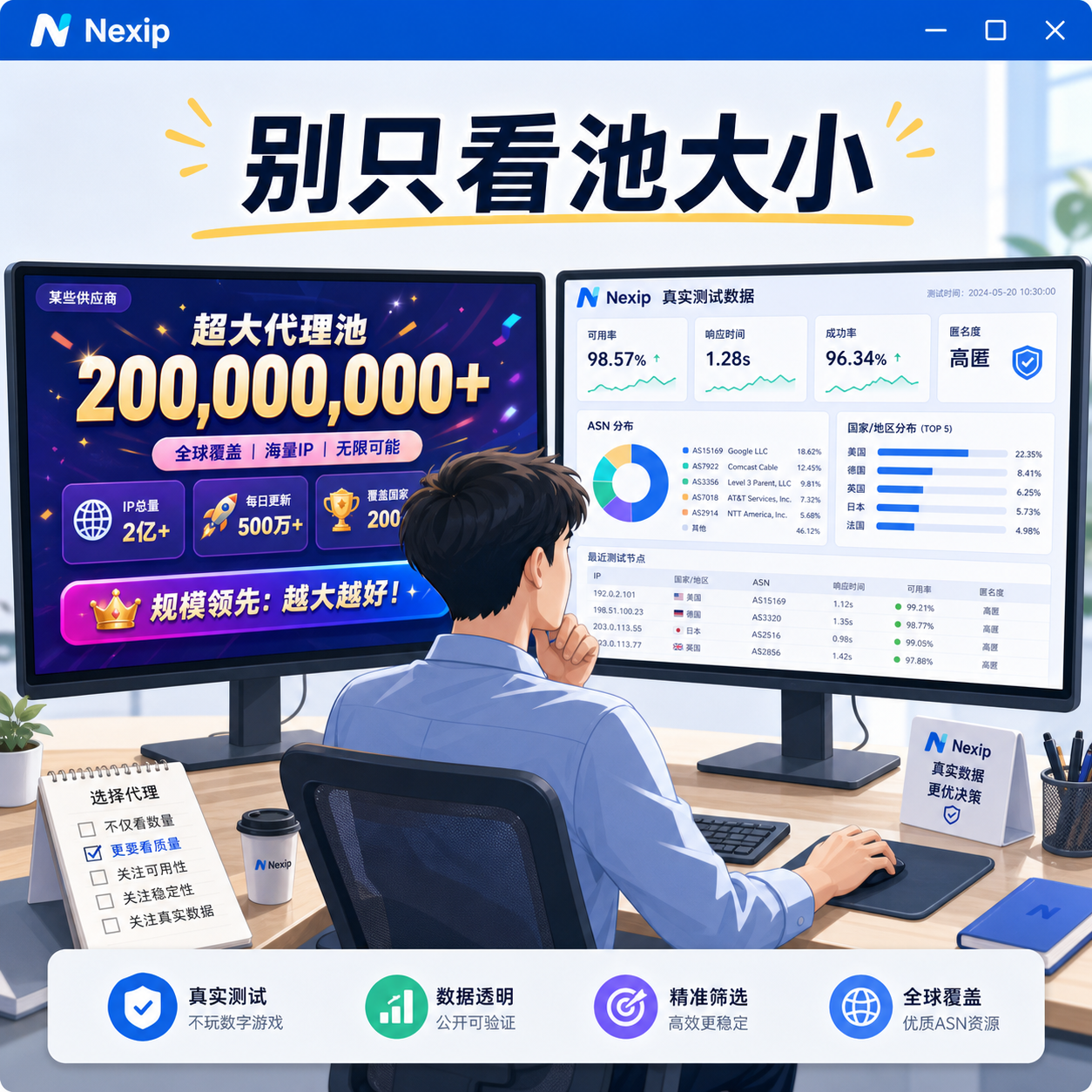
For newcomers, this means don't start by comparing "whose pool is biggest." First ask what scenario you need it for, then test on a small scale. Market saturation brings more choices and price competition, but also creates noise. You need to verify for yourself, not just look at homepage numbers.
When choosing a residential IP as a beginner, which metrics are more important than pool size?
- ASN diversity: How many different operator networks the IPs come from. The more distributed, the more they resemble natural traffic, reducing the risk of bulk identification.
- Real success rate: Test with your target sites, request volume, and region. Distinguish between 403, 429, timeouts, and captchas—don't just trust advertised "99%."
- Rotation vs. stickiness control: Rotation is good for scraping many pages; stickiness is for actions requiring a logged-in state. Check if switching is stable and latency is controllable.
- Geographic accuracy: City-level or ISP-level positioning accuracy directly affects localization results.
- Compliant sources: Prioritize pools that clearly obtain user consent or partner with legitimate ISPs to reduce future risks.
These are far more useful than just a "million IP" pool. Nexip, for example, emphasizes matching exit quality to the task rather than simply piling up numbers. Beginners can start with a small traffic package, run their own scripts for a few days, and compare ban rates and completion rates under the same conditions across different services.
In which scenarios is a residential IP clearly superior to a data center IP?
Data center IPs are fast and cheap, suitable for internal monitoring or low-protection targets. But when websites value "user profiling," residential IPs have the edge. Common situations include:
Checking local search results—map packages and merchant listings vary greatly by city; home IPs are closer to real user perspectives.
Verifying ad delivery—confirm that creatives, landing pages, and language are correctly displayed by region. Data center traffic is often treated differently by platforms.
Monitoring public prices and inventory—e-commerce and travel sites may return incomplete pages or extra verification for data center IPs.
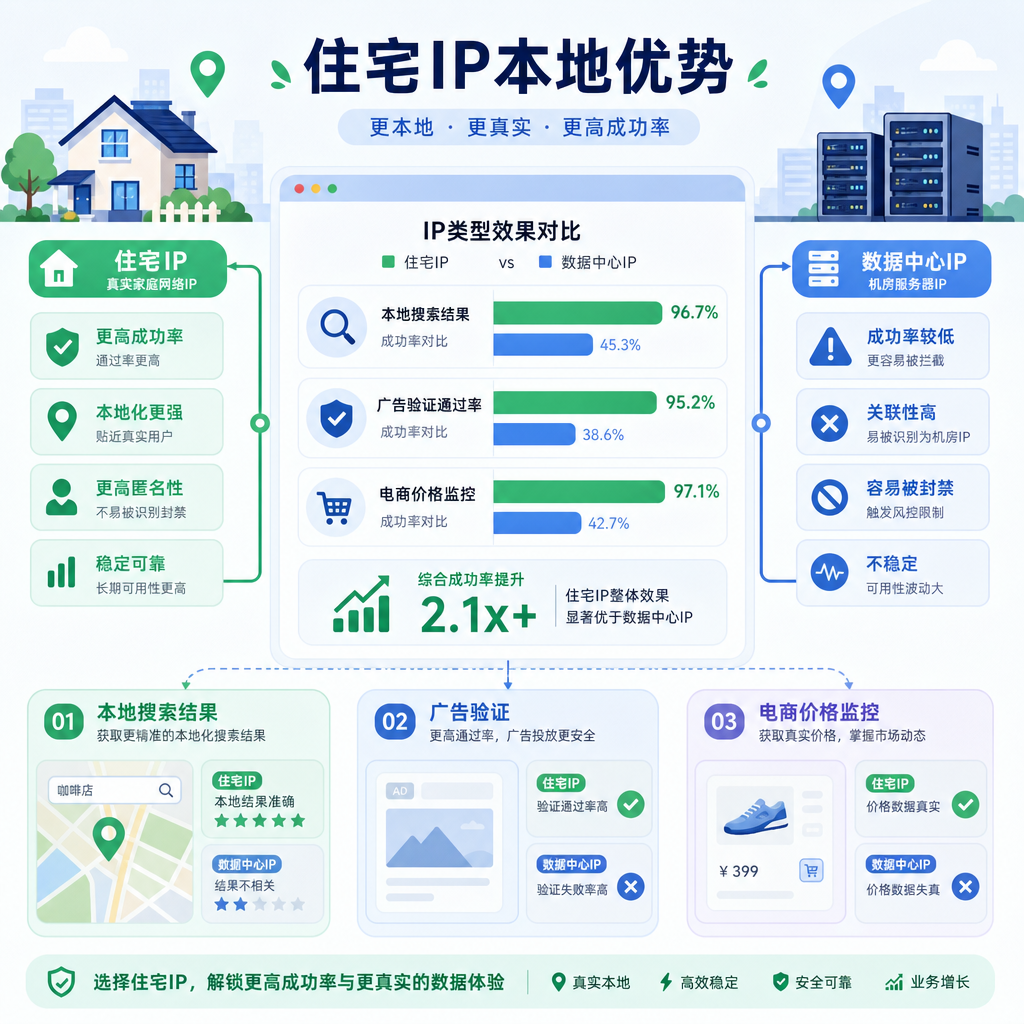
Testing localized content and checkout flows—currency, shipping, payment methods, promotions should display correctly by region.
Conducting regional market research—when browsing local forums, job listings, or reviews, a residential exit reduces redirection to generic versions.
In these tasks, the "looks like a real person" attribute of residential IPs significantly reduces interference. Of course, they are not a silver bullet—medium speed, higher cost—only prioritize when trust signals matter.
How to quickly get started and avoid common pitfalls after entry?
First define your scenario and budget, then choose a service. Open the dashboard, configure authentication (username/password or IP whitelist), set target regions and session type. Test connectivity, latency, and page completeness with simple scripts or browser extensions.
Watch your pace: simulate human request intervals, don't blast through. Monitor IP health; if failure rates are high, switch pools or adjust parameters. Tools like Nexip support flexible switching, making it easy for beginners to adjust as they go.
Don't believe promises of "unlimited traffic" or "never banned." Compliant use and respecting target site rules is the long-term approach. In a saturated market, those who insist on real testing and record-keeping are more likely to find a residential IP solution that suits them.
Recent industry discussions also remind that some residential networks are used to hide malicious activities, further highlighting the importance of choosing legitimate sources. By starting with basic concepts and actual metrics, beginners can stand firm in the saturated market of 2026.


Comments(0)