 NexIP官方博客
Mid-July Report Reveals Truth About Proxy IP Dirty Pools
Last week (mid-July), data released simultaneously by multiple security agencies kept many teams involved in multi-accounting and data collection up at night. Accertify, through analysis of real customer traffic, found that attackers have massively shifted to residential proxy networks for account takeover (ATO). Single attack peaks reached 12 million login attempts, consuming 14,864 unique IPs within 10 minutes, with a rate of 300 TPS. These IPs came almost entirely from real residential ISPs like T-Mobile, Cox, Verizon, and Comcast; 99.29% appeared clean in traditional reputation databases, with very low single-IP reuse that never hit speed thresholds.
A simultaneous report from the Digital Citizens Alliance was even harsher: after inspecting multiple residential proxy pools, they found that an average of 85% of IP connections had previously been flagged for fraud or criminal activity. In the U.S., over 20 million residential IP connections are drawn into such networks each year, and nearly half of the IPs circulate among multiple providers. Discussions on X are also heating up, with someone directly posting the core figure “85% already flagged,” warning that ordinary home connections might be used as jump hosts without the owner’s knowledge.
This is not abstract news. For cross-border teams relying on proxy IPs for price monitoring, multi-shop login, and ad verification, this means the “clean residential” IPs you bought may have already been abused. Once the platform’s risk control escalates based on correlations, success rates will drop sharply, and accounts may get caught in the crossfire.
Real Scenario: How an E-commerce Team Went from Crash to Stability
Take a medium-sized cross-border e-commerce ops team (covering US multi-store price collection + daily account maintenance). In early July, everything was normal, using dynamic residential proxies for rotation scraping and login. Around July 10, monitoring scripts suddenly faced widespread timeouts, success rates dropped from the usual 92% to about 55%, several main store backends showed abnormal login prompts, and some sessions were directly kicked out.
The first step in troubleshooting was specific. They exported the exit IPs used in the last 24 hours and batch-checked them in public detection tools (like IPinfo’s residential proxy detection API or free reputation lookups). The result was alarming: over 70% of IPs were flagged as proxy-related, and some were directly linked to known high-risk pools. Cross-referencing with the attack pattern described by Accertify—attackers also used massive amounts of low-reuse residential IPs for credential stuffing—platforms had begun downgrading the trust of “clean but anomalous residential IPs” overall.
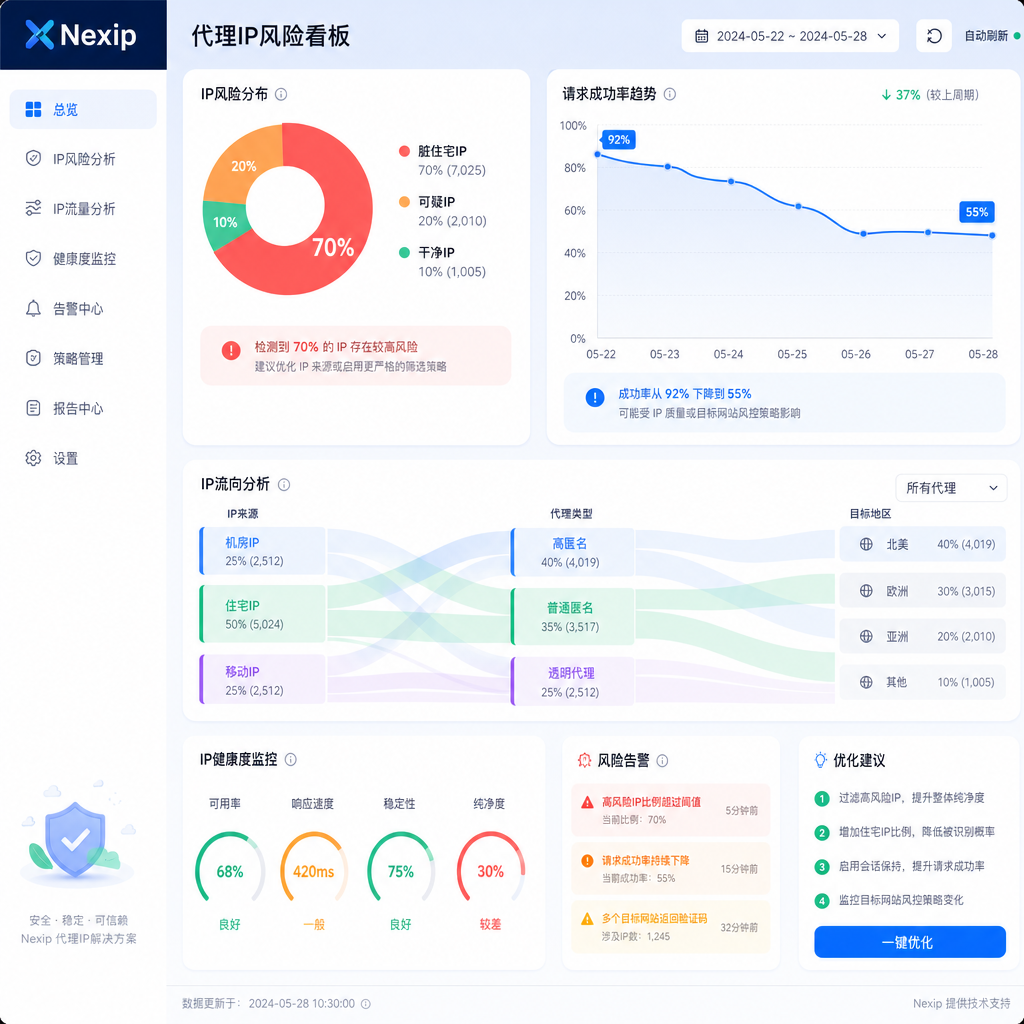
The second step was isolation. They immediately stopped all dynamic rotation tasks, keeping only essential manual logins. Suspicious IP ranges were added to a local blacklist, and scripts incorporated real-time health checks: pinging the target site and checking IP type before each request, auto-switching on failure. Meanwhile, they enabled session logs recording each IP’s response time, CAPTCHA trigger rate, and geographical match.
The third step pinpointed the root cause. The team found that the proxy pool they had been using, though labeled “residential,” included many nodes from SDK-embedded devices or ISP segments tunneled entirely (a contemporary study by Spur dissected how GRE tunneling with policy routing turns entire university/regional ISP prefixes into commercial exit points). These IPs superficially belonged to residential ASNs, but were actually shared by many users, with reputations already depleted. Platform risk control now looks not only at IP type but also at historical behavior density and cross-site correlations.
Operational Trio: From Detection to Switching
Solving the problem doesn’t rely on mysticism but on concrete actions. Here are the steps they implemented, which can be directly replicated:
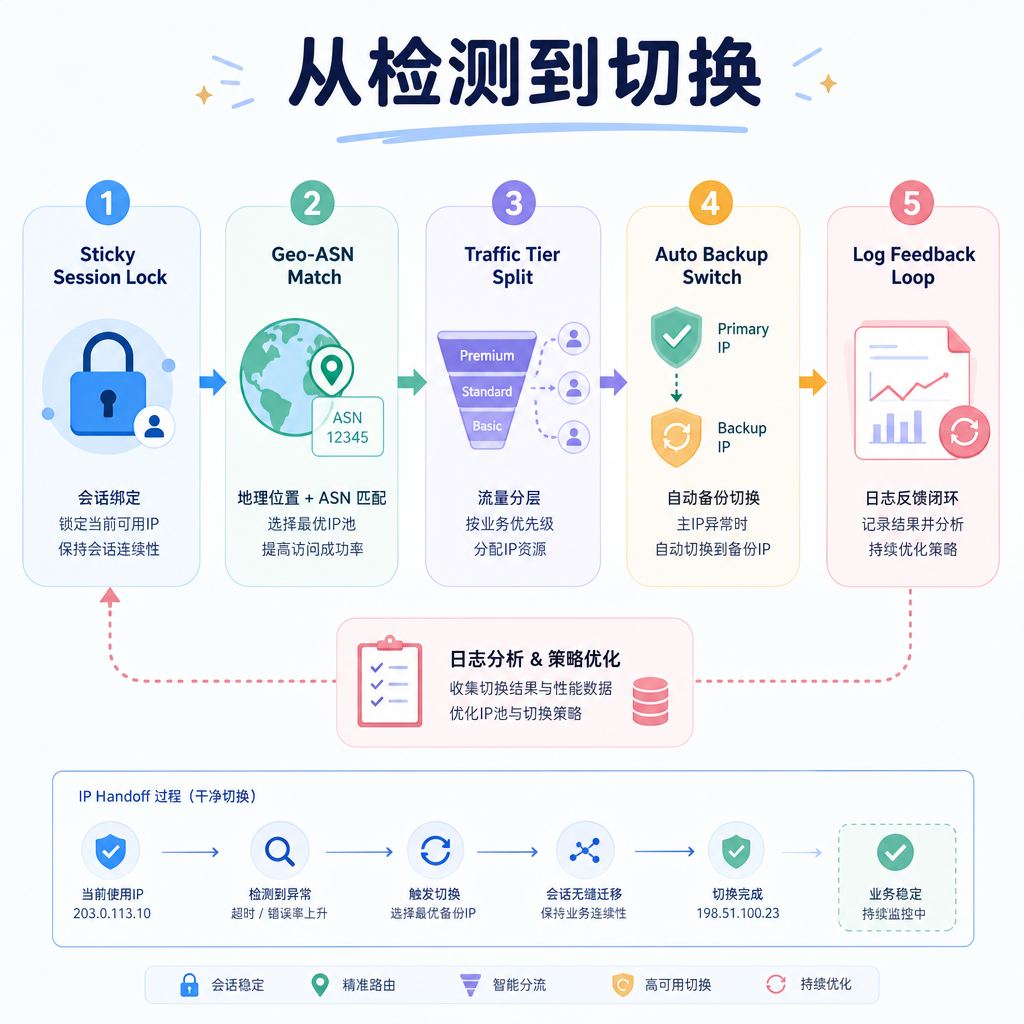
- Daily sampling detection: Randomly sample 50–100 current pool IPs, query the residential proxy database for
last_seenandservicefields, and remove those withpercent_days_seenabove a threshold. - Session stickiness: For price monitoring, switch to sticky sessions (bind the same IP for at least 15–30 minutes per task); for multi-account logins, bind fixed residential IP + fingerprint to avoid behavioral fragmentation.
- Geo and ASN precise matching: If targeting US East Coast users, select the corresponding state/city + real ISP rather than just any “US IP.” Mismatches trigger additional risk controls.
- Traffic layering: Use static/sticky residential for high-sensitivity logins, dynamic rotation for public collection, with separate billing and monitoring.
- Backup switching mechanism: When the primary pool is abnormal, instantly switch to a backup provider; scripts should have health thresholds (auto-switch if success rate <80% or latency >2s).
- Log loop: Record full request headers, TLS fingerprints, and IP metadata on each failure for post-mortem analysis.
After implementing these, they switched to Nexip. They directly created sticky residential sessions in the console, specified city-level location and session duration, and changed the proxy endpoint in monitoring scripts. After two days of testing, success rates returned to over 90%, with no further account anomalies. Nexip’s pool had a significantly lower dirty IP ratio in daily checks, and supported on-demand rotation or fixation, perfectly matching the layering needs.
Three Practical Details to Watch When Choosing Proxy IPs
After the reports came out, many people’s first reaction was “switch to a larger pool.” But bigger doesn’t mean cleaner. What really matters is source traceability and real-time health.
First, check if the IP has ever been “hijacked” as a whole. The case dissected by Spur showed that some static residential IPs actually came from GRE tunnels installed on ISP border routers, leasing out entire prefixes without the end users’ knowledge. Once such IPs are used for ATO, the reputation of the entire segment is damaged. When selecting, ask clearly whether it’s device opt-in or ISP partnership, and whether ASN and historical usage overviews are provided.
Second, focus on detection capability. Services like IPinfo have now turned residential proxy detection into an independent dataset updated daily, directly returning service names and active day ratios. Integrating this into your own scripts is more useful than simply checking “is it a proxy.”
Finally, session control granularity. Dynamic rotation works for high-volume scraping, but logins and account maintenance require stickiness. Nexip handles this directly: when creating a task, select sticky mode, set duration and region, maintain session ID in scripts, and replace individual sessions without affecting the whole pool if issues arise.
The July data is not the end. Platform risk controls will continue learning from attackers’ low-reuse residential techniques, imposing higher requirements on legitimate proxy IP users. Rather than waiting for the next large-scale failure, now is the time to integrate detection and layering into daily processes. Clean, controllable, and traceable residential exits are the only foundation for stable operations going forward.


Comments(0)