 NexIP官方博客
In the past two weeks, the sticky session performance of residential proxies has once again become a hot topic in the industry. Under the same "residential IP" label, session survival rates vary from over 80% to nearly 99%, while unexpected rotation rates range from just over 1% to above 6%. For tasks requiring login, pagination, shopping cart, or long-term state retention, this directly determines the success rate. Additionally, geo-location accuracy is inherently imperfect, making local ad verification or regional price monitoring more prone to pitfalls.
First, let's look at the big picture. A large amount of automated traffic actually comes from residential and mobile networks. Behind these IPs are often device-side software that fetch pages and send back data on command—some are unauthorized malware, while others access bandwidth via free VPNs or app SDKs under the guise of "bandwidth sharing." Defenses on the website side are also upgrading: some have introduced proof-of-work, others have strengthened behavioral analysis and fingerprint matching. Simply swapping IPs is no longer enough. Temporary network cleaning can reduce traffic for a while, but the overall pressure remains. For users, it's better to prioritize pools with relatively transparent sources and consent mechanisms for long-term stability—burned IPs or high-risk pools will lead to faster bans.
Sticky session differences are especially pronounced. When continuous operations are required after login, changing the IP midway will break the session, losing all cookies, tokens, and authentication states. Recent continuous probing data shows that sticky session survival rates vary widely among providers: the highest can exceed 98%, while the lowest is just over 80%; the proportion of mid-session rotations also varies. The "high availability" often advertised masks this, and only sustained stress testing can reveal the truth. For long sessions and repetitive workflows, stability often matters more than frequent rotation. Static or ISP-based residential IPs are better suited in this regard, reducing unexpected interruptions.
Geo-accuracy is another easily overlooked point. New research in the advertising industry indicates that among residential IP-based targeting, the actual hit rate for the target geographic area is only about 23%. Device-level identifiers are significantly more consistent. For tasks like ad verification, local SEO rank checks, and regional inventory monitoring, if a request for a certain city actually lands in a neighboring one or even farther away, the results seen will be distorted. City or postal-level targeting sounds precise, but the available IPs are much fewer, and accuracy is far from 100%. Country-level is usually more stable, but when localization is required, you must cross-validate yourself.
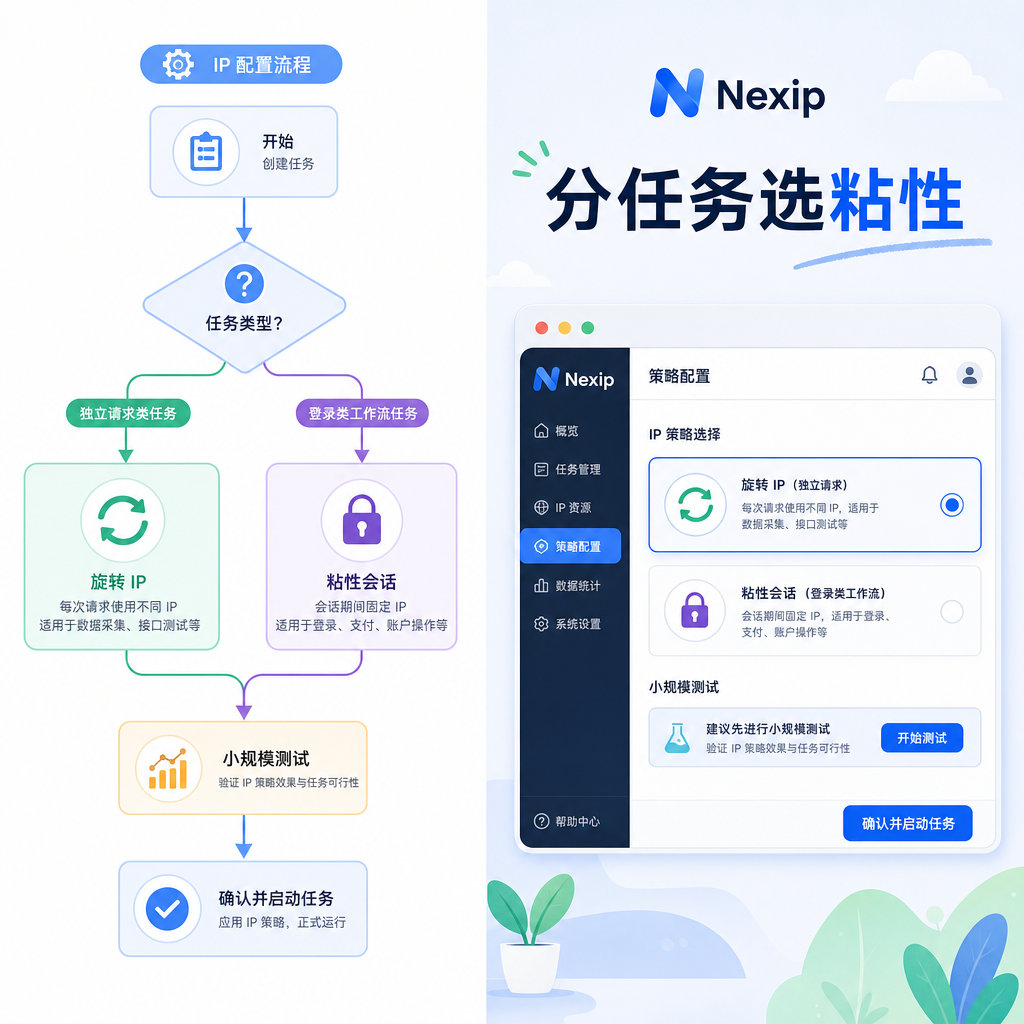
In practical configuration, first distinguish task types. For independent requests—like batch SERP checks or pulling public prices—use rotation: change IP per request or at short intervals to spread out pressure. For stateful workflows—login, checkout, pagination, multi-step forms—you must use sticky sessions. Most services support locking an IP via a username-attached session ID, typically lasting 10 to 60 minutes, depending on provider limits. After setting it up, test on a small scale: send dozens to hundreds of requests within the same session, check if the IP stays constant, success rate, and latency. If mid-session rotation is high, shorten the session duration or switch pools.
Don't just focus on IP. Modern detection also looks at TLS fingerprint, header consistency, browser fingerprint (canvas, WebGL, timezone, language), and behavioral rhythm. A User-Agent claiming Chrome but sending a Python-style handshake, or timezone/language mismatching the IP's location, will quickly flag you. It's recommended to use anti-detection browsers or strictly matched automation stacks, keep cookies within the session, simulate human-like request intervals (a few seconds to tens of seconds), and render JavaScript when necessary. For geo-verification, don't rely on just one database; use multiple tools to check ASN, city, privacy markers, then compare with the actual content returned by the target site.
Common pitfalls include: First, using sticky sessions for too long—having the same residential IP on the same site for hours is unnatural. Second, mixing up rotation and sticky usage—forcefully using sticky for independent tasks wastes resources, while random rotation for login tasks crashes the session. Third, ignoring hidden bandwidth costs: failed pages, retries, handshake, images, and scripts all consume traffic. Fourth, skipping ethics and freshness checks—if the pool contains already flagged IPs, you'll face high ban rates right away. Fifth, only looking at country-level targeting without verifying actual exit points for local tasks. Multi-account scenarios also require fingerprint isolation to avoid correlation.
When selecting a service, focus on session control flexibility (whether custom duration and ID are supported), pool freshness and ASN diversity, actual geo-granularity performance, documentation, and support responsiveness. Start with small traffic to test, record survival rates, mid-session rotations, and target site success rates, then scale up. Services like Nexip emphasize session stability and compliant sources in dynamic residential IPs, suitable for login collection or regional monitoring scenarios requiring sticky sessions. In configuration, tune the session parameters and pair with a consistent browser environment to significantly reduce disruptions. In practice, Nexip's residential proxy pool allows switching between rotation and sticky modes on demand, making it easy to mix tasks in the same project.
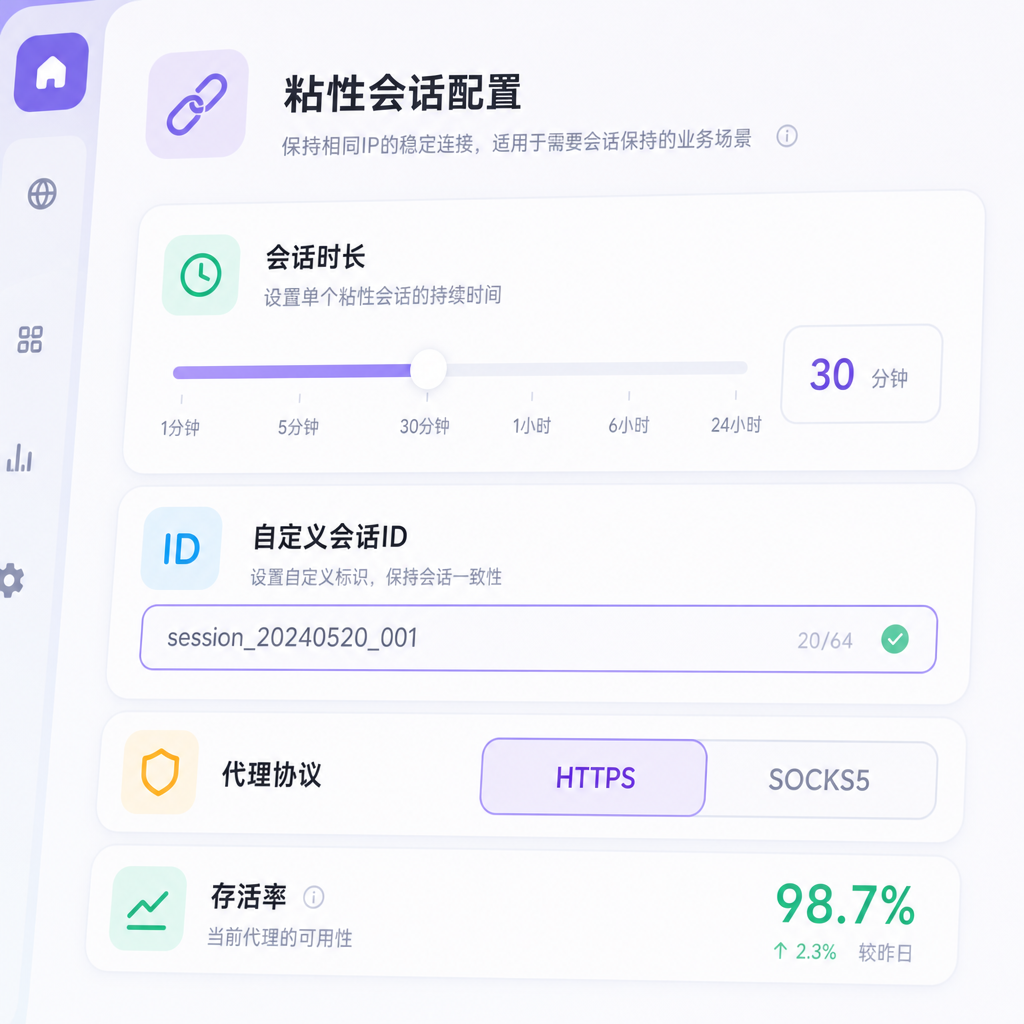
A few additional details. For setup, prioritize HTTPS or SOCKS5 for protocols, and use username-password authentication as the most universal method. During testing, confirm the exit IP with curl or scripts first, then proceed to a full browser flow. To monitor mid-session rotation, set up periodic IP checks via an API; once it changes, rebuild the session. For localization tasks, first run the logic at a country level, then gradually add cities, and record deviation rates. For bandwidth estimation, don't use ideal page sizes; add 3 to 5 times margin to account for retries and rendering.
Overall, residential proxies are not a silver bullet. Quality varies widely, geo-location has deviations, and detection layers are increasing. The key is matching session strategy, fingerprint consistency, and ongoing verification to the task. Incorporate sticky survival rate, mid-session rotation, and geo-hit rate into daily checks, rather than just looking at price or advertised pool size. Compliant-source pools may sometimes be pricier, but in the long run, they result in fewer bans and retries, often lowering total costs. For login-based scraping, ad verification, and regional monitoring, following the above approach in configuration will steadily improve success rates. Nexip provides stable dynamic residential support for such needs, and with practical details, it will be much easier to implement.
Once you're truly running, regularly review: which sessions broke, why, and what anomalies the target site returned. As data accumulates, your optimal session duration and rotation strategy will become clear. The environment is still evolving—defenses and proxy quality are both iterating. It's more reliable to keep small tests and multi-source verification than to set it once and leave it untouched forever.


Comments(0)