 NexIP官方博客
In recent weeks, the issue of residential proxy SDKs embedded in smart TVs and consumer apps has been heavily exposed. Numerous LG and Samsung apps were found to contain proxy SDKs that turn home networks into exit nodes, routing third-party traffic. Scanning thousands of apps, nearly half of LG-related apps carried such SDKs. Smart TVs, always online and unattended, make ideal stable nodes. Consent pop-ups are often hidden in setup processes or privacy policies, dismissed with a remote click, and continue running in the background, even ignoring whether the screen is on or the user is on a call.
This directly hits the core pain point of residential proxy IPs: whether the source is genuinely compliant and the user is fully informed. Federal agencies have also issued public warnings that residential proxy networks acquire IPs through SDK partnerships, hidden clauses in free VPNs, compromised IoT devices, malware, and "passive income" bandwidth-sharing apps. Once a device becomes a node, the risk extends beyond bandwidth usage—it can serve as a springboard into the home LAN, exposing router admin pages, NAS, cameras, and other local services. Some SDKs implement private address blocking, but boundaries ultimately depend on the provider's filtering policies and client vetting, leaving device owners unable to verify in real time.
For those involved in data scraping, multi-account management, price monitoring, or AI agents, this is not a moral slogan but an operational risk. Using a pool with unclear sources can lead to IPs being flagged, associated, or even implicated in law enforcement investigations. Target websites' anti-bot systems are increasingly sophisticated, analyzing client concentration, geographic anomalies, known proxy attribution, device diversity, and session behavior. Simply "looking like a residential IP" is no longer sufficient; infrastructure signals and behavioral patterns will expose proxy traces. Clean, auditable residential IP pools thus become more valuable.
When selecting, start with the source. Prioritize services that emphasize explicit user consent, verifiable KYC, independent audits, and a clear prohibition of local network access. Avoid massive pools assembled from free apps or vague terms. Pool size does not equal quality; refresh rate, ASN diversity, and the proportion of genuine home IPs are more critical. Dynamic residential IPs suit high-concurrency rotation, while sticky residential IPs are better for scenarios requiring login states, shopping carts, and multi-step operations. Static ISP types offer more stability but vary in cost and availability. Services like Nexip, which focus on compliant sourcing, align better with frontline needs in native home IPs and session controllability, reducing unexpected batch bans.
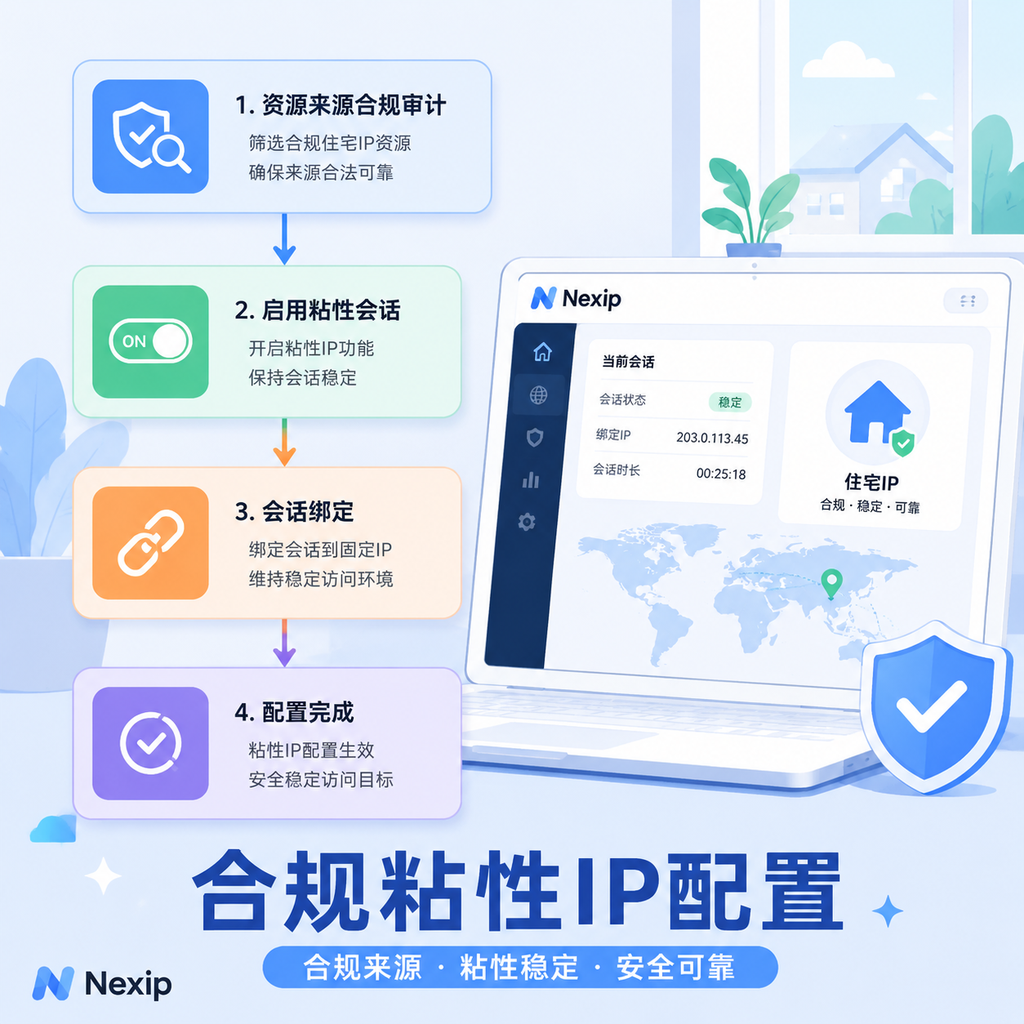
Next is the practical implementation of sticky sessions. The core of stickiness is to route all requests within the same session through the same IP, mimicking real human continuous operations. It is essential for login, account nurturing, multi-account switching, and scraping that requires maintaining cookies. However, sticky survival rates vary greatly among providers. Recent continuous probe data shows overall session survival improving from previous levels to around 90%, with unexpected mid-session rotations decreasing significantly, but gaps between providers remain: top performers exceed 98%, while poor ones barely reach 80%; mid-session IP jumps range from 1% to 6%. Despite all bearing the "residential proxy" label, performance during login processes differs drastically. Advertised "high availability" often masks mid-session rotation issues, which only continuous probing can detect.
How to implement in practice? First, define the task type. Use rotating residential IPs for high-volume public page scraping, changing IP per request or short intervals. For login and multi-step processes, force sticky sessions with reasonable timeouts (commonly tens of minutes to hours, adjust per business). In tools (Playwright, Puppeteer, or automation frameworks), bind proxy parameters at the session level: specify country/city, enable sticky flag, store authentication via environment variables or key management—avoid hardcoding. Match geolocation to the target, diversify ASNs to avoid IP clustering. Align fingerprints: browser fingerprint, timezone, language, resolution should match the IP location; disable WebRTC and DNS leaks separately. Add random delays and throttling to requests, avoiding constant rates.
Multi-account scenarios require more nuance. Each account corresponds to a sticky session, reusing the same IP or a small pool long-term, and rotate slowly when necessary. During initial account nurturing, use sticky to build trust, then introduce light rotation later. For price monitoring or OTA price comparison, mix: sticky for key pages, rotating for listing pages. For AI agents or data pipelines, use residential proxies only for high-risk targets, and cheaper solutions for low-sensitivity tasks to control costs. When integrating, prioritize interfaces supporting session ID, city-level targeting, and real-time usage statistics for easy issue backtracking.
Common pitfalls abound. First, only looking at price and "unlimited traffic" while ignoring real sticky survival and mid-session jumps, leading to IP changes mid-login, triggering two-factor authentication or account bans. Second, ignoring source compliance: pools containing SDK or compromised device IPs may work short-term but degrade long-term reputation, leading to mass blacklisting. Third, fingerprint-proxy mismatch: IP is US residential, but fingerprint shows European timezone—easily detected. Fourth, lack of monitoring: no dashboards for success rate, TTFB, or session interruption rate, reacting only after problems arise. Fifth, loose permissions: proxy credentials shared widely or the same proxy used across the whole network, risking total exposure.
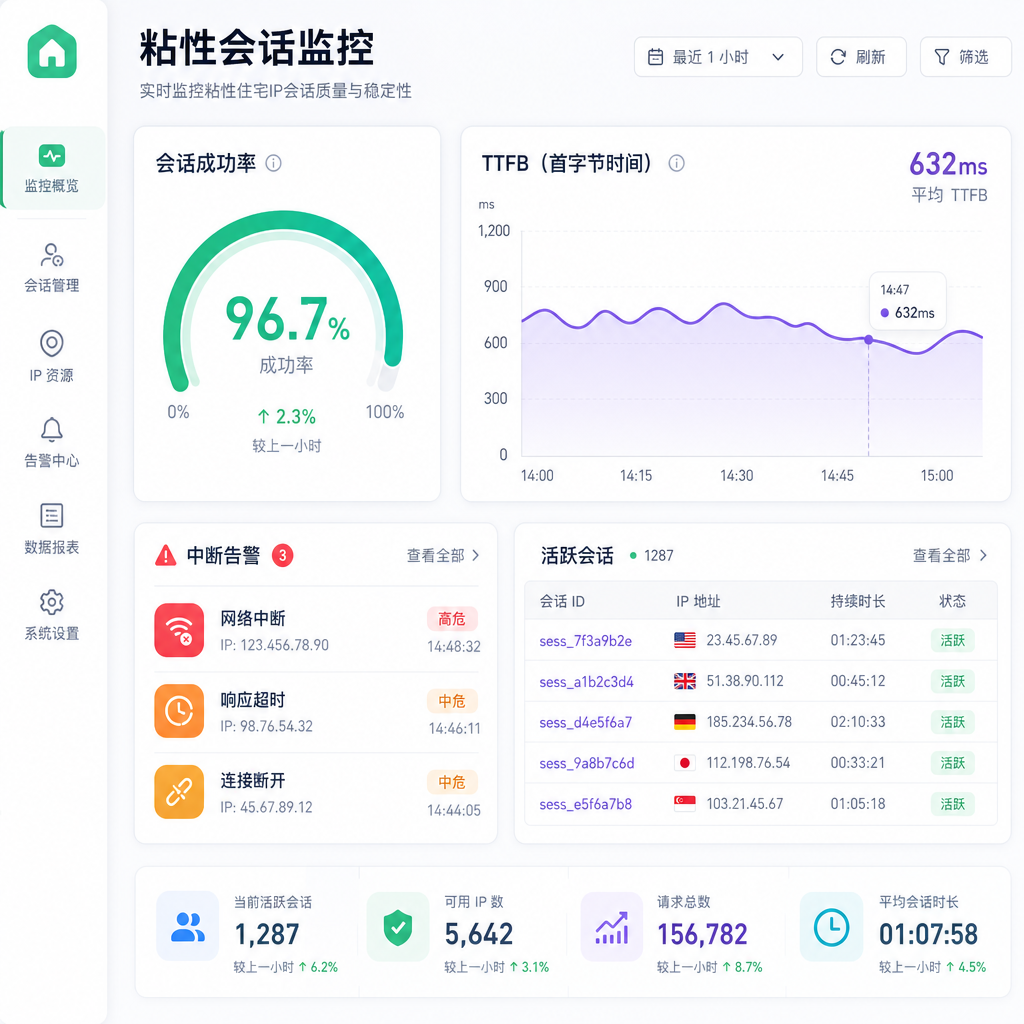
A practical checklist: first, test with low traffic on target sites, record sticky survival and success rates; compare stability across different session durations; check for local network access risks (review provider documentation and audit reports); set alerts to switch to backup pools if mid-session rotation or failure rates exceed thresholds; periodically review IP quality and remove high-risk segments. For home users, protective measures include: avoid downloading free VPNs and obscure TV apps, use trusted app stores, update firmware, monitor home traffic anomalies, and use DNS filtering to block known proxy SDK domains when necessary.
Residential proxy IPs themselves are not the problem; the issue is source and usage. The smart device SDK incident reminds us that the market is diverging: on one side, large-scale nodes with vague consent; on the other, compliant pools emphasizing transparency, auditing, and session quality. For multi-account automation, e-commerce monitoring, or AI scraping, prioritize compliance selection first, then fine-tune sticky parameters—success rates will stabilize. Nexip's native residential capabilities in such scenarios allow you to focus on business logic rather than constantly firefighting IP issues. Choose the right pool, configure sessions properly, and monitor metrics—it’s more effective than blindly scaling volume.
In daily iteration, treat sticky survival rate as a core KPI alongside business conversion rates. When onboarding new providers, first stress test at small scale; don’t switch all traffic at once. For cross-team efforts, document proxy strategies in operations manuals, clarifying who handles rotation, who monitors, and what the fallback plan is. This way, even as the external environment changes, your scraping and account systems can withstand challenges.


Comments(0)