 NexIP官方博客
E-commerce price monitoring sounds simple, but in practice it's full of pitfalls. You track competitor SKU prices, promotions, and inventory, hitting thousands or tens of thousands of requests a day. When the target site tightens risk control, you get 429 errors or fake data. That's when dynamic residential IPs become essential—they route through real home broadband, have high trust, and can pinpoint cities even zip codes, matching local pricing variations.
First, why residential proxies are a must. Datacenter IPs are cheap and fast, but against tough targets like Amazon and Walmart, they're easily flagged as data center traffic. Residential IPs come from real ISP users, making requests look like ordinary shoppers browsing. In 2026, e-commerce data demand is still rising, pricing strategies get more localized, and tariff changes widen regional price differences. The price you see from a New York exit can be completely different from Los Angeles. Without a geographically accurate residential pool, your monitoring data is biased, and dynamic pricing adjustments go wrong.
Practically, first define your goals. List competitor URLs, product matching rules (EAN or title similarity), and set monitoring frequency—hot SKUs hit several times a day, long-tail ones less. Then route to the proxy pool. The key here is session strategy.
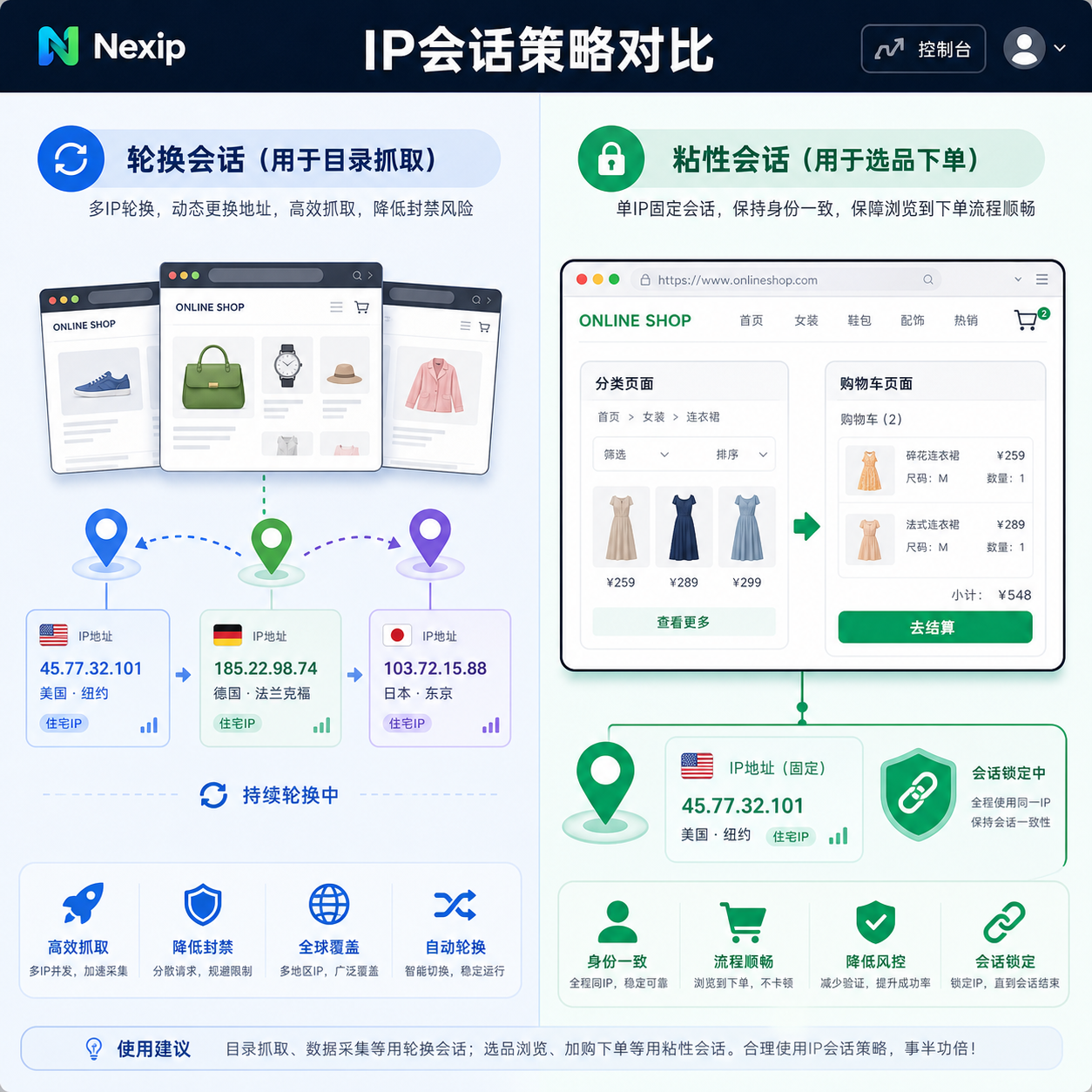
Dynamic residential IPs usually support two modes: rotation per request and sticky sessions. Rotation per request is ideal for large-scale catalog crawling; each request uses a different IP, distributing load and boosting success rate. Sticky sessions lock the same IP for a period, say 10 to 30 minutes, suitable for simulating real browsing paths—from category page to product page to add-to-cart flow. In production, many mix them: wide monitoring uses rotation, continuity scenarios use sticky. Too frequent rotation makes behavior look unnatural, while too long sticky can get a single IP flagged. Finding the balance stabilizes success rate.
Don't overlook these details when configuring. Request intervals at least 2 to 5 seconds, ideally with random jitter, not fixed rhythm. User-Agent follows geographic location, using current mainstream browser strings, and stays consistent within a session. Manage cookies and session state to avoid fingerprint jumping. Error handling: temporary failures use exponential backoff retries, permanent bans switch IPs or pools. Monitor success rate, latency, and ban reasons in real time, or you waste money.
Common mistakes abound. First, blasting requests without considering target site load, rapidly degrading your IP pool. Second, wrong geographic selection—monitoring US prices with European exits, data is useless. Third, focusing only on pool size, not cleanliness and update frequency—dirty IPs raise fake data risk. Fourth, ignoring compliance; public data is okay to scrape, but don't touch login-sensitive info or violate site terms. Some think all scenarios need residential IPs, but low-protection independent sites can use datacenter—test bottlenecks first to save bandwidth.
When implementing, run small-scale tests. Start with dozens of SKUs to test success rate, geographic accuracy, response time, then scale. Services like Nexip offer flexible session control and multi-region coverage in dynamic residential IPs, letting you quickly switch between rotation and sticky modes for price monitoring's high and low frequency needs. When choosing a pool, prioritize real user sources, city-level location precision, and retry stability.

Connect the flow: URL list → proxy routing (rotation + sticky mix) → parse price/inventory → time-series storage → rule alerts or feed into pricing system. Store historical prices to see trends and predict promotion patterns. For medium scale of a few thousand SKUs, monthly cost is manageable, much cheaper than manual monitoring.
One more emphasis: quality over quantity. Better fewer clean residential IPs than a pile of cheap dirty pools. Monitor with a success rate dashboard, adjust frequency or switch strategies when issues arise. Nexip's dynamic residential capabilities suit scenarios needing stable sessions and geographic dispersion; in practice, they significantly reduce account bans and data contamination.
Price monitoring isn't a one-time deal; risk control evolves, and your configuration must too. Regularly review success rate and costs, optimize request efficiency for long-term play. Start with core competitors and gradually add volume—use dynamic residential IPs correctly, and data freshness maxes out, giving more confidence in pricing decisions.


Comments(0)