 NexIP官方博客
Those working on AI agents or LLM training data scraping are all pondering the same thing lately: how to make residential proxy IPs scale while not dropping the ball in multi-step tasks. Static data is no longer sufficient; models need real-time, localized, human-generated fresh content. Websites are increasingly aggressive with anti-scraping measures, data center IPs get blocked instantly, and residential IPs have become a necessity. But just buying a pool isn't enough—how you manage sessions is the key to success or failure.
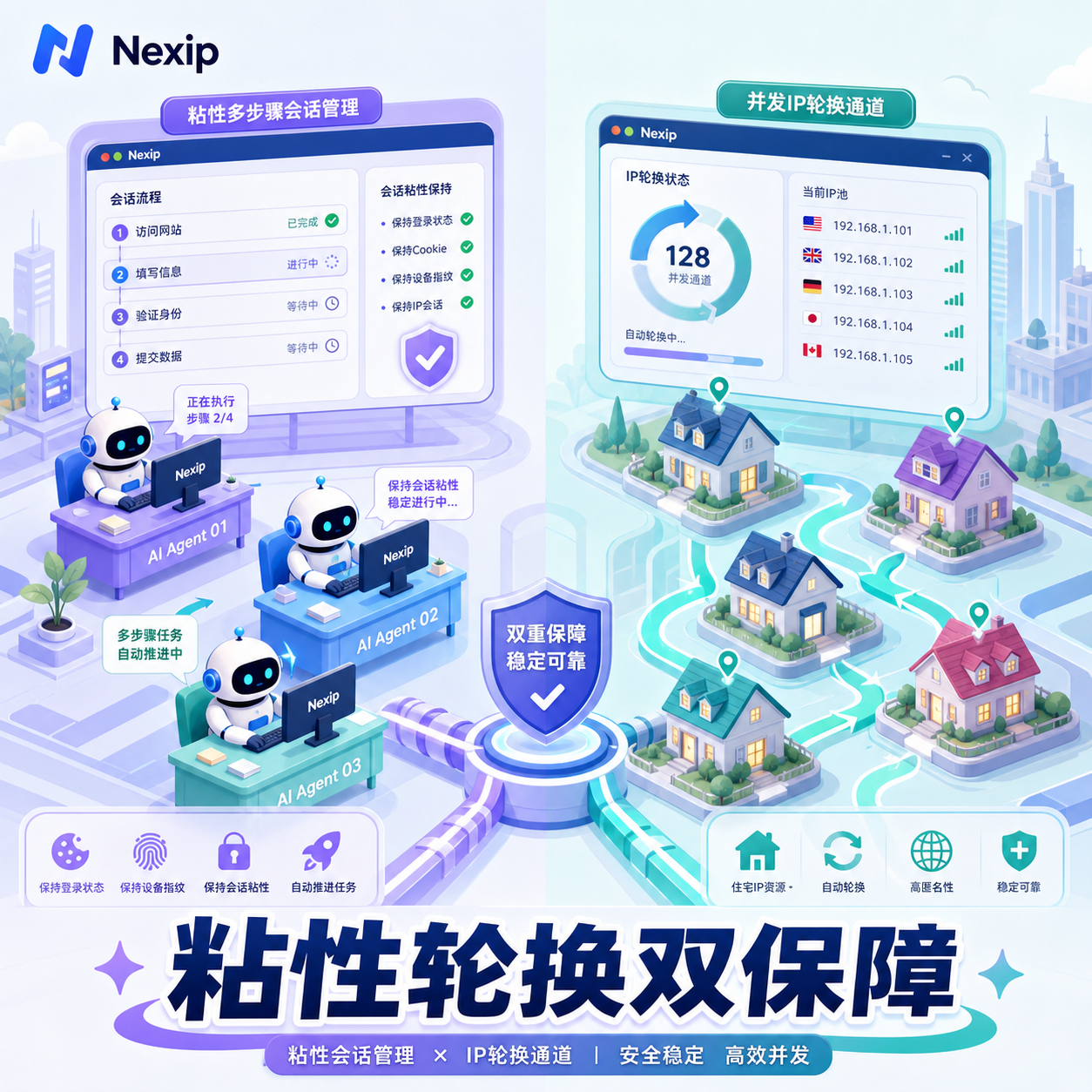
Let's first clarify the division between rotation and stickiness. For independent requests—like SERP checks, bulk price fetching, or single-page content collection—rotation is most suitable. Changing IPs per request spreads the load and avoids rate limits. In production environments, a common practice is to use dynamic residential IPs with a 10 to 30 minute session window: not switching on every request (too fragmented), nor holding onto a single IP indefinitely. This maintains a certain continuity while not appearing as abnormal. For multi-step flows, the opposite applies: login, add to cart, paginated browsing, checkout—all must maintain the same IP. Changing IP midway makes the platform suspect account hijacking, leading to checkpoints or bans. A common pitfall is treating sticky tasks as fully rotated, resulting in process breaks mid-flow and wasted bandwidth on retries.
AI agent scenarios are even more pronounced. A single agent may run dozens or hundreds of concurrent sessions, each requiring a clean geographically matched IP. Country/city targeting must be accurate for tasks to see local prices and local content. Sticky sessions ensure multi-step coherence, while rotation ensures concurrency doesn't contaminate each other. Success rate and concurrency capability matter more than mere per-GB price. If the success rate drops to 60%, the effective cost doubles or more because failed requests still consume bandwidth. Residential IPs on protected sites typically achieve over 90% success rates, far above the 40-60% of datacenter IPs.
When selecting a service, don't just look at pool size. Ethical sourcing is crucial. Clean, user-consented IPs have a low chance of being pre-marked and high long-term availability. Pools from opaque sources may have dirty IPs or pose compliance risks. In enterprise networks, queries related to residential proxies are actually common, often directly linked to AI model scraping. This reminds us: when choosing a service, prioritize transparency, opt-out mechanisms, and abuse handling.
In practice, optimize first, then use proxies. Don't burn through residential traffic right away. Use lightweight methods for enumerating lists, cache results, fetch only necessary resolution media, add random jitter and rate limiting. Often, datacenter IPs with these techniques can sustain initial testing. Switch to residential when truly scaling. When configuring, match fingerprints: User-Agent, TLS characteristics, behavior patterns—all should mimic a real human. The proxy is just the exit; if the browser or automation framework itself isn't clean, even the best IP is useless.
Geographic coverage and session flexibility should be considered together. Services like Nexip provide dynamic residential IP pools that support on-demand rotation and controllable sticky duration, making it easy to switch between AI workflows. For localized training data, directly specify the target region exit to obtain a true local view. At high concurrency, assign each agent a unique session ID to avoid IP sharing triggering correlation detection. Monitor success rates, latency, and failure types, and adjust window length or rotation frequency timely.
Cost control should not ignore the failure multiplier. Large pages, heavy JS, many retries—actual consumption far exceeds theory. Start with a small traffic pilot to test real bandwidth and success rates, then scale up. Pay-as-you-go models with non-expiring traffic are better suited for burst AI tasks. Common pitfalls also include ignoring ASN diversity, leading to IPs clustered in the same subnet; or setting sticky time too long, holding onto a rate-limited IP.
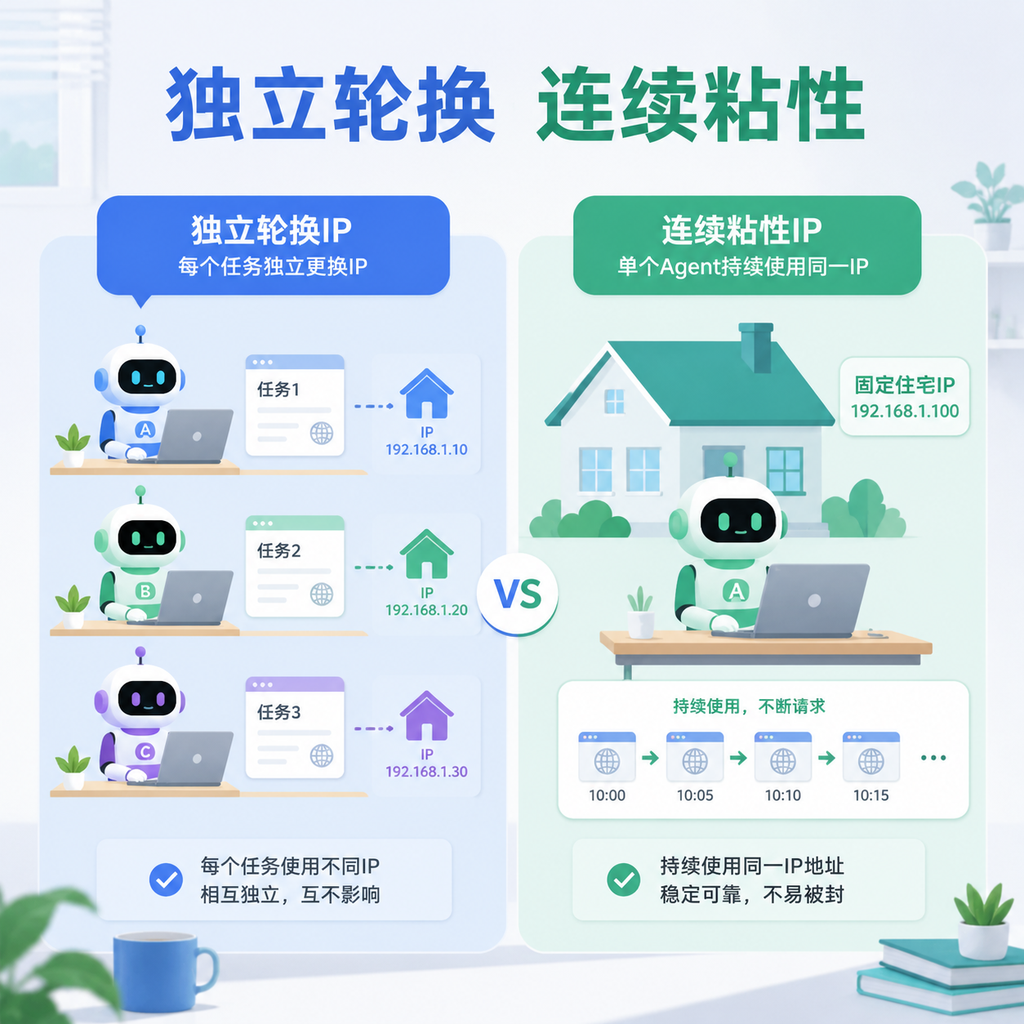
Putting it all together: first optimize the requests themselves, then choose ethically clean residential proxies with flexible session support. Rotate for independent tasks, stick for continuous tasks; in production systems, combine both with a 10-30 minute window. Ensure geographic accuracy, sufficient concurrency, and fingerprint matching. Nexip's general capability in dynamic residential scenarios exactly supports this balance—stable exit plus controllable sessions—making AI data pipelines less prone to pitfalls and more productive.
When implementing, start with single-task validation: write session parameters, run the full flow, check for unexpected mid-way switches. Then scale to concurrency. For high-protection sites, appropriately lengthen stickiness or supplement with mobile IPs. Prioritize data quality over quantity; targeted scraping of high-value local content is more effective than vacuuming the entire web. Following this rhythm, residential proxy IPs can truly become reliable fuel for AI scraping, not a money pit.


Comments(0)